
Sunnyside Yard vs. Atlantic Yards: a Huge Contrast in (Proposed) Scale and Process
12,000 units (or even 24,000) over 140 acres vs. 9,000 units over 22 acres? The ingredients for real planning in Queens vs. a massaged, opaque process in Brooklyn?

On Feb. 26, the prospect of developing most of 180-acre Sunnyside Yard in western Queens, an eternally beguiling but dauntingly difficult prospect—given the need to protect operations for Amtrak, the Long Island Rail Road, and New Jersey Transit—somehow become less of a pipe dream.
New York City Mayor Zohran Mamdani, with his showman’s style and Trump-flattering touch, visited the White House for a crucial photo op—a mock Daily News headline, “Trump to City: Let’s Build,” echoing the infamous “Ford to City: Drop Dead”—and a rhetorical commitment to work toward $21 billion (!) in federal subsidies.
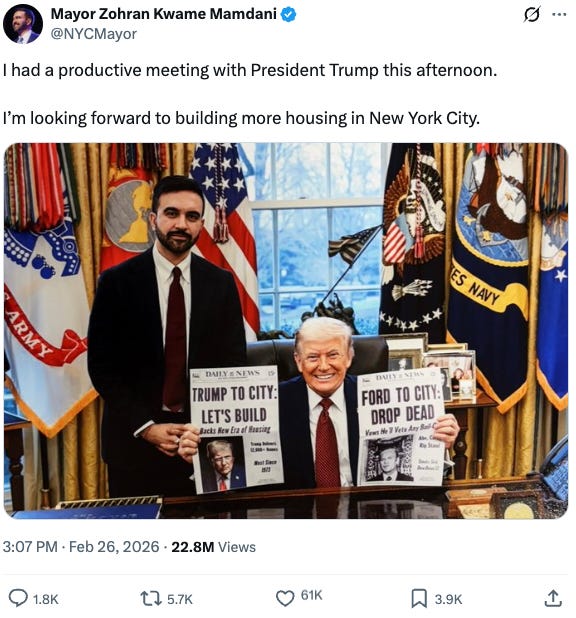
After all, Trump is a real estate developer, albeit an unreliable, ethically dubious one. And he’s from Queens. (Then again, Queens is known for welcoming immigrants; Trump’s known for the opposite.)
“New York City is facing a generational affordability challenge,” Mamdani said in a statement. “Working families are being priced out of the neighborhoods they built. To meet this moment, we need a true federal partner prepared to invest boldly and act urgently. I appreciated the opportunity to speak directly with President Trump about building more housing in any single project than our city has seen since 1973.”
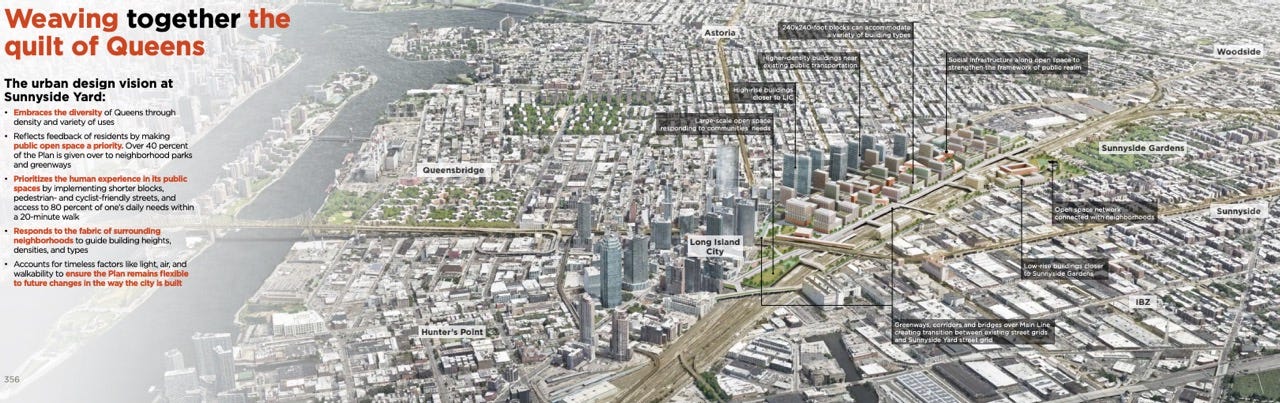
The 2020 master plan, commissioned by the New York City Economic Development Corporation (NYC EDC) and involving a large team of professionals led by Vishaan Chakrabarti’s Practice for Architecture and Urbanism, proposed 12,000 units, with 100% affordable housing, split between rentals and ownership units.
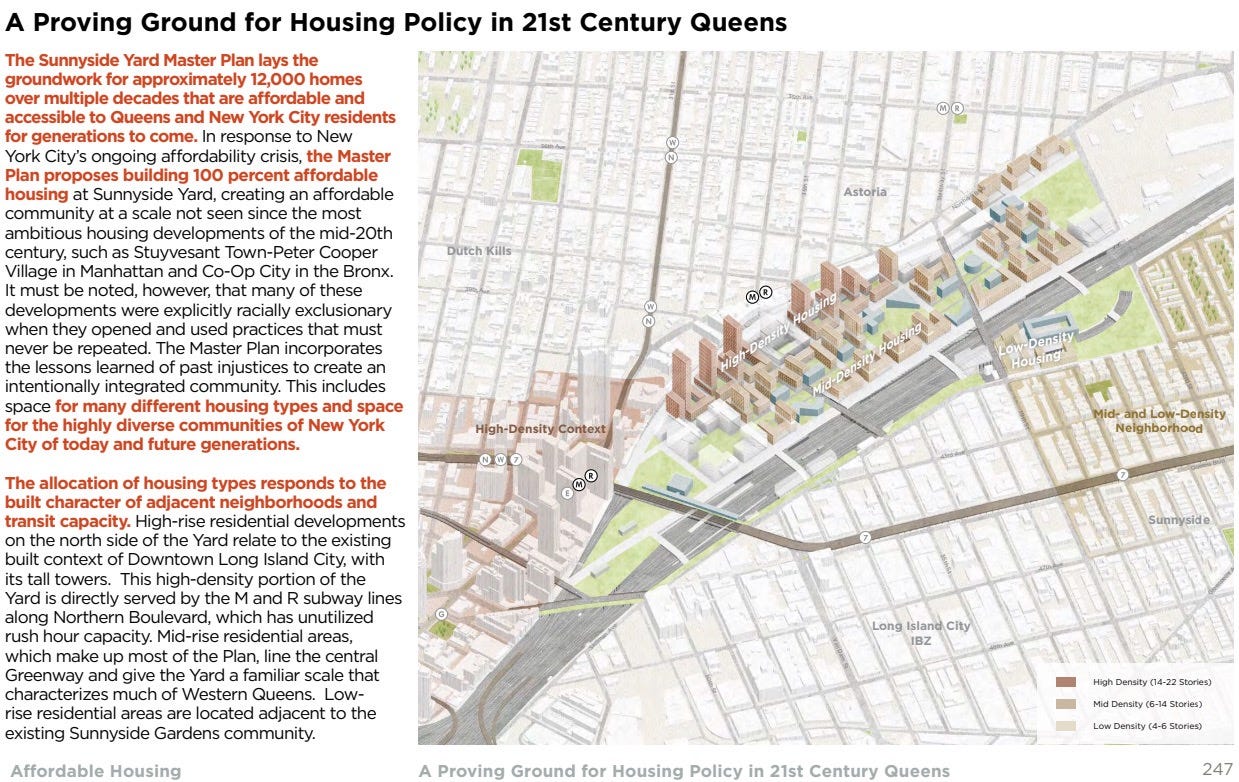
As the illustration above suggests, key rail tracks would remain uncovered, and density pushed to the north and west, a transition from high-rise Long Island City.
The rentals, at least according to the 2020 plan, would be split among very low-income (0-30% of Area Median Income, or AMI) and extremely low-income (30-50% of AMI).
The other half would be moderate-income (80-120% of AMI) homeowner units, what the 2020 plan called “a 21st century renewal of the Mitchell-Lama Housing Program to provide wealth-building opportunities for families.”
In 2025, for a family of three, the 100% of AMI limit was $145,800; the 50% ceiling was $72,900; the 30% limit was $43,740. (The numbers will rise.) A one-bedroom at 30% of AMI could rent for $911; at 50% of AMI, it could rent for $1,518.
High cost, but context
The $21 billion figure quickly provoked skepticism on social media, given the huge cost per unit, but the price tag—as studies suggest—involves a platform for construction, commercial space, retail space, schools, libraries, childcare/healthcare centers, new railroad and subway stations, and 60 acres of open space.
(It would “create 30,000” construction jobs, which are counted in job-years.)
Sure, such funds might be better spent on transit, on fixing public housing, or on projects that create housing at a lower cost. Still, this would be a new central neighborhood, “weaving together the quilt of Queens,” to quote the 2020 study.
Either way, though I haven’t seen this discussed much, New York has a strong case for a federal subsidy: it’s historically a huge net contributor, among states, to the federal budget, easily dwarfing that $21 billion.
(Where does $21 billion come from? Unclear, but the 2017 study estimated total development cost from $16 billion to $19 billion. The 2020 study didn’t offer a total, but offered various component costs. Over what time period and funding mechanism? Unclear.)
How many units?
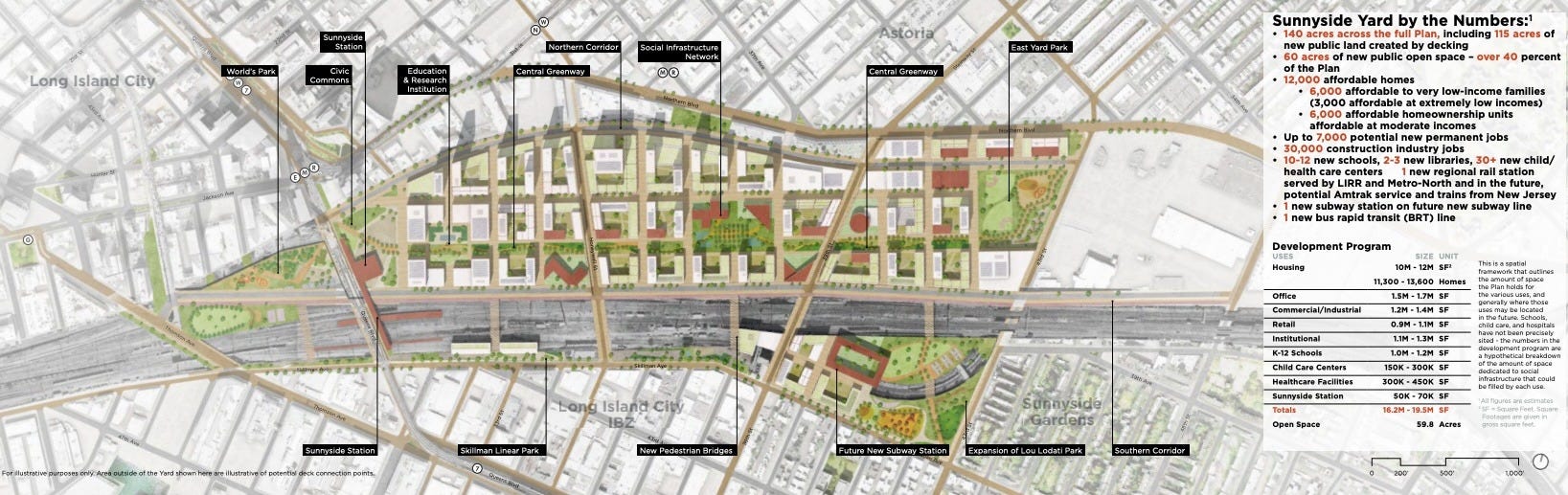
More skepticism: why only 12,000 units, as shown in the image below from the 2020 study, on 140 acres, including 115 acres of new public land created by decking?
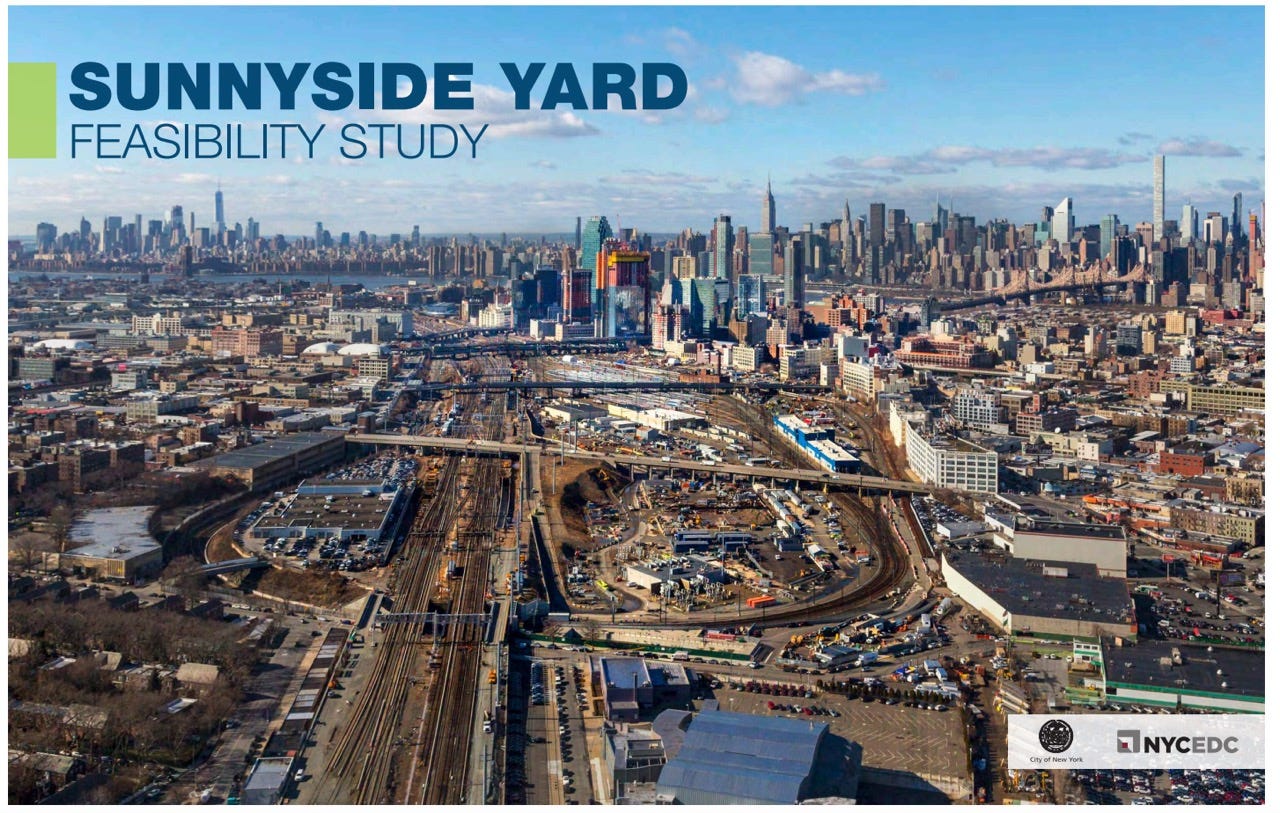
After all, a 2017 feasibility study from NYC EDC, as shown in the screenshot below, proposed up to 24,000 units, double the total, with 30% of them below-market.
That would’ve meant up to 7,200 affordable apartments, albeit at higher rents than proposed in 2020. The 2017 plan assumed Mandatory Inclusionary Housing Option 2, averaging 80% of Area Median Income (AMI) the top bound of “low-income.”
That’s $116,640 for a family of three, as of 2025, and a one-bedroom up to $2,430. (Some units could cost more, or less, as long as the average is met.)
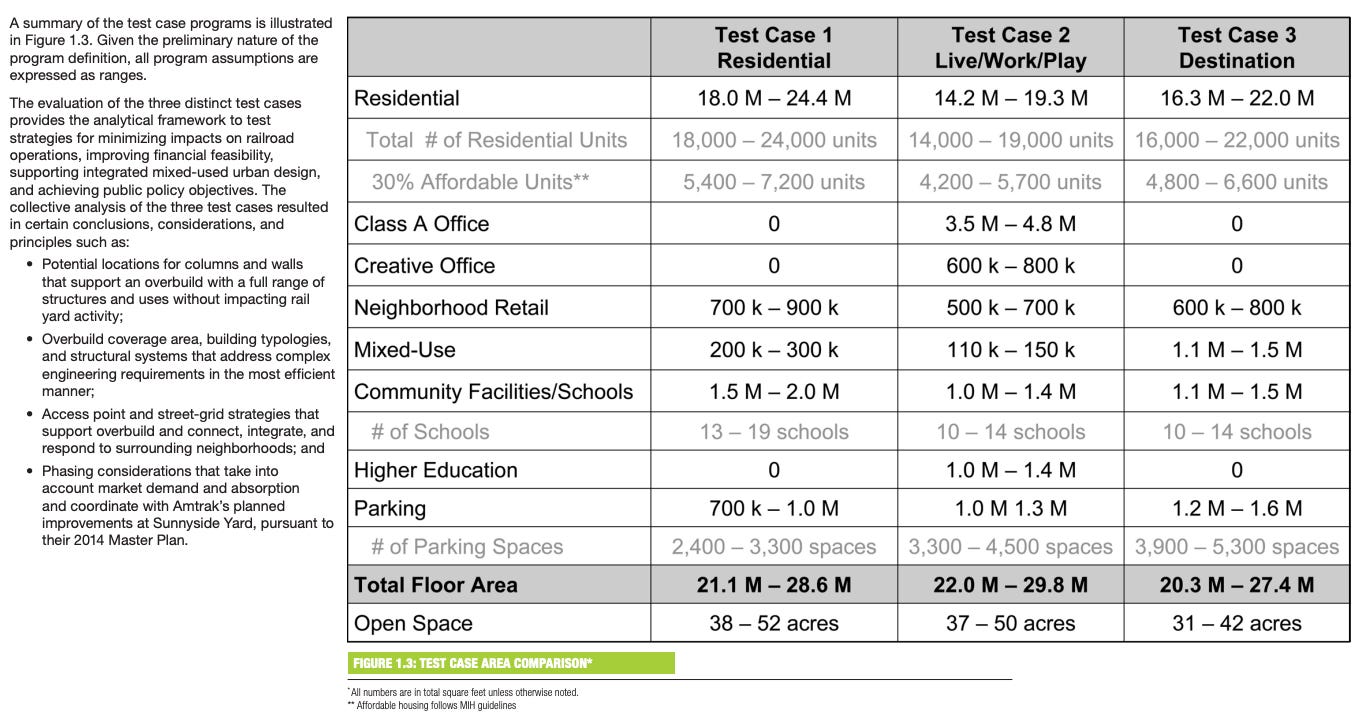
Both the 2017 and 2020 projections for Sunnyside Yard would be vastly less dense than Atlantic Yards as approved in 2006 and, especially, the pending proposal to supersize it, as I discuss below.
How big?
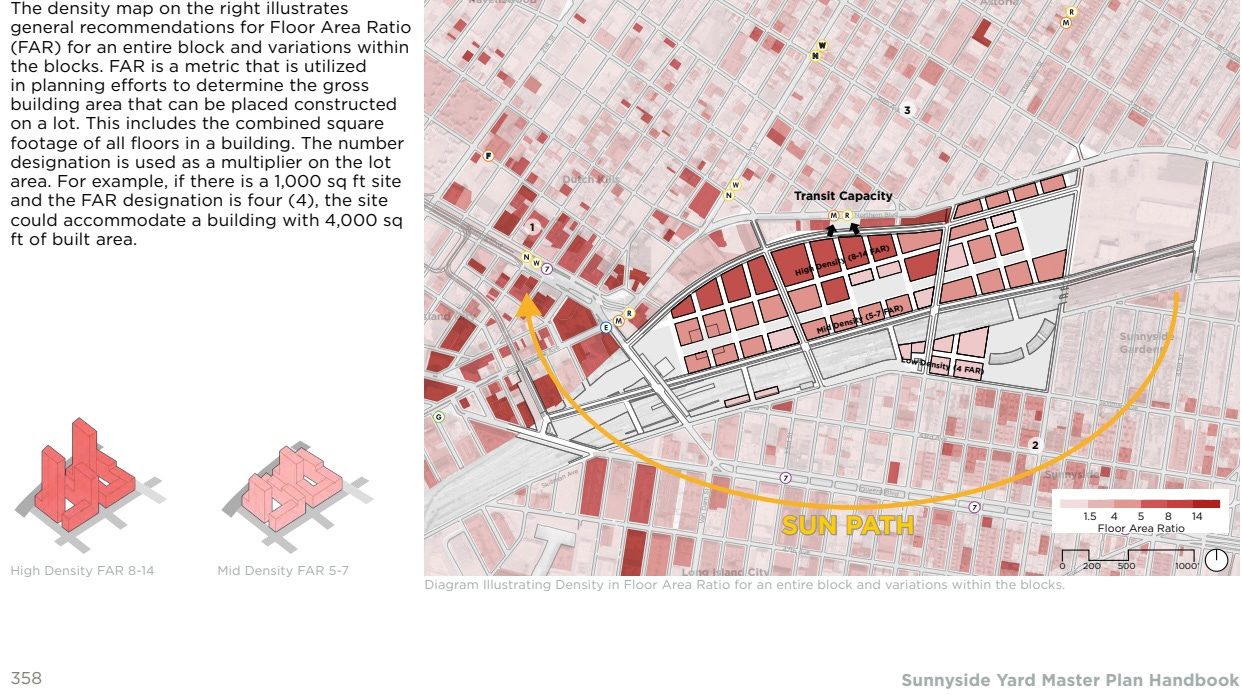
The 2020 plan defines high-rise as 14 to 22 stories; mid-rise as 6 to 14 stories, and low-rise as 4 to 6 stories. It seeks to further growth “while still creating a human-scale place.”
That density framework, the plan states, “reflects and responds to surrounding neighborhoods and maximizes sunlight penetration from the south, ensuring open spaces at the Yard receive direct sunlight,” noting a street buffer for higher-density blocks on the north side of the railyard.
Presumably, it’s somewhat negotiable, especially since, in the last six years, many progressives have moderated on development, with Representative Alexandria Ocasio-Cortez praising the latest news after resisting the previous plan.
Others proudly call themselves YIMBYs (Yes in My Back Yard) and likely would embrace a larger project. (That said, the initial reaction from the YIMBY group Open New York was unqualified support.)
Though local Council Member Julie Won criticized Mamdani for not starting with the community—well, the 2020 plan offers much to chew on—former Council Member Jimmy Van Bramer, a one-time critic of Sunnyside Yard development, told City & State, “The political climate in New York City in 2026 is light years away from the political climate when we last visited this.”
So it wouldn’t be surprising to hear calls to consider elements of the 2017 proposal, which aggressively defined high-rise as up to 64 stories, mid-rise as up to 38 stories, and low-rise as up to 10 stories.
(The New York City Department of Buildings defines low-rise as under 75 feet, or 7 floors, and high-rise as above that. In Vital City, two architects last year suggested that mid-rise buildings were 5 to 8 stories.)
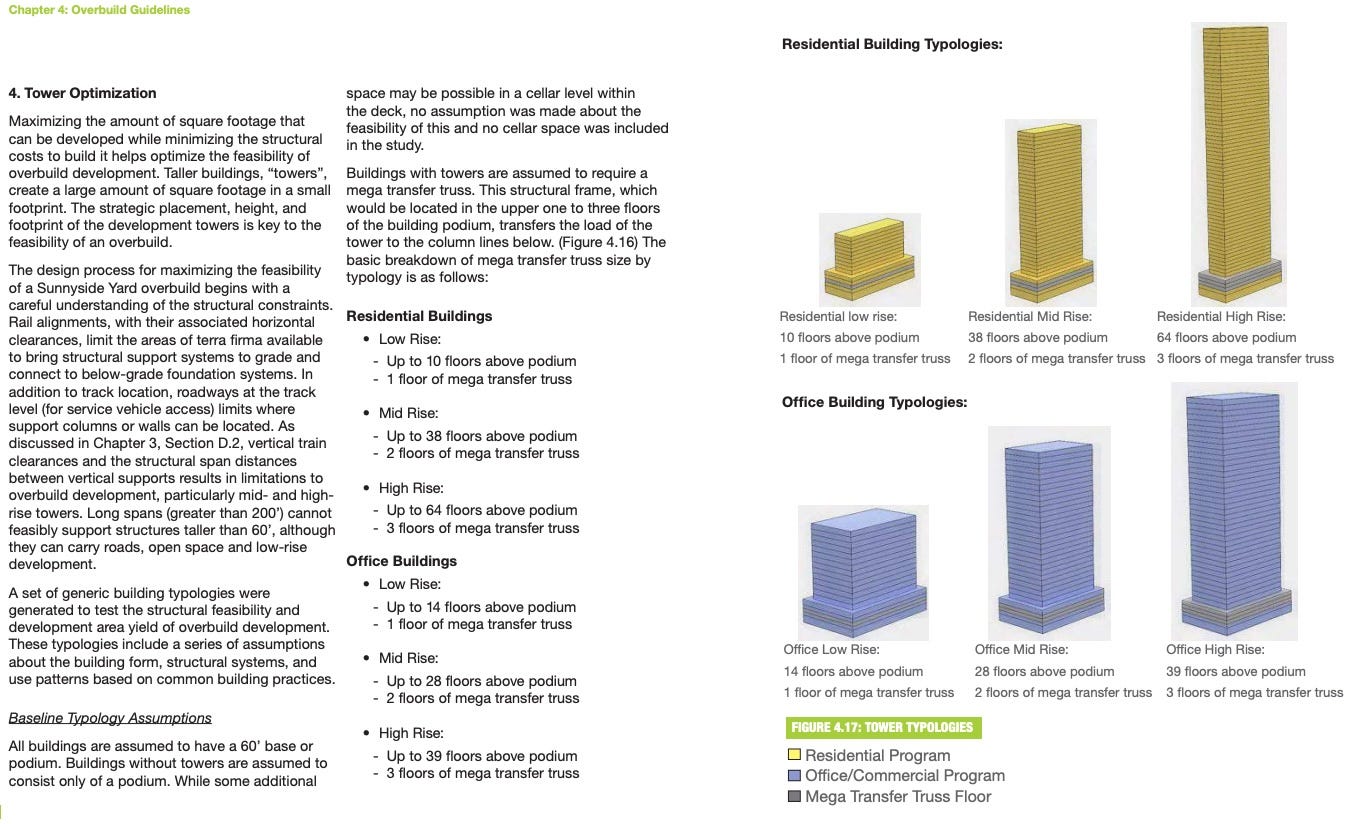
That said, the 2017 study projected only ten large towers, ranging from 30 to 69 stories, with most at 45 stories.
“For the purposes of this study, the maximum number of technically feasible towers was evaluated for marketability at a high level,” the 2017 study said. “While dense and walkable mixed-use neighborhoods are in high–demand and often result in increased property values, there is a point where an increase in density negatively impacts the quality and livability of the environment.”
“[T]here is a point where an increase in density negatively impacts the quality and livability of the environment.”—2017 Sunnyside Yard study
That notion has barely been discussed recently—except by planner Ron Shiffman, a member of the advisory Atlantic Yards Community Development Corporation—regarding Atlantic Yards, where a proposed vast increase in scale is driven by the project’s (opaque) budget, including affordable housing and infrastructure.
What next for Sunnyside Yard?
The 2017 plan was mostly market-rate housing. Former Deputy Mayor Alicia Glen, who under Mayor Bill de Blasio pushed for Sunnyside Yard development, told the New York Times that Mamdani’s proposed union-built, 100% affordable project wasn’t financially feasible. So that faces a test.
So too do the assumptions about cost and timing.
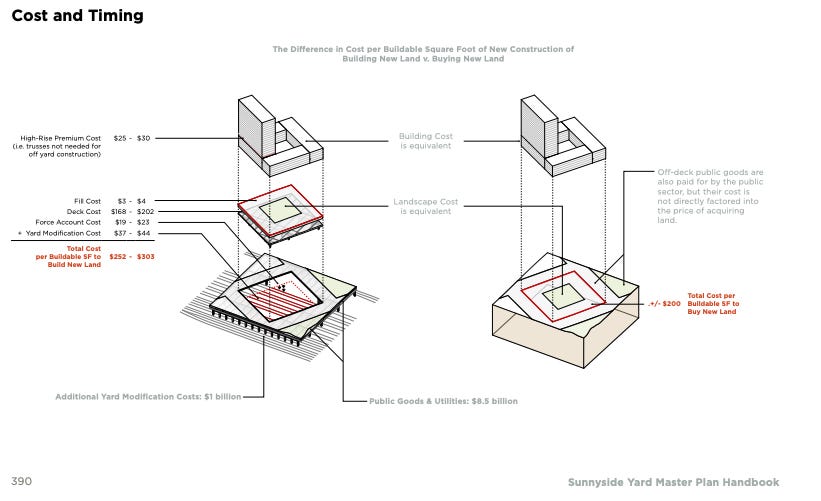
Prameet Kumar, Chair of the Land Use and Housing Committee of Queens Community Board 2, writing in his personal capacity, suggested that to move forward, the city needs:
an updated feasibility and design study to clarify cost, infrastructure, and affordability targets, working with federal and state partners
early and meaningful community engagement
approval via the city’s Uniform Land Use Review Procedure, involving City Council and the City Planning Commission
phasing that ties housing production directly to infrastructure delivery
The Atlantic Yards contrasts
Let’s consider some contrasts with Atlantic Yards/Pacific Park. First, the Brooklyn project is not a tabula rasa. It’s about half complete, but the heavy lift—the platform over a two-block railyard (which has some terra firma intruding)—awaits.
Atlantic Yards has had one developer at a time. It’s now on its third, though arguably a fourth, since the joint venture Greenland Forest City Partners succeeded original developer Forest City Ratner, but Forest City later bowed out, leaving Greenland USA nearly alone.
With Sunnyside Yard, according to the 2020 plan, the number of small sites allow “different nonprofit, private, and emerging developers, creating a broader range of housing options while encouraging architectural variety.” It also contemplates “alternative land ownership models such as like Community Land Trusts.”
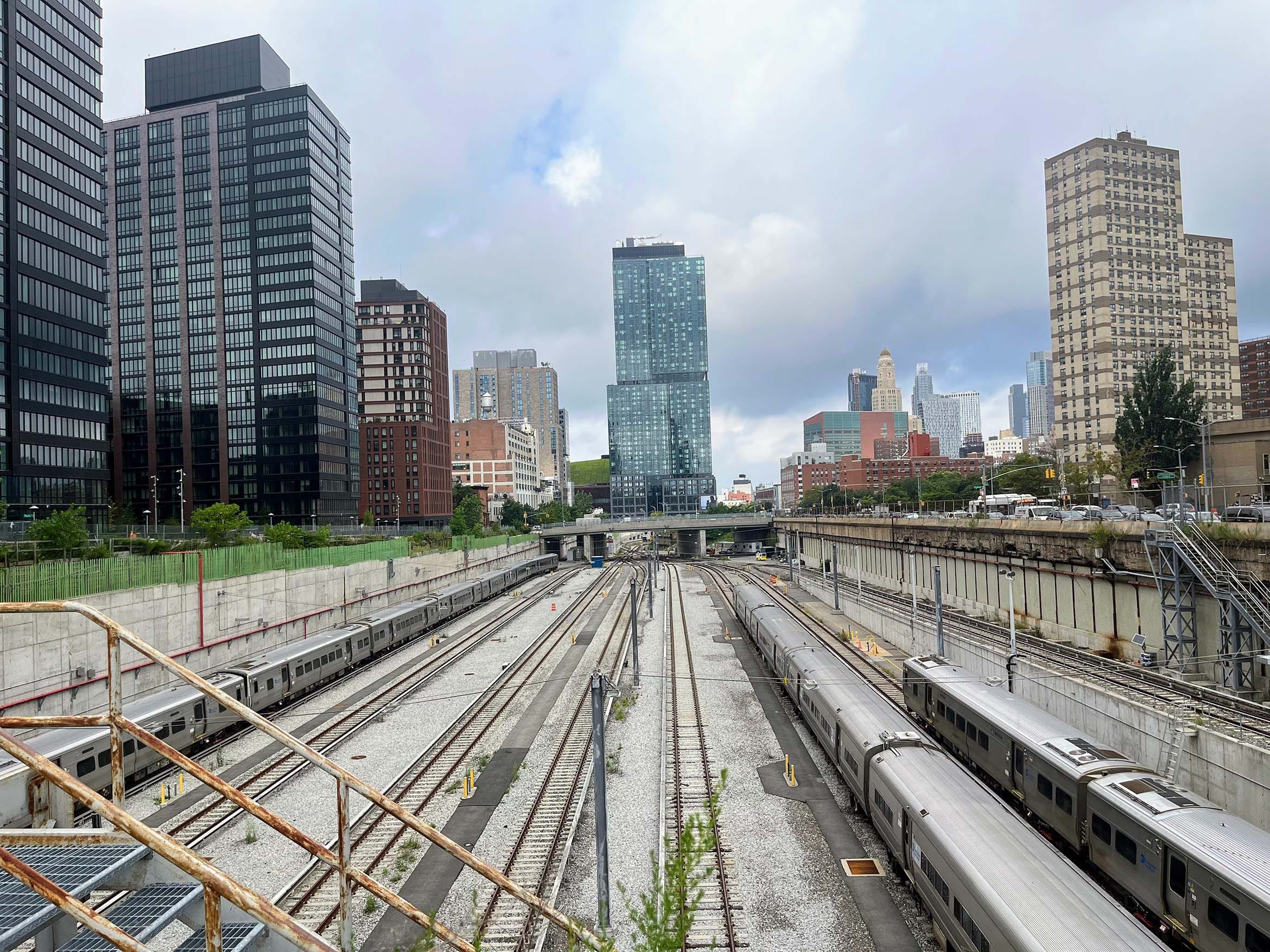
Atlantic Yards never had a true feasibility and design study, with no professional team—as with the Sunnyside Yard study—sharing its work for preliminary assessment.
The project is overseen/shepherded by Empire State Development (ESD), the state’s economic development authority, ensuring a facade of process—a state-mandated environmental review—without a vote from local elected officials. ULURP is bypassed.
Nor has the project’s new developer, Cirrus Workforce Housing and LCOR, shared much of its plan beyond a request for 1.6 million additional square feet of bulk, worth by my estimate perhaps $320 million, and a revised open space layout.
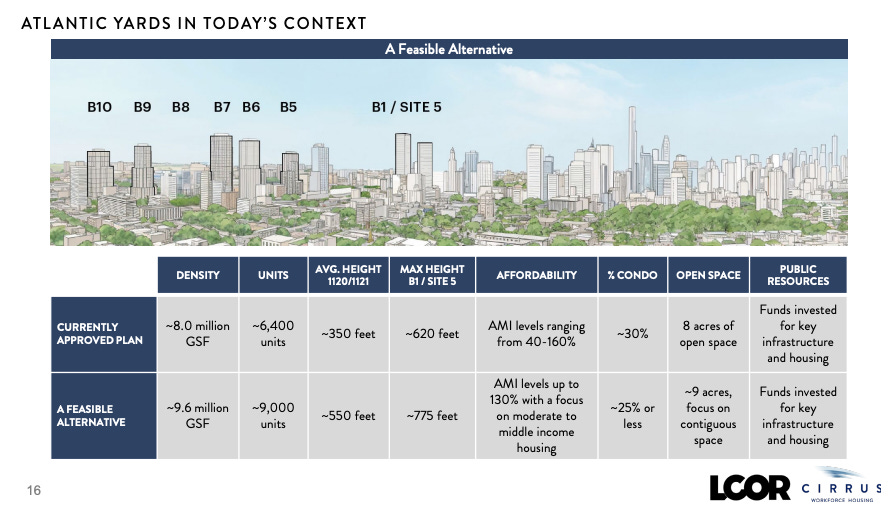
They apparently expect that bulk for free, as opposed to paying the Metropolitan Transportation Authority for air rights, previously subject to bidding.
Beyond that, without sharing their cost basis or financial assumptions, Cirrus and partner LCOR seek subsidies for affordable housing and for the platform. (More on the latter in another article.)
ESD is quietly negotiating a Memorandum of Understanding (MOU) with the developers regarding state support.
Trust the process?
Their vague imagery isn’t helpful, while carefully managed public workshops present attendees with simplistic graphics suggesting that only increased density can deliver needed open space and affordability.
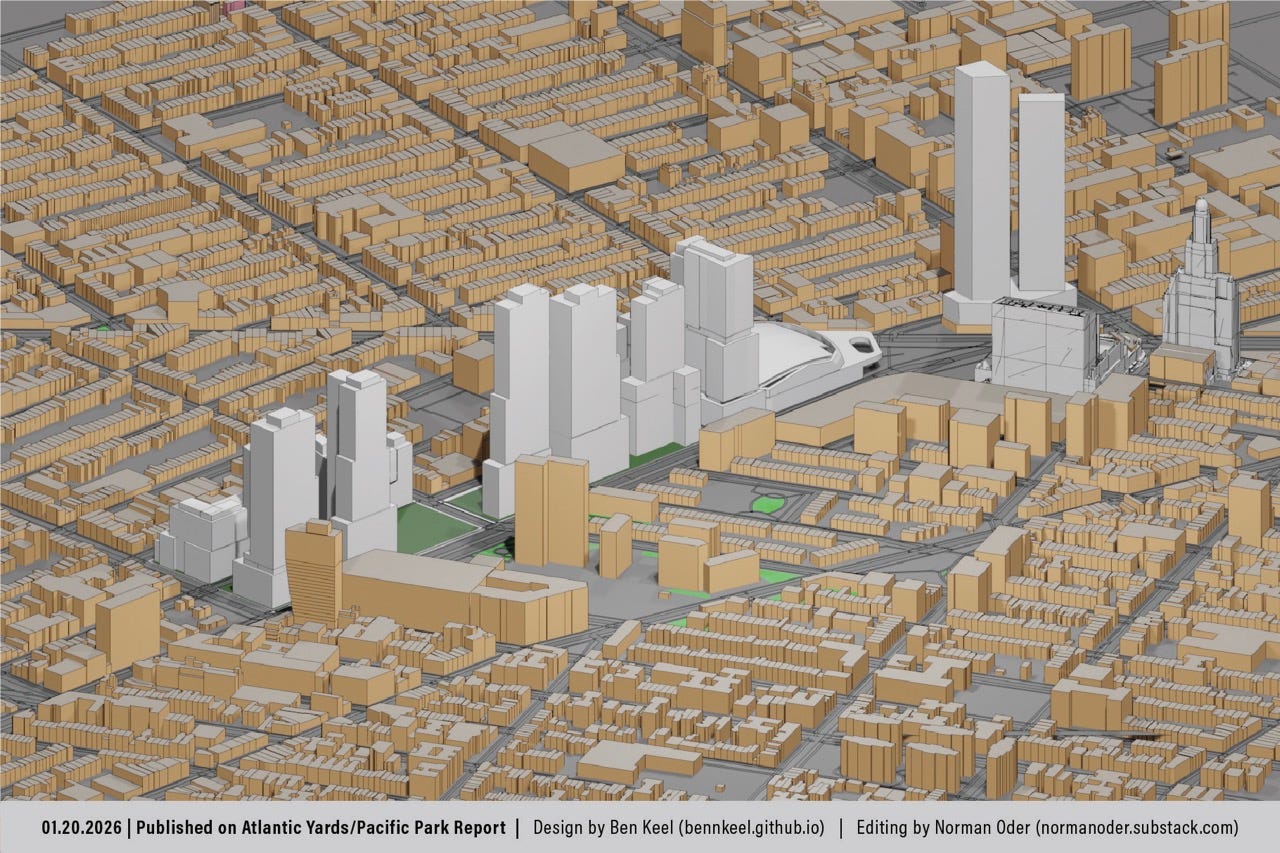
OK, they did release a bit more detail. The below slide, from a Dec. 8 presentation on open space, is the only image so far to depict a proposed tower—in this case, B7, likely the tallest over the railyard, perhaps 630 feet, but only visible in part.
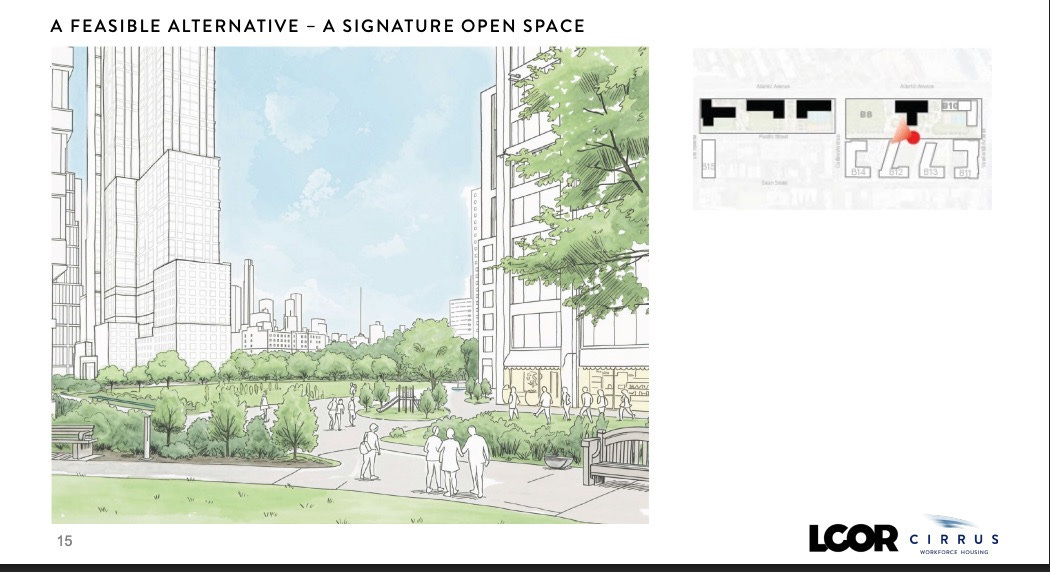
We’re still waiting for a draft Community Engagement report, which likely will reify those assumptions without providing sufficient information to assess the project’s financial feasibility and urban practicality.
We’re just supposed to take their word.
An executive at Cirrus called entering Atlantic Yards a “no-brainer,” likely a references to the relatively small investment—$100 million? $130 million?—needed to control existing approved square footage, such as the plans for two giant towers at Site 5, catercorner to the arena, and build on Greenland’s past investment.
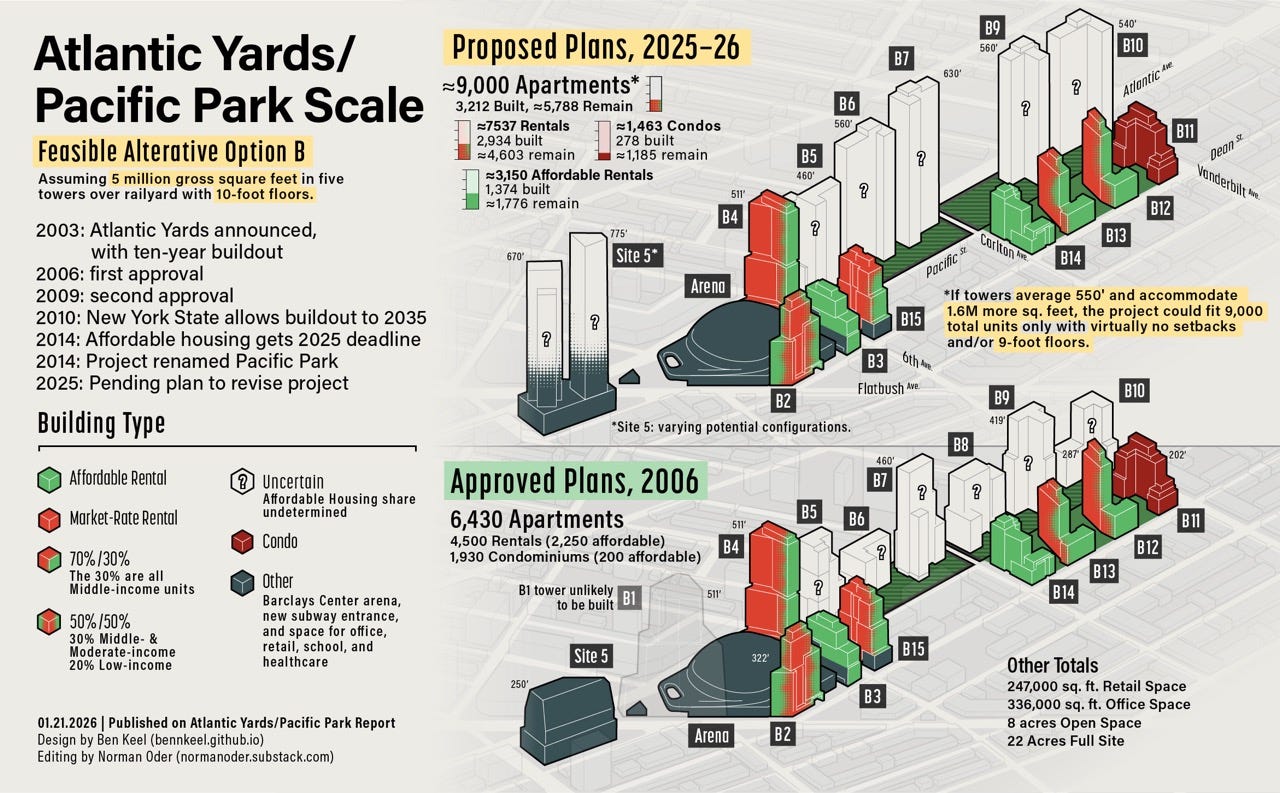
Such subsidy-seeking demands financial and planning transparency. That’s why I commissioned my collaborator Ben Keel to provide a preliminary image of their project. It may not be precise, but it’s more than what’s officially been released.
A one-acre “transformative amenity”?
Note the new proposed acre of green space at the B8 parcel, slated to be the third tower going right (west) from Vanderbilt Avenue, the project’s western border, at left in the image above.
By eliminating the proposed B8 tower, at a site complex and costly to build on, the developers could deliver another acre of open space “as a public park amenity,” LCOR’s Anthony Tortora said at the Jan. 22 workshop. “Given its location at the center of the platform blocks, we believe this could be a transformative amenity.”
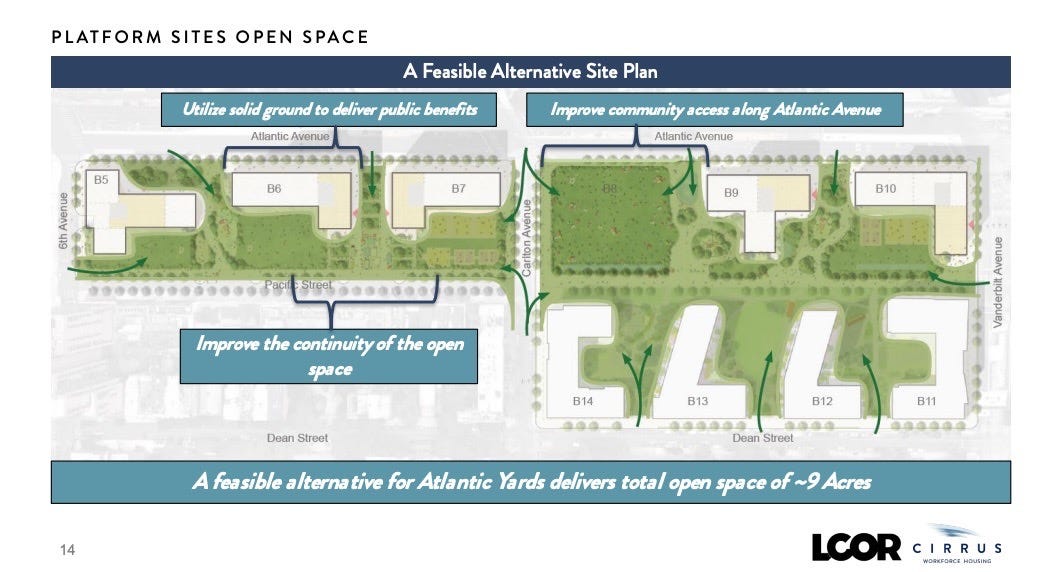
Now that we’ve seen the Sunnyside Yard master plan, with extended parks, new infrastructure and civic buildings, do we really think that extra acre in Brooklyn would be transformative or, instead, an attempt to tread water?
After all, the increase in open space would be outpaced by the increase in population. Also, given that it would be built on the second of the two railyard blocks, there’s no guarantee it would be built early in the process—or at all.
Meanwhile, Sunnyside Yard plan contemplates near-term public realm improvements—in other words, investments to ensure public benefit first. That’s been a consistent flaw in Atlantic Yards.
The density comparison
As indicated in the headline, the density of Atlantic Yards would vastly exceed that of the proposed Sunnyside Yard plans.
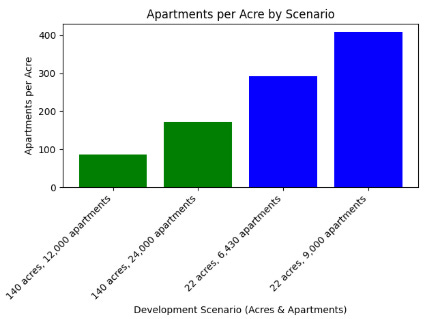
Over 140 acres, 12,000 units, as in the 2020 study, would be 86 units per acre. With 24,000 units, the maximum in 2017, it would be 171 apartments per acre.
With 22-acre Atlantic Yards, already partly built on terra firma, the originally approved 6,430 units is 292 per acre. The proposed 9,000 units, with five towers over the railyard averaging 550 feet, would be 409 per acre—for the project as a whole.
But maybe that calculation doesn’t show it clearly enough. The two railyard blocks, by my calculation, total 7.71 acres.1
With 5,788 projected apartments to build, I’ve estimated that Site 5, the proposed two-tower complex across from the arena, might contain 800 to 1,100 apartments. That’s 716 to 895 apartments per acre.2
So the five railyard towers would fit the remainder: 4,688 to 4,988 apartments. That translates as 608 apartments per acre or 647 apartments per acre.
Density comparison
At that Jan. 22 Atlantic Yards workshop, the moderator read my question: what other large real estate projects in New York City have a density comparable to what’s being proposed here, about 409 apartments per acre?
(I didn’t share the more dramatic math regarding the remaining buildable sites.)
LCOR’s Tortora, clearly prepared, claimed the proposal was contextual to changing Brooklyn, “Our proposed density,” he said, “is consistent with the Atlantic Avenue portion of AAMUP,” the Atlantic Avenue Mixed-Use Plan, a recent rezoning.
“It’s less than Downtown Brooklyn,” he added, “and there are other examples of this type of density in other neighborhoods, like Hunters Point, Jamaica and Long Island City.”
That dodged the question, as he was comparing the density allowed for buildings in those rezonings, as measured by Floor Area Ratio (FAR), with the density (FAR) for Atlantic Yards as a whole, including open space. (Individual buildings in Atlantic Yards would be far more dense, as measured in relation to each underlying parcel.)
My question referred less to bulk than a concentrated population. I tried to follow-up in writing: “My question referred to large real estate projects, like this one, with a projected 9000 units over 22 acres. What do you see as comparable?”
It was ignored.
The bottom line
However the Sunnyside Yard process has been criticized, the exercise seems far more credible, and aspirational, than the current Atlantic Yards plan. The urban design vision at Sunnyside Yard aims to “weav[e] together the quilt of Queens.”
The urban design vision with Atlantic Yards is yet unexplained, beyond the crude formula that larger, taller towers could bring more affordability and open space.
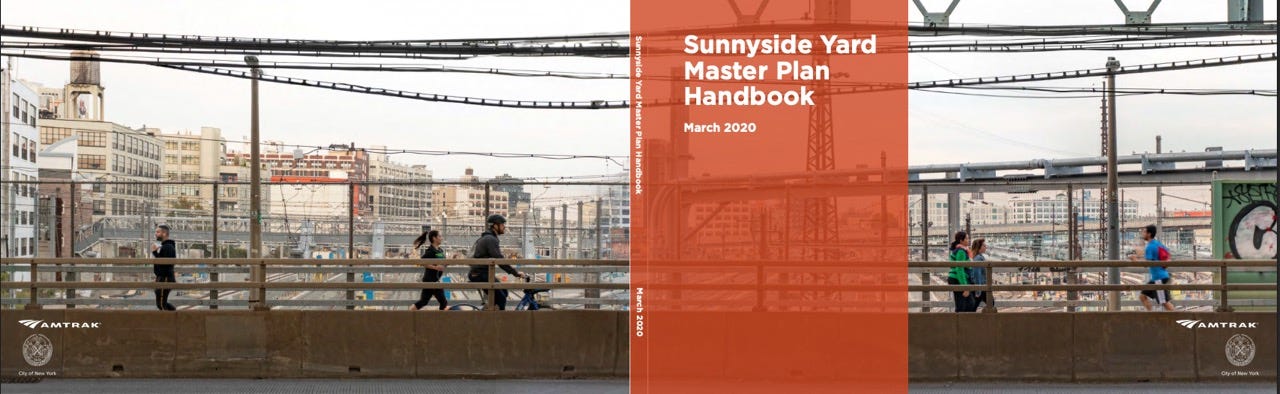
There’s no Master Plan Handbook, as with Sunnyside Yard. There’s no plan at all.
In The Nation, Karrie Jacobs, with fortuitous timing, recently called the Sunnyside Yard master plan “a thing of beauty” and “the most utopian thing I’d ever seen proposed for New York City.” (Writing before Mamdani’s visit, she also suggested progress was impossible under Trump.)
It deserves a close hearing.
The murky vision for Atlantic Yards, so far, is trust the unspoken assumptions about costs, subsidies, and density.
It deserves an even closer hearing.
Reminder: a flaw in the 2020 plan
When the 2020 plan emerged, just before the pandemic, I suggested it was another example of the phenomenon I call “Atlantic Yards down the memory hole.”
I’d found only one reference to Atlantic Yards in the plan, and it was disturbingly misleading.
Similar to Park Avenue or Atlantic Yards, which built over rail lines to create new land, a platform structure, or a deck, is required at Sunnyside Yard in order to support new streets, open spaces, and buildings above the active rail operations.
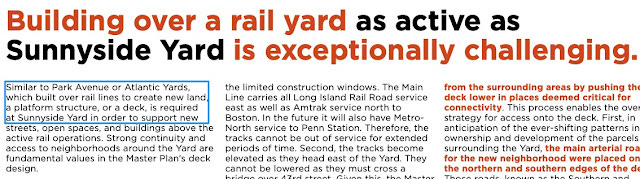
However, nothing had yet “built over rail lines to create new land.”
The only block of the railyard subject to development included properties built below-grade: part of the arena, and the B4 tower.
Indeed, development has proven to be “exceptionally challenging.”
The three-block railyard was only about 8.5 acres, with the third block already used for part of the arena and the B4 tower.
The two remaining railyard blocks, notably the block between Sixth and Carlton avenues, also include terra firma bordering Atlantic Avenue that was once private property, so they are larger than the railyard component of those blocks, which means there’s less need for an expensive platform.
Here’s my math, based on this city map:
Block 1120, Lot 1: 52,000 square feet (sf); Lot 2: 60,000 sf; Lot 3: 53,000 sf. Total: 165,000 sf, or 3.79 acres.
Block 1121, Lot 1: 153,768 sf; Lot 42: 11,500 sf; Lot 47: 5,625 sf. Total: 170,893, or 3.92 acres.
Site 5 is 48,655 square feet, or 1.117 acres.