
As Developers Propose Much Larger Buildings, Their Renderings Distort Reality
Images downplay proposed changes while inflating what's been approved. The claimed 20% increase in bulk translates to 46% at the railyard but 71% at five sites.

It’s rare to get accuracy from developers’ promotional renderings, so the latest images of Atlantic Yards—including the currently approved plan and a proposed alternative—are par for the course.
The renderings below from the developers LCOR and Cirrus Workforce Housing exaggerate the scale of the current plan and understate their ambitious proposals, thus downplaying the degree of change. (I already wrote about a glaring example.)

Moreover, the unrealistic helicopter perspective, looking south, seems chosen to suggest that the proposed skyline for towers in Prospect Heights would remain dwarfed by changes a good distance away in Downtown Brooklyn.
Sure, these are only a start, and might be partly explained as placeholders or artifacts from the unusual perspective chosen.
The developer’s proposals deserve robust discussion. But a fair discussion should rely on clarity rather than obfuscation.
Let’s see if this gets discussed at today’s meeting of the Atlantic Yards Community Development Corporation (AY CDC), which is supposed to advise the parent Empire State Development (ESD), which oversees/shepherds the project.
Comparing the two
In the slide above, first released publicly at the Nov. 18 workshop on height and density, the developers purportedly contrast the Currently Approved Plan, with six towers planned over the Metropolitan Transportation Authority’s Vanderbilt Yard, with a Feasible Alternative, with only five towers.
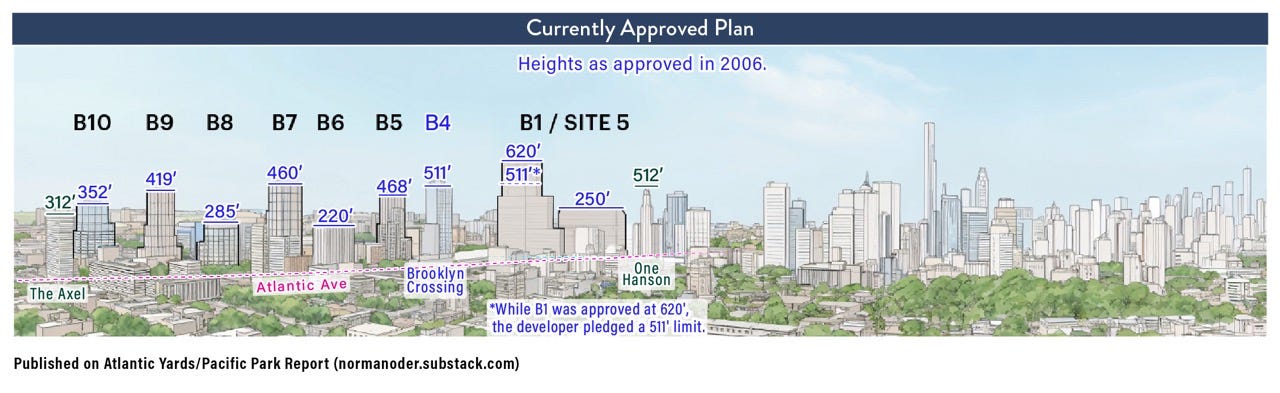
The version below, annotated with documented and estimated heights, offers key details and suggests some distortions.
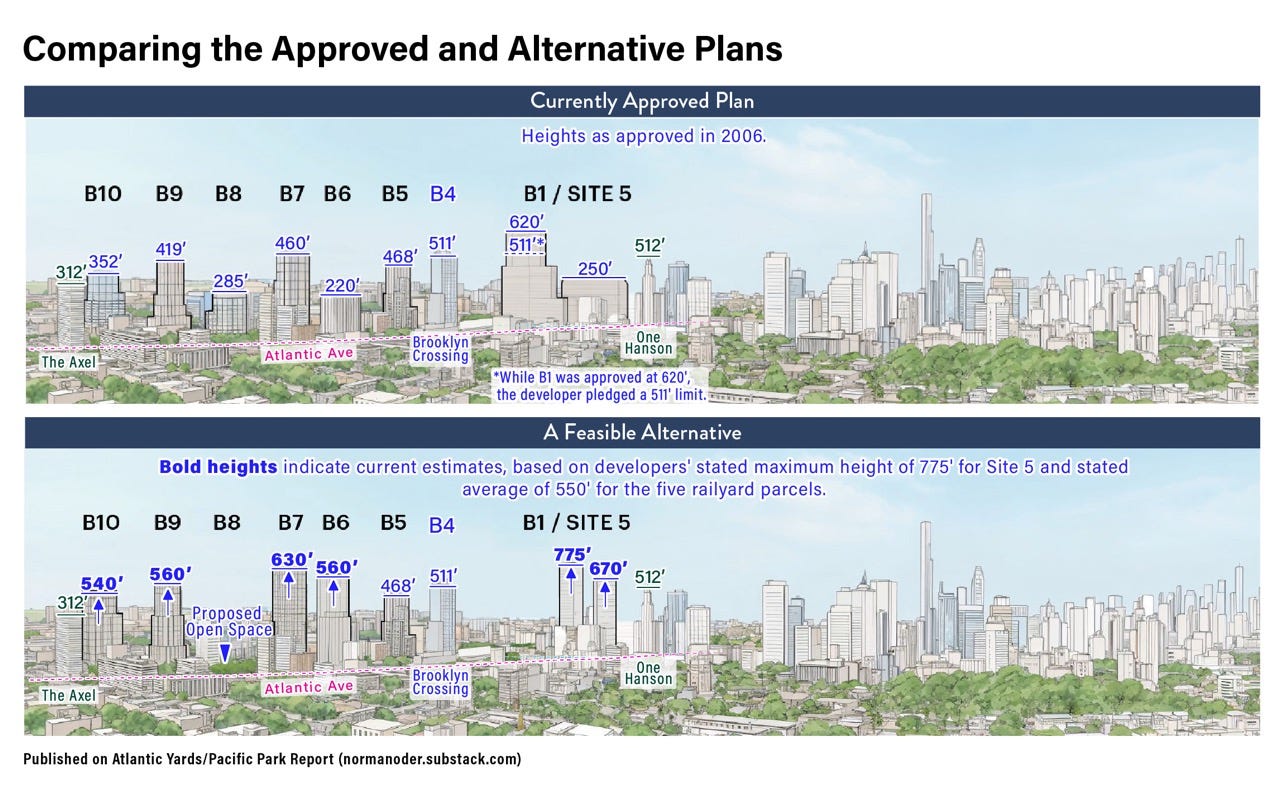

The upper panel, with the Currently Approved Plan, adds the planned heights to existing heights, including the B4 tower (18 Sixth Ave., aka Brooklyn Crossing), at 511 feet, and One Hanson (the Williamsburgh Savings Bank), at 512 feet.
Immediately, one building doesn’t pass the eye test. The 250-foot tower approved for Site 5, the parcel catercorner to the arena long home to the big-box stores P.C. Richard and the now-closed Modell’s, should be less than half the height of One Hanson. Instead, it’s exaggerated, as I wrote.
In the bottom panel, the Feasible Alternative estimates of new tower heights are based on the developers’ stated plans: a maximum height of 775 feet at Site 5 and an average 550 feet for the five railyard towers. (I consulted on this with graphic designer Ben Keel, a frequent collaborator, who updates a digital model of the project sites.)
Those estimates are imprecise, but there’s a logic to them: they rely on benchmark heights within the same panel.
They do not rely on comparisons with the Currently Approved Plan. After all, the B1 tower, at 620 feet, looks almost as tall as the new 775-foot Site 5 tower. (See more below.) Also, the new B7 tower, at 680 630 feet, does not appear nearly 50% taller than the current version, as elaborated below.
Not just height but density
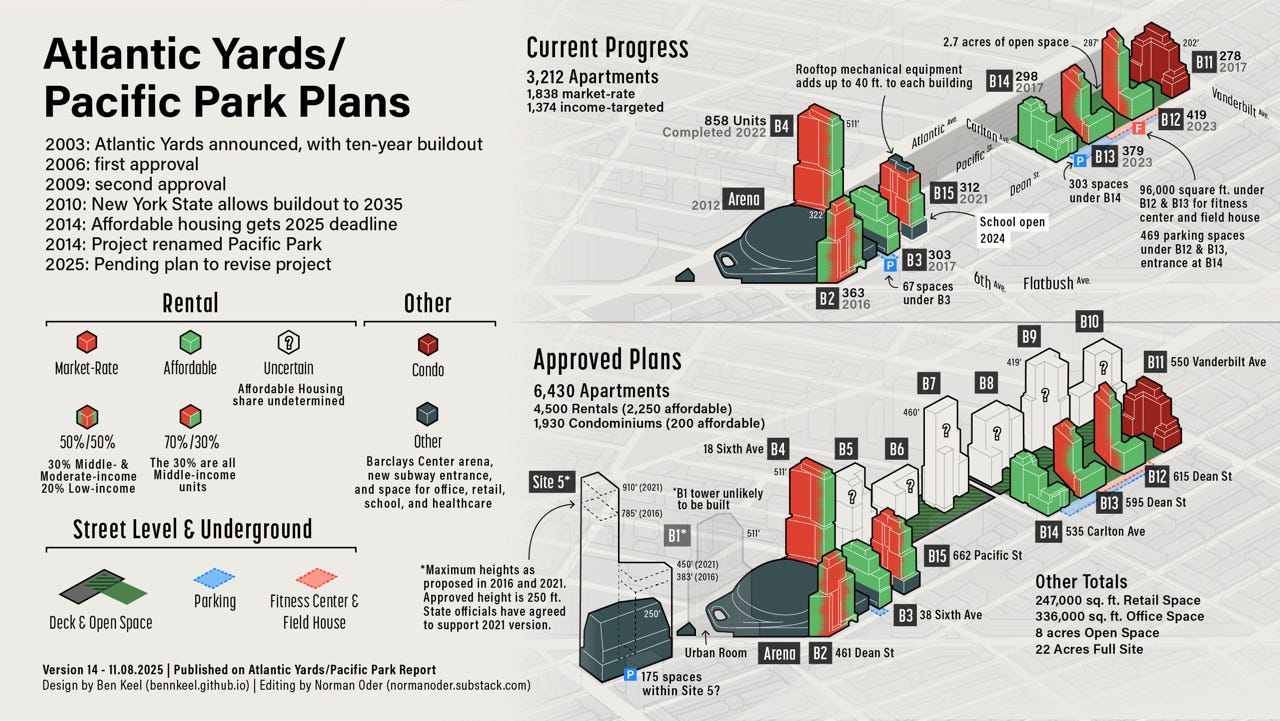
The issue goes beyond the new skyline and the buildings’ height. At some point, the images should better portray the buildings’ proposed density, or bulk. Cirrus and LCOR aim to add 1.6 million total square feet to the project, likely at the railyard sites: B5 through B10.
As originally approved, I calculated—based on the maximum square footages document—that the six railyard sites (B5/B6/B7/B8/B9/B10), would total 3,487,392 square feet.
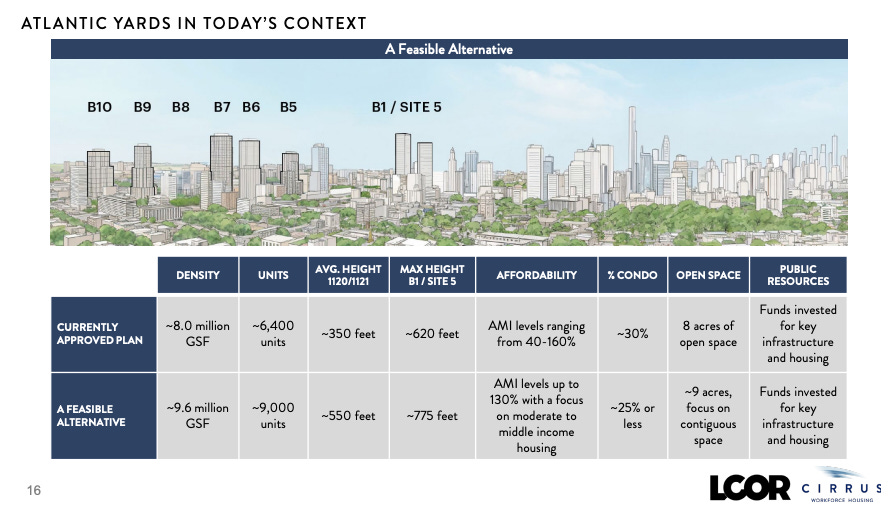
Adding 1.6 million square feet would mean 5,087,392 square feet, or a nearly 46% increase at the railyard sites. (The developers portray the increase as only 20%, based on the project’s approved square footage, which includes the arena, already built towers, and B1/Site 5.)
Even my 46% calculation downplays the proposal. Remember, they want to eliminate the B8 site, given the complexity of construction, creating an additional acre of open space. Subtract B8’s 523,336 square feet from 3,487,392 square feet and the result is 2,964,056 square feet, as approved, in the five other railyard towers.
An increase from 2,964,056 square feet to 5,087,392 square feet is 71.6%.
Even that may be too conservative. Consider that the B5 tower, already designed, looks unchanged, at least in these preliminary renderings.
If it remains unchanged, we’d subtract the 635,443 square feet of B5 from both totals. So an increase from 2,238,613 square feet to 4,451,949 square feet in four towers would be 98.9%, or nearly double.
Update: it seems likely it that B5 would be enlarged as well, according to a statement at the Dec. 2 Atlantic Yards Community Development Corporation meeting.
Do buildings B6/B7/B9/B10 in the Alternative plan look double the size of their predecessors? Not really.
Street-level views
Another way to frame it: the largest tower in the image below, B4, was approved to have a maximum 824,629 gross square feet and was built at 814,256 gross square feet and 790,392 zoning square feet.
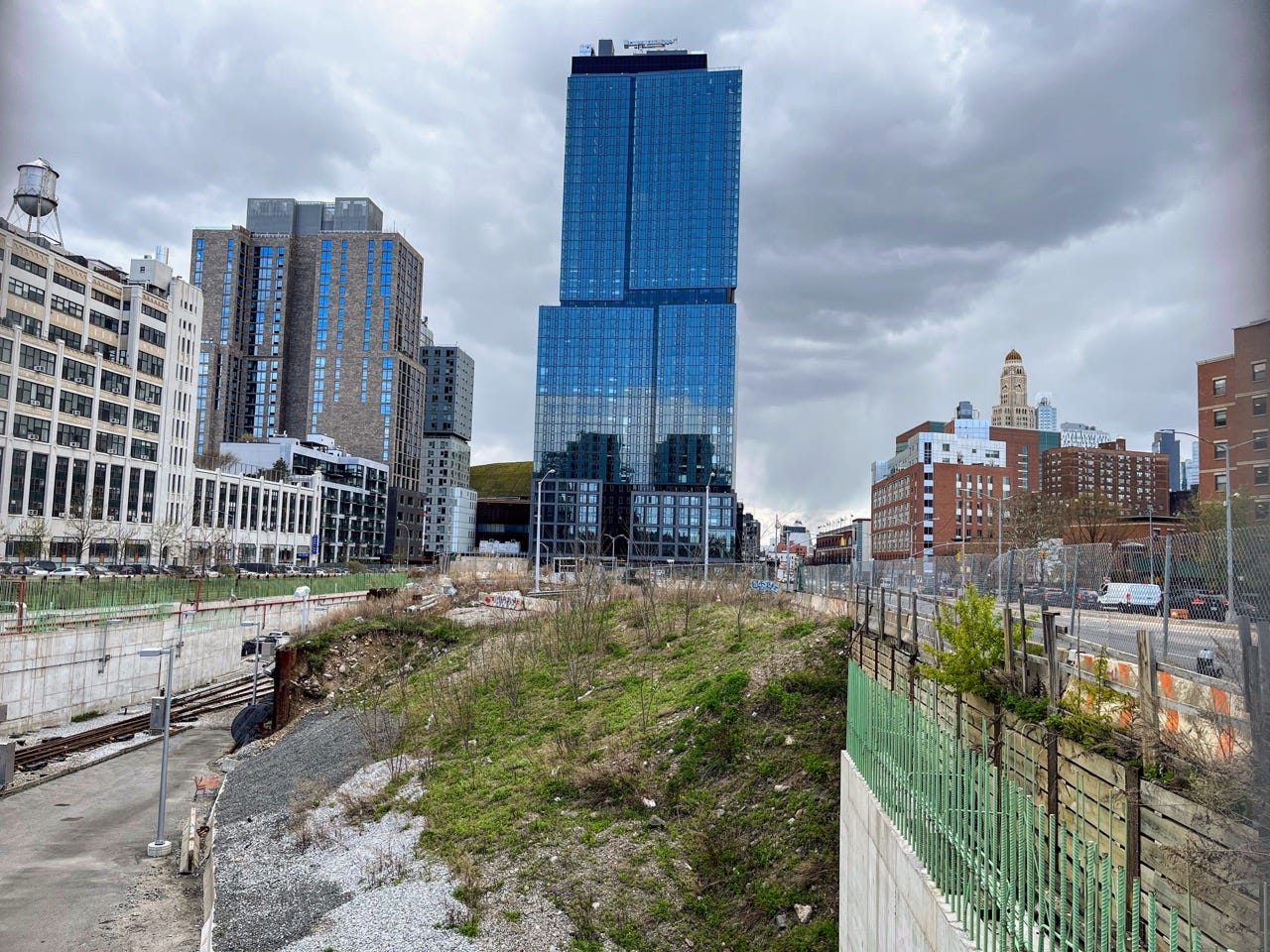
Even if they still planned six towers, they’d each have to be larger than B4, in average. By eliminating tower B8, they now must re-allocate that bulk. That would mean five towers significantly larger, at least in bulk, than B4. (Three would be taller, as estimated in the graphic.)
In the “Feasible Alternative” rendering above, towers B6, B7, B9, and maybe even B10 look bulkier then B4. If they each average more than 1.1 million square feet, they should be.
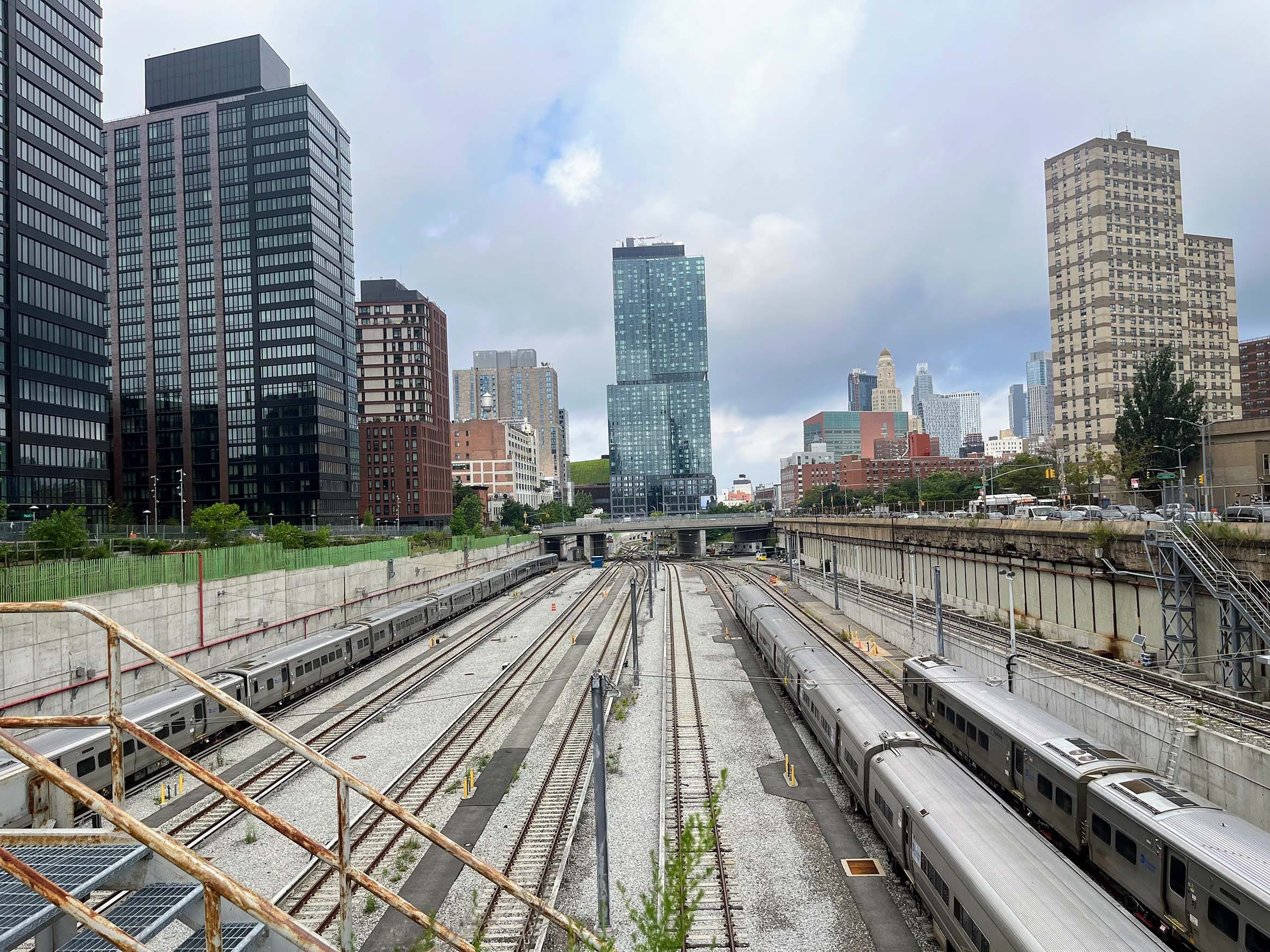
All would be far larger than the four buildings flanking the railyard between Vanderbilt and Carlton avenues, as shown in the photo below, and larger than B4 in the distance. So alternate renderings should be produced from a street-level perspective.
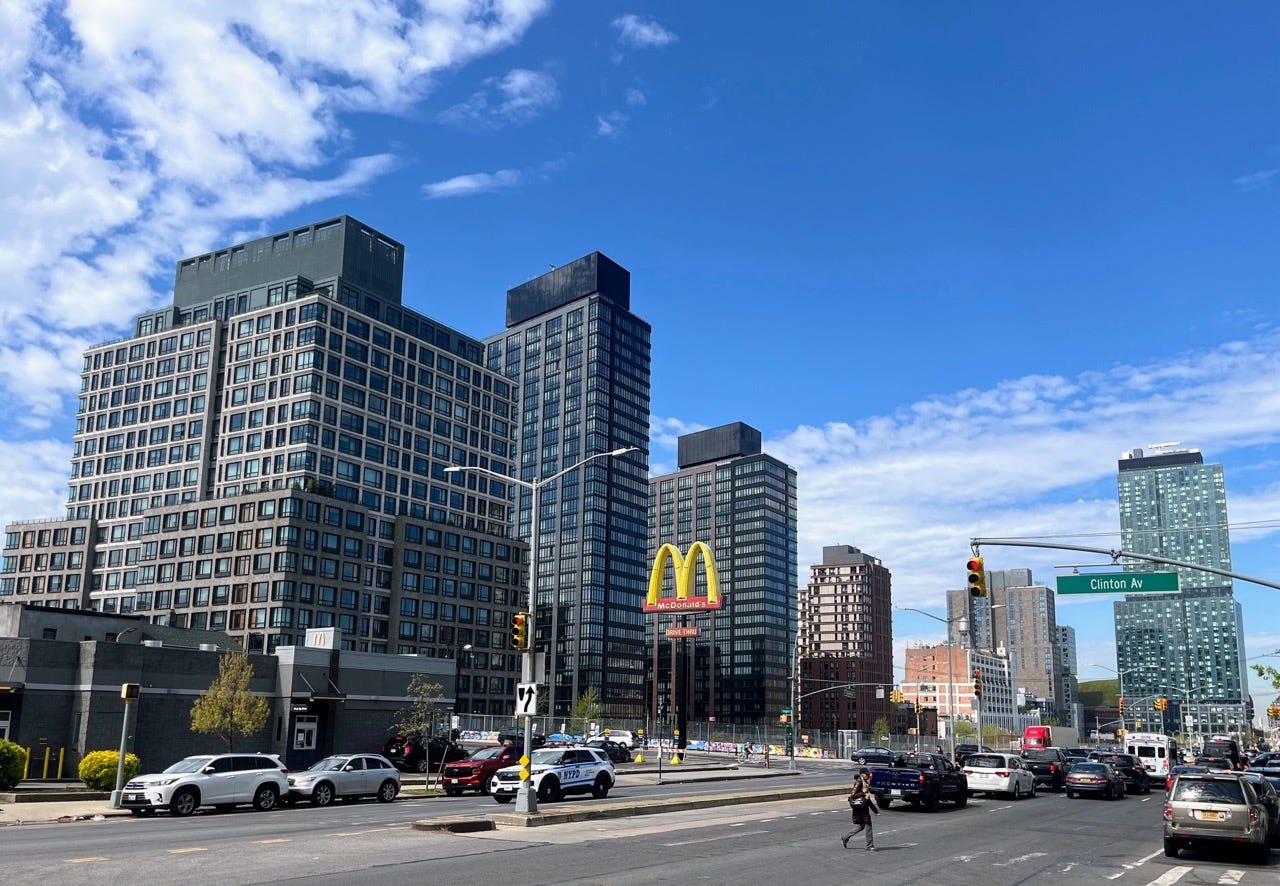
If they’re not planning to increase the size of B5, they’d essentially re-allocate the bulk of the Bank of America tower (near Bryant Park) over four towers: B6, B7, B9, and B10.
Again, itf they’re that much larger than B4, as seen below, they should show us.
What about near the arena?
For now, it seems unlikely they’d fully combine the approved bulk from B1 (1,106,009 square feet) and Site 5 (439,050 square feet) into a two-tower project with 1,545,059 square feet.
Why? Well, Exhibit K of a Site 5 Interim Lease, which ESD approved in October 2021 to advance development there, allows for up to 1,242,000 gross square feet at Site 5. That number is 303,059 square feet less than the combined total.
Could they seek permission to increase the approved bulk at Site 5? Maybe. After all, the lease currently sets a maximum height of 910 feet for the taller tower and 450 feet for the shorter one. (Total combined average: 680 feet.)
Redesigning the towers to the estimated 775 feet and 670 feet (total combined average: 722.5 feet) would require a revised lease. Maybe they could add more bulk. Still, it might be tough to exceed that 303,059 square feet of bulk already left to add.
A slight difference emerges
The Current and Alternative images do offer a slight difference in perspective. Consider the mash-up image below, based on equal-size screenshots of the sections including the railyard towers, starting at the bottom border of the image.
As shown, the top of border of the Alternative section almost cuts off the building labels, while the top border of the Current section leaves a little clearance.
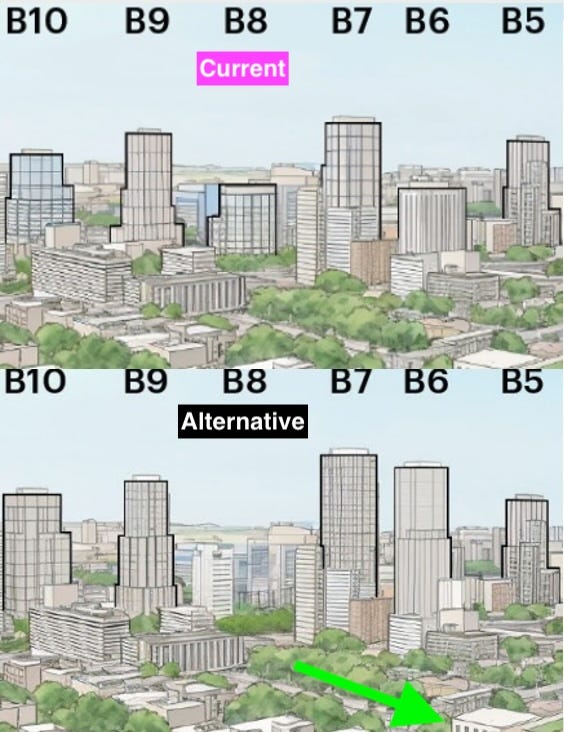
Also, as the arrow suggests, the Alternative image depicts slightly more of the building at bottom right. That suggests the perspective starts slightly farther away, thus downplaying the scale of the Alternative proposal—but only slightly.
Height near the arena
As I wrote, to better compare the images, I extracted equivalent segments of each image, focusing on the area near the arena, adding the red rectangle and annotations.
As that rectangle suggests, the approved B1, at 620 feet, seems as tall as the Site 5 tower at left, at 775 feet.
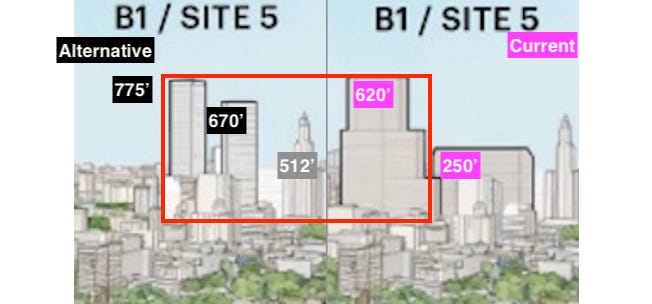
Moreover, the approved Site 5 tower, at 250 feet, is significantly distorted. Though it should be less than half the height of the 512-foot One Hanson, the Williamsburgh Savings Bank tower, it clearly exceeds that benchmark.
Yes, if the Alternative version is slightly underplayed, as established above, the 775-foot tower might be slightly larger. Still, that difference wouldn’t make up for the discrepancy.
Other contrasts
One proposed railyard tower, according to the analysis, would be more than twice as tall as the 312-foot The Axel (550 Clinton Ave.), at the northeast corner of Vanderbilt Avenue and Atlantic Avenue, while another would be nearly twice as tall.
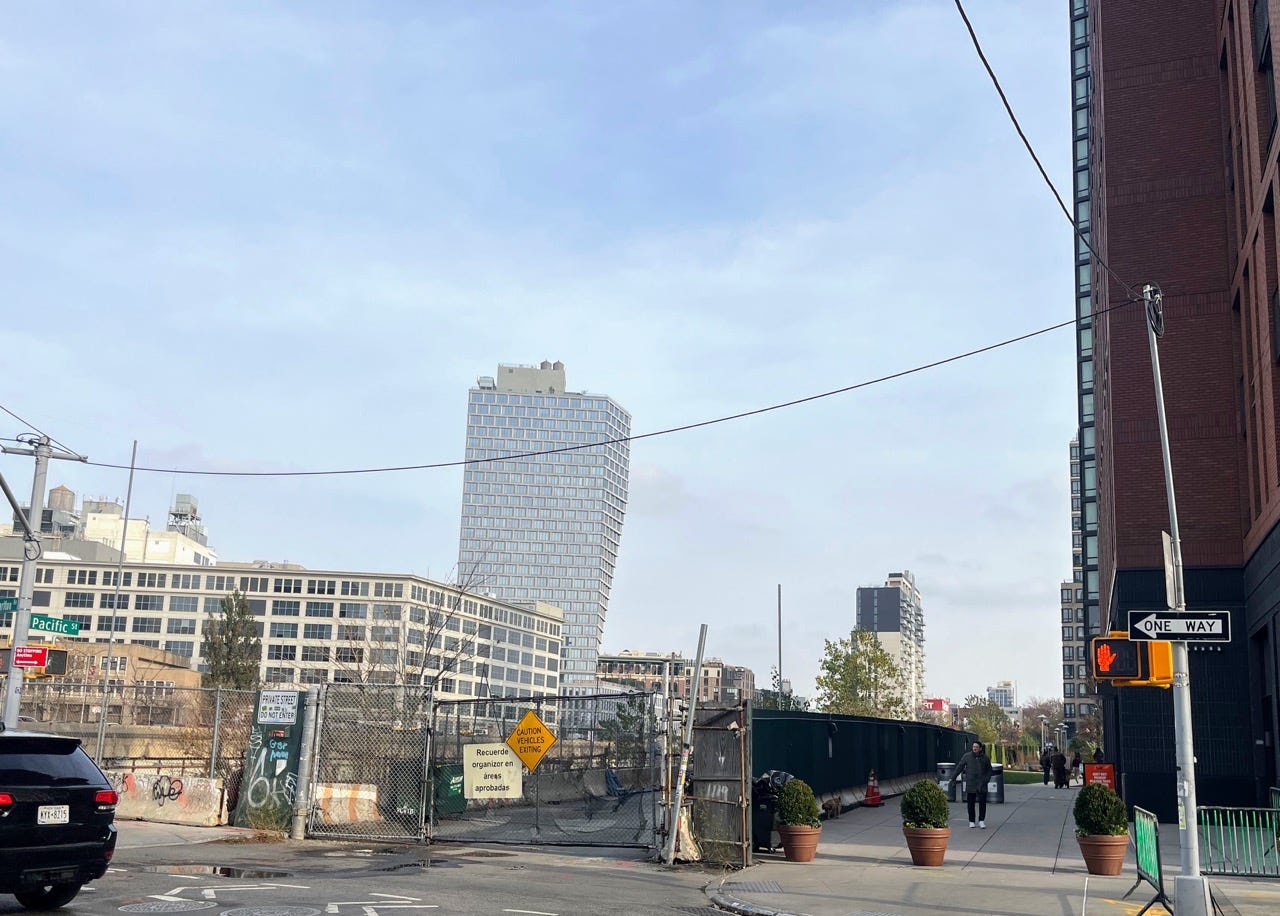
Below, a closer-up view of the Vanderbilt Yard, with The Axel at left. The B8 parcel, in the foreground, would become open space.
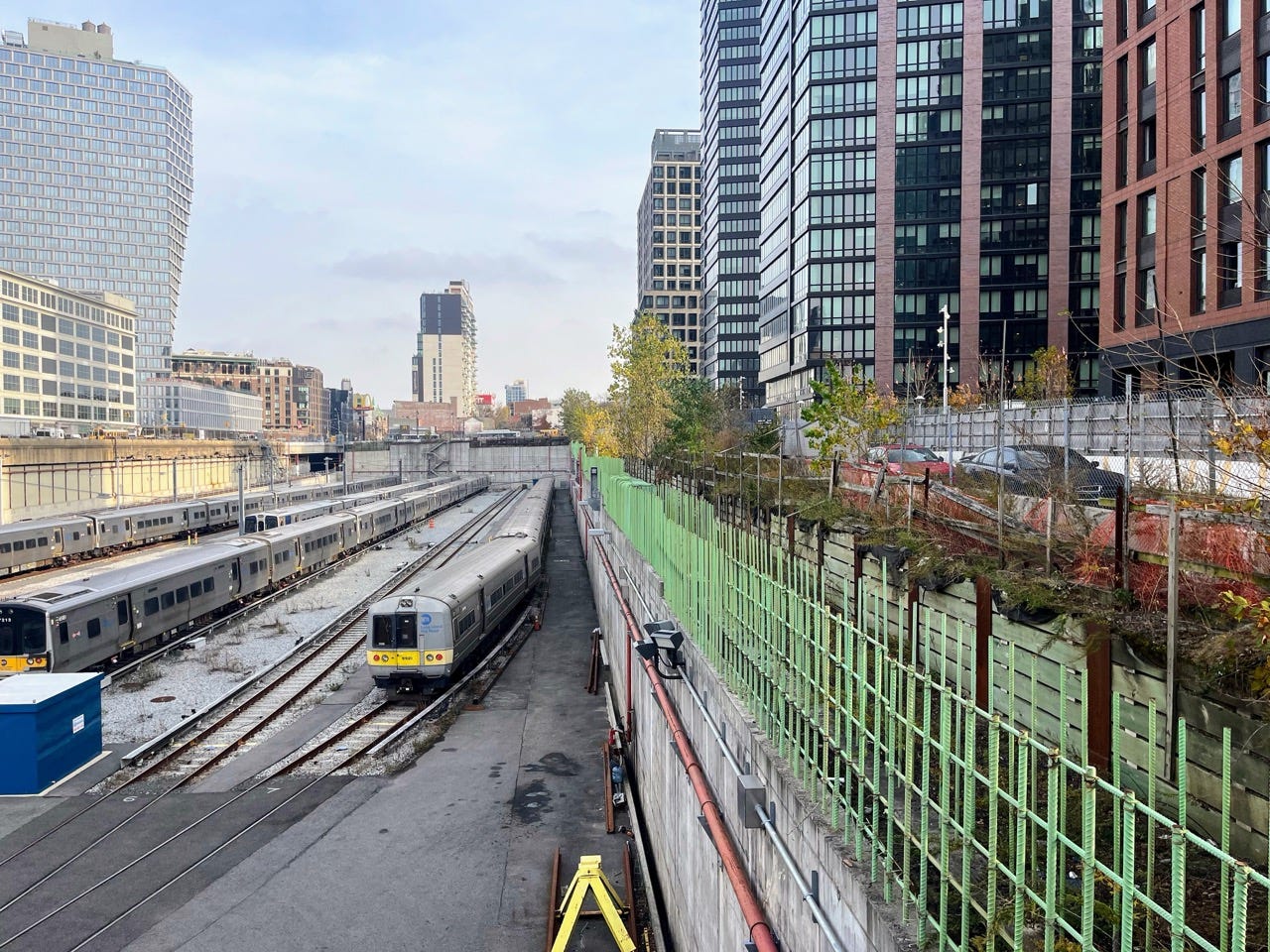
Maybe the newly proposed buildings can work. To better assess the new plans, though, the developers and ESD should offer more accurate renderings, and more accurate portrayals of the proposed increases.