
February Roundup: Waiting for a Workshop, and Key Project Details
What "public resources" (subsidies) are sought? How pay for the platform? A Community Engagement report awaits. Much more to review.

This belated round-up includes everything I’ve published since early January in this Substack, which is sent out by email, as well as my Atlantic Yards/Pacific Park Report blog, which is not.
There’s a lot to catch up on, including (scroll down):
efforts to assess the scale of the proposed project
coverage of the third public workshop (of four) aimed to gain community input into the proposed project
a surprising—and worth probing—claim by new developer Cirrus Workforce Housing that investing in Atlantic Yards was a “no-brainer”
a legal battle (!) between two junior partners in Atlantic Yards, raising questions about their ownership and decision-making stakes
a curiously unfulfilled budget for the advisory Atlantic Yards Community Development Corporation
an initial look at the claimed impact of the Joe and Clara Tsai Foundation’s Social Justice Fund
Waiting for a report, and a workshop
What’s next for Atlantic Yards? Well, consider a slide from the most recent public workshop, the third of four. (The slideshow was finally uploaded.)
The schedule had already slacked a bit. The chart suggests that Public Workshop #3 was originally to be held in the first half of January. Instead, it was held Jan. 22.
That graphic, distributed Jan. 22 without an update, suggested that the Draft Community Engagement Report would be released in mid-February, and that the fourth public workshop, to get feedback on that report, would be in the second half of February.
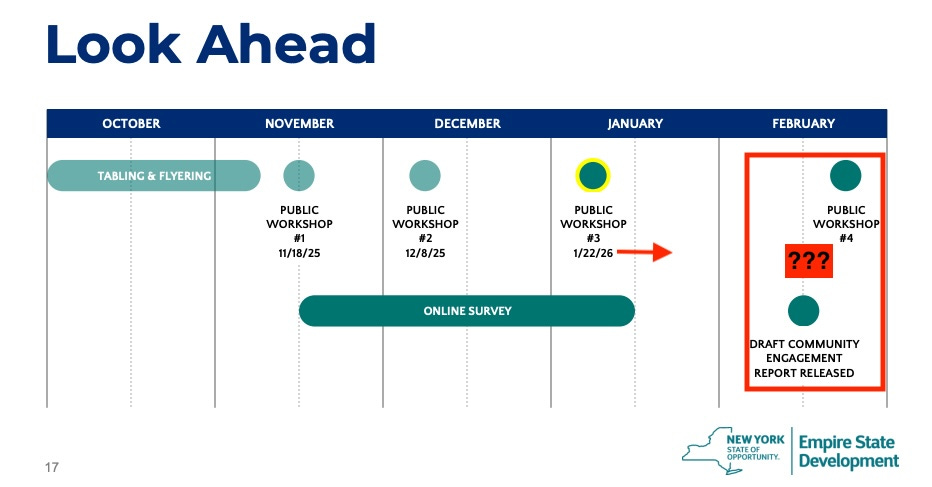
Well, the report hasn’t yet been released, and the fourth workshop hasn’t yet been scheduled.
How much that report will deal with the project’s big questions remains in doubt, since, for example, the public was never given an official rendering of the proposed plan.
It’s possible that everything has merely been nudged back a few weeks. Or, possibly, longer.
Waiting for “public resources”
A looming question involves what kind of “public resources”—subsidies, tax breaks, tax-exempt financing—the new developers, a joint venture led by Cirrus Workforce Housing, are negotiating, especially for the platform needed over the Metropolitan Transportation Authority’s two-block Vanderbilt Yard.
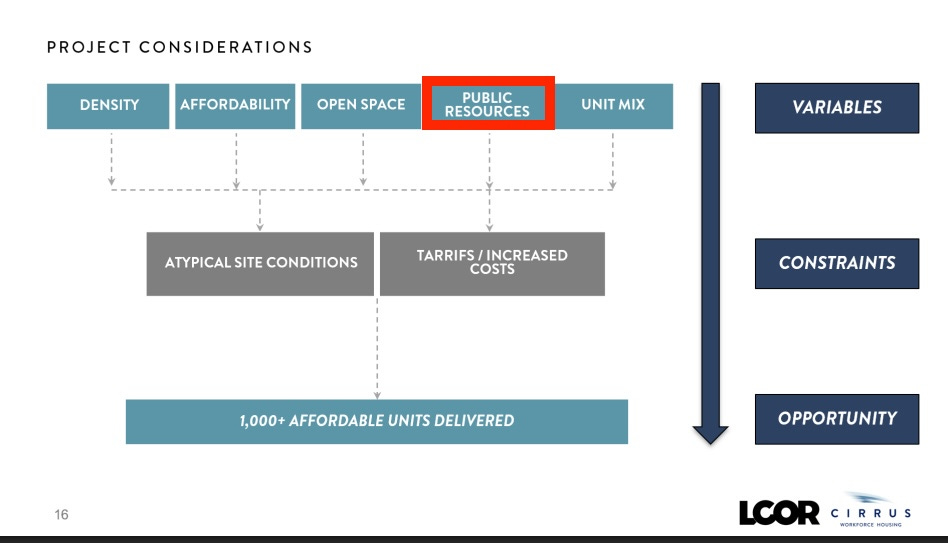
If Hudson Yards Got Taxpayers to Pay for the Platform, What Happens With Atlantic Yards?, I asked last Sept. 29. That question lingers.
In a Feb. 16 article in Politico, Iconic Hudson Yards project tests Mamdani’s approach to development, Janaki Chadha reported that new Mayor Zohran Mamdani hasn’t yet decided whether to back, or reverse, that plan for the second half of Hudson Yards:
The question is how Mamdani will proceed on an agreement struck by his developer-friendly predecessor Eric Adams, under which the city would cover the cost of a $2 billion platform over the last section of rail yards — making way for some 2 million square feet of office space and 4,000 apartments, roughly 15 percent of them affordable. Future revenues generated from the project would be used to pay back the debt.
Deputy Mayor for Housing and Planning Leila Bozorg, in a careful statement, told Politico they “support the broad goal of delivering housing … and will carefully evaluate any potential public financing,” while Manhattan Borough President Brad Hoylman-Sigal, said he hoped the deal would face new scrutiny.
Does that mean they renegotiate fractionally more public benefits? Or that they scrap it? How pragmatic is this professed Democratic Socialist?
In a recent article in The Nation, Sunnyside Yard and the Quest for Affordable Housing in New York, architect and planner Vishaan Chakrabarti, whose firm released an ambitious plan to build over the 180-acre railyard site in Queens, noted, “There’s no way to build a platform without a federal grant.”
He expressed frustration that the administration of Mayor Eric Adams, didn’t apply when it was possible under administration of President Joe Biden. No such grants are available under President Donald Trump.
The lesson for Atlantic Yards may be that resources are limited. That does not mean such deals—and the parties behind them—don’t deserve scrutiny, especially given the apparent limited investment by Cirrus to leverage the project, and the unexplained role of junior partners that hold a significant slice of project debt.
My coverage in this Substack
I’m presenting my articles as graphic links, with headlines and brief summaries. Click through to the read the whole articles.
Note: I have more coverage coming, thanks in part to responses from the Social Justice Fund. Stay tuned.
Note: according to the video, the Bryan Cave contract passed without debate. There was no discussion of the questions I raised about the AY CDC budget, nor any response from ESD to my questions about the budget.
From Atlantic Yards/Pacific Park Report
Jan. 6: Pacific Park Conservancy, in report on 2024, ramps up its spending (and there was likely more in 2025). Will fixing the dog run be on the table?
Jan. 13: BSE Global’s new Brooklyn Basketball Training Center hosts a social uplift event, but mainly $65/hour youth classes, with murky info on financial aid. (This was before I reported that BSE Global became Brooklyn Sports & Entertainment.)
Jan. 16: The aftermath of the Pintchik sale of properties in north Park Slope: turnover after new owners of retail in blocks near arena raised rents.
Jan. 17: In another stage of arena revamp, Brooklyn Sports & Entertainment plans to replace Qatar Airways Club with new space.
Feb. 3: Barclays Center February 2026 event calendar: 21 ticketed shows (updated with official calendar).
Feb. 14: City & State ranks Joe and Clara Wu Tsai #45 (too low IMO) in the Brooklyn Power 100, returns Social Justice Fund head Gregg Bishop to the list. A key lobbyist on Atlantic Yards is high in the list.
Feb. 15: CNBC says Brooklyn Nets and associated businesses worth $6 billion (above Forbes’ number, below Sportico’s).
Feb. 16: Unrivaled 3-on-3 women’s basketball semi-finals coming to Barclays Center March 2.
Feb. 17: Barclays Center reports modest drop in cash receipts in first half of FY 2026, and a slightly larger drop in net operating income. Will new premium spaces help?
I spent my formative years in Park Slope in the 70s, in a brownstone on 7th Avenue and Sterling. I currently live in the Kansas City area, and the sports team stadium issue is huge here. One team is moving across the state line (to Kansas City, KS), and the other wants to build in downtown Kansas City, MO.
Anyway, what's happening with the Atlantic Yards just makes me feel ill. Thanks for keeping us informed, though. As a teen, I spent a lot of time walking around Brooklyn neighborhoods, and even when neighborhoods changed and the culture and food with them, that does not mean they became slums!!!