
Draft Community Engagement Report Backs (!?) Developers' Aim to Downplay Low-Income Housing
Other findings are mostly predictable, as key info was withheld (despite transparency claim). Was online survey representative? Respondents mostly white and well-off.

Yesterday, Empire State Development (ESD), the state authority that oversees/shepherds Atlantic Yards, issued the promised Draft Community Engagement Report aimed to “solicit public input on the future development.”
It was just three days before an online workshop set up for public comment on the report, as well as a meeting of the (purportedly) advisory Atlantic Yards Community Development Corporation (AY CDC).
Update: Here’s info on the meeting Agenda, which includes an executive session to discuss, presumably, subsidies.


The Community Engagement effort, involving three workshops (so far) and online surveys, seemed aimed at ratifying the new developers’ framing—only taller, bulkier towers can deliver the desired affordable housing and open space—while also crowdsourcing tweaks to open space, streetscape, and retail plans.
That’s what the 48-page report delivers. Most of the findings are predictable, such as general priorities for affordable housing, open space, and infrastructure capacity.
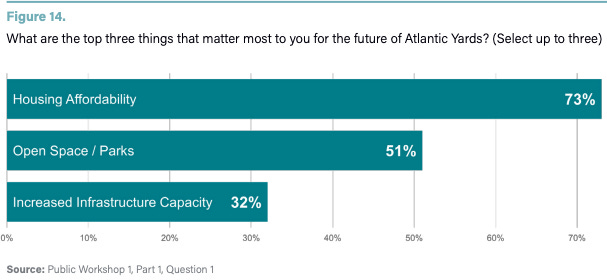
However, it includes a surprising—but dubious, given the limited and unrepresentative input—suggestion that respondents prefer below-market “affordable housing” at relatively higher incomes, disregarding the project’s unfulfilled promises to deliver low-income apartments.
Note: because this is a state override of New York City zoning, the level of affordability is not required by statute; instead, it is negotiable.
Questions and comments on the report can be submitted via this form through Wednesday, March 25, at 11:59 pm. Register here for the March 19 workshop.
Notably, that message points out that the model open spaces cited by participants are public parks, not privately managed (as is “Pacific Park”), and suggests that an independent financial analysis must reconcile “project cost, subsidy and public benefit,” not merely the project’s viability.
Questions of transparency
“ESD and the Development Team recognize the importance of ongoing dialogue, transparency, and responsiveness,” the report, produced by the consulting firm Karp Strategies, states solemnly, “and are dedicated to ensuring that community input meaningfully informs project planning and implementation.”
Oh, please.
Yes, this engagement effort precedes a Memorandum of Understanding (MOU) ESD is expected to sign with developers Cirrus Workforce Housing and LCOR, outlining the provision of “public resources” such as subsidies, tax breaks, and additional bulk. The MOU is due by the end of July.
And yes, only after that would a formal public approval process, with public hearings and a Second Supplemental Environmental Impact Statement, proceed, likely lasting through 2027.
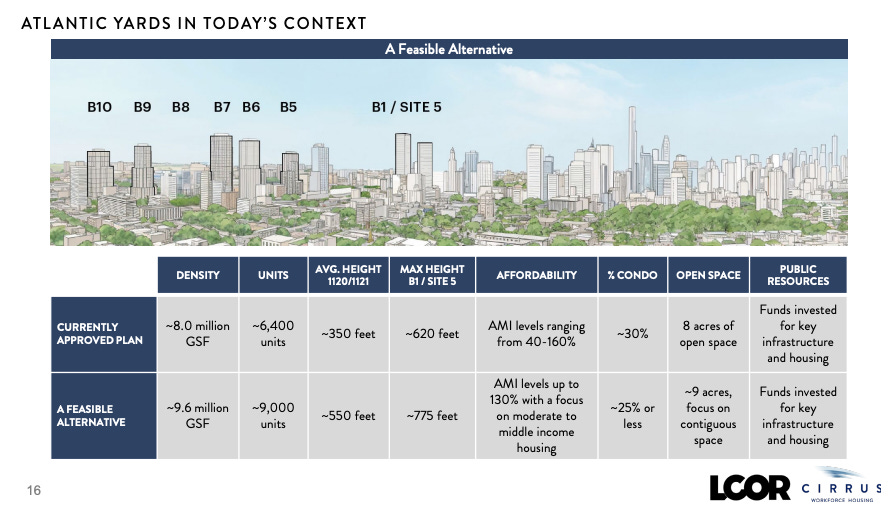
However, were this effort transparent, meeting organizers would’ve:
distributed information about the developer’s dramatic plans to supersize the project before the first workshop on Nov. 18
allowed attendees at tables in the second workshop to report back to the crowd at large (as Assemblymember Jo Anne Simon noted at the third workshop)
answered follow-up questions at the third workshop
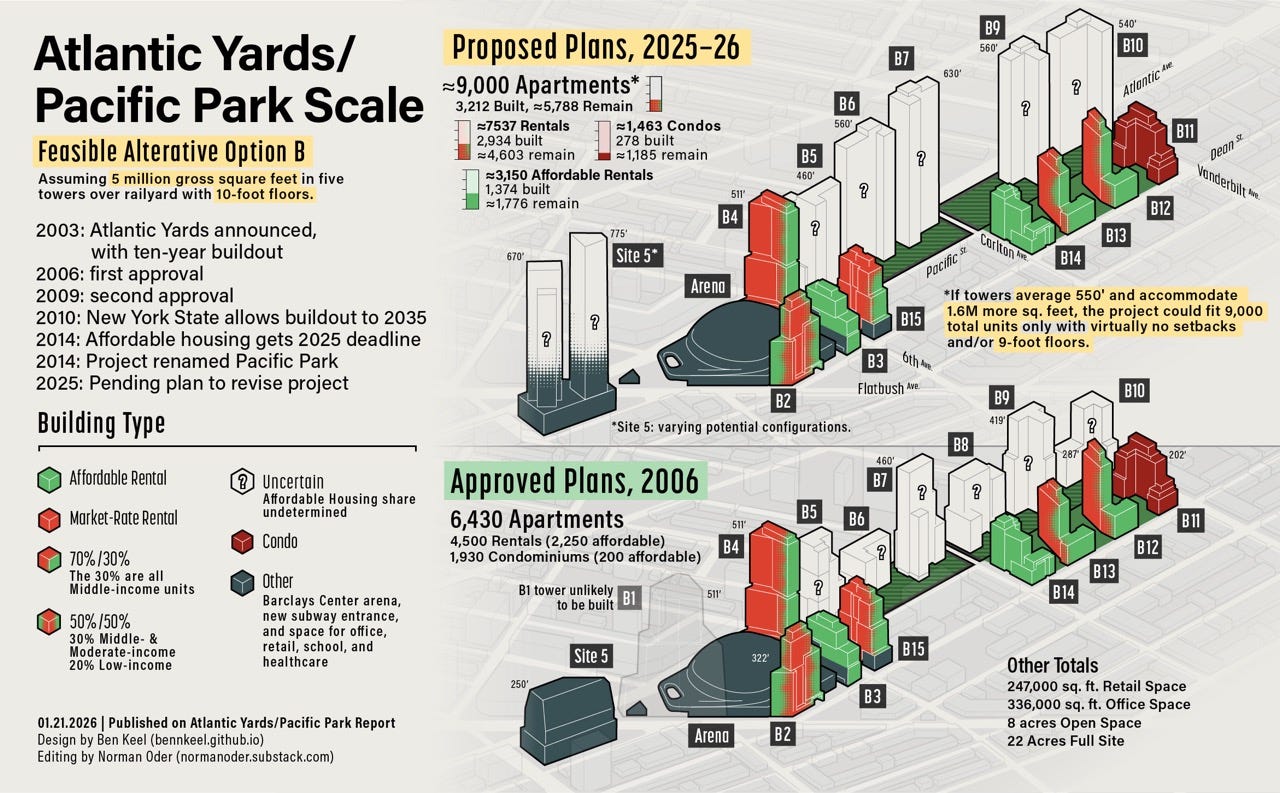
It also means they would have:
shared what the proposal might look like (see above and below, unofficial images produced with my collaborator Ben Keel), rather than issuing vague outlines
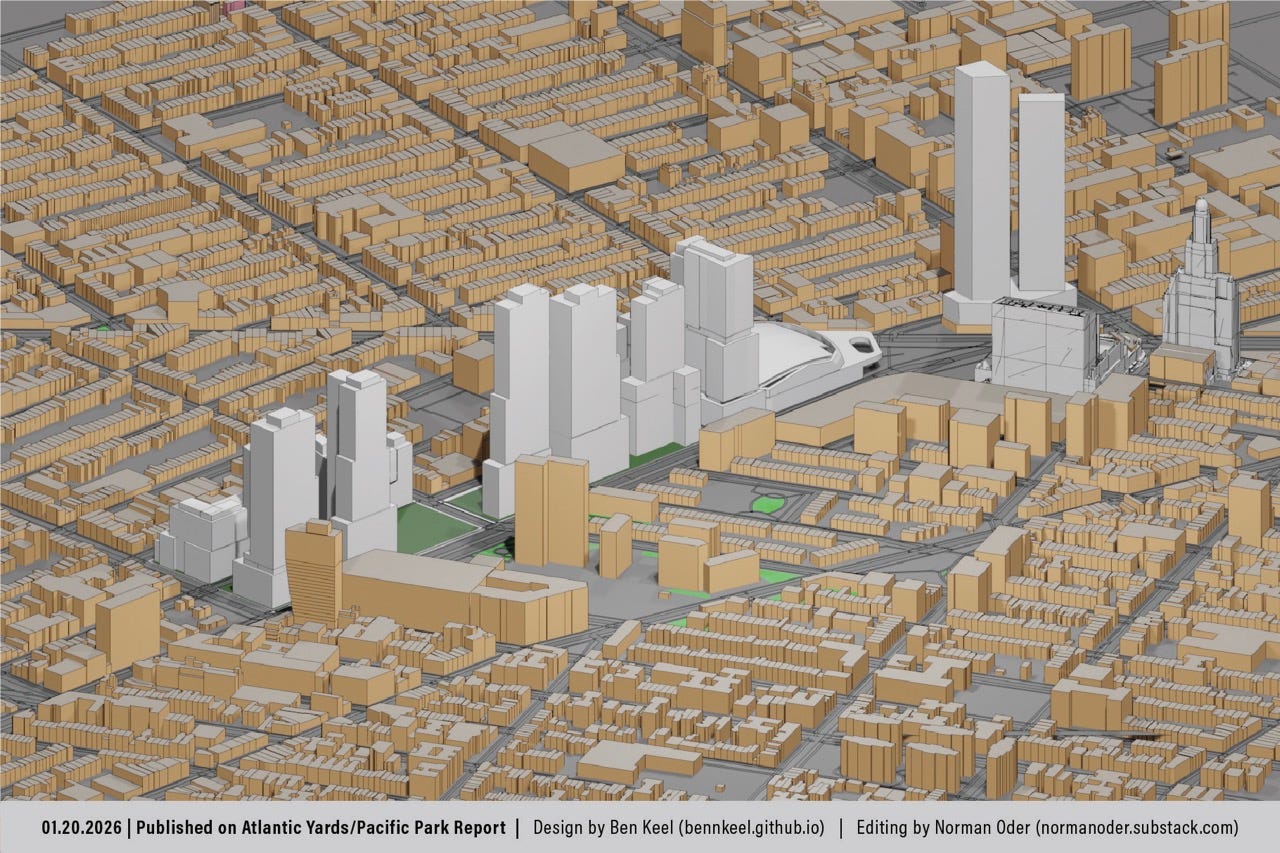
identified comparable large real estate projects in New York City that have 409 apartments per acre, as is proposed for Atlantic Yards, rather than evading my question
explained that, though they plan to add an acre of open space by eliminating a building, the amount of open space, related to population, would go down, given the increase in apartments
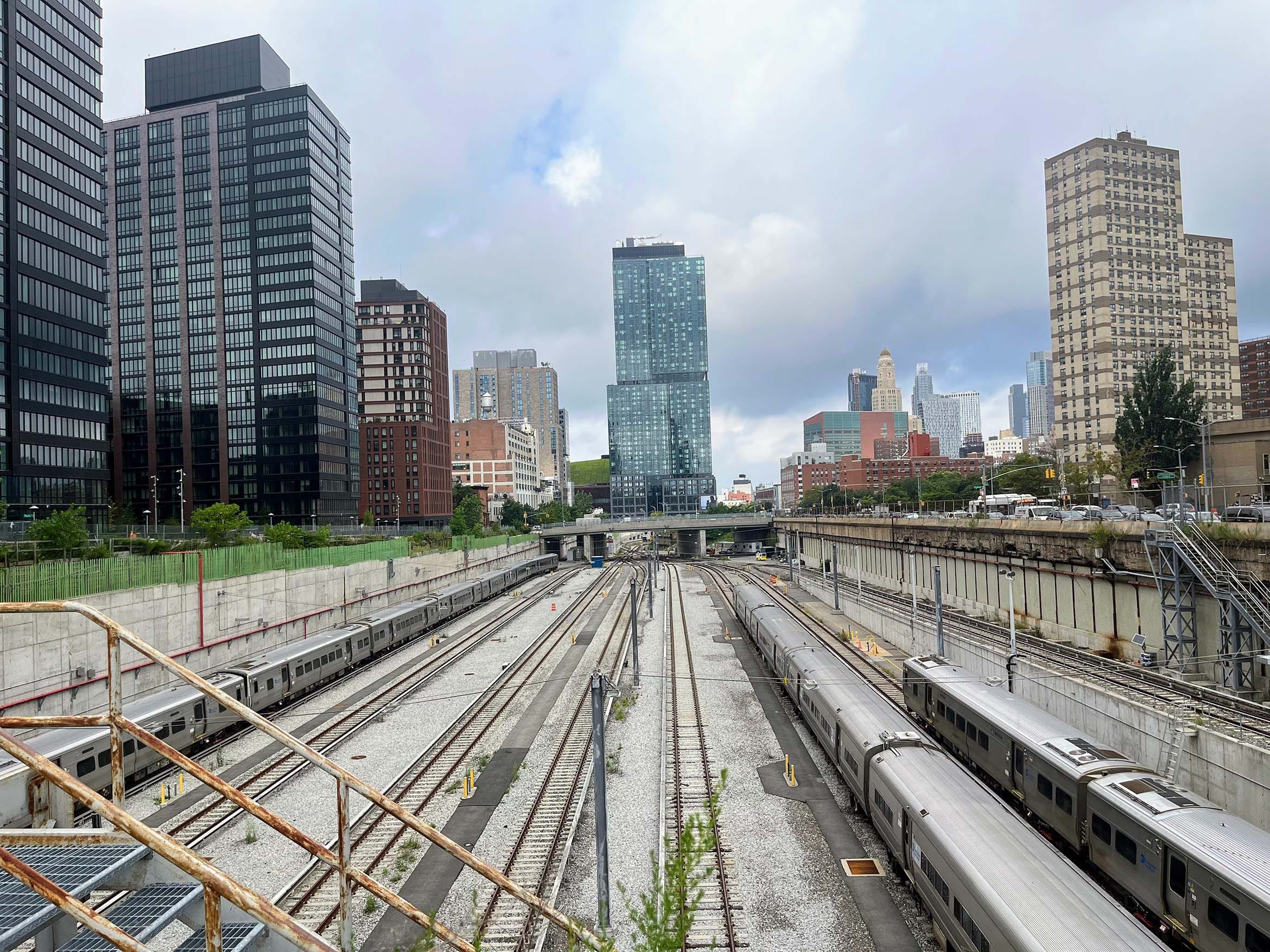
disclosed their quest for $350 million in state subsidies to build the platform needed for vertical development over the Metropolitan Transportation Authority’s Vanderbilt Yard
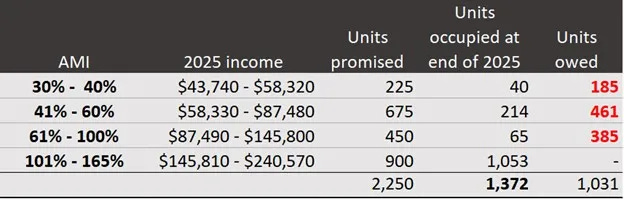
described, as has the coalition BrooklynSpeaks and has Ismene Speliotis of the Mutual Housing Association of New York, the divergence between promises in 2005 of affordable units across the income spectrum and the record of delivering disproportionate middle-income apartments, which argues for a “catch-up”
acknowledged that concerns about accountability were driven by the development’s failure to deliver 2,250 affordable units by May 2025 and ESD’s failure to enforce $2,000/month penalties for each of the 876 missing units, instead agreeing to $12 million in cumulative payments, a vastly lesser sum
explained that the developers’ willingness to cap “affordable” incomes at 130% of Area Median Income (AMI), as opposed to 165% of AMI in the past, is less a sacrifice than a concession to reality, given how rent levels at 130% of AMI today approach market rates
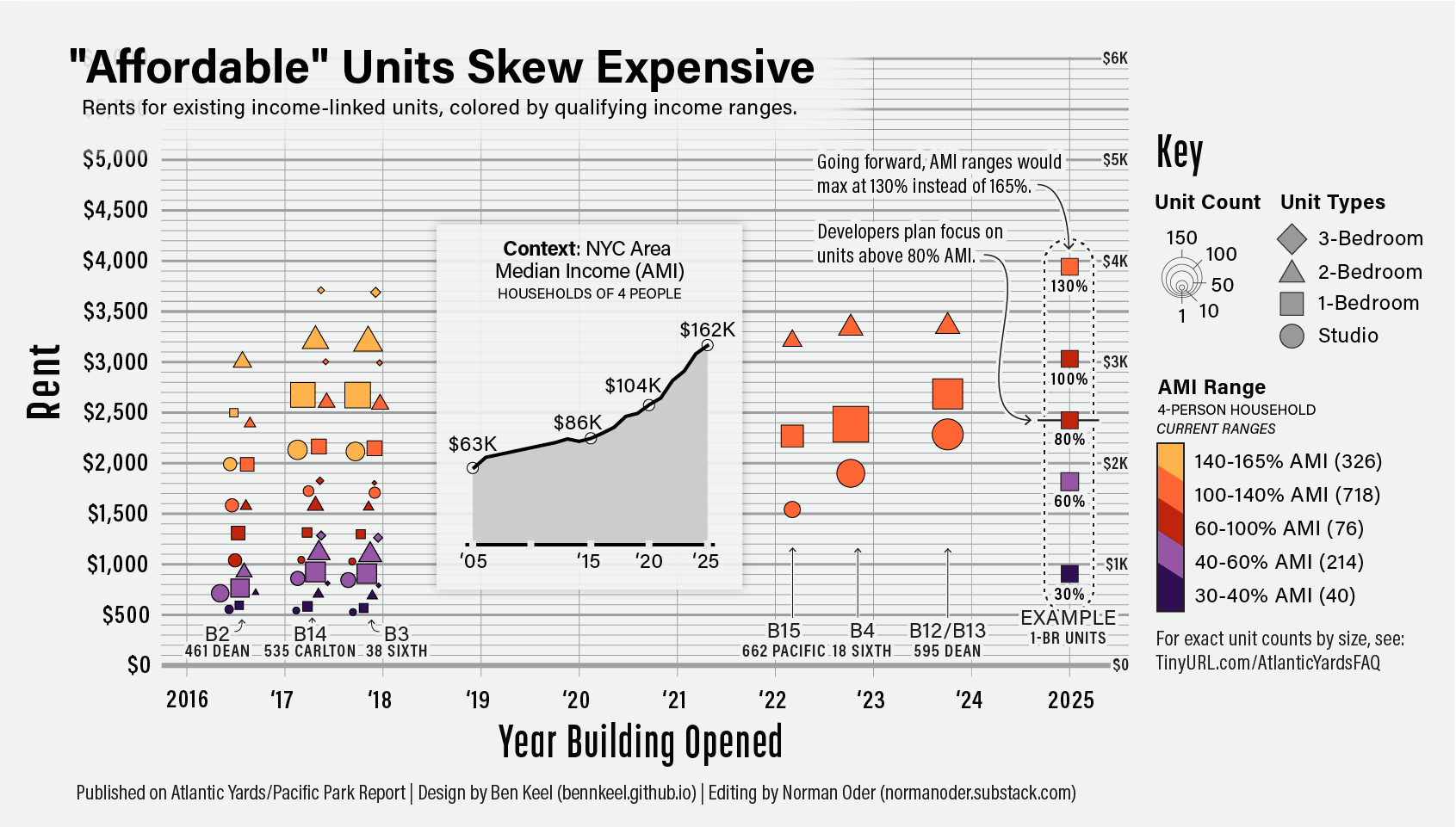
Note that at the most recent workshop, the developers offered at least a rhetorical concession, promising some lower-income units, but left the promises—surely dependent on subsidies—vague.
One surprising takeaway: affordable housing
Six of the report’s seven “Key Takeaways” are predictable and banal, without enough detail and context to provide serious guidance, as noted below. The first one, however, was not predictable:
HOUSING AFFORDABILITY: Maximizing the number of affordable housing units across a range of income levels, particularly for moderate and middle incomes, and prioritizing family-friendly unit sizes are a top priority.
That takeaway ratifies the stated plan of the developers, as stated in the first workshop, to focus on higher-rent moderate- to middle-income housing as part of the “feasible alternative” that also requests 1.6 million more square feet (worth $320 million?) and unspecified other subsidies.
Such housing, of course, is less costly for the developers. Cirrus called the project a “no-brainer,” apparently because of the low cost of acquiring previous master developer Greenland USA’s debt, allowing it to leverage the latter’s investment and the right to build.
Unmentioned: Atlantic Yards was supposed to deliver 900 low-income units, but has fallen well short, even as the AMI baseline keeps rising, to more than 2.5 times the number when Atlantic Yards was being wrangled two decades ago.
At the first workshop, on Nov. 18, a simplistic slide from the developers suggested that greater density would deliver greater affordability, while taller, thinner buildings would mean more open space.
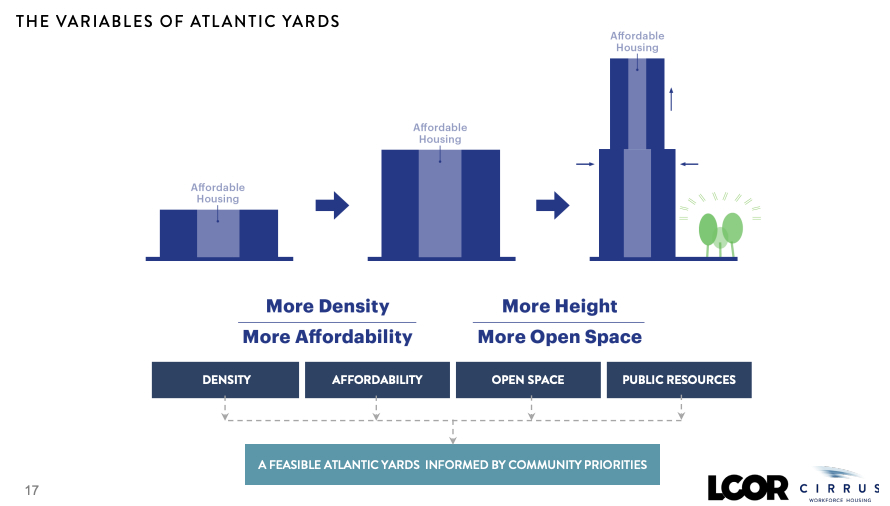
I suggested that a key was “public resources.” At the third workshop, on Jan. 22, Cirrus’s Joseph McDonnell said they “continue to modulate the variables.” As the graphic below suggests, they added “unit mix”—the size of the apartments—to the variables.1
They added constraints: atypical site conditions, given construction over the railyard below, plus tariffs and increased costs, which other projects face.
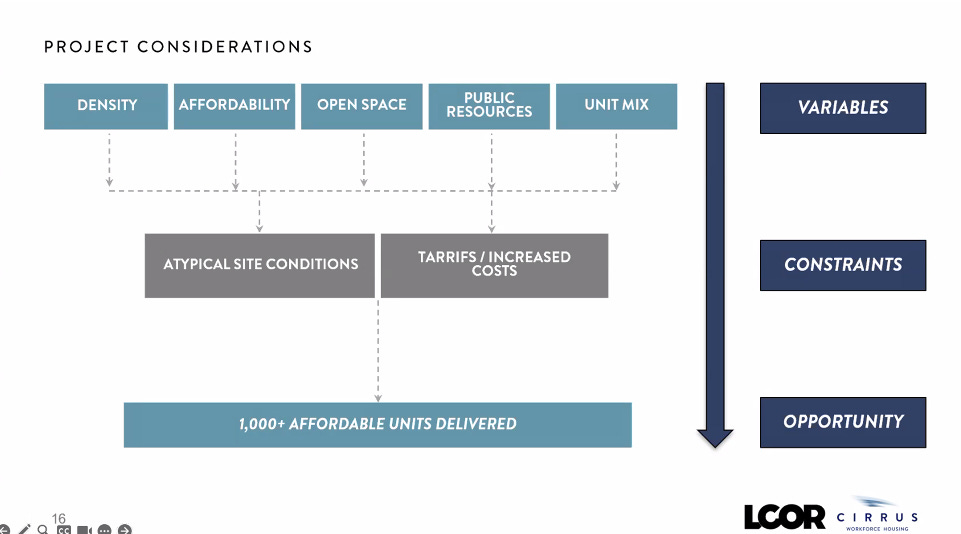
Again, looming is that unspecified request for “public resources.”
Looking more closely
The charts below deserve a closer look. Figure 3 reflects one of the four questions from the first public workshop, about what types of housing the neighborhood needs. While it offered the option to prioritize “income-restricted housing,” it did not specify its type.
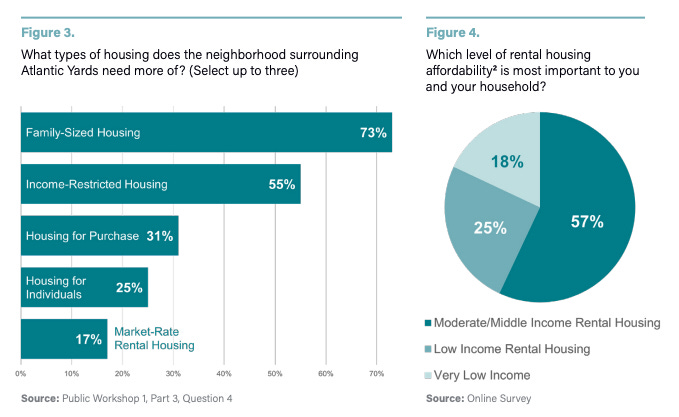
Figure 4 (right) shows a question from the online survey: 57% of respondents indicated that moderate- and middle-income rental housing was most important to them. (That was 339 respondents. A total of 593 people responded to the survey.)
However, we can’t call those responses representative. After all, for the 82% of respondents who disclosed their income, their median household income is $151,767. (As of 2023, Brooklyn’s median income was $79,830.)2
Meanwhile, only 56, or 11.5% of those who disclosed their income, earned below $50,000, according to a separate Survey and Workshop Results document. Only 50 (11%) of those who disclosed their monthly housing costs paid $1,500 or less.
Only 40 respondents, or 8% of those who disclosed their race/ethnicity, identified themselves as Black, while 321, or 66%, identified as white. The feared—and since realized—displacement of Black residents in the neighborhoods around Atlantic Yards has fueled advocates’ calls for affordable housing.
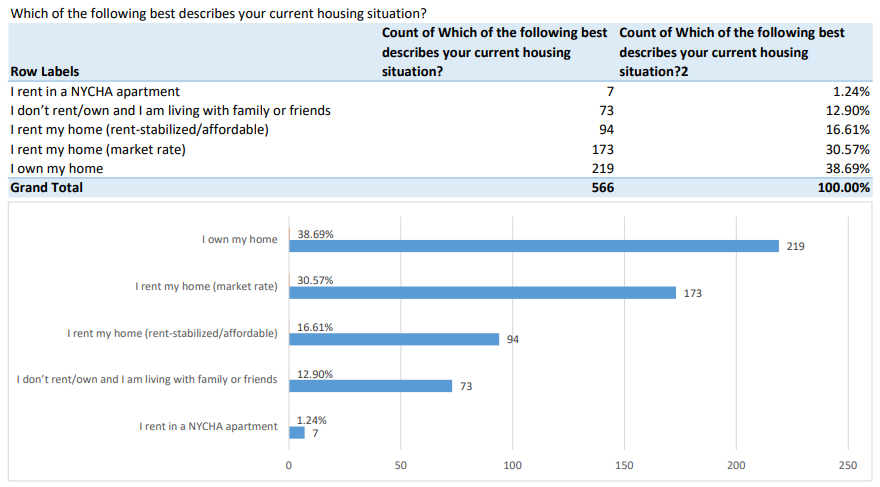
More than 69% of respondents were homeowners or market-rate renters, as shown in the chart below, so they may be less focused on affordability.
More caveats
Data points “are representative of the majority sentiment identified during the engagement process, but do not reflect all responses or perspectives,” the main report allows, gingerly.
(The backing data, in a separate document, suggests more caveats, as I’ve noted above.)
While more than 80% of the respondents were from Brooklyn and 10% from elsewhere in New York City, that means 9% were from outside the city.
Given the digital divide and the lack of a concerted presence from affordable housing groups, low-income renters were clearly underrepresented.
Not reflected in a chart, the report text acknowledges that, “while 68% of survey respondents were in favor of more affordable units at higher AMI levels, participants at the first public workshop were split roughly evenly with an average indication slightly towards fewer affordable units at lower AMIs.”
In other words, at that workshop, which presumably drew more engaged neighbors (and a good number of construction union workers allied with Cirrus), participants recognized the importance of lower-cost units.
Attendance at the three workshops averaged 136 participants (160, 121, 128), according to the report. While the total is 419, the report states that 333 unique attendees attended those workshops.
The other Key Takeaways
The other Key Takeaways, quoted verbatim below, were unsurprising, with some deserving of significant footnotes:
STREETSCAPE: Prioritize safer and more pedestrian-friendly streets and intersections surrounding the project sites.
OPEN SPACE: Design and develop high-quality green spaces that offer multiple uses and build community.
RETAIL: There is strong interest in local, accessible retail that meets daily needs and makes room for small businesses.
COMMUNITY SPACES: Incorporate new community spaces that serve residents of all ages.
ACCOUNTABILITY: Accountability for delivering on the project is important to the community with interest in making sure both the State and Development Team complete the plan in a timely manner.
INFRASTRUCTURE & QUALITY OF LIFE: Ensure the project addresses the effects of additional buildings and residents on existing infrastructure.
A note of protest
As shown in Figure 8 (below), survey respondents prioritized more greenery and shade in and around the Atlantic Yards area.
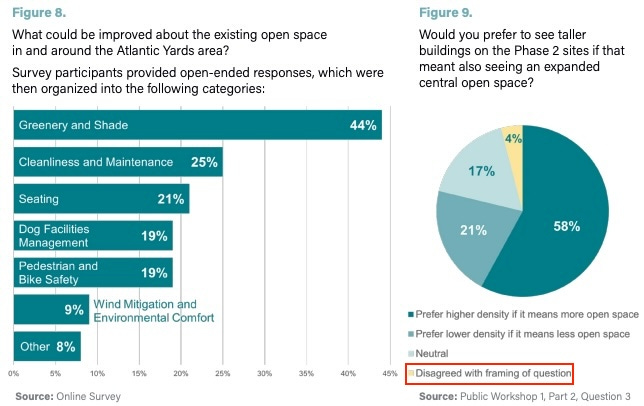
As shown in Figure 9, while 93 (58%) of the 160 people at the first public workshop said they preferred higher density if it delivered more open space, and smaller percentages were either neutral or preferred lower density if it meant less open space, 4%—or six or seven people—disagreed with the framing of the question.
Indeed. As I’ve written, the framing is simplistic, since other factors, including the financial expectations of the developers, deserve analysis.
The separate Survey Results document indicates that 5% disagreed with the framing as presented.
Some other iconoclasts emerged: 8% and 17%, respectively, disagreed with the framing of questions that trade off density and affordability, and trade off the number of affordable units and their affordability levels.
That said, the report declared that respondents preferred more below-market units at higher income levels than fewer apartments at lower income levels.
Accountability framing
“Accountability for delivering on the project is important to the community with interest in making sure both the State and Development Team complete the plan in a timely manner,” the report states.
That’s a little too pat. Why would a workshop participant, as quoted, state, “Accountability for empty promises”? That goes unexplained.
“Many community members voiced a desire for ESD and the Development Team to demonstrate how it will ensure that project commitments are delivered,” the report states. The record suggests that ESD is now obligated not only to deliver on its commitments but also to ensure it won’t renege on enforcement.
Since the report frames accountability as ensuring that the project gets done, it bypasses the failures of transparency I’ve cited. It ignores the requests for direct subsidies, new bulk, and, apparently, tax breaks.
In other words, it treats the deal as a black box.
If state officials open up their coffers to subsidize the project, well, maybe it will get done. But is that responsible development?
More from the report
Community members, the report said, “highlighted the need to reduce vehicular traffic and incorporate streetscape features that make major roadways and intersections safer for pedestrians, cyclists, and people of all ages.” OK, sure. It just takes money.
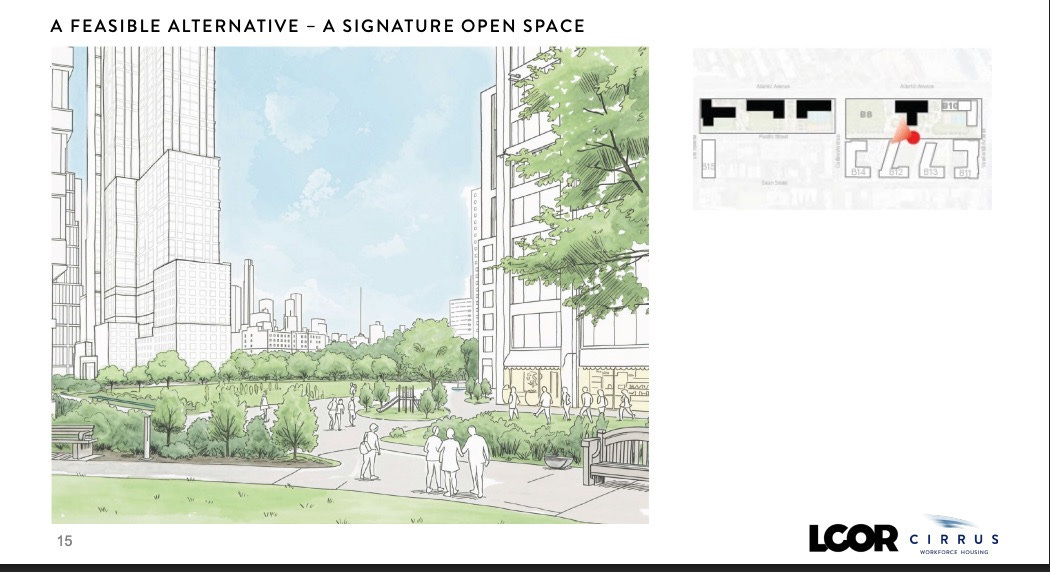
Looking west from the Pacific Street corridor—well, somewhere above ground— toward the new acre of open space, Carlton Avenue, and part of the B7 tower.
Asked “which existing open spaces in the area they felt were most successful and could serve as inspiration for the next phase of Atlantic Yards,” the report said, “participants most frequently mentioned South Oxford Park [adjoining Atlantic Commons north of Atlantic Avenue between S. Oxford and Cumberland streets], Cuyler Gore Park [at Fulton Street and Greene Avenue], and Prospect Park.”
Those, of course, are not analogous to what’s planned, given the much larger population and much larger towers, averaging 550 feet. It would be wiser to draw on inspiration and comparisons from other megaprojects, and to provide more extensive renderings than the images above and below.
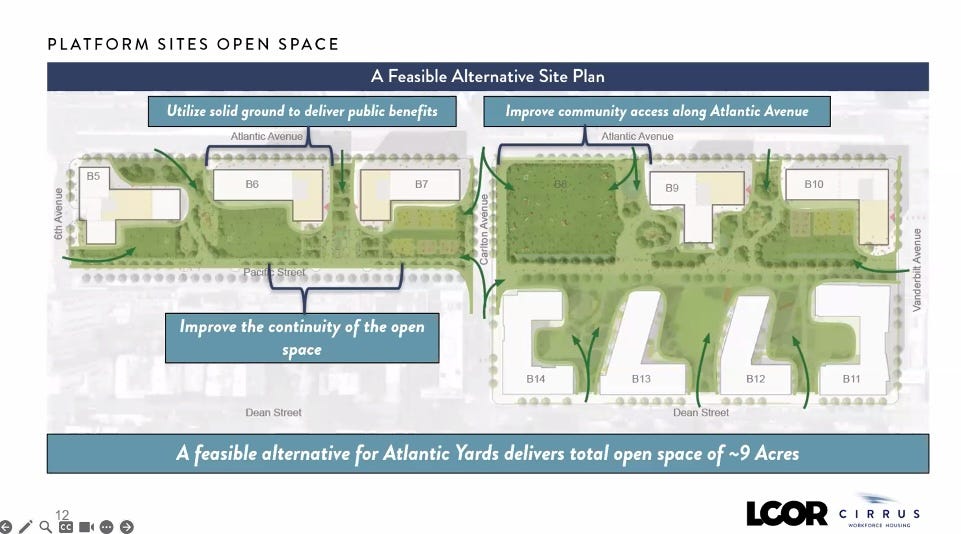
Public and nonprofit spaces
“Workshop participants’ top priority was a recreational center or intergenerational community facility, followed by a day care center or preschool, a senior center, and an arts center,” the report said.
However, a recreational center is not the same as an intergenerational community facility, with space for day care and seniors, which the project plan already requires.
That’s the legacy of a promise original developer Bruce Ratner (of Forest City Ratner) made to key community partner the Rev. Herbert Daughtry, who formed the Downtown Brooklyn Neighborhood Alliance (DBNA) to support the project.3
A close look shows how they finessed the issue. In the online survey, respondents were asked what kinds of public or non-profit spaces they preferred, and indicated a “community center/recreational center.” As suggested in the graphic below, they were not given the option to consider an intergenerational center.
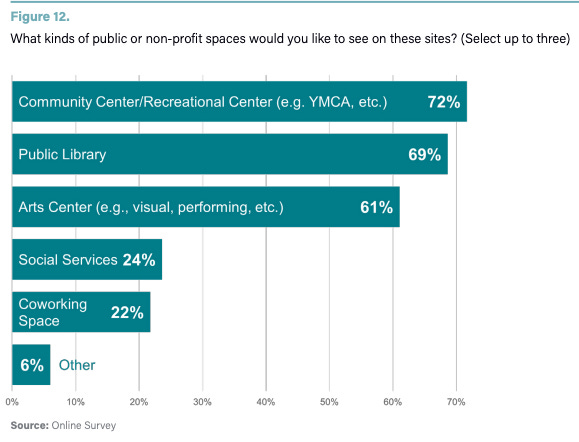
At the workshop, participants were asked, “What types of community-serving / non-profit facilities would help create a more complete neighborhood and better meet the communityʼs needs?”
One response option was: “Community center / recreational center / intergenerational community facility.”
However, those are not the same thing, given different user populations. (After all, “Senior Center” and “Daycare Center” were separate options.)
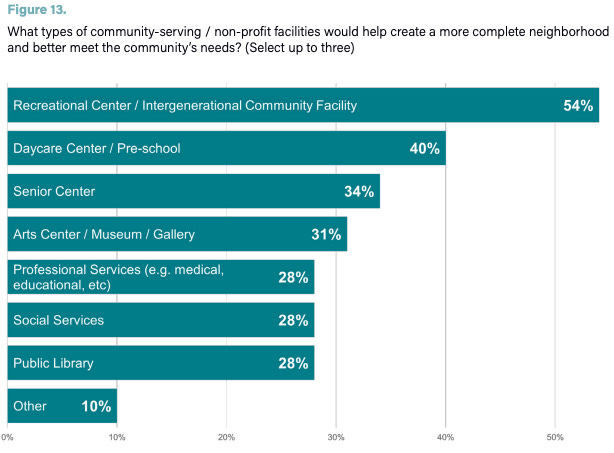
Bottom line: a misleading question may be used to ratify the existing plan for an intergenerational center.
About retail
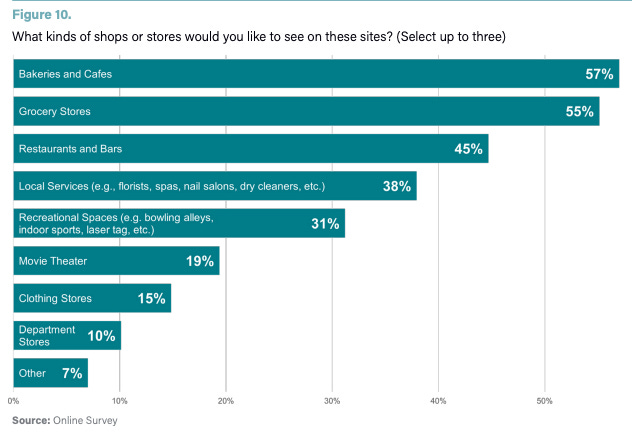
“In order of priority, workshop participants highlighted the need for supermarkets and/or grocery stores and local services, as well as bakeries, cafes, restaurants, and bars,” the report stated.
Interestingly, that did not fully reflect the online survey, which showed bakeries and cafes nudging out grocery stores, as shown in the graphic below.
Infrastructure needs
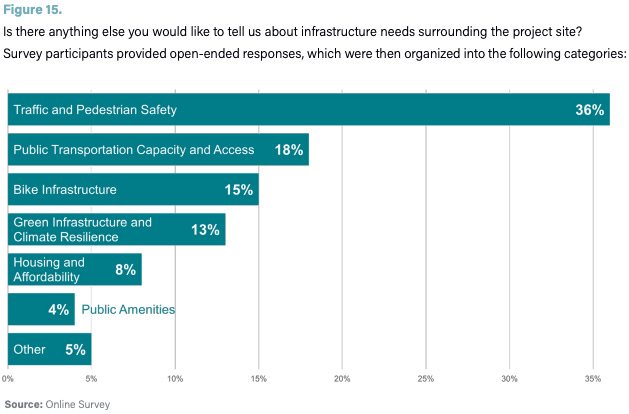
Asked about infrastructure needs, as shown in the graphic below, respondents in the online survey prioritized traffic and pedestrian safety.
What next?
The timeline indicates that the final report will be issued next month, incorporating feedback from online respondents and Thursday’s meeting.


The formal environmental review won’t begin until the third quarter of this year and, apparently, is expected to last 18 months.
A few nuggets of interest
A look at the separate, 51-page Survey and Workshop Results document yields a few nuggets of interest.
When asked to identify something they love about Atlantic Yards and the surrounding areas, nearly half picked “connectivity/walkability,” with retail and open space/parks far behind.
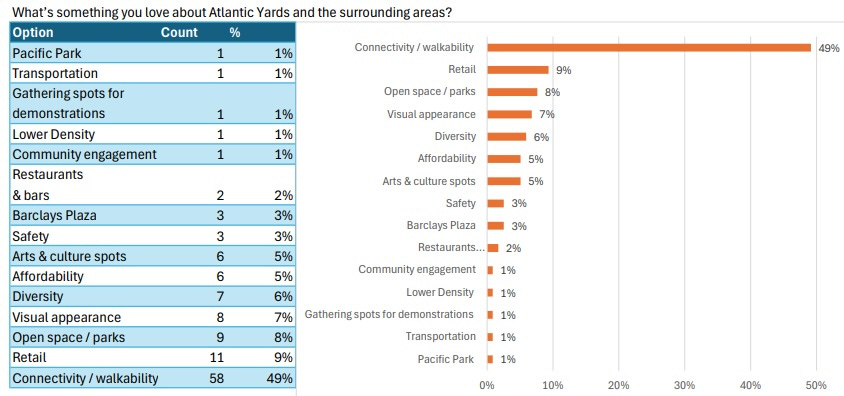
Three people picked the Barclays Center Plaza, and one picked Pacific Park, the name applied to the existing 2.7 acres of open space.
Asked what they’d want to change about Atlantic Yards and the surrounding areas, a plurality (28%) cited the pedestrian/public transit experience, followed by affordability and open space/parks.
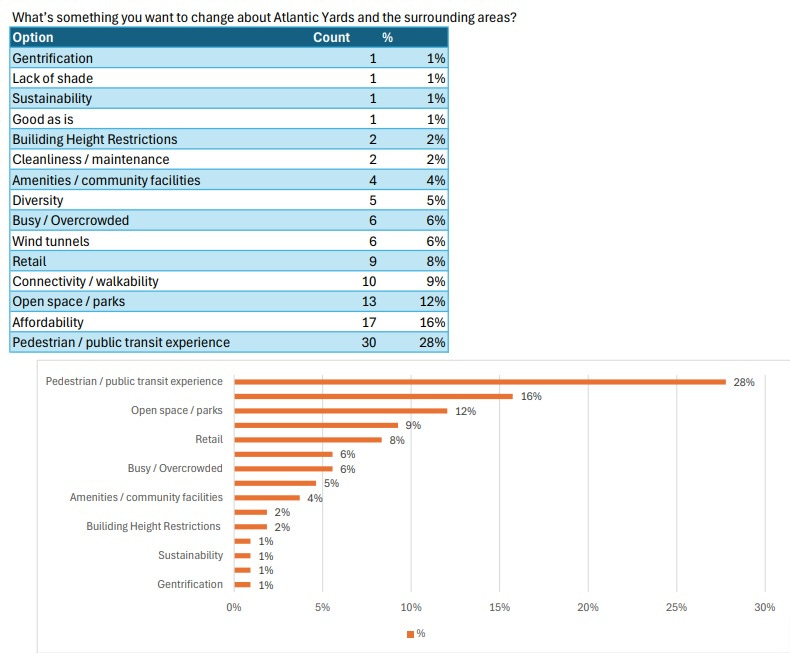
Exactly one person chose gentrification, while two cited building height restrictions. (Remember, this was a small sample.)
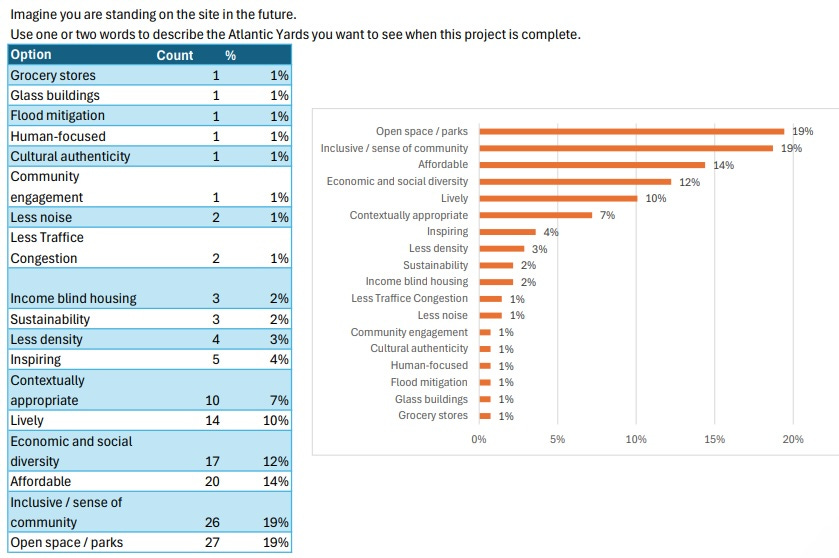
Asked to use one or two words to describe the Atlantic Yards they want to see when this project is complete, 19% chose “open space/parks,” and another 19% chose “inclusive/sense of community.” Also, 14% chose “affordable,” and 12% chose “economic and social diversity.”
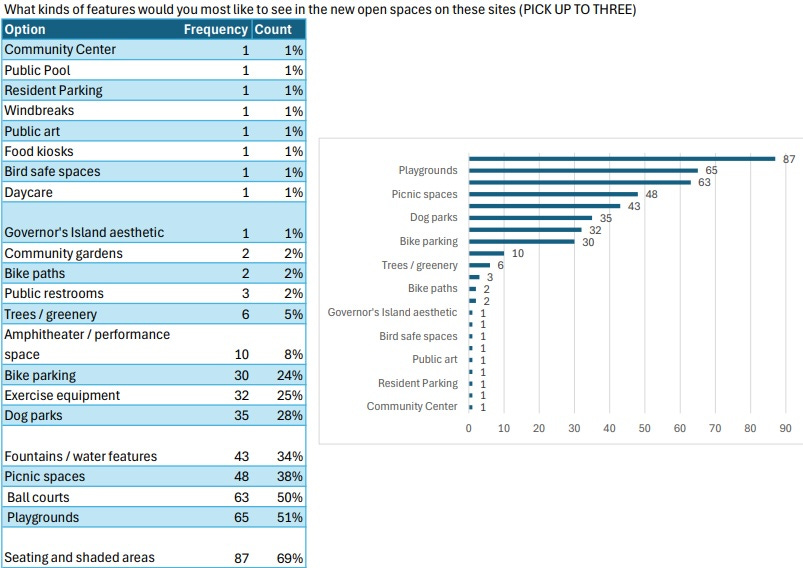
Asked about preferred open space features, they prioritized seating and shaded areas, followed by playgrounds and ball courts.
Asked if they’d visited the Barclays Center or its immediate surroundings, nearly 46% said they visited regularly, 42.5% said they’d visited once or twice, and 11.6% said they’d never visited.
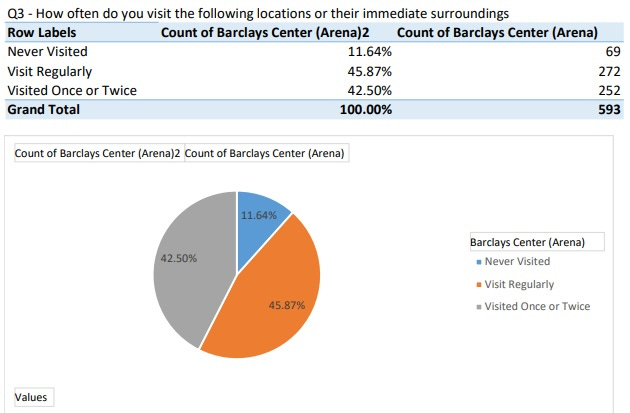
That’s somewhat surprising. I’d think almost everybody in the nearby neighborhoods had visited the arena surroundings regularly. Could they have interpreted the question as asking if they’d entered the arena?
Meanwhile, more than 71% and 72% of respondents, respectively, said they’d regularly visited stores and restaurants along Vanderbilt Avenue and along Flatbush Avenue.
Asked why they visited the sites or their immediate surroundings, the most common answers were that they live nearby, take transit to or from the area, or shop nearby.
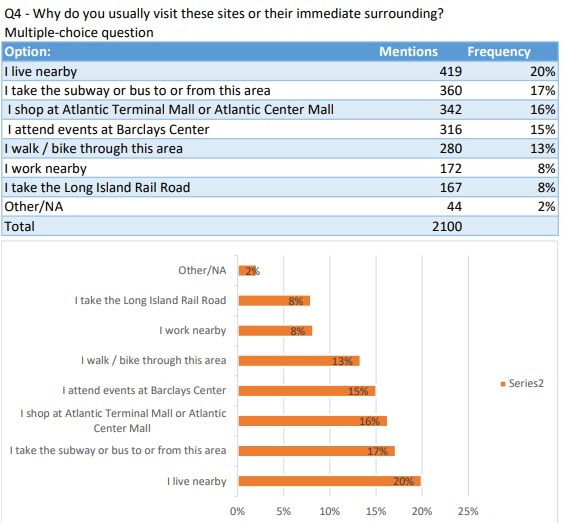
It’s notable that 316 people—more than half the respondents—said they attended events at the Barclays Center.
Given rising rents, Cirrus’s McDonnell suggested at the third workshop that “folks who are experiencing rent burden”—paying more than 30% of their income on rent—shifted from the sort of bottom or lower income part of the income band, all the way up to professions that were traditionally thought of as middle-income or workforce.”
That, as I wrote, is disingenuous. Even if moderate- and middle-income households face a greater squeeze, the AMI Cheat Sheet produced by ANHD, an association of nonprofit housing groups, consistently shows that the poorest are most likely to be rent-burdened.
I’m not sure it’s an apples-to-apples comparison, given that household sizes were not specified.
The DBNA later was contracted to run the program distributing free arena tickets to neighborhood groups. Daughtry and his organization also benefited from a new, albeit short-lived, foundation funded by the developer.
You have covered everything! This project hasn’t delivered its “promises” and wants to continue asking for for more monetary and scope concessions without guarantees again. I’m left thinking again: When does it become too costly for the community to bother with? The developers just keep expecting to take profits before delivery of goods.