
Developer Cirrus Seeking $350M in State Subsidies to Build Crucial Railyard Platform
An opportunity to ensure public goods like affordable housing, or a giveaway? Cirrus/LCOR also seek more bulk (worth $320M?), housing subsidies, & tax breaks.

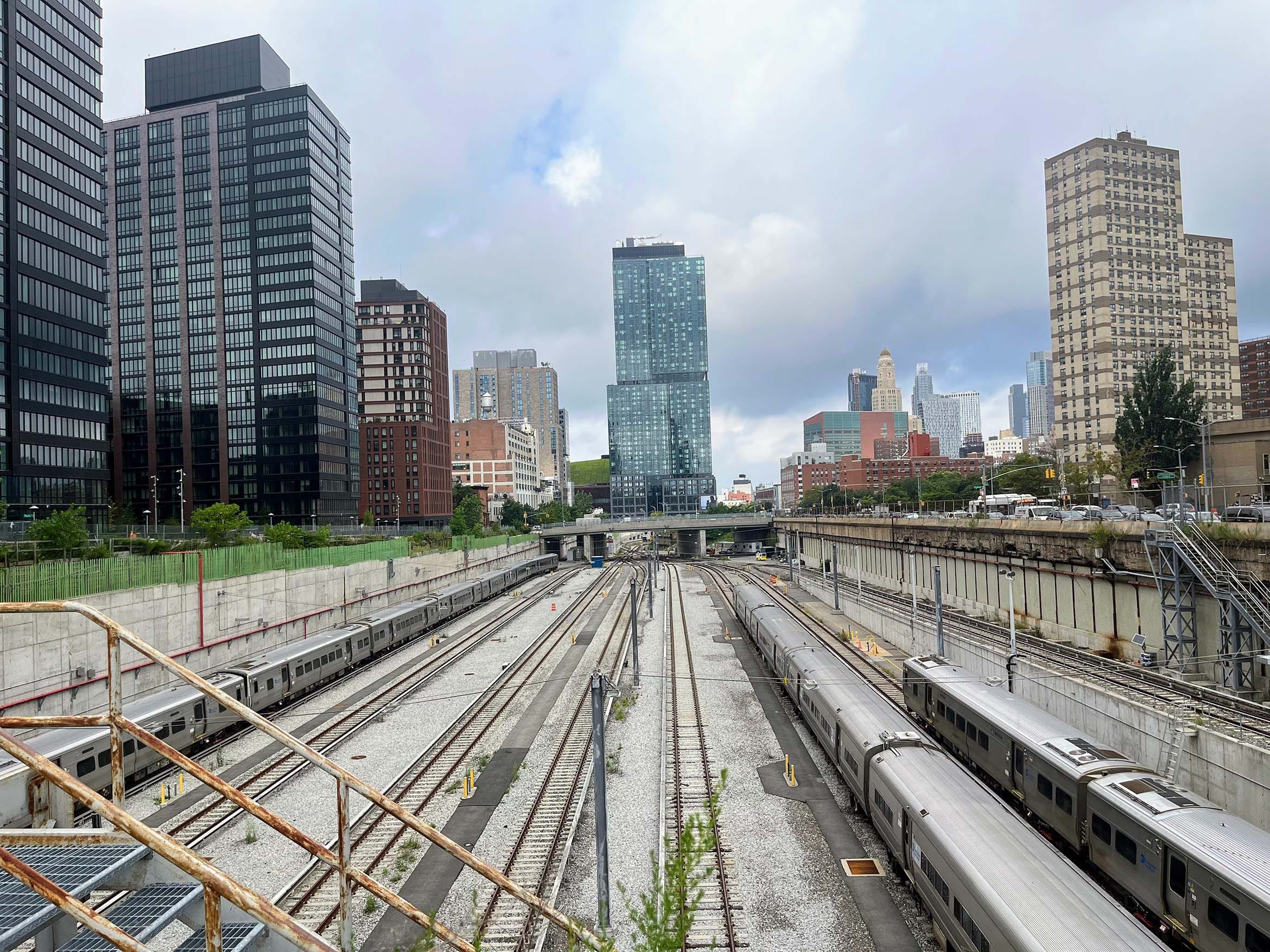
The new master developer of Atlantic Yards/Pacific Park is seeking some $350 million in state subsidies to pay for the platform over the Metropolitan Transportation Authority’s (MTA) two-block Vanderbilt Yard, needed to support five huge towers and some six acres of open space, according to a state legislator.
Cirrus Workforce Housing also seeks 1.6 million additional buildable square feet, valued at perhaps $320 million, in the revised project plan, subject to approval by the gubernatorially controlled Empire State Development (ESD), the state’s economic development authority. The original development rights were bid out by the MTA.
Beyond funding and entitlements (the bulk, new timeline, etc.), Cirrus, according to its latest lobbying report, also seeks an unspecified tax abatement.
The timing of the platform remains in question, as does the budget: as of 2019, the platform was estimated to cost $240+ million, including payments to the Long Island Rail Road. As of 2024, I estimated it at more than $300 million.
An expected state approval process for the project likely wouldn’t conclude until late 2027 or early 2028, after which construction of the platform, as well as on terra firma properties, could start. My queries to Cirrus did not get a response.
Housing subsidies too
Cirrus, working with the firm LCOR, surely also seeks additional subsidies for below-market affordable housing, after initially saying it would focus on moderate- and middle-income units, 80% to 130% of Area Median Income (AMI), but not low-income ones, where the need is greatest.
How much subsidy?
A $350 million subsidy would be the largest direct subsidy for the project, in nominal (but likely not inflation-adjusted) terms.
The original developer, Forest City Ratner, claimed $305 million in direct subsidies from the city and state, used for land purchases and infrastructure, mostly for the arena.
Other public assistance includes eminent domain, free city streets and property, tax-exempt land, tax-exempt financing, tax breaks, affordable housing financing, and, for the arena company, the ability to sell naming rights and otherwise monetize the exterior.
However, other Cirrus requests would surely increase the total subsidy.
Information surfaces
The subsidy request was revealed at the Feb. 25 meeting of the Prospect Heights Neighborhood Development Council (PHNDC), in a presentation by Gib Veconi, who, as co-chair of the Housing Committee and a leader of the coalition BrooklynSpeaks, is one of the few people keeping tabs on the project. He credited “multiple state legislators” for the information.
“That change is very significant,” he told the attendees, “but I’m not saying that it’s necessarily a bad thing.” It offers the opportunity, he said, to seek guarantees for deeply affordable housing, publicly-controlled open space, new accountability for quality of life issues, and project design.
Of course, given the project’s history, in which a 2025 deadline for affordable housing negotiated by Veconi and Michelle de la Uz of BrooklynSpeaks was not enforced by ESD, allowing Cirrus to negotiate vastly reduced penalties, any new guarantees would have to be memorialized with escrowed funding and/or oversight by an entity not controlled by the governor.
Is it good public policy, I asked Veconi afterward.
“Good public policy is that which balances entitlements and subsidies with public goods such that the public receives fair value,” he responded. “It’s also that which is the product of negotiation by the public’s elected representatives. Having the platform subsidy come as a budget request does create an opportunity for elected officials to be more deeply involved.”
Perhaps, but it also reflects power dynamics. If the elected officials can push to analyze this subsidy request and the developer’s underlying financial plans, that’s one thing. But if Gov. Kathy Hochul pushes it through, that’s another.
Interestingly enough, the first block of the platform, between Sixth and Carlton avenues, might be constructed alongside work at street level on terra firma on the B6 and B7 sites, as the railyard does not occupy the full rectangular block.
A report from Albany
Assemblymember Jo Anne Simon, another BrooklynSpeaks leader, later told me that, while Cirrus has told state and local elected officials about a $350 million request, it’s unclear where that stands. It’s not in the Assembly budget.
Simon said that the Legislature can’t line-edit budgets, so if Hochul agrees, she can put it in, and it “comes out of the governor’s pocket.” Well, ESD’s pocket, I suspect.1 The budget is due by April 1, but it often takes longer.
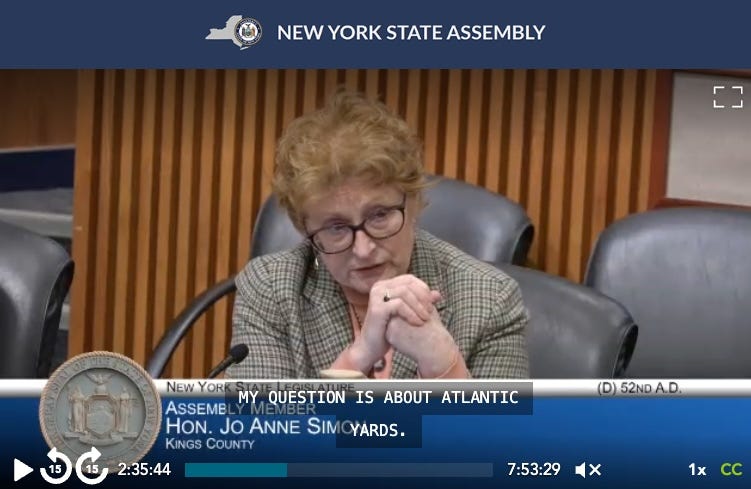
“The person with that kind of money is the governor,” Simon said. “What I think they’d like is our support.” Elected officials need guarantees for, among other things, more deeply affordable housing, she said, pointing to an unilluminating recent exchange (below) she’d had with ESD CEO Hope Knight.
Simony also seeks greater and more effective community engagement. “They had us in these little groups,” she said of the second and final in-person workshop, but “never brought us back together” to share conclusions. Presumably, that will be part of the pending Draft Community Engagement Report, expected later this month.
Affordable housing in question
At the Feb. 26 Joint Legislative Budget Hearing, Simon briefly questioned Knight, starting at 2:35:38 of this video.
Simon asked about the types of subsidies under consideration for Atlantic Yards and what ESD considers the income range for affordable housing: “As you may recall, the existing MGPP [Modified General Project Plan] starts at 40% of AMI [Area Median Income], and there’s been a lot of discussion about higher levels.”
Simon’s summary deserves footnotes. The 2009 Modified General Project Plan said the project would “generate at least 2,250 units of affordable housing on site for low-, moderate- and middle-income persons” and suggested financing was expected to involve the city’s 50-30-20 program, which includes units at 40% of AMI.
However, previous city and state funding agreements had already vaguely defined affordable housing in the project, as did the later Atlantic Yards Development Agreement, simply as apartments subject to income and rent restrictions contained in a city, state, or federal regulatory agreement, with a ceiling of 160% of AMI. That loophole has prevailed.
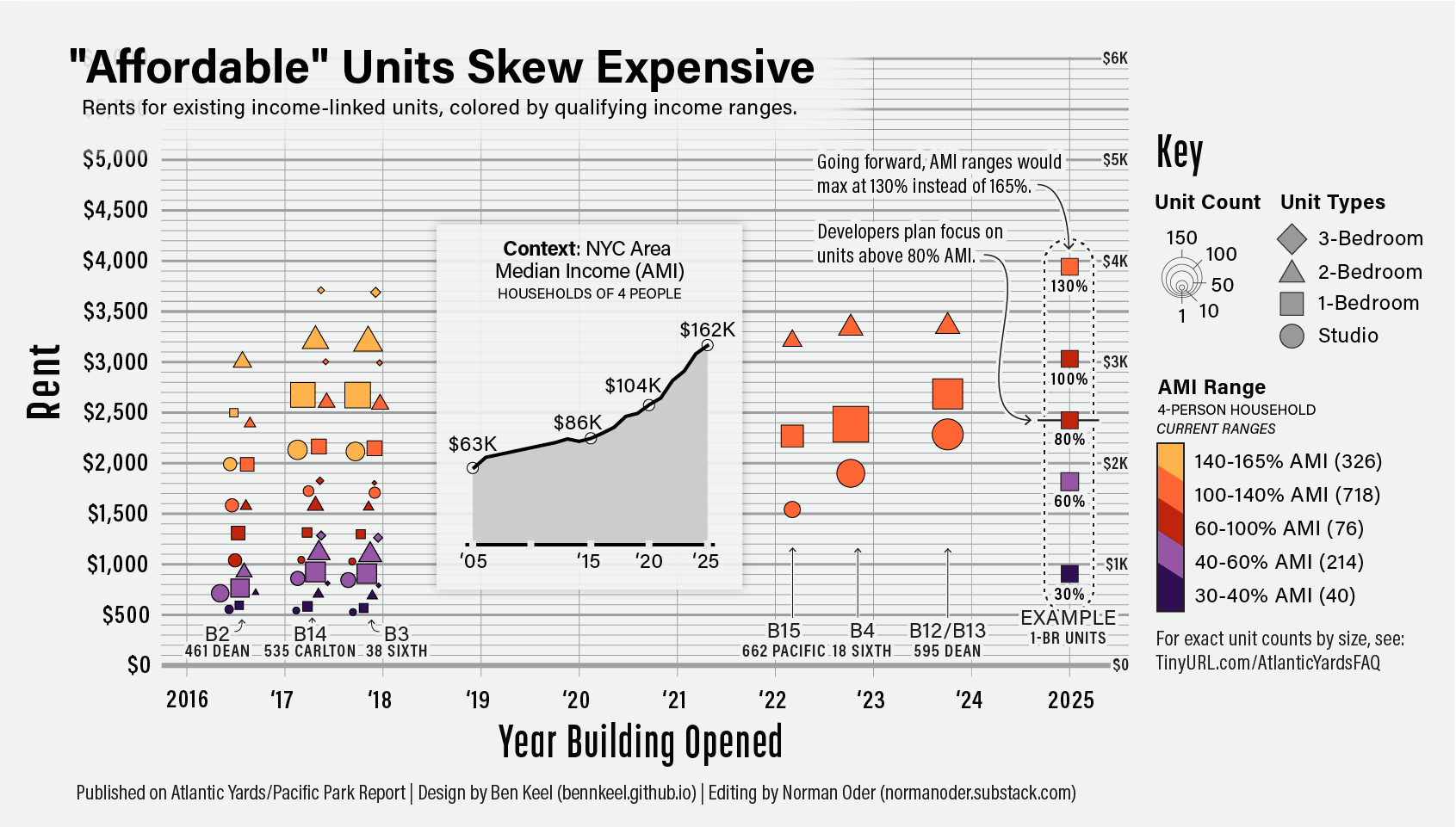
The result, as shown in the chart at top and described further below, has been a skew to middle-income units.
130% of AMI no sacrifice
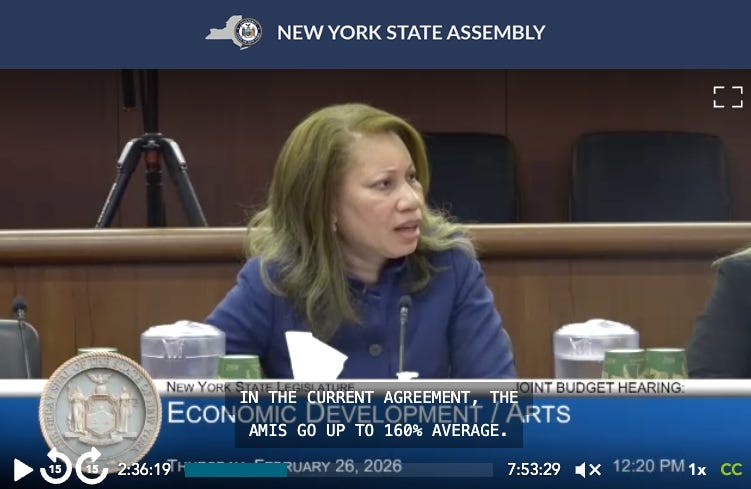
“In the current agreement,” responded Knight, “the AMIs go up to 160% average, and we are looking at AMIs in this next phase at a maximum of 130%.”
“We know that,” parried Simon. “That’s very high, number one. I mean, I don’t even earn 130% of AMI.” (Indeed, for one person, it’s $147,420. Legislators earn $142,000.)
As I’ve written, setting the ceiling at 130% of AMI, rather than 160%, would be less a sacrifice than a concession to reality.
Rising AMI means ever-rising baselines for income-linked housing. Consider, under the 2025 city guidelines, units at 130% of AMI could rent at these monthly levels: studio: $3,685; 1-BR: $3,948; 2-BR: $4,738; 3-BR: $5,476.
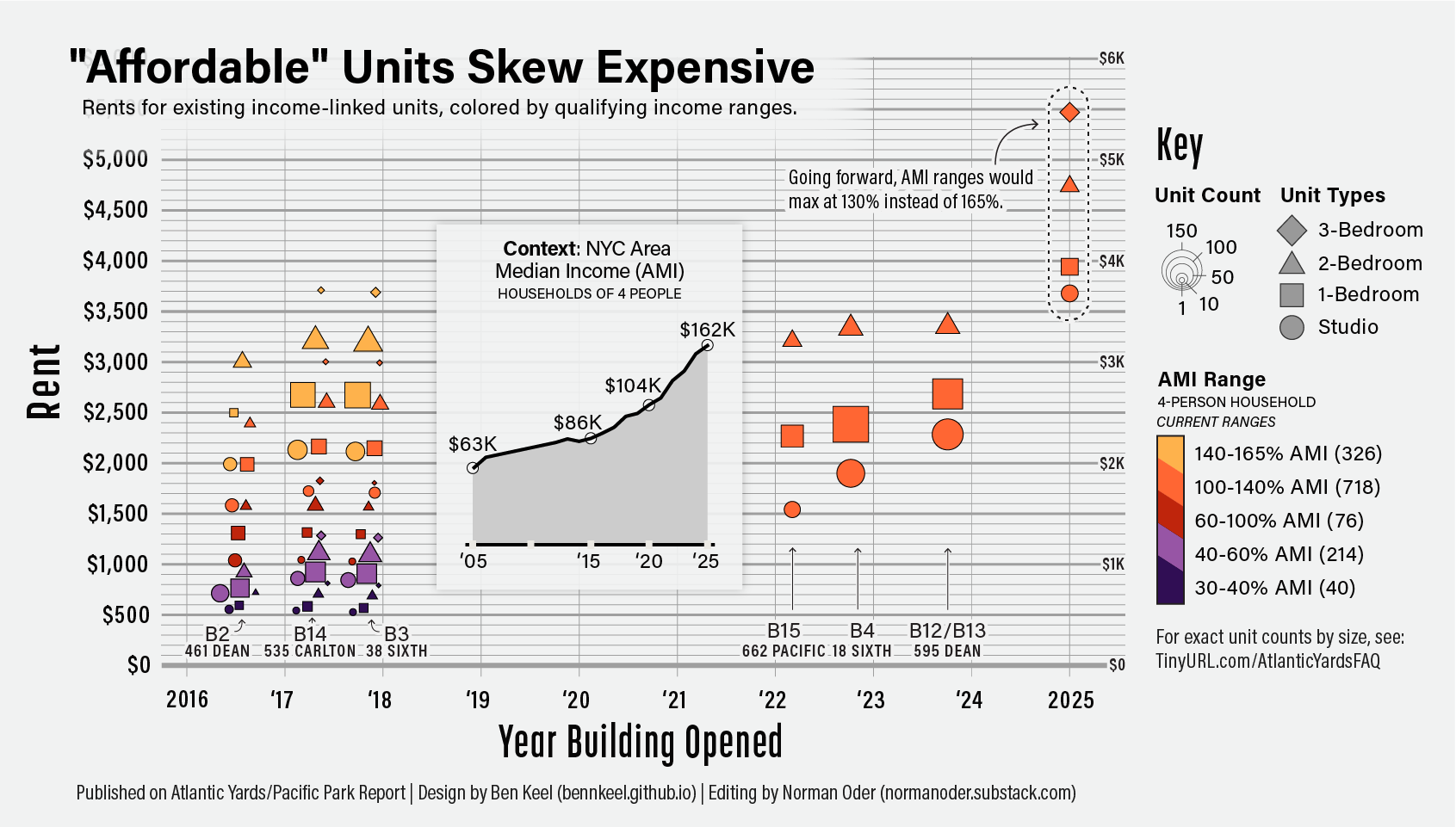
Those numbers, at least for smaller units, are at or above market-rate.
Not only do people think the floor should be lower, Simon observed, “obviously, AMI has gone up a lot in 22 years. So we’re talking about fundamentally different dollars.”
“We’re working to make sure that we can make these units as affordable as possible,” Knight said, “and we’re working through some analysis right now, and we’ll be putting together a framework with the developer to come up with that formula.”
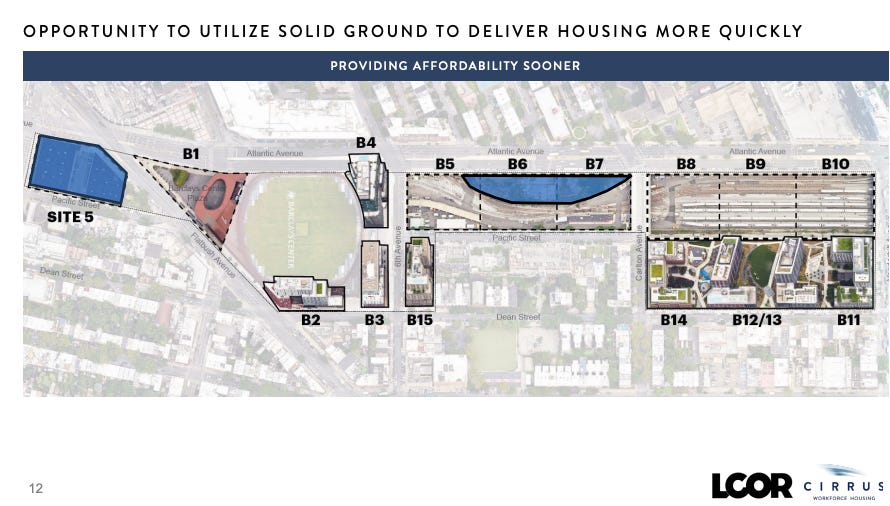
The developers’ presentations, commented Simon, “seem very out of whack to a lot of people.” That said, Cirrus has modulated its rhetoric, promising some lower-income housing, as shown in the slide below.
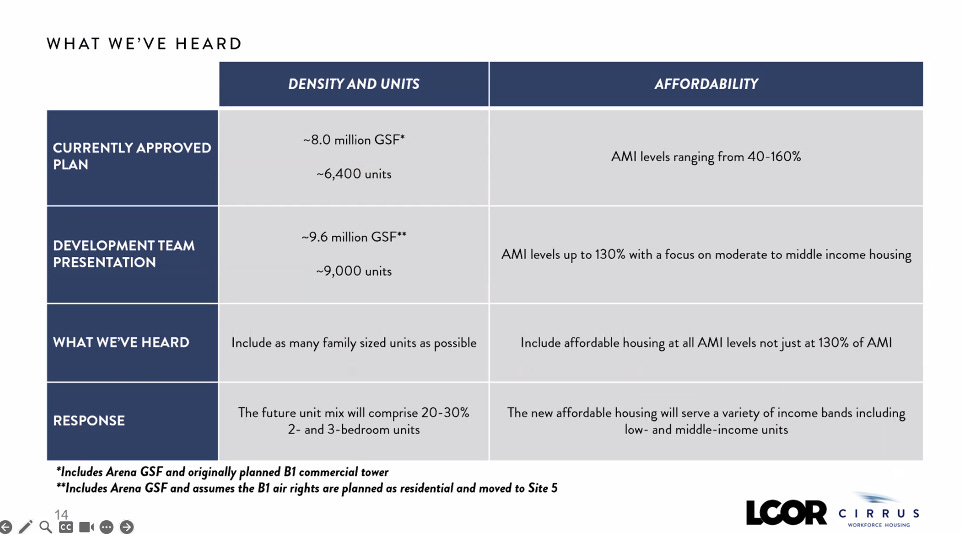
At the hearing, Simon then tried to ask about other subsidies, but her time expired. Knight, in response, seemed to say, “We’ll be talking.”
Financial need
Simon acknowledged that the developer, despite benefiting from Greenland’s embedded investment in platform precursors, still faces high costs and a higher-cost environment. “I knew they would need more money,” she said.
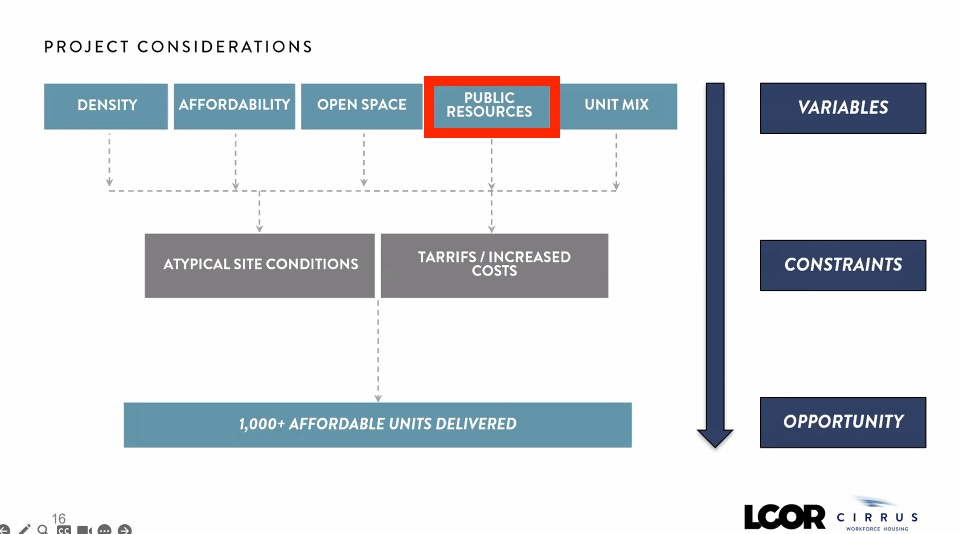
I think it’s murkier. If Cirrus can call its investment to control Atlantic Yards—buying $200 million worth of debt, at a discount—a “no-brainer,” that suggests a significant upside.
That could require government agencies to require reciprocal financial transparency from the developer, as well as, in exchange for subsidies, some participation in the project’s upside.
“I would’ve liked for them to have gotten some money from the Nets and the arena,” Simon said in an aside.
We didn’t get to ventilate that, but I’ve argued that, by not building the flagship tower (B1, aka “Miss Brooklyn”), once planned to loom over the arena, that’s a huge win for Brooklyn Nets and arena company owner Joe Tsai, since it would preserve the plaza, crucial for both arena crowds and digital advertising.
New York State still has leverage at this point.
Scale and feasibility
By not building B1, Cirrus and LCOR, with previous developer Greenland USA playing a role, aim to move that bulk across Flatbush Avenue to Site 5, longtime home of the big-box stores P.C. Richard and Modell’s (now the Brooklyn Basketball Training Center), enabling a giant, two-tower project at Site 5.
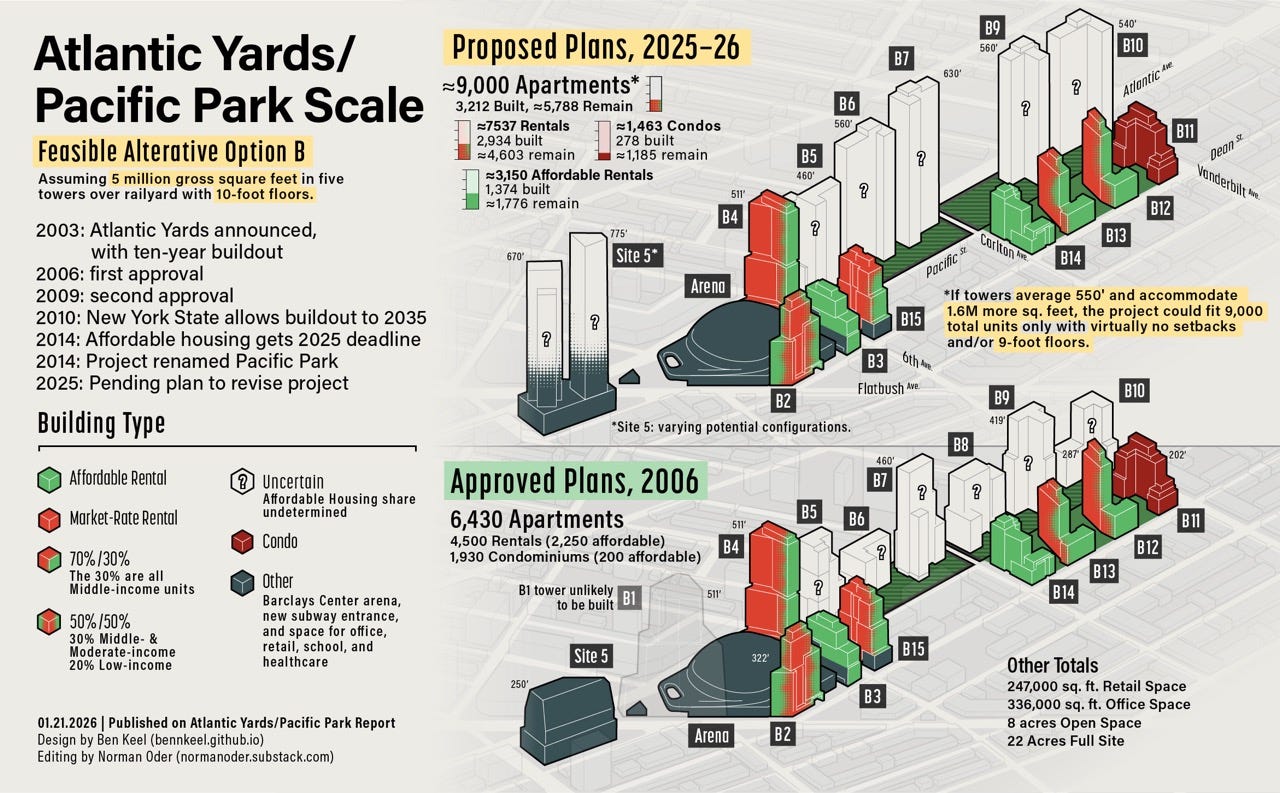
Simon said she’s also concerned about the proposed density at Site 5, which, as I’ve written, is some 50% greater than the 80 Flatbush (aka Alloy Block) project, a spot rezoning, with towers up to 775 feet tall.
Otherwise, there’s been little public criticism of the project’s proposed scale. That essentially accepts the developers’ case that only more density would make the project “feasible.”
This likely reflects the withdrawal of various once-active advocates, general “Atlantic Yards fatigue,” the rise of YIMBYism, and the influence of leaders like de la Uz, executive director of the nonprofit Fifth Avenue Committee, who prioritize affordable housing above all.2
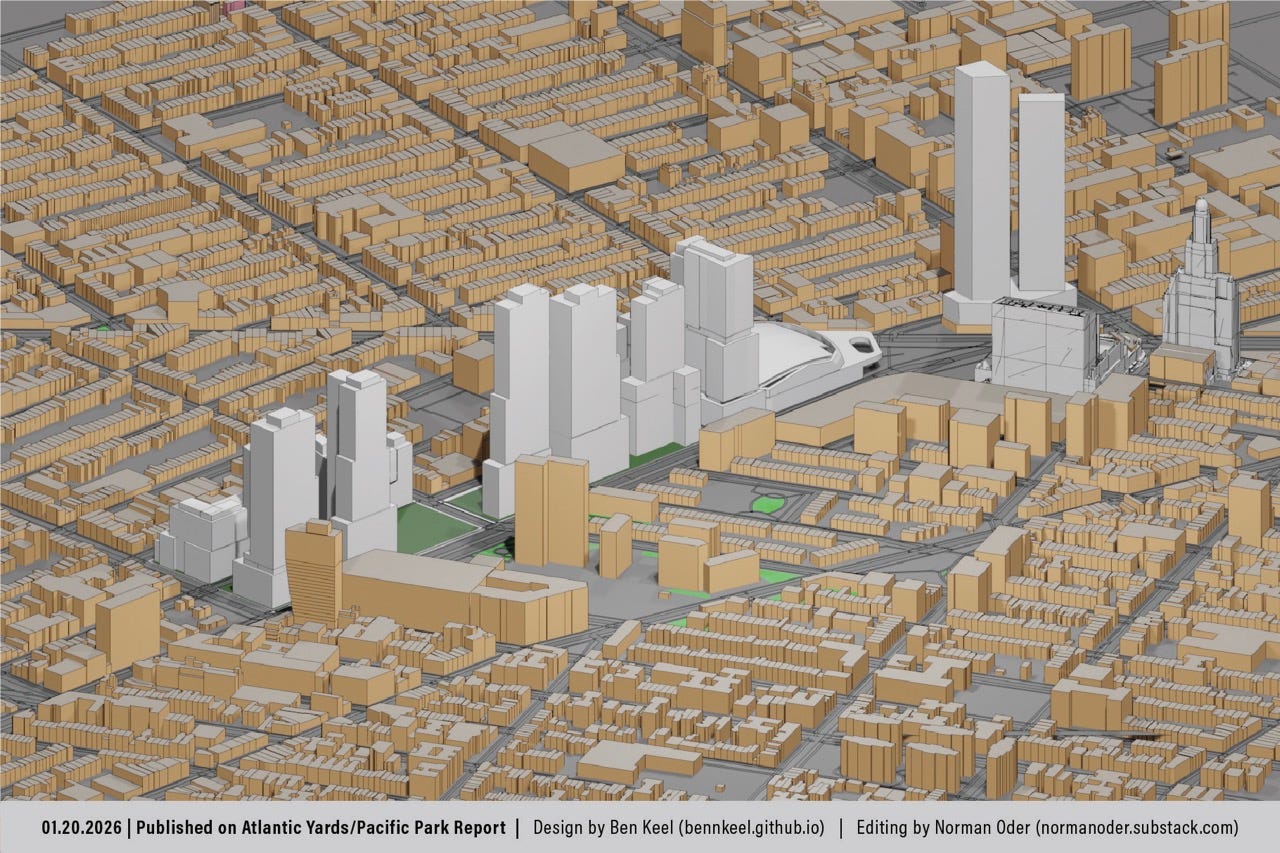
However, we haven’t yet seen the project’s financials, nor a reasonable portrayal of the developers’ plans. That pushed me to ask my frequent collaborator Ben Keel to attempt it.
Veconi spoke before the Sunnyside Yard development, with its vastly less dramatic proposed scale, was placed back on the table after a discussion in Washington between Mayor Zohran Mamdani and President Donald Trump.
Compared with the 2020 Sunnyside Yard plan, Atlantic Yards, as now proposed, would have 4.75 times as many apartments per acre overall. If limited to the two-block railyard parcel, Atlantic Yards might have 7.5 times as many apartments per acre.
Financial feasibility
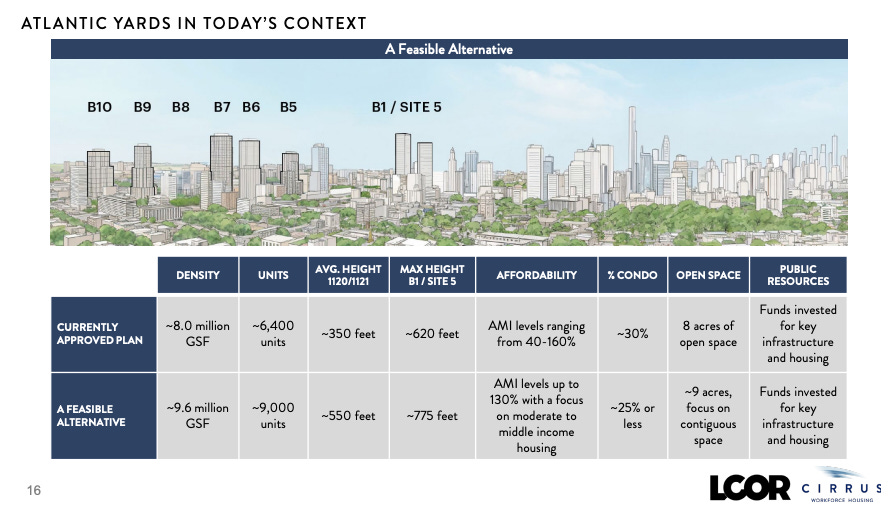
Veconi, who began his presentation by outlining the developers’ “feasible alternative,” including new bulk and an extra acre of open space, also said the new plan “must be subject to an independent financial review.”
When people “sort of gain acceptance of this idea that the public will pay for the platform cost,” he said, that suggests “the state really completely missed the feasibility of the previous projects.”
The requirement that the developer pay for the platform “probably was never viable at all, and it’s why the project’s been so delayed,” he said.
That’s an interesting question. It’s clear that the platform cost, as well as the cost of a new railyard, were initially underestimated by the MTA appraiser, which is part of why Forest City Ratner bid much less to acquire development rights.
However, before COVID, successor Greenland USA was prepared to build the platform on its own and, in 2022, announced it would begin construction. Later, Greenland got closer, at least if it was granted increased square footage, only to be stalled in negotiations with ESD and, especially, the MTA.
That would’ve been a new subsidy—increased development rights—though not a cash outlay.
Greenland presumably saw building the platform as helping it monetize its embedded investment in the new railyard and the platform precursors, even if, overall, the project might not be profitable.
Today, Cirrus can take advantage of that investment while asking for both increased development rights and a direct subsidy.
An independent review?
“But we have to know that it really is feasible now, and that needs an independent review,” said Veconi, who added that he’d been told by ESD that they’ve hired a consultant for such a review.
“I do not know,” he said, “to what extent the review will be shared with elected officials and the Atlantic Yards Community Development Corporation [AY CDC],” the purportedly advisory body created in the 2014 settlement agreement, with directors appointed by public officials. Veconi is perhaps the body’s most active member.
“Sometimes I’m told things I’m asked not to repeat,” said Veconi, who later clarified that he gained that information as an AY CDC Director. “This isn’t one of those things….And I do believe it’s positive.”
While it’s too soon to judge, the record so far—based on ESD-commissioned assessments of the project from the consulting firm KPMG—is not encouraging. KPMG massaged the numbers to justify ESD’s approvals.
Afterward, I noted that Veconi had previously called for elected officials to have resources to engage independent technical assistance.
“The word ‘independent’ in that case means independent of the developers,” he responded. “If ESD has undertaken a scope with a consultant that also meets the needs of elected officials with the intent to share the consultant’s work, that may qualify.”
Well, it might. But, again, the record does not bode well. Can a new review be subject to public criticism and revision?
New oversight
Under negotiation right now is a Memorandum of Understanding (MOU) between ESD and Cirrus, presumably indicating state (and city?) support for the additional bulk, a new timeline, affordability, and more.
The MOU, Veconi said at the meeting, should be approved by AY CDC. That’s not unreasonable, but it may not be enough.
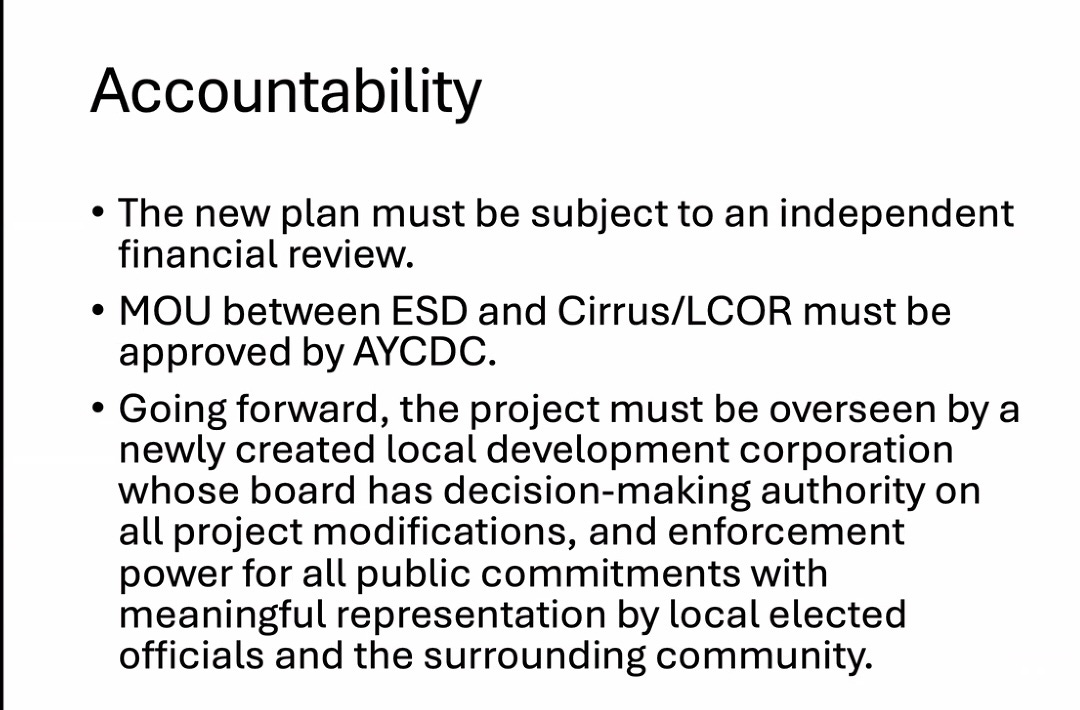
“Going forward, we’d like to see a more robust oversight structure that involves a Local Development Corporation whose board has decision-making authority on the project,” he said, reviving a longtime ask.
The project will surely have a new deadline beyond 2035. “So we need to avoid making the mistakes we’ve made in the past,” Veconi said, “and it needs to be resourced appropriately with meaningful representation from local elected officials and the community.”
That’s not unreasonable. But if the governor retains control, then it’s the governor’s call.
Affordable housing
Veconi reiterated that most of the affordable housing “has been delivered at relatively high income levels that in some cases, make it competitive with market-rate housing.”
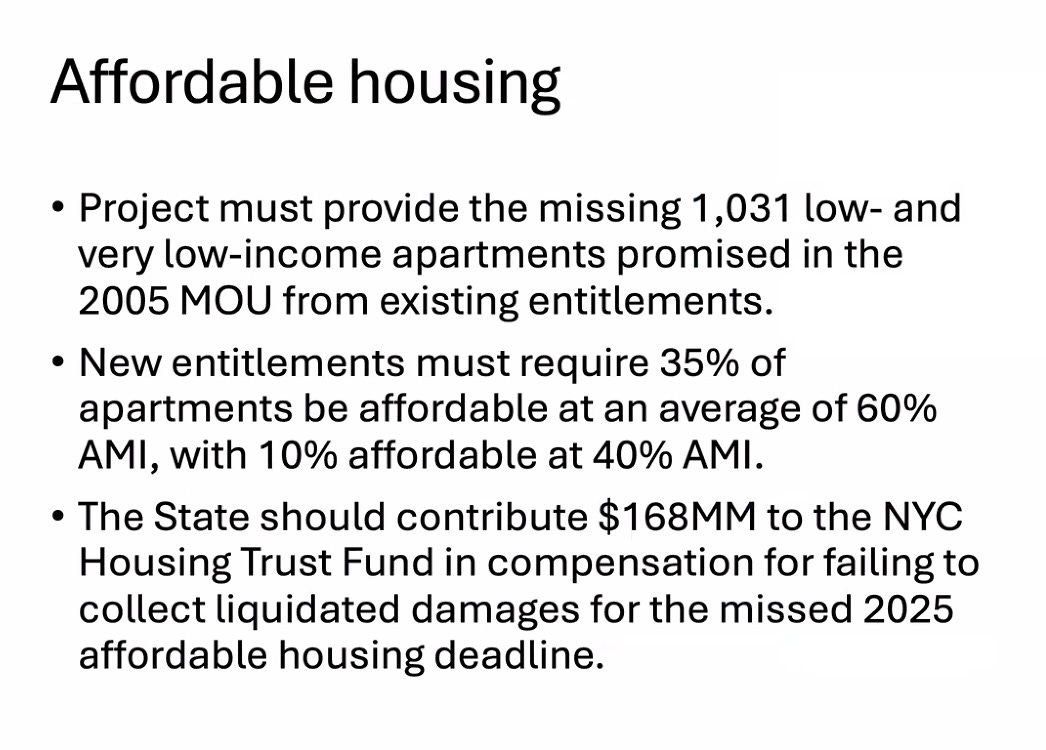
The proposed focus on moderate- and middle-income housing, he said, contrasts with the recent city rezonings east of Atlantic Yards, the Atlantic Avenue Mixed-Use Plan, and in Gowanus, which require Mandatory Inclusionary Housing (MIH) Option 1, reaching tenants at an average of 60% of AMI.
“So we think that part of the developers’ proposal needs an adjustment.” (Those rezonings have 25% of units affordable, while Atlantic Yards/Pacific Park has more infrastructure costs. Then again, it also seeks more public resources.)
Veconi’s chart showed the contrast between units promised and those delivered.
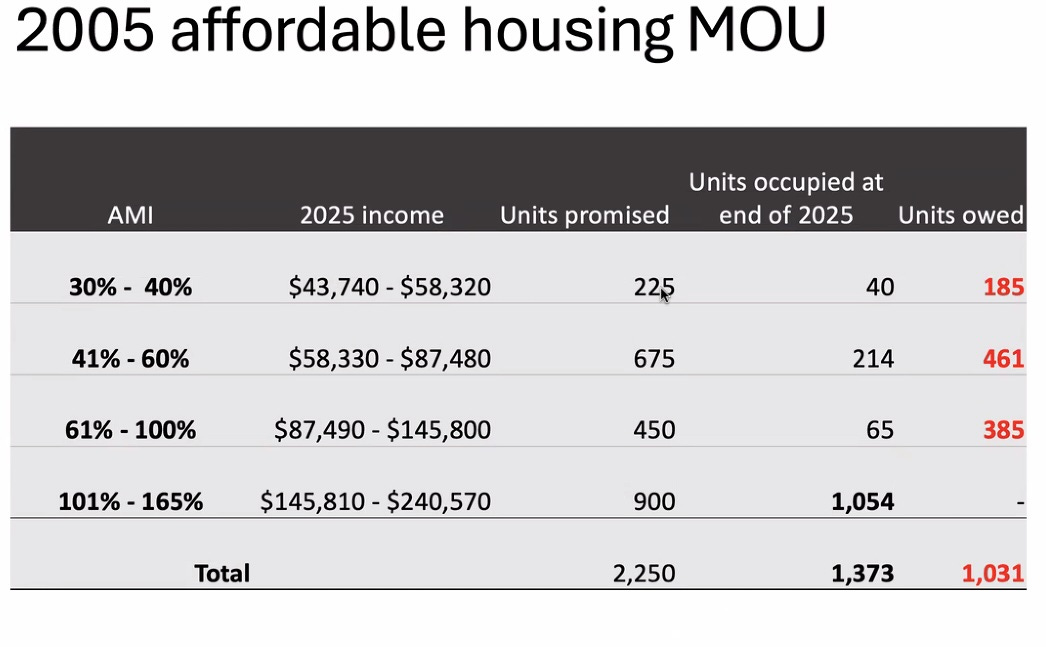
Now, he said, “there’s an opportunity for the state to require the developer to complete these low, very low, and extremely low income units from its existing [approved] density,” before granting approval for more density.
Who’s rent-burdened?
At the Jan. 22 workshop, Cirrus Managing Partner Joseph McDonnell suggested that, given rising rents, “folks who are experiencing rent burden”—paying more than 30% of their income on rent—include better-off households.
That’s disingenuous, as I wrote. Even if moderate- and middle-income households face a greater squeeze, the AMI Cheat Sheet produced by the Association for Neighborhood and Housing Development (ANHD), an association of nonprofit housing groups, consistently shows that the poorest are most likely to be rent-burdened.
Veconi adapted that ANHD chart to bolster his case that the recent rezonings would better serve the rent-burdened, while Atlantic Yards would not.
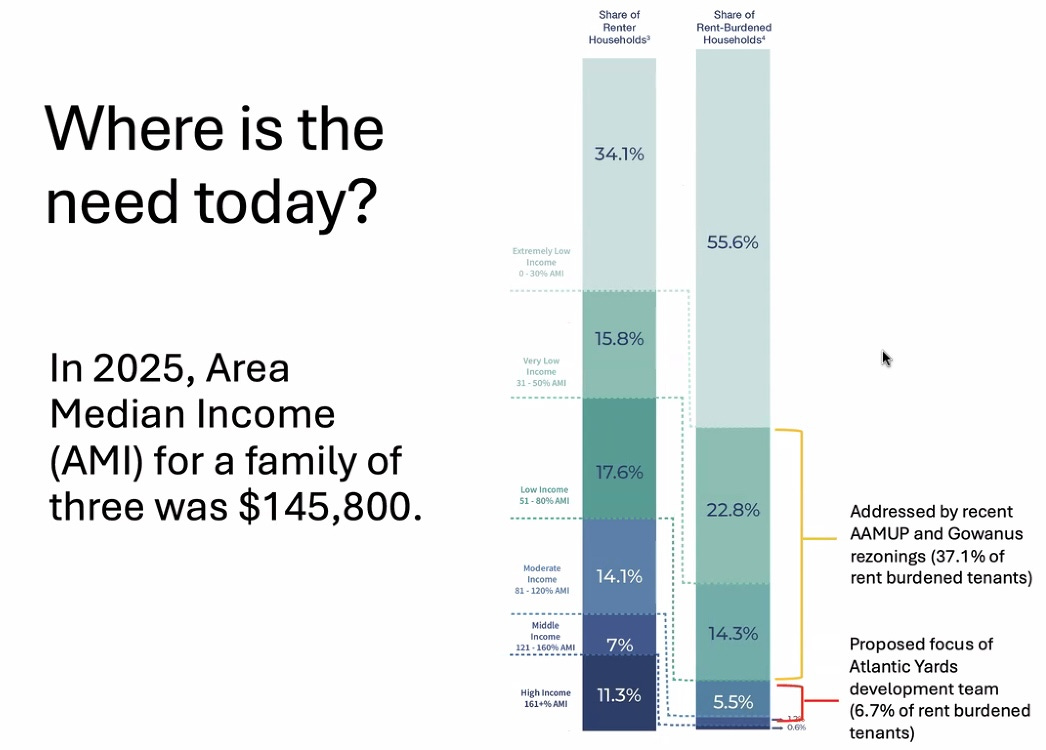
So, beyond the “missing” units originally promised, Veconi proposed that 35% of additional units be affordable at an average of 60% AMI, with 10% affordable at 40% AMI. That, presumably, is an ask rather than a red line.
New bailout?
Veconi also referenced the compounding penalties that ESD negotiated away, $1.75 million a month. “We believe that the state should contribute $168 million to the New York City Housing Trust Fund in compensation for failing to collect the liquidated damages for the missed 2025 affordable housing deadline,” he said.
Noting that “the state has agreed with the current developers that they can pay $12 million and not be responsible for the full extent of the liquidated damages,” he said, “ We believe that it’s not sufficient. The liquidated damages would go to fund affordable projects in the areas surrounding the project, and we need them now.”
Simon said she agreed, “that’s the penalty for not delivering the housing by a certain time,” but acknowledged the request was unlikely to be met.
At this moment, it should be noted that New York State has leverage to gain a piece of the project’s financial upside or to extract value from the Site 5 approval.
Was this, I asked Veconi afterward, a bailout? Doesn’t such a payment cast doubt on any future promises?
“On the contrary, the payment would represent the State guaranteeing the public goods that were committed at the time of the 2014 settlement,” Veconi responded, “a guarantee that should also be extended to new commitments made in exchange for changes to the GPP and additional subsidies.”
Such guarantees, the record shows, are negotiable. Why would the state do this unless it agreed to never suspend penalties or require payment up front?
Community preference
Veconi reiterated the goal of ensuring that neighborhoods around the project have community preference in the affordable housing lottery. While that’s part of city-funded affordable buildings, albeit for only 20% of the apartments (and declining to 15%,) it wasn’t part of the four most recent Atlantic Yards buildings, which were state-financed.
Given the displacement—which Atlantic Yards was supposed to stem—PHNDC supports preference for those displaced since 2006. That concept, however, has been shut down by the city. This was the only issue that generated questions from PHNDC members.
The emerging project
“So now let’s talk about the exciting part… the new entitlements,” Veconi said at the meeting, citing the proposal to add 1.6 million square feet and nearly 2,600 units, delivering taller—and, of course—bulkier buildings.
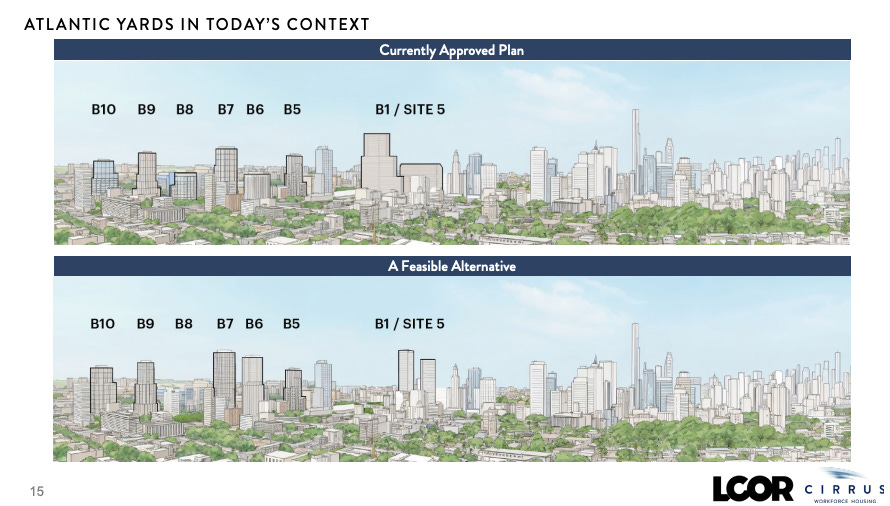
He showed the developer’s rendering, which he said wasn’t “a particularly accurate picture,” then Keel’s tan-tinted rendering (above), “probably a more reasonable representation,” showing the towers in contrast.
Remarkably, there was no discussion about whether this makes a tenable community. Then again, the few dozen people at the meeting, to discuss various neighborhood issues, might not make Atlantic Yards a priority.
Pacific Street and open space
Veconi briefly discussed plans for Site 5, including a loading dock on Pacific Street. Citing work for BrooklynSpeaks by architect/planner John Massengale, he said it “should really be a slow, shared street with a continuous sidewalk, and the loading should not impede traffic or the pedestrian uses on any of the surrounding buildings.”
The project’s open space “needs to be created through a participatory community design process,” and it should be “administered and maintained by an entity that’s independent from the owners of the buildings, so that the public really has accountability.”
“That should extend to all of the open space areas in the project, in our view,” he said.
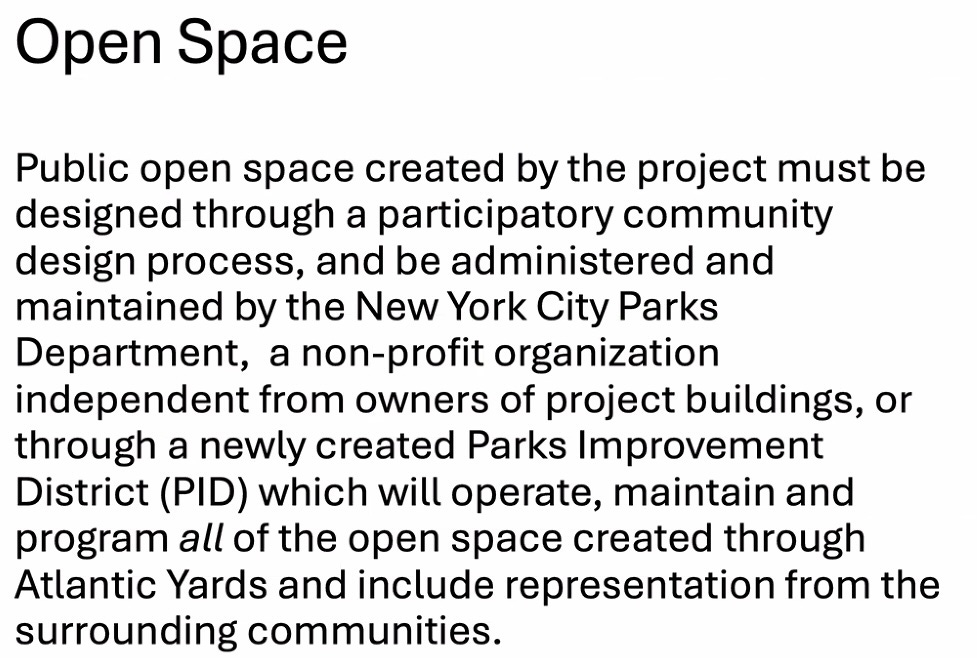
The question, then, is: would Atlantic Yards/Pacific Park be more like Battery Park City, or Stuyvesant Town?
So far, ESD has been distinctly resistant to the idea, pointing to the existing, developer-controlled Pacific Park Conservatory. Then again, as Veconi argued, new public commitments should create reciprocal obligations.
Urban Room
Veconi noted that the 2021 Interim Lease for Site 5 “bargained away” the Urban Room, the “indoor public gathering space” in the base of the B1 tower.
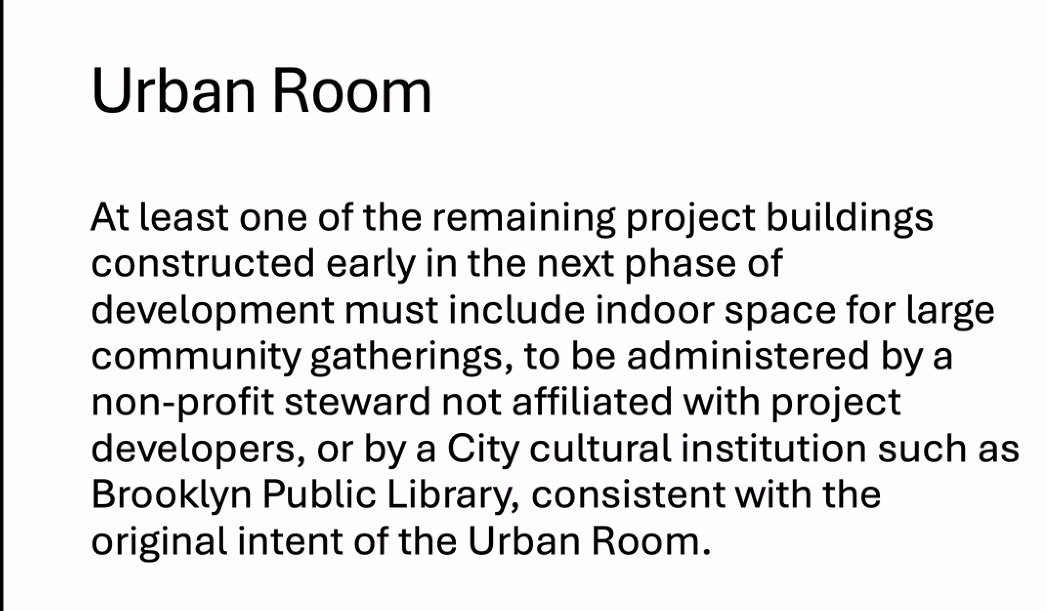
“We would like to see that be returned to the project in one of the new buildings,” he said.
That strikes me as a relatively easy ask, especially if the developers—as previous ones had done with school space—ensure it’s not counted against the buildable square footage they seek.
Arena-related quality-of-life issues
“We’d like to see a special enforcement district get created after all of this time to handle quality of life issues around the arena,” Veconi said. “This is something the community has been clamoring for since the arena opened in 2012.”
While he said “we’re removing the burden of having construction of a tower in front of the arena,” Veconi didn’t suggest, as he’d done in the past, that this be funded by the beneficiary, the arena company.
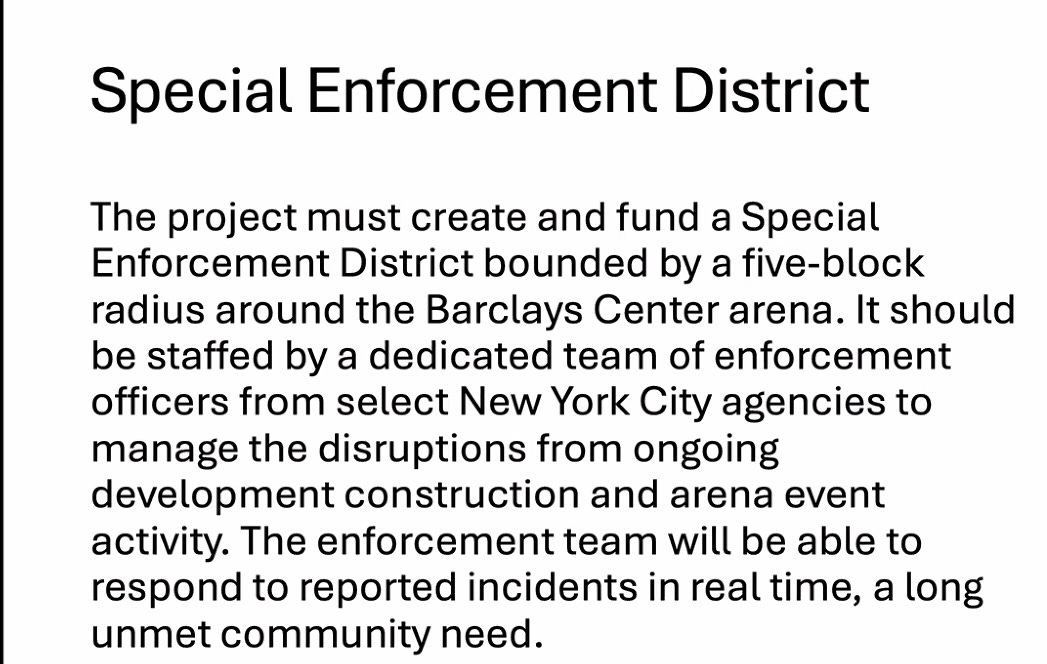
Afterward, I asked if requiring funding from Tsai was still their position. He didn’t quite confirm.
“That is an equitable way of compensating the public for relieving the arena operators from having a building in front of their venue,” he said. “The most important thing is that we take this opportunity to address longstanding quality of life issues raised by siting an arena in a dense residential neighborhood.”
The currently approved plan, likely to be changed
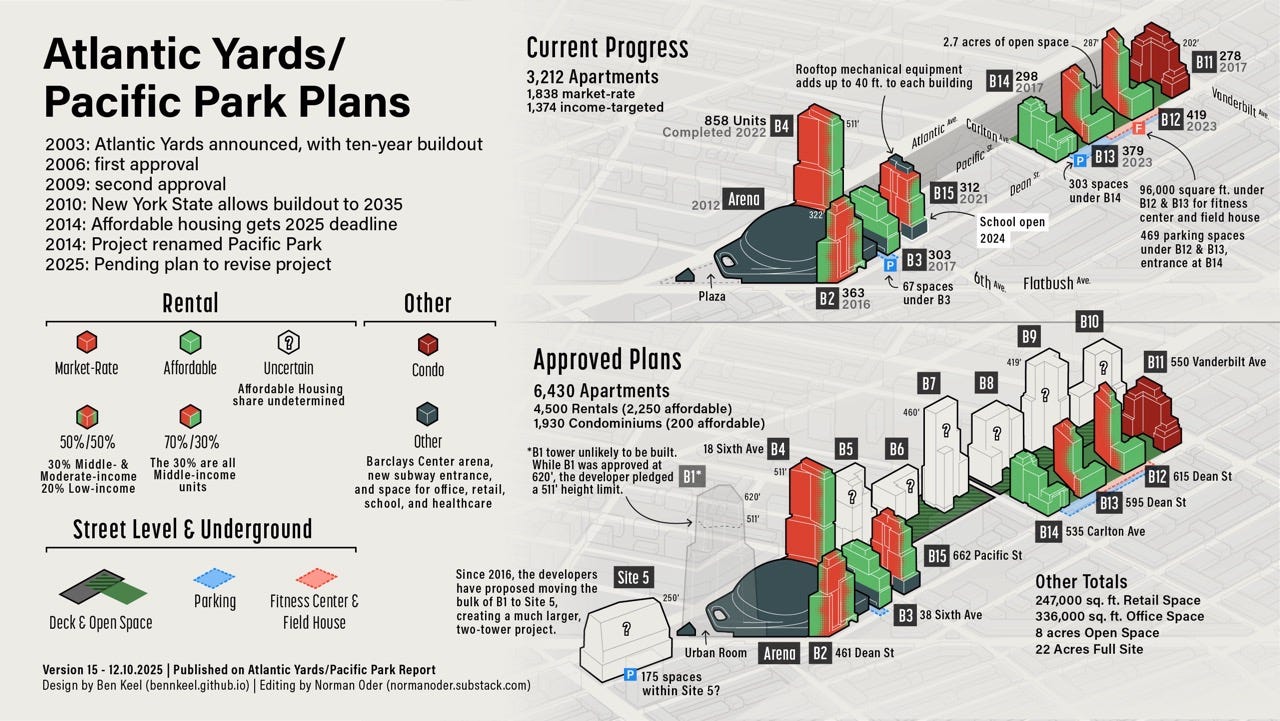
Is there ever been a point where the increasing cost of the platform makes this a unwise place for government subsidies to achieve housing? Like maybe we need to look elsewhere instead for land to build housing with that platform money?