
Why Has the Atlantic Yards CDC Spent So Little of its Budget? Couldn't the Money Be Used for the Public?
Also, New York State set to extend contract for law firm Bryan Cave to help with the Second Supplemental EIS.

Tomorrow’s scheduled Board Meeting for Empire State Development (ESD), the state authority that oversees/shepherds Atlantic Yards, offers some confounding statistics on page 362 of the Board Materials.
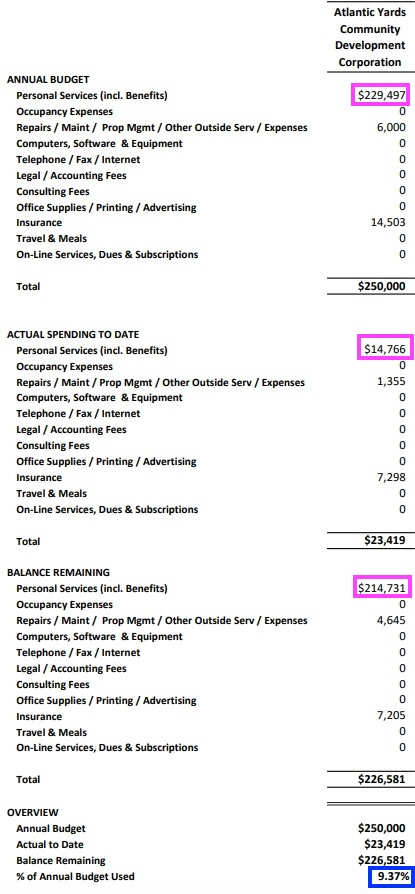
The advisory Atlantic Yards Community Development Corporation (AY CDC), as of Dec. 31, 2025, three-quarters of the way through the fiscal year (which ends March 31), had spent only 9.37% of its annual $250,000 operating budget, as shown in the screenshot below.
That’s confounding. By contrast, the comparable percentages for Dec. 31 of the previous nine fiscal years ranged from 43.65% to 76.24%. The tally is linked in the footnote.1
Questions raised
Was the AY CDC budget—funded by the project developer—diminished, or in limbo, because previous developer Greenland USA had run out of money and incoming developers Cirrus Workforce Housing and LCOR were not approved until last October?
The AY CDC budget was once used to support separate staff dedicated to Atlantic Yards, but more recently was said to fund proportionate staff time devoted to the project.
Over the past year, those staffers did not pause work on Atlantic Yards but remained compensated. If so, then, what’s the point of the AY CDC budget?
Will the full budget be used by March 31? Was it in past years? Or are those budgeted numbers merely aspirations?
I noticed the statistics in the Board Materials over the long weekend—they’re typically posted with just a few days notice—and early yesterday, I asked ESD for comment by the end of the day. I haven’t heard back, but will post an update when I learn more.2
Public comments due by noon today
Those wishing to attend the meeting in person must RSVP by 4:30 pm today. Info here.
Members of the public may submit comments on the Agenda items in writing to ESD@esd.ny.gov by noon today. All comments received by the deadline will be distributed to the Directors prior to the meeting and will be posted online.
Budget options
Last August, I wrote about past AY CDC discussions about funding to support consultants who are not, ultimately, answerable to the Governor. Though that seemed unlikely, it could, ultimately, add legitimacy.
Today, if the AY CDC budget gets fully funded at $250,000, there seems to be significant slack to support consultants.
If the AY CDC is not fully funded, well, doesn’t that suggest the budget is a fiction—a modest “tax” on the developer to fund state operations?
At a November 2024 meeting, discussing ESD’s plans to hire an engagement consultant Director Ron Shiffman, a veteran community planner, said he’d like to see a consultant who understands the finances of such projects.
ESD’s Joel Kolkmann, Senior VP, Real Estate & Planning, said the engagement consultant could hire a subcontractor. That hasn’t happened. A draft report on public engagement from the firm Karp Strategies is anticipated soon.
Third-party consultants?
The process might gain legitimacy, I wrote, if the AY CDC, as previously proposed, could hire its own consultants.
The coalition BrooklynSpeaks has told elected officials, as leader Gib Veconi shared last October, that any proposed changes--including an expected request for increased density and bigger buildings--merit a third-party analysis of their financial feasibility.
As I wrote, there’s a potential tension between scale and affordability; and third-party analyses are needed for more than financial feasibility.
In 2018, Jaime Stein, then an AY CDC Director, proposed that the board hire its own planning, design, and construction consultants—not merely facilitators—to review what was then an expected new proposal for Site 5, the parcel across Flatbush Avenue catercorner to the arena.
Now the AY CDC must advise on not just Site 5 but proposals for new bulk at the railyard parcels.
The role of engagement
At the November 2024 meeting, Shiffman asked of the public engagement plan, “Is it really to determine the program or to review and sell the product that the developers are proposing?”
“It would be to review the options and hear what people envision for the site,” said ESD’s Anna Pycior, Senior VP, Community Relations.
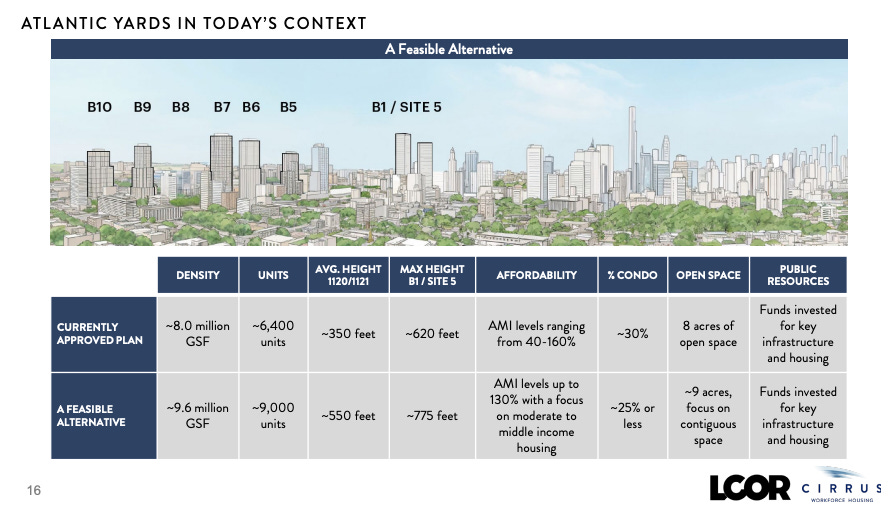
That’s not exactly what’s happened. Rather, the public was given what the developers consider a “feasible alternative,” involving significant additional bulk, and told that only increased height and bulk can deliver affordable housing and open space.
That didn’t leave a lot of flexibility.
As I wrote, while the public might express preference about the amount and affordability of below-market housing, as well as hopes for new public space, that does not necessarily address the impact of the developer’s desired scale and the significant gift of the additional bulk, much less the overall economics of the project.
Note: the developer considers the project a “no-brainer,” which suggests they see a calculated risk for big returns from a relatively modest investment.
The issue recurs
At a March 2025 meeting of the AY CDC, Chair Daniel Kummer noted that, at the previous meeting, they had discussed the possibility of AY CDC hiring its own consultant to advise on issues.
He said it was worth getting in the record why the AY CDC budget had no line item for consulting fees.
“It would be part of any cost agreement that we would enter into with future development teams should there be a change in development teams,” said Pycior, “because that would be triggering the community process.”
“So there’s no need to budget for a consultant in this budget,” Kummer followed up.
“That means that we could not engage a consultant,” observed Shiffman, “to undertake a plan before we have a developer, to really decide on what the scope of the developer might be.”
“I think that is the case,” Kummer said.
Shiffman suggested they consider amending the budget for an AY CDC consultant. He asked if ESD would contribute.
Pycior was unencouraging, saying it needed to wait for a developer’s proposal.
Kummer asked ESD if they had “in-house expertise that could inform us on those questions.” He was told yes, and it could come out of ESD’s general budget.
“So we can hold that as an option,” Shiffman said.
“This would not preclude it,” responded Pycior.
That hasn’t happened, either.
An extended contract for Bryan Cave
According to the Board Materials (p. 339), ESD is set to approve extension of a contract, previously 2006 through 2025, with the law firm Bryan Cave Leighton Paisner, to advise on land use and environmental issues, including the planned Second Supplemental Environmental Impact Statement (SSEIS) needed to consider proposed project modifications.
ESD has already approved a $2 million-plus contract with consultant AKRF to prepare the SSEIS. (The funding source for both is a developer-funded imprest account.)
The Bryan Cave contract term is two years through December 31, 2027, with ESD options to extend for up to two additional one-year terms. The contract amount is not to exceed an additional $500,000—though of course they could go back and amend/extend it.
Bryan Cave, as of last July, had already earned more than $9.7 million from the project.
The board materials state:
ESD legal and project staff recommend retention of Counsel based on the firm’s demonstrated environmental and land use expertise and history of providing exceptional services to ESD on large scale projects. The Firm has served as ESD’s outside environmental counsel since the inception of the Project in or around 2006 and has the requisite experience and expertise to advise on the SSEIS for proposed modifications to Phase II of the Project.
My query:
First, was the $250K budget fully funded in the first place? If so, by which developers? If not, how much has been funded?
Will the full budget be used by March 31? Was fully used in past years?
Do you expect it to be fully funded in the next year?
The AY CDC budget was once used to support separate staff dedicated to Atlantic Yards, but more recently was said to fund proportionate staff time devoted to the project. Over the past year, those staffers did not pause work on Atlantic Yards but remained compensated.
So if their work on Atlantic Yards continues but isn’t funded by the AY CDC, doesn’t that suggest the AY CDC budget isn’t meaningful?
Alternatively, could the AY CDC budget be used for other things (as suggested), like outside consultants?
Any other explanation or comment is welcome.