
If the Consultants Have Earned $63.4M+, How About a Few Bucks For the Public?
Could there be an independent voice on the project's financial viability, scale, and community impact? Past independent reports have been credible.

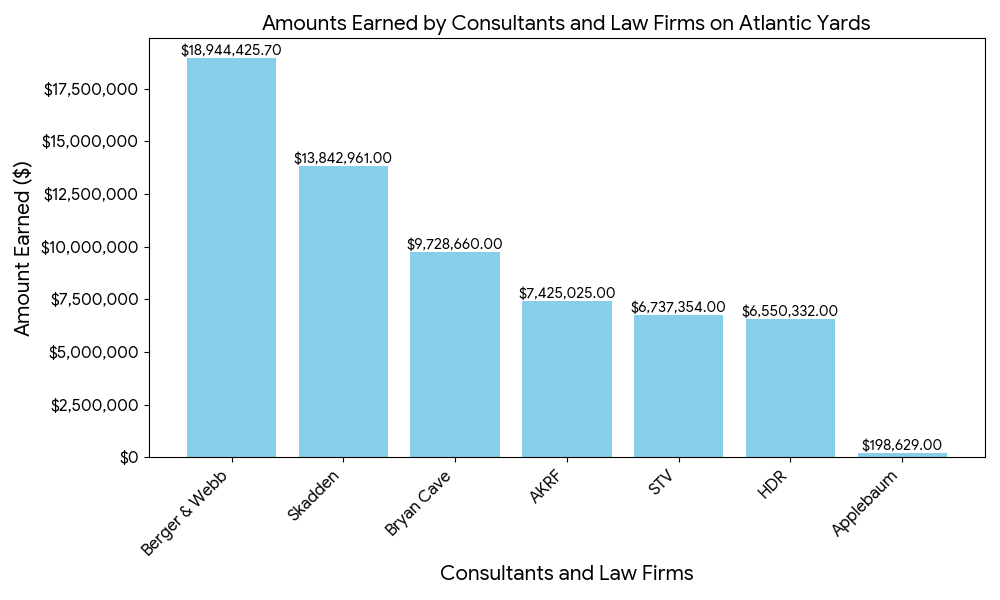
I recently calculated that consultants and law firms hired by Empire State Development (ESD), the state authority that oversees/shepherds the project, had been paid more than $63.4 million of the developers’ money, over some 20 years.
Needless to say, that’s a lot of money.
That money has helped the project proceed, from condemnation to environmental review to monitoring contracts and environmental commitments.
However, that does not necessarily—or fully—serve the public interest.
What about the AY CDC?
Nor has such funding bolstered the Atlantic Yards Community Development Corporation (AY CDC), the under-powered body that’s supposed to advise ESD on the project’s public commitments, including upcoming changes.
The AY CDC meets tomorrow.
Could there be a smidgen of funding to support consultants who are not, ultimately, answerable to the Governor? (Is there any money hidden in the proverbial couch?) That seems unlikely but it could, ultimately, add legitimacy.
Perhaps there’s another solution, as I’ll discuss below. In a few instances, outside funding has bolstered independent evaluations of Atlantic Yards issues—and in one key case, such outside funding was ignored.
Planning for public engagement?
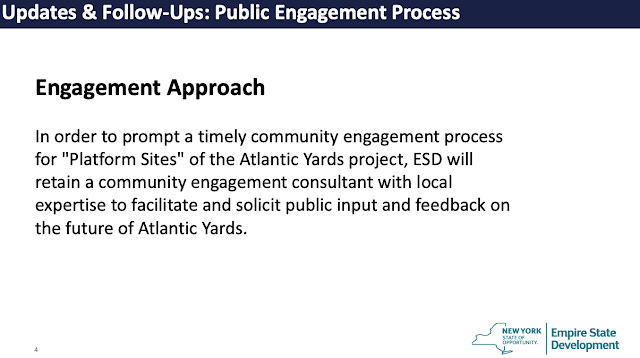
The issue is ripe, since the AY CDC will discuss "Public Engagement Process Planning” at tomorrow’s meeting.
What that means is unclear, but it sounds like an effort to add legitimacy to a project that now faces widely embedded skepticism.
At a meeting last November, AY CDC Director Gib Veconi, a leader of the BrooklynSpeaks coalition aiming to monitor and improve the project, led a vote requesting a review of the engagement scope before it's finalized. So that may be part of tomorrow’s discussion.
Director Ron Shiffman, a veteran community planner, said he’d like to see a consultant who understands the finances of such projects. ESD’s Joel Kolkmann, Senior VP, Real Estate & Planning, said the engagement consultant could hire a subcontractor. (Come to think of it, those are very different tasks.)
“We could bring that back up when we see the scope,” Veconi said.
Third-party consultants?
The process might gain legitimacy if the AY CDC, as previously proposed, could hire its own consultants.
Then again, the AY CDC has a budget of just $250,000—paid for by the developers—and, while it once went to dedicated staff, it now is used to compensate ESD staffers for their time on the project.
BrooklynSpeaks has told elected officials, as Veconi shared last October, that any proposed changes--including an expected request for increased density and bigger buildings--merit a third-party analysis of their financial feasibility.
As I wrote, there’s a potential tension between scale and affordability; and third-party analyses are needed for more than financial feasibility.
Past AY CDC proposal
In 2018, Jaime Stein, then an AY CDC Director, proposed that the board hire its own planning, design, and construction consultants—not merely facilitators—to review what was then an expected new proposal for Site 5, the parcel across Flatbush Avenue catercorner to the arena.
That proposal was stalled, but it’s expected to advance, along with a plan for the six towers over the Vanderbilt Yard, in the project’s next phase.
Would such consultants gum up the works? Surely that’s what the developers (whoever they might be) and ESD would say.
Alternatively: could it add legitimacy to—and useful feedback for—a project that’s widely seen as tainted?
Hype unfulfilled
Atlantic Yards has a mixed history with outside monitors.
The much-hyped Community Benefits Agreement--a private contract, not a public one--was to have an Independent Compliance Monitor to ensure that job training, affordable housing, and the hiring of and contracting with minorities and women would be fulfilled.
However, original developer Forest City Ratner never hired such a monitor, saving $100,000 a year as well as avoiding scrutiny.
Helping the EIS response
Public officials have sometimes helped.
Some may remember that the (now-defunct) Council of Brooklyn Neighborhoods (CBN), a coalition of more than 40 organizations concerned about Atlantic Yards, gained $130,000 to hire consultants to analyze the massive Draft Environmental Impact Statement.
(The money came from the City Council, but an expected $100,000 grant from the state Legislature was put on hold by Assemblymember Roger Green, according to CBN. It’s a long story.)
The lead consultant was Phillips Preiss Shapiro Associates. While CBN had no official position on the Atlantic Yards project, given the job of responding to the environmental review, many of its member groups opposed the project. The CBN response, released in September 2006, was tough.
Critiquing the state’s construction oversight
In June 2012, consultant Sandstone Environmental Associates produced a report for (now-defunct) Atlantic Yards Watch, concluding that developer Forest City Ratner and its contractors, bent on getting a huge project finished by a tight deadline, had regularly failed to comply with mitigation protocols officially agreed to, and that other mitigations were implemented late, poorly, or unevenly.
Sandstone was paid by Atlantic Yards Watch (a coalition of three community groups), via a $4,000 grant from Council Member Letitia James.
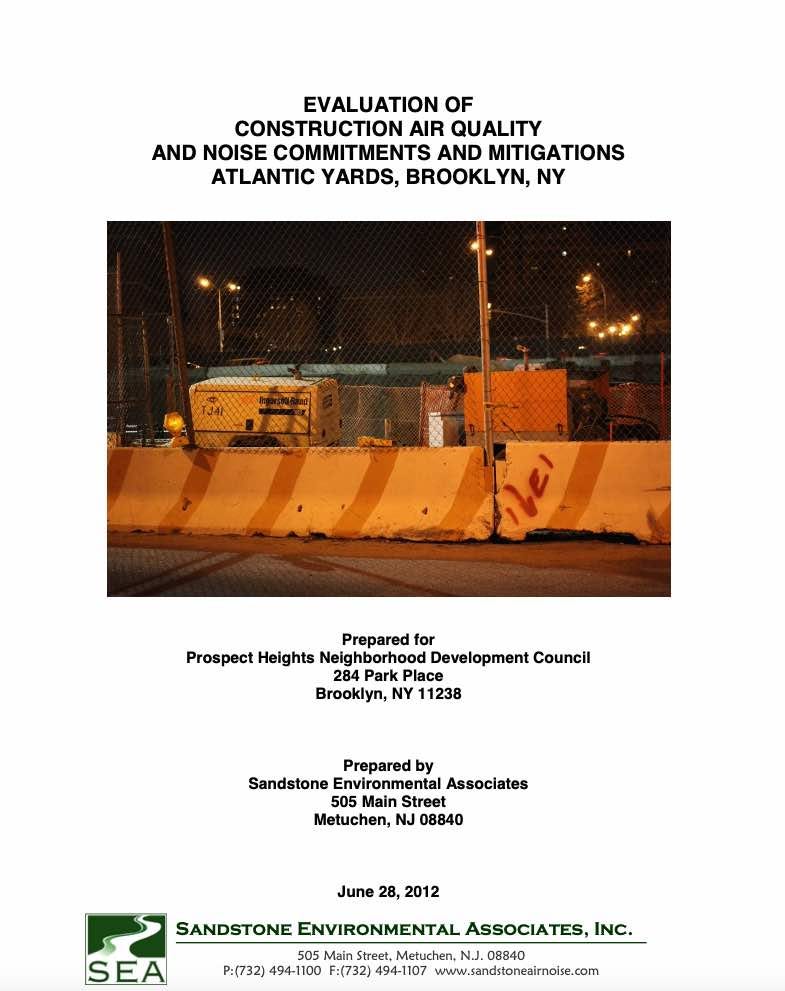
The report was validated, at least in part, when ESD in 2014 promised new monitoring by an outside firm, plus new procedures to ensure environmental compliance.
Casting doubt on the project timetable
In September 2009, CBN submitted a report, “A Decades Long Project: Atlantic Yards Financial Feasibility Study,” as part of its comments to ESD on the 2009 Modified General Project Plan.
Report author Joshua Kahr concluded that Forest City Ratner's plan--as presented officially by the state--"calls for development to continue unabated for almost 10 years irrespective of the state of the overall economy. In reality, buildings will not be developed if demand is lacking."
History has proven that analysis very much correct. (Kahr was paid a relatively modest sum by CBN. I’m still trying to pin down some details.)
Putting aside the response to the Draft EIS, which requires far more analysis than I have time for at the moment, the Sandstone report and the Kahr report both show the clear value of independent analysis.
If ESD has no funds for such analyses, perhaps elected officials can step in.
Discussing “engagement”
As of today, a joint venture led by Cirrus Real Estate Partners is expected to take over the project. Last November, when the joint venture was expected to be led by Related Companies, developer of Hudson Yards, the AY CDC learned of plans for that “public engagement process.”
Anna Pycior, Senior VP, Community Relations, said ESD planned to hire a community engagement consultant to “do a robust public process for the remaining portions of the site. That would include visioning sessions, soliciting input from the public.”
At the time, they recommended two separate processes: one for the railyard sites (B5-B10), and another for Site 5. Those parcels had different terms and timelines, Pycior said, and different companies may be responsible.
Today, that might have changed.
As I wrote, the proposed developments might generate particular concern from different sets of neighbors and interest groups.
Still, separation would further dilute the capacity of an already fatigued—and cynical—neighboring public to respond.
What’s the point?
“I’m not concerned about splitting it up at this point, because I don't know what the role of the process is here," observed Shiffman at the time. "Is it really to determine the program or to review and sell the product that the developers are proposing?”
“It would be to review the options and hear what people envision for the site,” Pycior said. That seems unlikely, since the contours of the project surely will be shaped by the costs of construction and the developer’s bottom line.
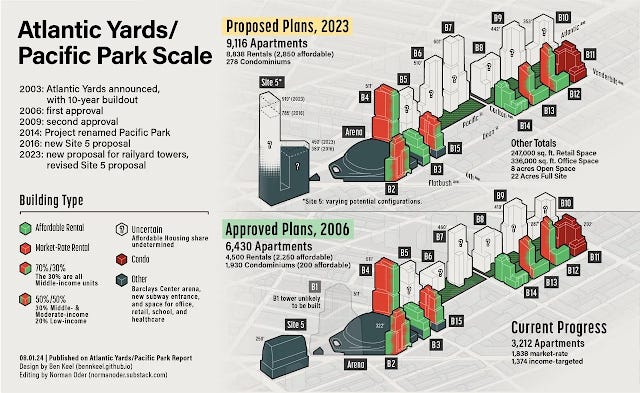
Keep in mind, as I reported last August, that current master developer Greenland USA in 2023 proposed to supersize the project by adding 1 million more square feet--free land!--in larger railyard towers.
It sought an extension of the May 2025 deadline to build 876 more below-market "affordable" units but agreed to build perhaps 600 more affordable units, gaining a new timeline and offering no clarity on affordability level.
Presumably any new developer might use that as a template.
Greenland also proposed--well, it was essentially approved in 2021 by ESD--to move the bulk from the unbuilt flagship tower (B1), once slated to loom over the arena, across Flatbush Avenue to Site 5, longtime home of the big-box stores P.C. Richard and the now-closed Modell's.
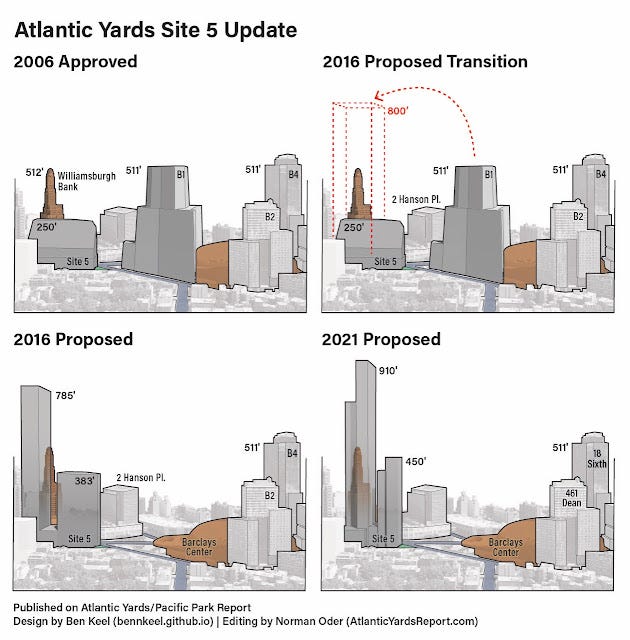
That would enable two towers, one 910 feet and the other 450 feet, far larger than the 250-foot tower approved in 2006 and both taller and bulkier than the 785-foot and 383-foot towers floated in 2015-16.
That would not only benefit Greenland, which would avoid the complexity of building the B1 tower over an active arena, it would benefit BSE Global, owned by Joe and Clara Wu Tsai (and the Koch family), which operates the arena and would see the branded plaza, for now known as Ticketmaster Plaza, made permanent.
How might it work?
A significant clue regarding ESD's plans come from a draft Scope of Work produced in May 2023 in response to Greenland's plans to supersize the project. (I acquired the document through a Freedom of Information Law request.)
The contractor's "inclusive" community engagement process would involve perhaps four public sessions, anticipating 50 to 100 attendees per session, that would:
use maps, texts, and graphics to explain the project history, site context, and programming options for the balance of the project site
solicit community feedback and vision on topics including but not limited to: affordable housing preferences, desired community amenities, priorities for open space and public realm, and non-residential space usage
translate session feedback into themes to shape project vision into actionable guidelines
hold a “follow-up” meeting with project partners including the developer, the MTA, and other governmental agencies to present community vision
(Emphasis added)
While the public might express preference about the amount and affordability of below-market housing, as well as hopes for new public space, that does not necessarily address the impact of the developer's desired scale and the significant gift of the additional bulk, much less the overall economics of the project.
The issue recurs
At a meeting this past March, AY CDC Chair Daniel Kummer noted that, at the previous meeting, they had discussed the possibility of AY CDC hiring its own consultant to advise on issues.
He said it was worth getting in the record why there's no line item for consulting fees.
"It would be part of any cost agreement that we would enter into with future development teams should there be a change in development teams," said Pycior, "because that would be triggering the community process."
"So there's no need to budget for a consultant in this budget," Kummer followed up.
"That means that we could not engage a consultant," observed Shiffman, "to undertake a plan before we have a developer, to really decide on what the scope of the developer might be."
"I think that is the case," Kummer said.
Pushing ESD?
Shiffman suggested they consider amending the budget for an AY CDC consultant. He asked if ESD would contribute.
Pycior was unencouraging, saying it needed to wait for a developer’s proposal.
Shiffman suggested that a consultant might help AY CDC advise ESD on how to pick a developer. That seems unlikely.
Kummer asked ESD if they had "in-house expertise that could inform us on those questions." He was told yes, and it could come out of ESD's general budget.
"So we can hold that as an option," Shiffman said.
"This would not preclude it," responded Pycior.
Stay tuned.
About the arena
Last October, Veconi said that, in exchange for removing the Urban Room—the atrium once promised at the prow of the unbuilt flagship tower—the public should be compensated, since the ‘existence of a plaza used to stage audience for arena events is not sufficient.”
(Yes, it’s an important passageway for many people, as well as an entrance to the transit hub. But the plaza above all benefits the arena company.)
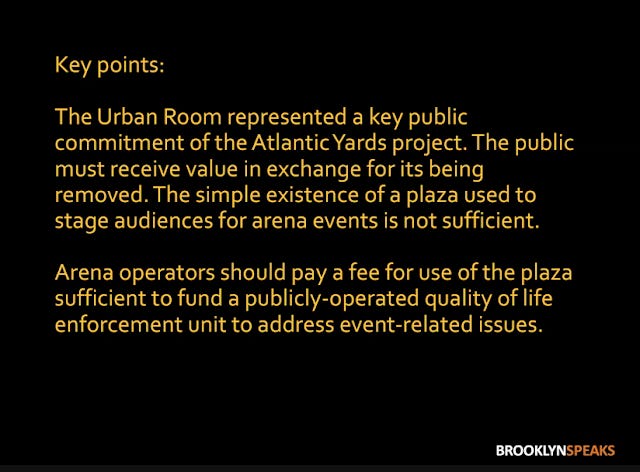
How compensate the public? "Through a charge to the arena operators that could be used to pay for the cost of a publicly operated quality of life enforcement unit, which, if you've spent any time at the intersection of Flatbush Avenue and Atlantic Avenue, is desperately necessary,” said Veconi.
As I noted, that's a good start, but I think they could ask for more. Just as the developer’s funds could support independent consultants, the arena operator in this case could fund independent monitoring. It might be seen as minimum reciprocity.