
Waiting for the MOU: Should the Key Criterion For Atlantic Yards Progress Be "Viability"?
What about "reconciling project cost, subsidy, and public benefit"? And whether the project can "support the people who will live there"?

I recently obtained, through a Freedom of Information Law request, the Oct. 7, 2025, letter agreement between Cirrus Real Estate Partners, the lead partner in the new Atlantic Yards development team, and Empire State Development (ESD), the state authority that oversees/shepherds the project.
What can we learn?
Well, ESD, which is moving toward signing a non-binding Memorandum of Understanding (MOU) regarding project terms like scale, affordability, and timetable, has agreed to sign that document “provided it results in a project which is viable, as determined by ESD, in its sole discretion.”
(Emphasis added)
Already, the developer has asked for a lot: 1.6 million square feet of additional bulk, worth perhaps $320 million (before adjustments for affordable housing), and $350 million in direct subsidies, along with unspecified other public support.
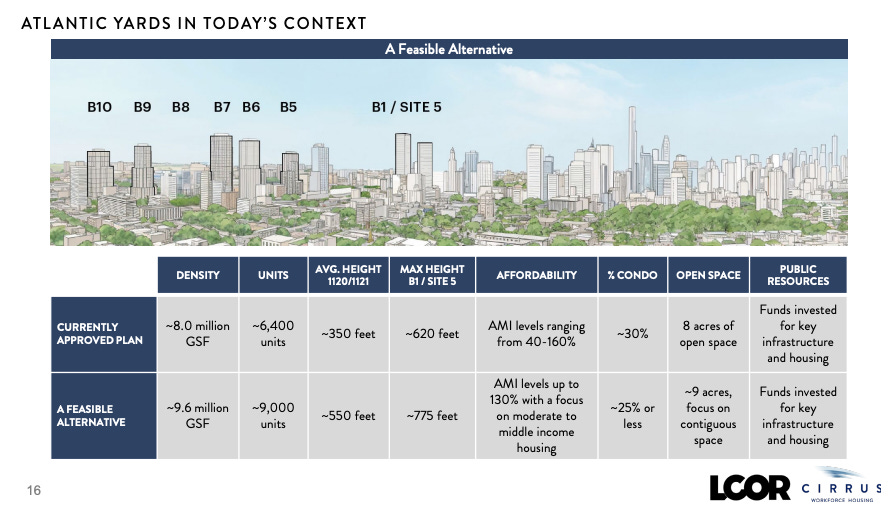
That would create a far larger and more valuable project than originally approved. A new public approval process, including public hearings, should begin after the MOU is signed and could take 18 months, until the end of 2027.
Strategic opacity
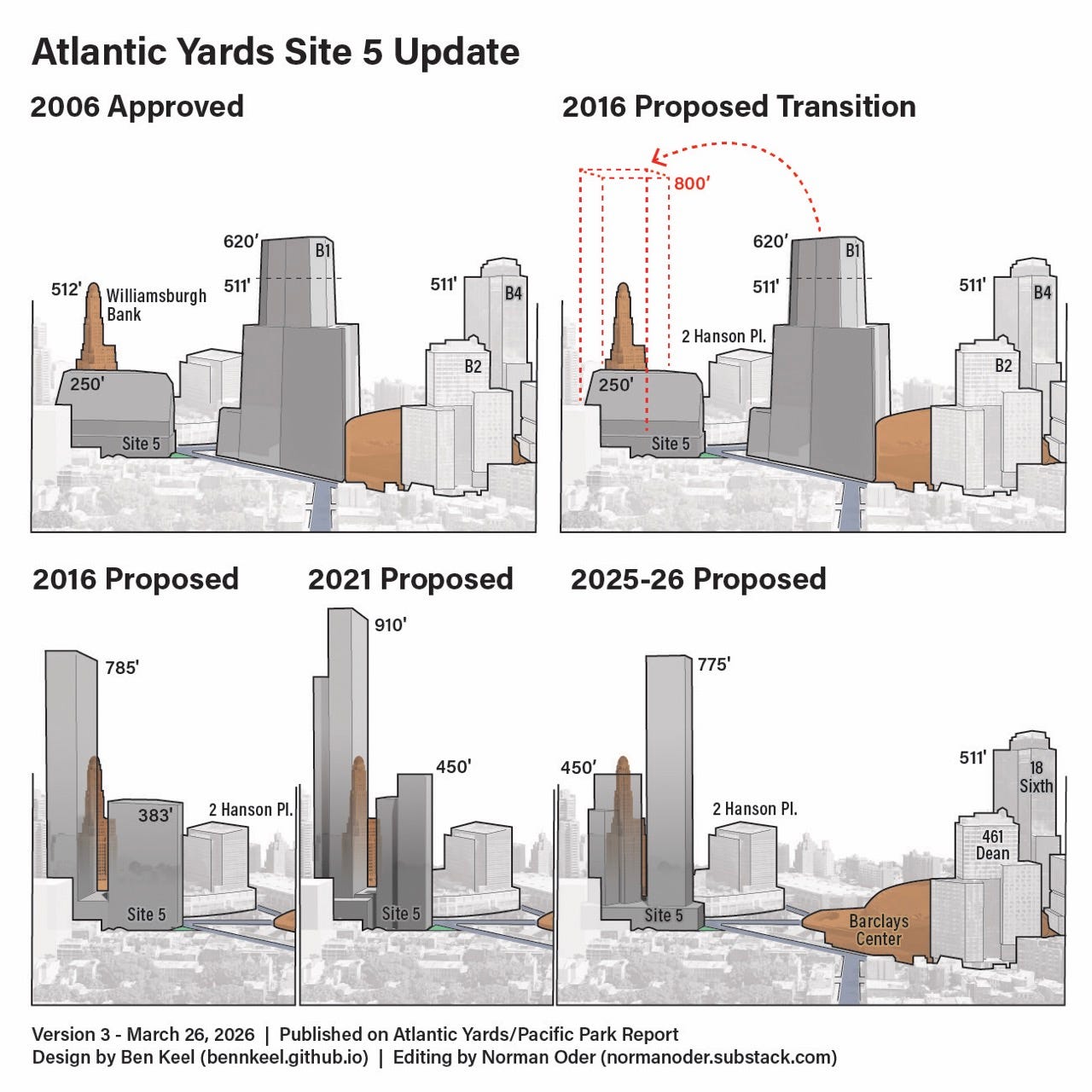
We haven’t seen any official images of what they’re planning, though surely some are circulating privately. The information needed for the MOU should prompt the developer and ESD to produce far more informational images than they have circulated so far.
The best we have, for now, is the unofficial effort below by my longtime collaborator Ben Keel.
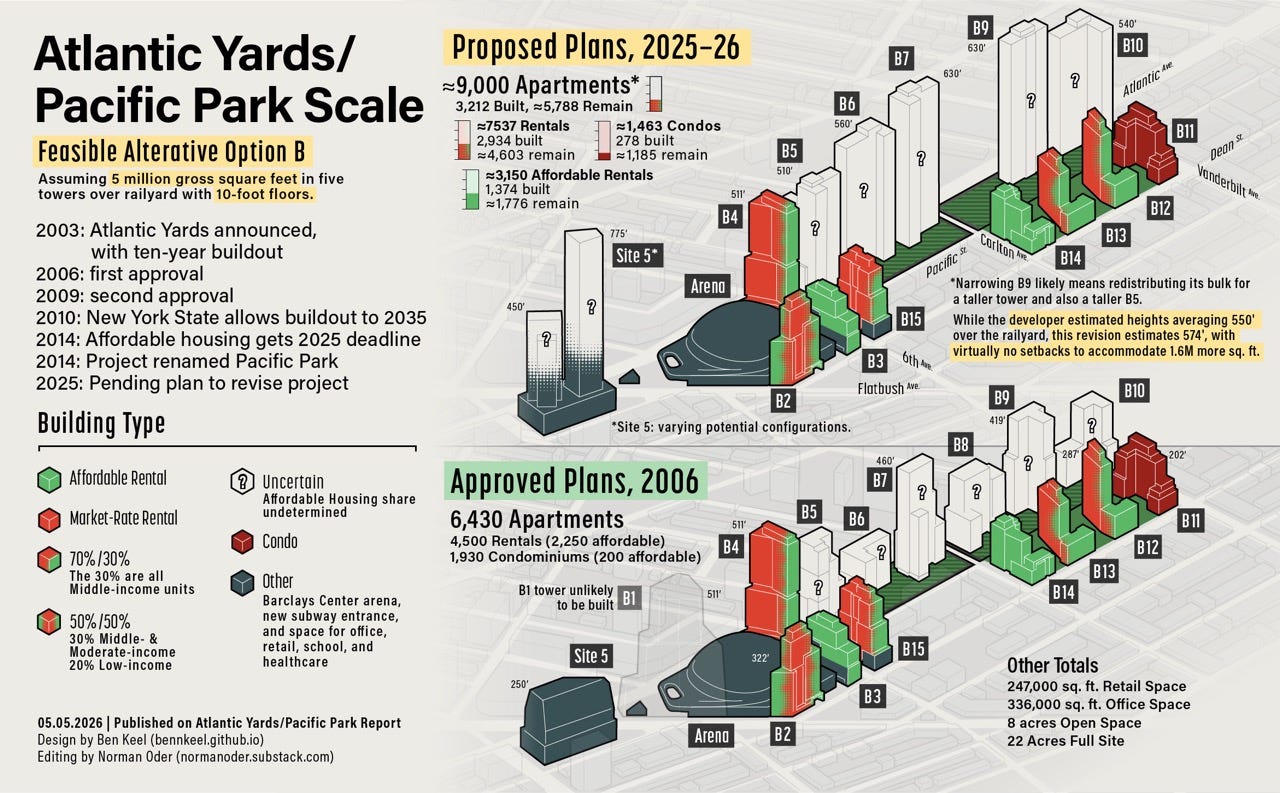
This hints at a dramatic change in scale, given that there would likely be five towers over the railyard larger than the project’s current largest tower, the 858-unit 18 Sixth Ave., which rises 511 feet and has more than 800,000 square feet of bulk.
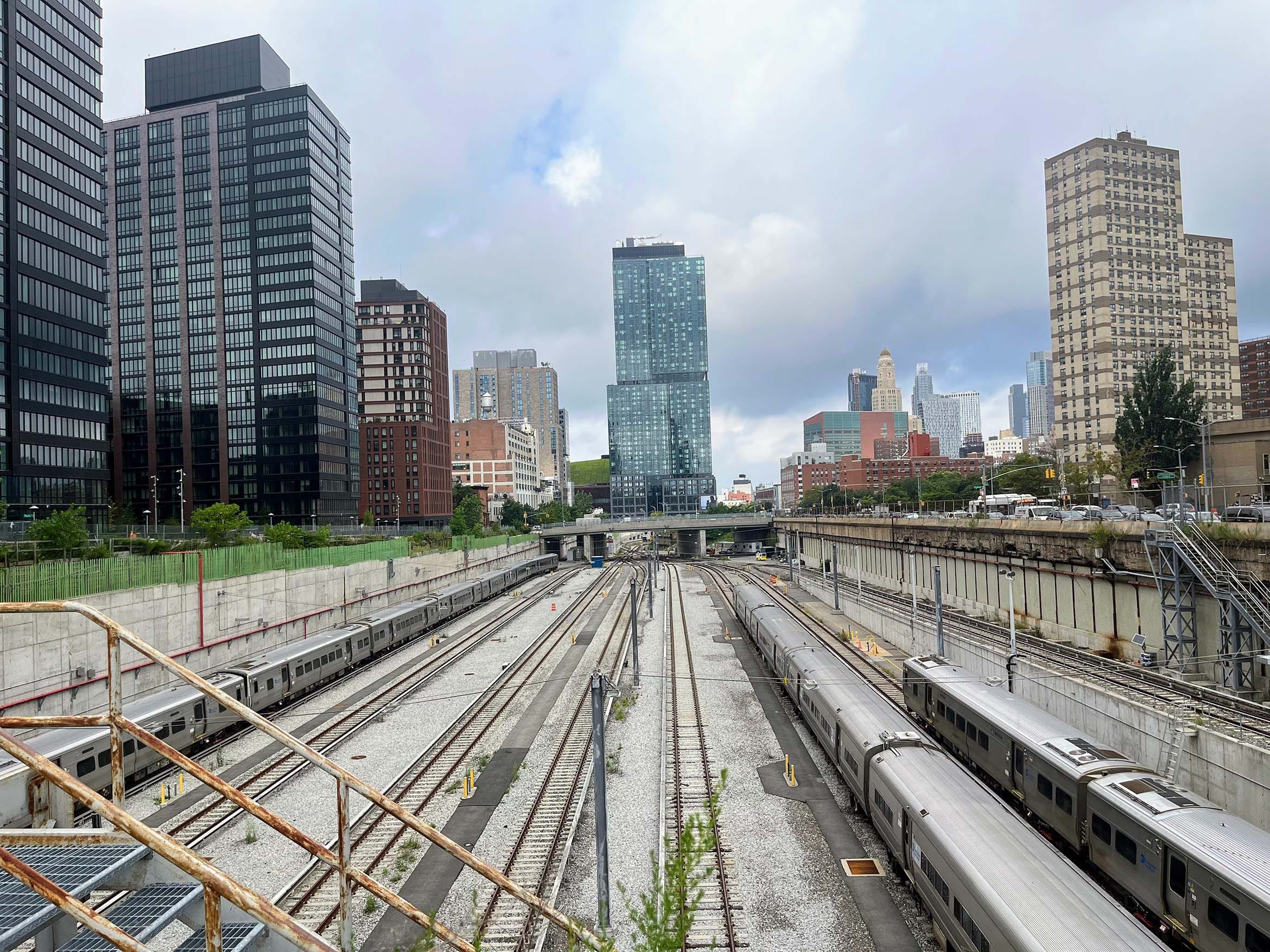
See below. One site, formerly planned for the B8 tower, would become an additional acre of open space, with that tower’s bulk redistributed to the other towers.
Viability—a low bar
Yes, it’s important to assess project viability, given that Atlantic Yards—announced in 2003 with an estimated ten-year timeline, and likely not even half-complete—has been hampered by unrealistic expectations and projections.
Some of that unreality was presented by the previous master developers, Forest City Ratner, Greenland Forest City Partners, and Greenland USA. Some was furthered by ESD itself, relying on the unreliable consultant KPMG.
Consider that the “viable” project ESD endorsed in 2005 involved:
four office towers flanking the arena, all of which have been discarded, with three swapped for residential space and a “temporary” plaza replacing the “Urban Room,” the atrium at the prow of the flagship tower
an outdated set of building configurations
an 850,000-square-foot arena designed by Frank Gehry, rather than a 670,000-square-foot one designed by Ellerbe Becket and SHoP
and a nine-track railyard, rather than seven tracks, as later “value engineered”
But viability is still a very low bar.
The proposed changes may make the project viable, but that shouldn’t be the only criterion. After all, a project may be “working, functioning, or developing adequately,” to choose one definition, while still not meeting the public interest.
Enhanced viability
Local elected officials, in a recent letter to Gov. Kathy Hochul, sought what might be seen as an enhanced version of viability.
“The new plan must be subject to independent financial review by a qualified firm to ensure feasibility,” they wrote, “and the results shared with the board of the Atlantic Yards Community Development Corporation (AY CDC) as part of an open meeting.”
The review seems to be in process. As previously reported, ESD has engaged BJH Advisors to evaluate the financial and economic feasibility of the proposals. 1
As stated in a memo regarding a revised contract, part of the Board Materials for ESD’s May 21 meeting, BJH’s services include:
underwriting reviews, evaluation of the Permitted Developer's plan and financial revisions, analysis of market comparables, analysis of proposed tax exemption and PILOT financing structures, and ongoing advisory and project management support.
The contract term, originally 12 months starting Nov. 20, 2025, is slated to be extended for 13 months, through December 2027. The total contract amount should not exceed $141,739.
“The proposed contract extension is necessary to cover continuous advisory support and discrete deliverable-driven engagements as the project progresses,” as BJH will review various iterations of the developer's financial model submitted to ESD.
That suggests continuing tweaks during the approval process. Remember, with such large projects, it’s not uncommon for developers to ask for more than they need, leaving room for seeming compromise in response to requests from the public and/or elected officials.
It’s unclear whether any versions of that BJH review will be shared publicly—or even semi-privately with the AY CDC board. (When I asked, I didn’t get an answer.)
Enhanced viability
The coalition BrooklynSpeaks in March raised the stakes, asking, “Will ESD commit to providing an independent financial analysis reconciling project cost, subsidy and public benefit?”
That’s an important framing.
After all, a viable project, propped up by significant subsidies, may not ensure the public gets a fair shake.
The “public benefit” should encompass deeply affordable housing, open space, and community amenities.
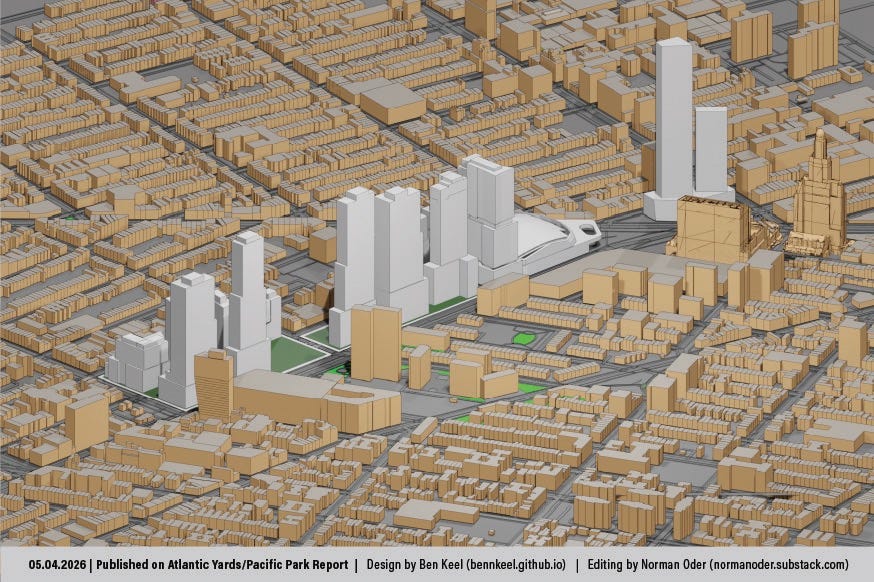
It also should encompass a viable community.
“The question should never be simply: Can we fit more units on this site? The better question is: Can this place support the people who will live there?” writes planner and academic Ron Shiffman, in a recent paper he shared with me.
“This is especially important for families with children, seniors, and low-income households,” Shiffman writes. “A development may meet a numerical housing target while still failing as a place to live if it lacks open space, safe pedestrian access, adequate schools, nearby services, and a healthy public realm.”
“We should therefore evaluate housing not only by height, floor area, or number of units, but by the human experience it creates,” writes Shiffman, a member of the AY CDC board, which is supposed to advise ESD.
A wider review?
In 2018, Jaime Stein, then an AY CDC board member, proposed that third-party planning, design, and construction consultants review a pending proposal for Site 5, the parcel catercorner to the arena, to inform the board and the public. (At that point, the remaining project was not on the table.)
The project’s developers, for the past decade, have proposed to move the bulk from B1, the unbuilt flagship tower once slated to loom over the arena, across Flatbush Avenue to Site 5, long home to the big-box stores P.C. Richard and the now-closed Modell’s (now the Brooklyn Basketball Training Center), creating a giant, two-tower project.2
Stein’s proposal could address the tension between fiscal feasibility and neighborhood impacts. But it got a cool reception from ESD, which, after all, answers to the governor and is always eager to ensure development progress.
If the AY CDC were truly an advisory body rather than an appendage of ESD used to provide a scrim of legitimacy, it would deserve its own experts. So if ESD won’t fund them, perhaps local elected officials or non-profits might step up, as I suggested last November.
The variables of Atlantic Yards
Back then, I annotated a simplistic slide from the developers—Cirrus and LCOR—to suggest that the amount of public resources should be assessed in light of the developers’ cost basis to enter the project and their expected financial returns.
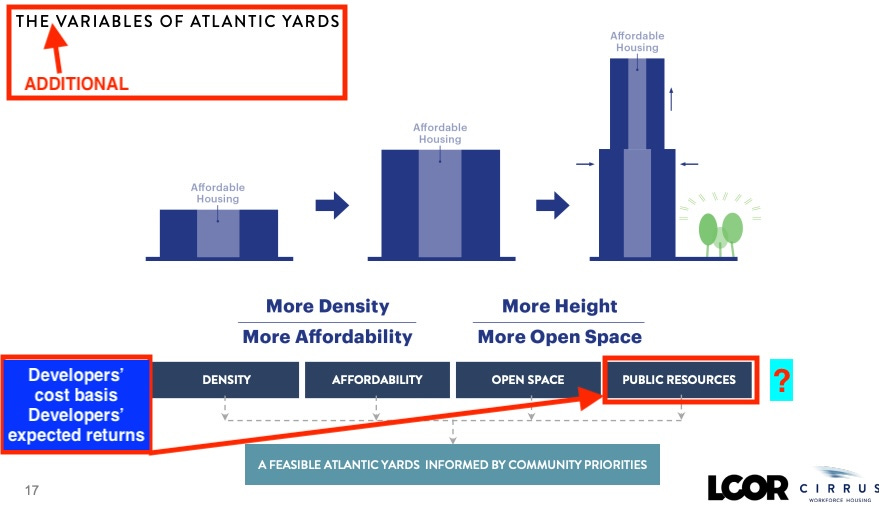
It’s unclear if the BJH Advisors review will address these key factors.
At a presentation on Jan. 22, Cirrus Managing Principal Joseph McDonnell said they “continue to modulate the variables.”
As the graphic below suggests, they added: “unit mix” (apartment size) and constraints such as atypical site conditions, given construction over the railyard below, plus tariffs and increased costs.
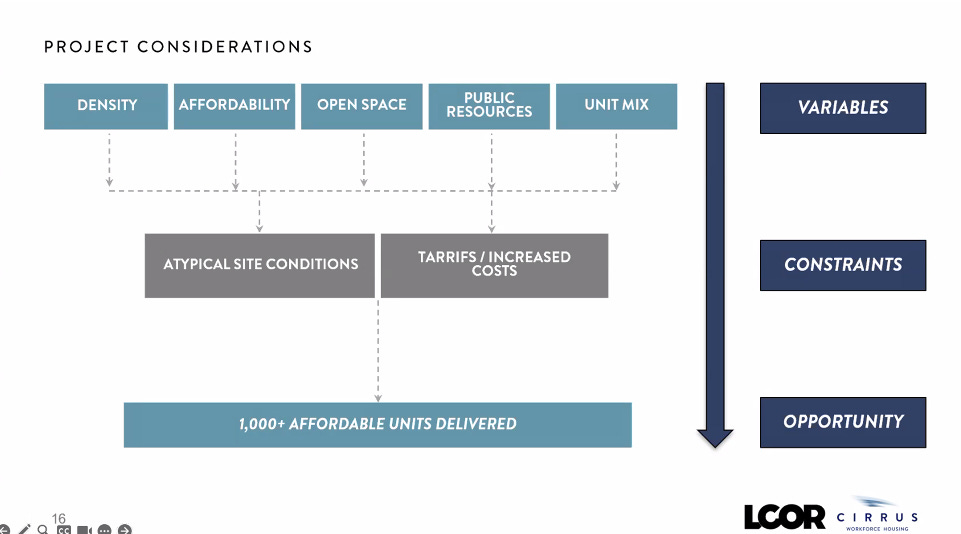
Those constraints, the graphic suggested, were modulated by a then-unspecified request for “public resources.”
Still, we should factor in the developers’ unstated cost basis and profit expectations. After all, if McDonnell considers entering Atlantic Yards a “no-brainer,” well, that bargain, based on a discount acquisition of predecessor Greenland USA’s debt, deserves assessment.
Also, as Shiffman notes, we must consider the community the project would create.
Let’s see if the discussion can broaden beyond mere viability.
What we learned in October
As disclosed to the press and at an Oct. 9 meeting of the AY CDC, a key element of that initial agreement was ESD’s willingness to accept a total of $12 million, rather than a potentially vastly larger sum, for the 876 affordable housing units not built by May 2025.
We also learned that the non-binding MOU was due by March 31, but could be delayed until July 31 if Cirrus makes an interim payment of $1 million, as explained below.
We are already well past March 31. With Atlantic Yards/Pacific Park, everything takes longer than expected, so the MOU may not emerge until closer to the deadline. Or the deadline might be extended.
What’s in the MOU?
The MOU, according to the letter, should include:
(a) proposed site plan
(b) proposed modification to the project design guidelines
(c) proposed open space
(d) proposed non-residential uses and additional community amenities
(e) proposed housing program including unit mix and income mix
(f) anticipated financing and tax structure, including public subsidy requests
(g) outline of requested entitlement and transaction processes
(h) local hiring and MWBE subcontracting requirements; and
(i) Project Timelines
Note the citation of “public subsidy requests,” which could be open-ended.
Missing: accountability
While the document includes “Project Timelines,” it omits an accountability structure and enforcement measures.
We already know that contractual requirements, such as the $2,000/month in damages for each missing unit not delivered by May 2025—required in a 2014 state agreement with the coalition BrooklynSpeaks—can be negotiated away by ESD.
Instead, the state has agreed to accept $12 million, while the cumulative total, more than $1.75 million a month, already exceeds $21 million.
How to ensure a true financial penalty? I’m not sure, but one solution might be a requirement to post a bond that puts funds in escrow.
The payment schedule
As previously disclosed, Cirrus and/or its affiliates agreed to pay $4.5 million upfront, $2.5 million upon signing the MOU (less a $1 million interim payment if not signed by March 31), and $5 million upon approval by the ESD board (appointed by the governor) of a modification to the Modified General Project Plan.
That’s indicated in the Oct. 7 letter, as excerpted below.
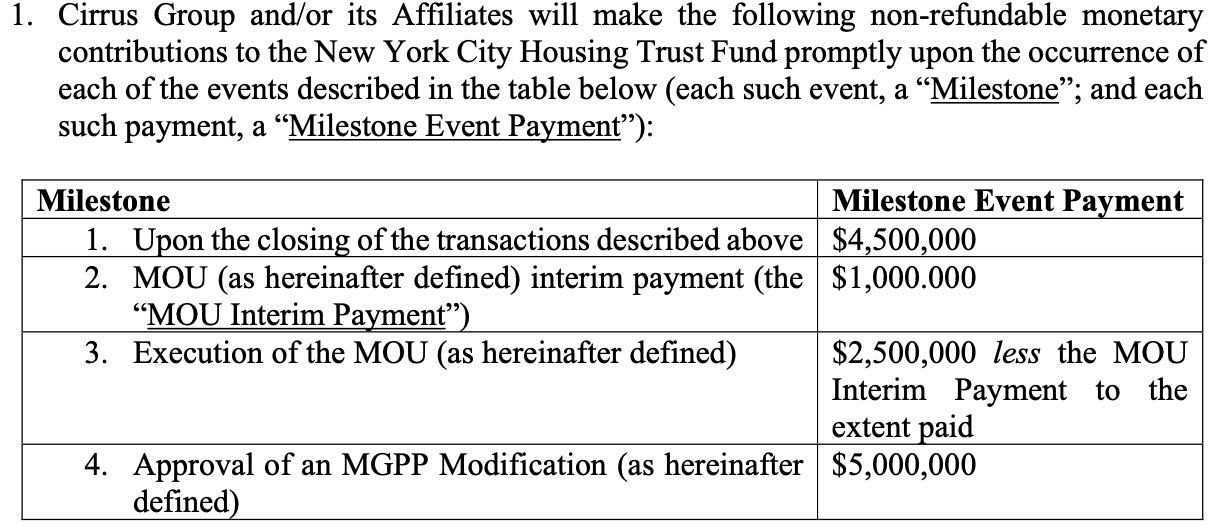
That final payment might not come until 18 months after a public process, including a Second Supplemental Environmental Impact Statement (SSEIS), begins.
Also note that, according to the letter, “ESD may extend the MOU Deadline in its sole discretion.”
So everything could be delayed past July 31. As one of my mantras goes, “Atlantic Yards is a never-say-never project.”
What about Cirrus?
While the slides shown at various project presentations are attributed to Cirrus Workforce Housing (and partner LCOR), the Oct. 7 letter is addressed to Jonathan Hirshey of the parent company, Cirrus Real Estate Partners.
As the latter company states on its website:
Cirrus’ value-based investment approach is grounded in a deep and granular understanding of the base factors which drive real estate performance generated through the 25+ year average commercial real estate and capital markets experience of its partners.
…Cirrus’ proprietary framework is designed to generate consistent, attractive returns through identifying investments that offer asymmetric risk-return profiles and significant downside protection while integrating direct, active asset management to ensure favorable outcomes for its stakeholders.
As I’ve suggested, it seems that they consider Atlantic Yards to offer an “asymmetric risk-return profile.”
Meanwhile, as shown in the screenshot below, the entity signing the document is a Cirrus affiliate called Brooklyn Ascending Owner, LLC.
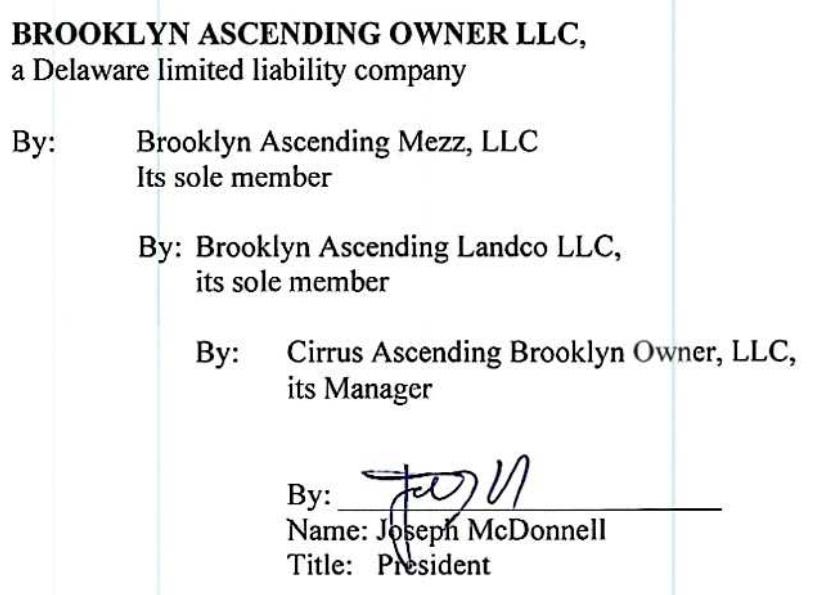
It is a limited liability company, as are the cascade of sub-owners, aligned—I suspect—to encompass the various parties involved with ownership stakes: Brooklyn Ascending Mezz, Brooklyn Ascending Landco, and Cirrus Ascending Brooklyn Owner.
The other entities are likely reflected in various documents cited in this letter, including AYB Funding 100, AYB Funding 200, and Pacific Park Site 5 Developer. The first two represent owners affiliated with the project’s EB-5 investors, and the third is Greenland USA.
All have unspecified minority stakes in the project. It’s not clear whether and how they retain any decision-making capacity.
What about LCOR?
It’s unclear, by the way, if LCOR, the firm with development experience that has joined funder Cirrus on the development team, has any skin in the game.
Cirrus, not LCOR, is responsible for the $12 million in payments.
Will we learn, perhaps at an AY CDC meeting, more about the development team’s shared responsibilities and funding requirements?
Great analysis. Every developer needs to show their cards and be accountable for promises not kept; especially when they are profiteering from the use of the leased land.