
Developers Express Confidence About New Designs, but Ignore Some Inconvenient Facts
Better tower arrangement and open space face a huge influx of residents. Constrained Site 5 would have unprecedented density, while adjacent Flatbush Ave. "is kind of a moat."
Key points
The new masterplan allows more open space connectivity and can be built faster
A half-acre increase in overall open space is dwarfed by 2,382 more apartments
Site 5, the parcel opposite the arena, is a “sticky wicket,” given an unprecedented amount of proposed density
A “shared street” on Pacific Street might be a challenge
There’s no structure yet for Atlantic Yards oversight
The project’s financial plan remains murky
While the governor calls the project an “affordable housing development,” there’s a far greater increase in market-rate units
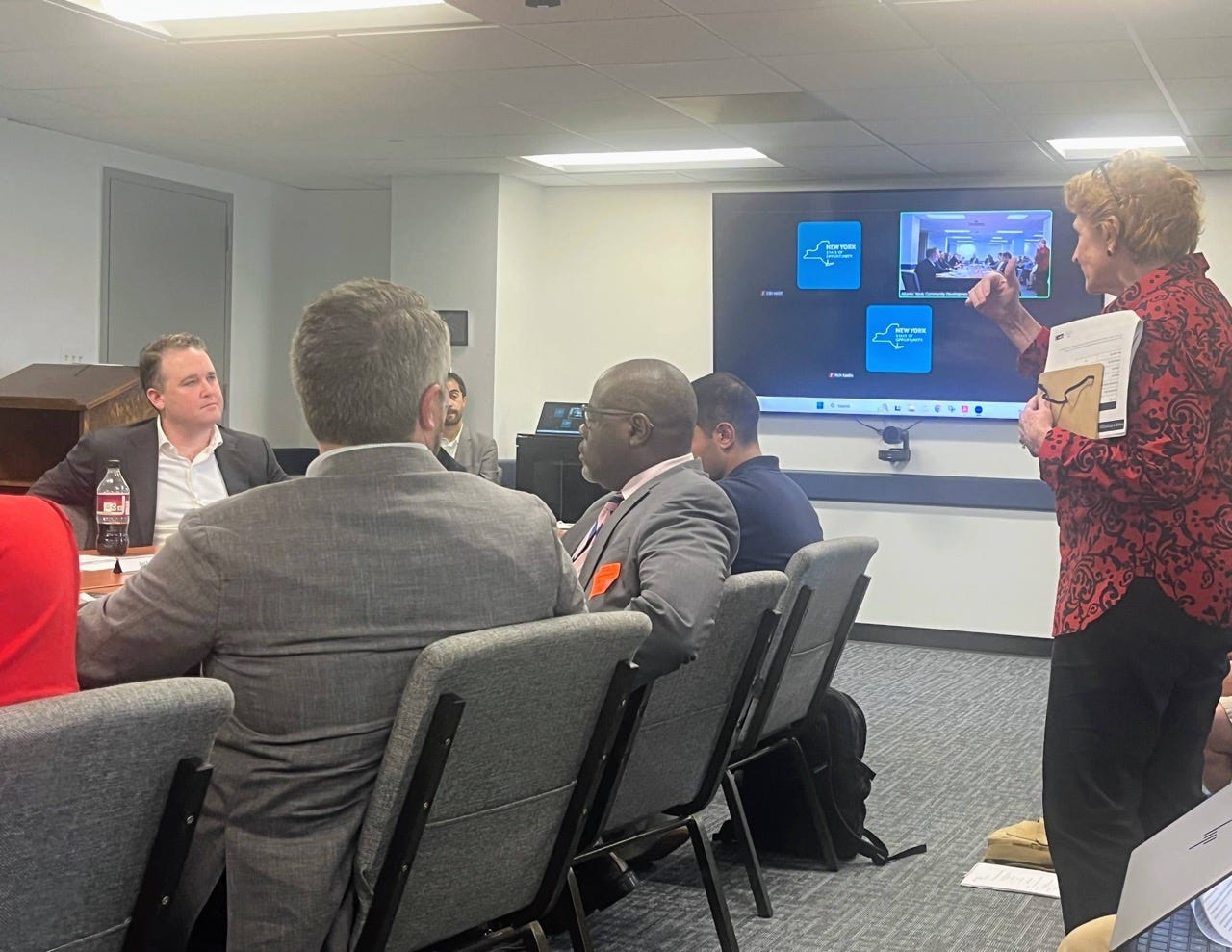
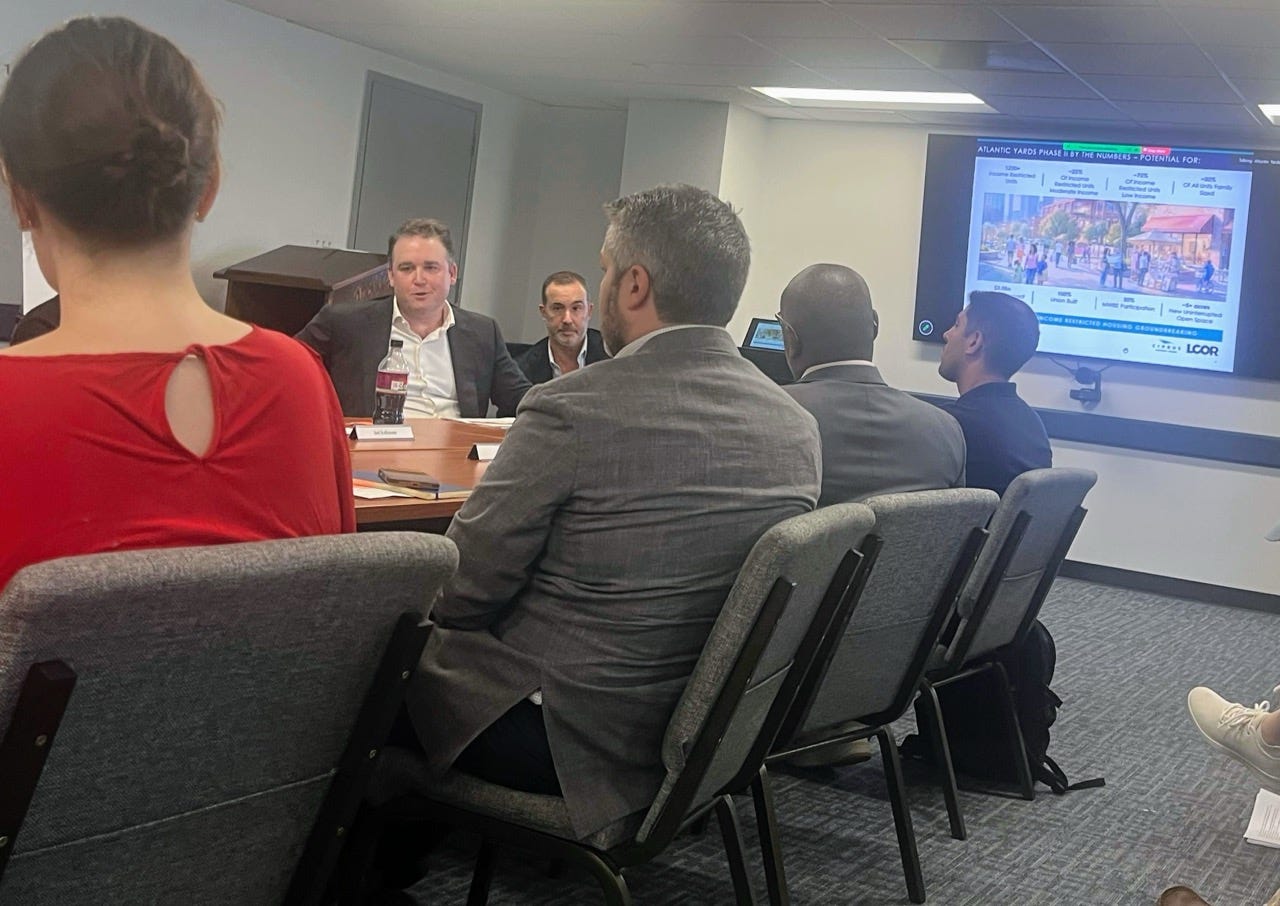
The new Atlantic Yards/Pacific Park developers, presenting their refined plans at a public meeting on June 29, contended, to general approval, that they’d made reasonable decisions about sequencing the project, redesigning the building footprints, and mapping the open space.
See my initial coverage of the meeting of the advisory Atlantic Yards Community Development Corporation (AY CDC).
However, on other issues—affordability and scale—the representatives of Cirrus Workforce Housing and LCOR were less than forthcoming or actively deceptive, even if directors of the AY CDC, the body purportedly set up to advise New York State, didn’t press them.
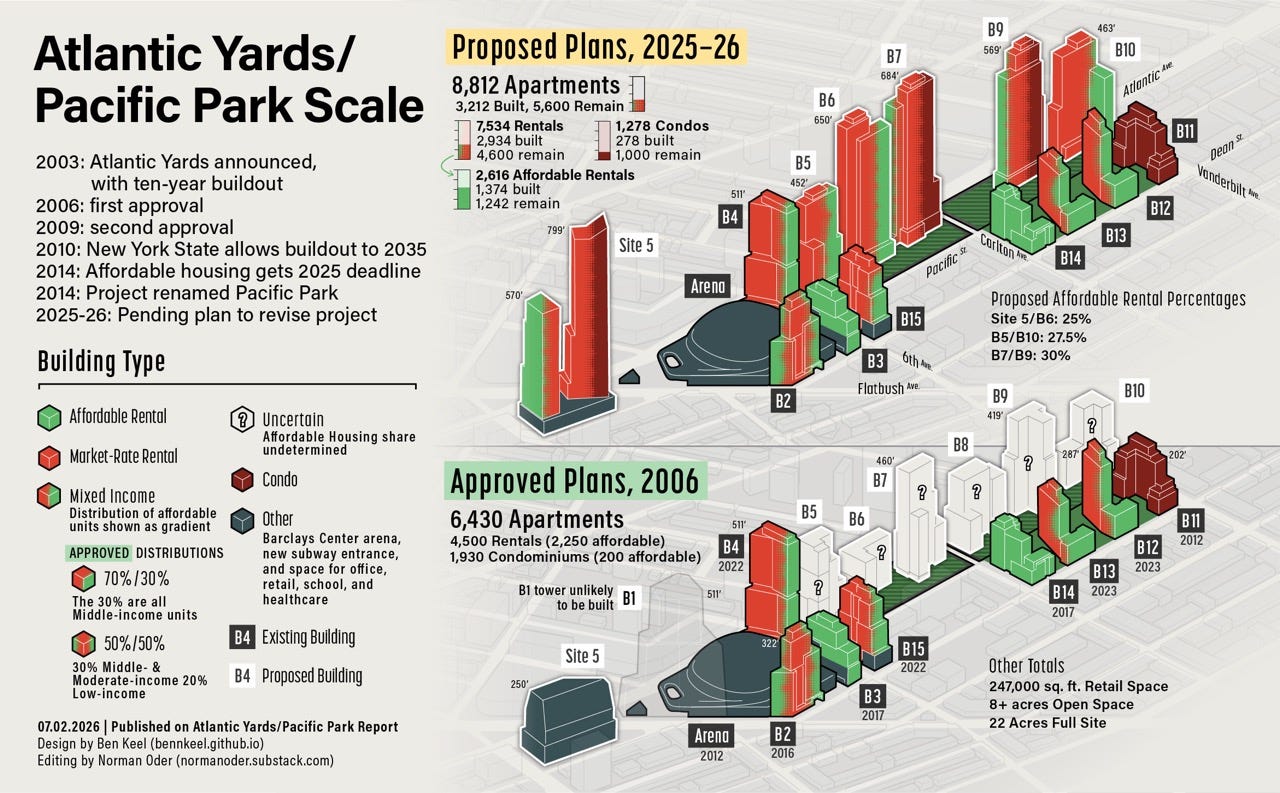
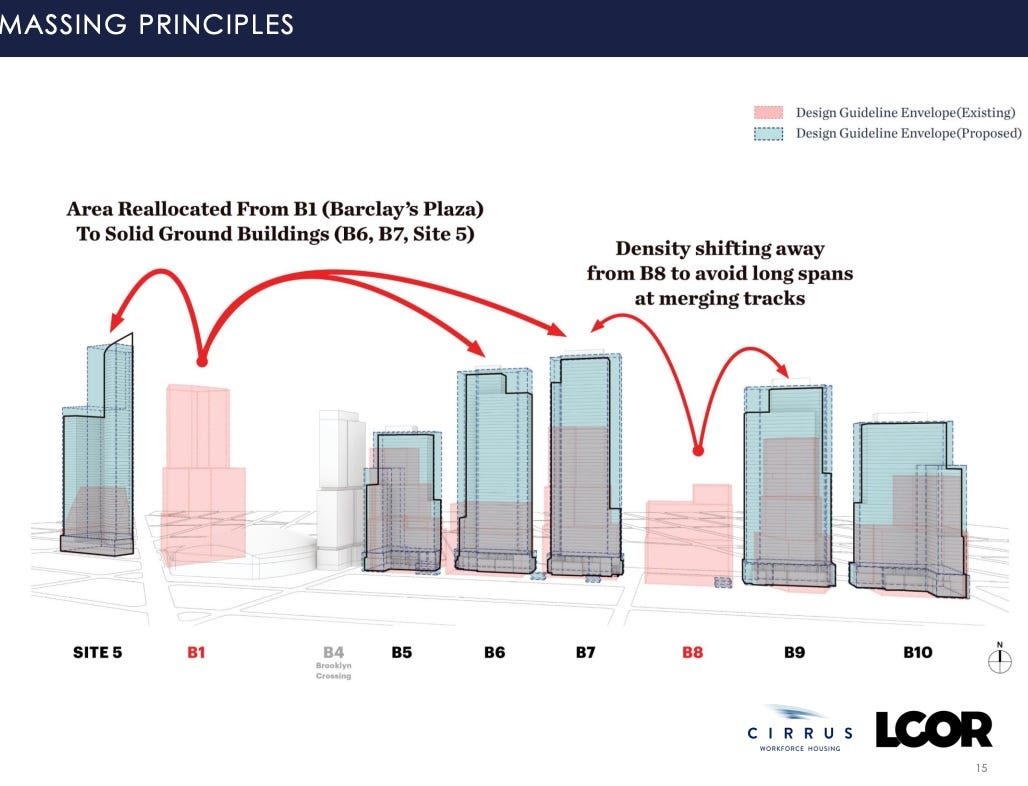
Note the significant difference between the scale of the remaining towers, as approved, in the bottom image in the graphic above, and, as proposed, in the top one. (Thanks to my collaborator Ben Keel.)
The elephants in the room
While the developers defended their decisions and expressed optimism, they skated over some elephants in the room:
The huge influx of new residents—with 8,812 units, the project could house 18,505 people—would significantly stress the open space
The two-tower project at Site 5, catercorner to the arena, would have unprecedented density, 1,257 apartments/acre (by my math), hampering livability at a constrained location
The density, at the two-block railyard site, at 544 apartments/acre, may be unprecedented
“While tall, it’s important to note that these buildings will not simply be a collection of housing units,” LCOR Co-Chief Investment Officer Anthony Tortora said in his presentation, seemingly reading prepared remarks.
“It will reflect what LCOR and Cirrus do best,” he said, “which is delivering vibrant residential communities that will include, as discussed, 30% family-size units across a variety of unit types and direct access for all residents to parks and open space, a variety of interior and exterior amenity spaces that are flexible and responsive to family needs, safer streets and mobility, and integrated retail for essential services, as well as community facility spaces, among other things.”
Well, it was a nice speech, but the team hasn’t built anything yet. Cirrus is a funder. LCOR has a track record, but not with Cirrus.
The meeting came a month before the parent Empire State Development (ESD), the state authority that oversees/shepherds the project, is expected to sign a non-binding Memorandum of Understanding (MOU) with the developers regarding timing, subsidies, and more.
Accountability questions
While ESD officials and AY CDC directors—many appointed by the governor—were enthusiastic about signs of progress, outside commenters pointed out that state support for the developers—which includes direct subsidies, a grant of 1.6 million square feet of bulk1, and an extended timetable—has not yet triggered any oversight structure.
“That accountability needs to be real and not make-believe,” said Assemblymember Jo Anne Simon. She’s a leader of the BrooklynSpeaks coalition that, in 2014, gained a new May 2025 deadline for the project’s affordable housing.
With 876 of the 2,250 required affordable units not built by the deadline, the state agreed to nominal penalties rather than enforce the $2,000/month fines for each missing apartment.
While New York State has committed $175 million in subsidies to help build the platform needed for development over the Metropolitan Transportation Authority’s Vanderbilt Yard, and seems willing to provide $700 million in total, completion is hardly guaranteed, given the time scale of the project—until 2040, at least—and the possibility that a wild card—recession, pandemic, what’s next?—could affect things.
Atlantic Yards “is fairly controversial,” Joseph McDonnell, managing principal of Cirrus, said at one point. “I think some people are actually borderline emotional about it, for good reason.” (In the audience, Michelle de la Uz of the Fifth Avenue Committee, another leader of BrooklynSpeaks, laughed knowingly.)
Well, there are reasons. The developers’ plans don’t come with guarantees. Moreover, while ESD has hired an outside consultant, BJH Advisors, to assess the project’s financial and economic feasibility, that analysis has not yet been made public.
Also, it’s hardly clear whether BJH has analyzed the developer’s costs to enter the project or its expected financial returns. Remember, Cirrus took over the project by buying previous developer Greenland USA’s debt, presumably at a deep discount, thereby bigfooting the EB-5 investors who held the other debt.

Iteration #40+
“What we’re showing you today is not iteration one, it’s not iteration 20, it’s iteration 40 or 50,” said McDonnell. Their goal is to deliver a feasible and resilient project, with public benefits like affordable housing sooner rather than later.
McDonnell recalled being warned about entering the project and advised to “‘look at this in a totally different way,’ which I think is what we’ve done.”
“We have very, very talented people with lots of resources making lemonade out of lemons,” he said, noting they face “a very, very constrained site.”
They’re working with the veteran firm KPF (Kohn Pedersen Fox) as the master plan architect, and WSP as the structural and MEP (mechanical, electrical, plumbing) engineer.
They’ve hired the respected Michael Van Valkenburgh Associates, responsible for Brooklyn Bridge Park, to design the open space.
They’re also working with the consultant Of Place, which, LCOR’s Tortora said, “specializes in placemaking design for large transit-oriented and arena-adjacent development projects.”
(I’m not sure about arena-adjacent, though Of Place has worked on Miami Freedom Park, which includes a 25,000-seat multipurpose stadium, with a soccer team.)
Escaping the past
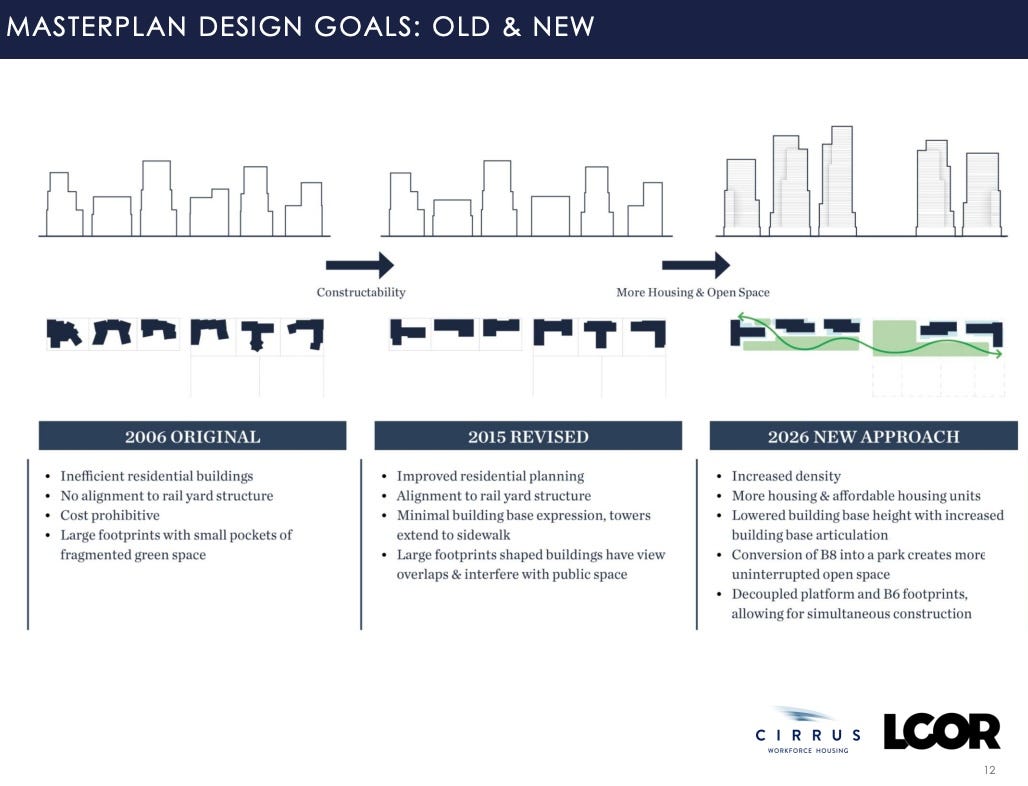
The original Frank Gehry Atlantic Yards masterplan, pictured (in part) at left in the slide below, may have been “fairly dynamic and sort of interesting to look at,” said McDonnell, but the towers stretched over the railyard north to south, “making it extraordinarily expensive to build,” while creating fragmented open space that functioned as courtyards.
Indeed, the Municipal Art Society (MAS), in its 2006 critique of Atlantic Yards, made exactly that point, likening the proposed Atlantic Yards open space to that of private-seeming Stuyvesant Town, while stressing that public parks are bordered by public streets.
That critique was then taken up by BrooklynSpeaks, which the MAS founded, but later left, wary of potential litigation.
In their new approach, Cirrus/LCOR have refined a redesign performed—quietly—by Greenland Forest City Partners in 2015, which aligned the buildings more to the railyard but jutted out farther. (See center example in slide above.)
Now they plan more rectangular buildings along wide Atlantic Avenue, lowering the lot coverage. That creates both more overall open space and more uninterrupted open space. It’s also much more efficient to build, McDonnell said.
He said they’re trying to leverage Greenland’s $1 billion infrastructure investment, notably the footings for the two-block platform. (He again called Greenland the project’s largest subsidy provider.) “Some of those layouts are relatively fixed,” he said,
Greenland committed not just money, he said, but also time. The firm spent three years obtaining permits to build the platform on Block 1120, bounded by Sixth and Carlton avenues. It did not make similar progress on Block 1121, between Carlton and Vanderbilt avenues.
So Cirrus and LCOR couldn’t work on both blocks simultaneously. They did conclude they could start building the B6 tower, which rests on terra firma—a “bump” jutting south of Atlantic Avenue into the railyard—while building the adjacent platform.
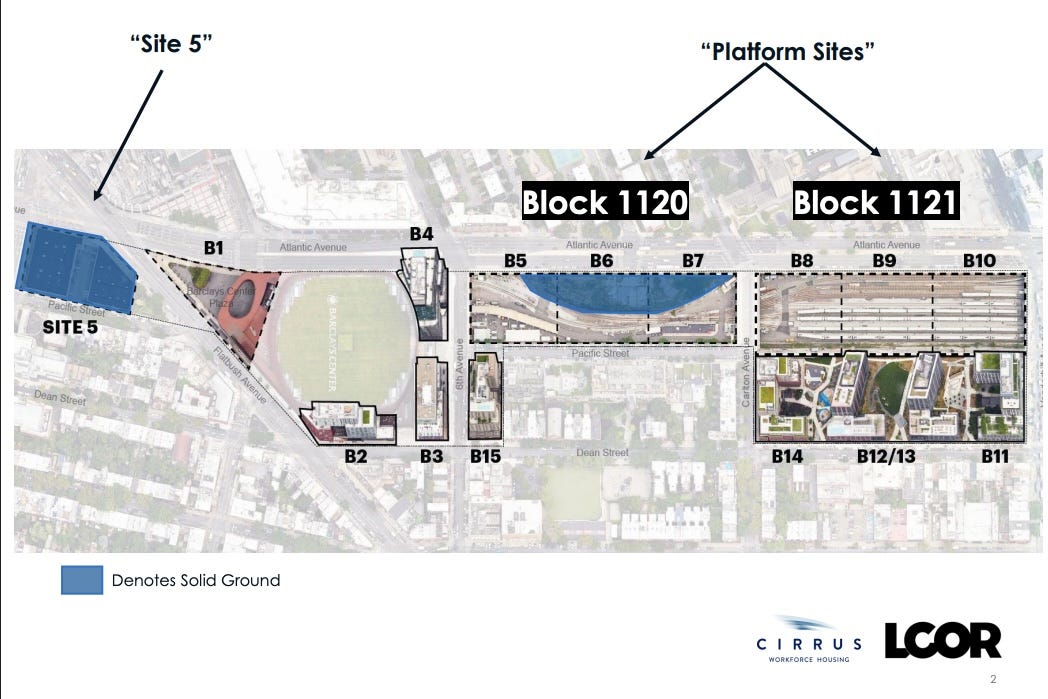
It and the two-tower Site 5 project are slated to be the first built, delivering 500 below-market units among 2,000 rental apartments, by 2031 at the earliest. (Site 5 also would have 400 condos.)
Paying for each phase
How, asked AY CDC Director Gib Veconi, would the platforms be paid for? “It’s a mix of private capital,” responded McDonnell, “which we provide from various funds”—Cirrus can draw on construction union pension funds—“as well as public financing.”
The actual budget wasn’t stated. As of 2018, platform costs were estimated at some $192 million, plus an additional $50+ million to pay for Long Island Rail Road operations.
Costs have surely increased. Still, it might be useful to get a third-party estimate to understand the price tag.
“You’re comfortable with that” for both blocks, ”even though the state has made no commitment for [Block] 1121 yet,” asked Veconi, who, with de la Uz and Simon, essentially steers BrooklynSpeaks.
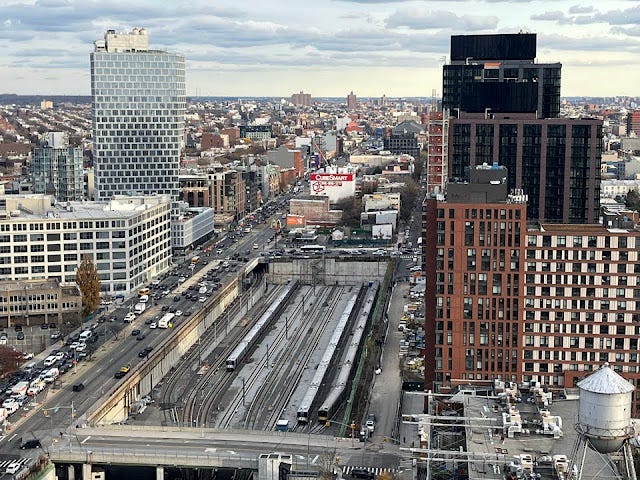
“There’s a viable plan,” said McDonnell, alluding to previous discussions—not public ones—involving “various PILOT [payment in lieu of taxes] payments basically sized for this.”
That sounds much like the solution devised for Hudson Yards, as I reported in the link below. If so, the city Comptroller should take a look sooner rather than later.

“We’re very comfortable with 1120 and, you know, 1121 coming together down the line,” McDonnell said. “I think asking the state to commit budget for something that’s years in the future also doesn’t make sense.”
That’s a fair point. Still, previous Atlantic Yards developers have also expressed confidence. It’s a developer attribute.2
Of course, if the New York State had, from the start, planned to pay for the platform, maybe the initial bid for the railyard development rights might have attracted a wider array of developers, rather than just Forest City Ratner, which had the inside track (and promised an arena), and rival Extell, recruited by arena opponents Develop Don’t Destroy Brooklyn.
Start eastern block first?
Veconi proposed that the developers start with the eastern segment, Block 1121, which includes new open space at the former site of the B8 tower, plus the B9 and B10 towers. If financing were needed, he noted, the western segment, Block 1120, could offer three towers as collateral rather than two.
Under the currernt plan, he suggested, density would be added without the open space “promised conceptually as a trade-off.”
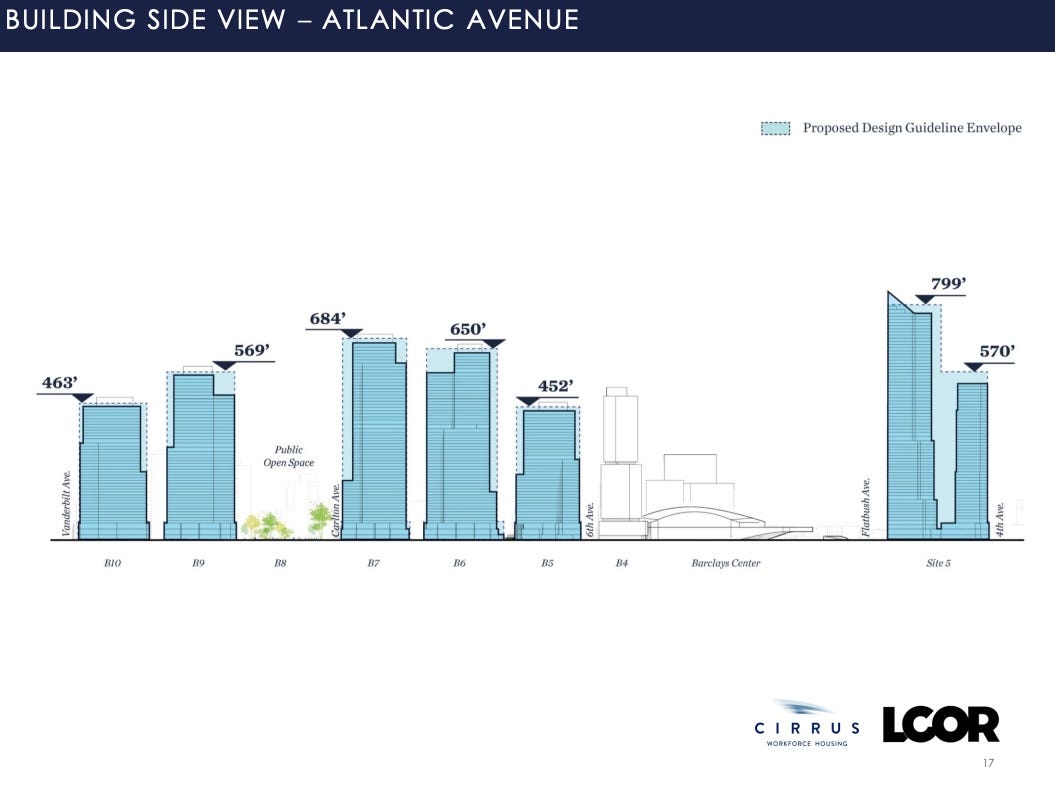
His proposal reduces risk, Veconi suggested, noting that past developers have chosen the easiest sites to build on. “And I think everybody knows where that led us.”
McDonnell said they’d considered it, but starting on Block 1121 would mean shelving the already-permitted Block 1120 and trigger both a three-year permitting process and at least three years for construction.
“When you build on top of it, you would have to build two buildings next to the park, with a crane swing over it. So, you would probably end up closing the park.”
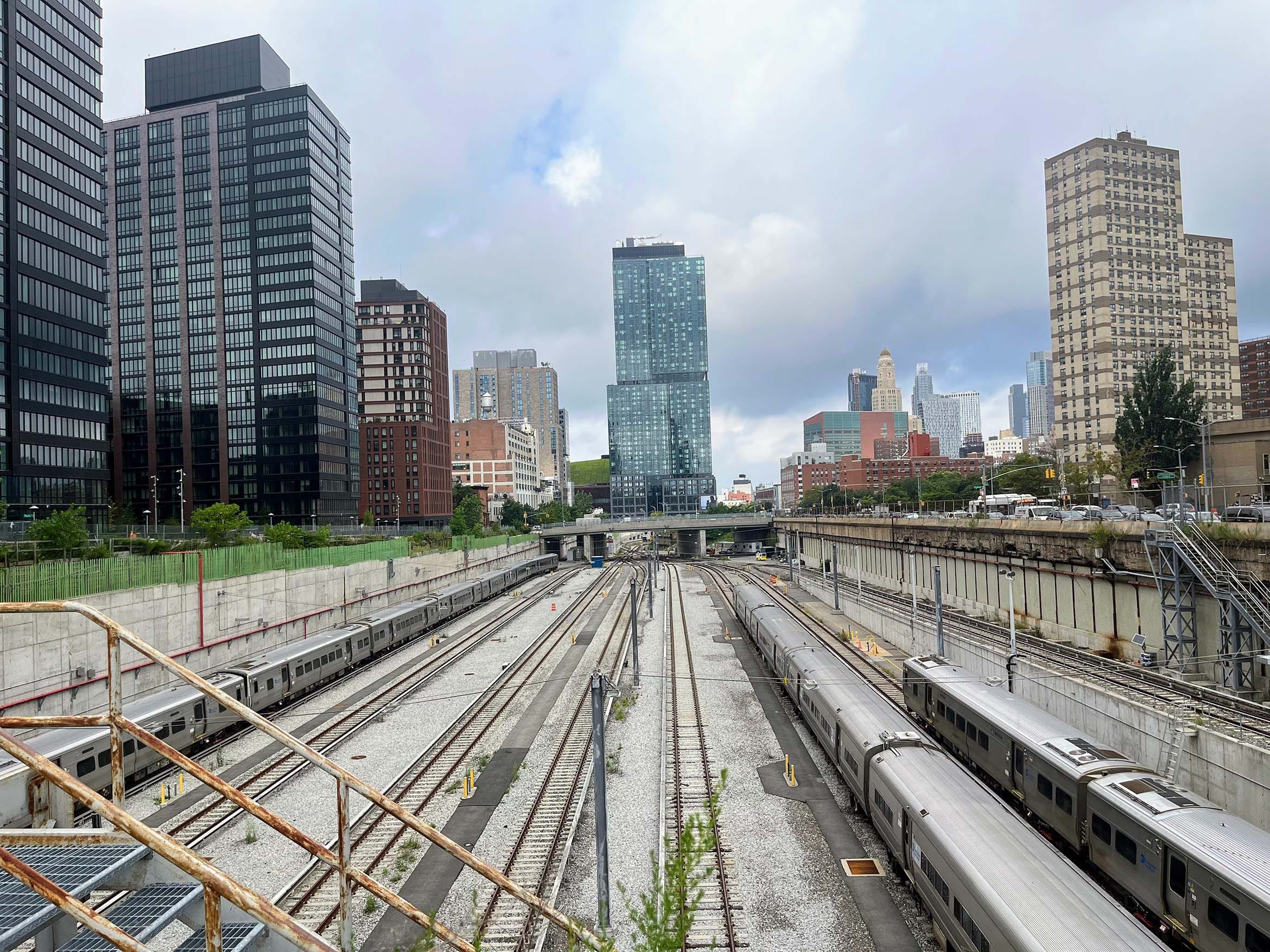
Well, if work on Block 1121 closes the open space on the southeast block, how extensive would that be, and how long would it take?
Later, Simon suggested that building the eastern block first “would really make a difference, because nobody believes they will end up with the open space.”
Dealing with constraints
LCOR’s Tortora noted that they’d previously discussed prior investments in foundations and utility infrastructure, highlighted in pink in the image below, and solid ground sites overlayed in gray.
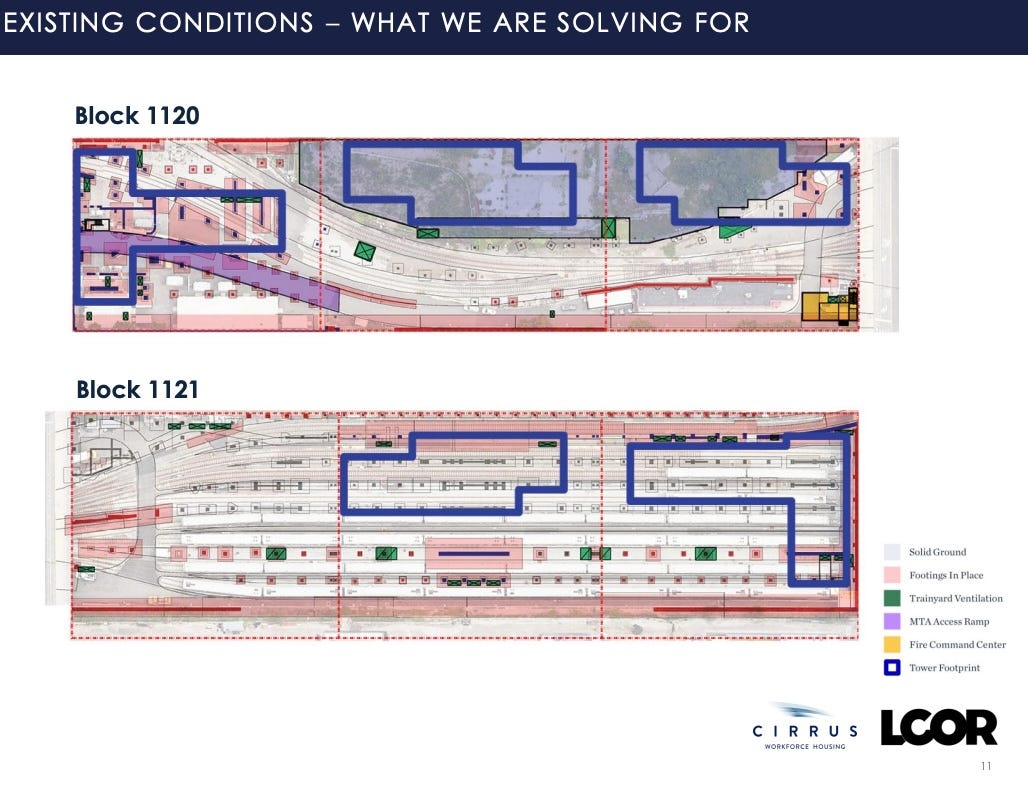
“We haven’t talked as much about the fixed platform design constraints,” he said. For example, the ramp at B5, shaded in purple top left, provides Long Island Rail Road access to the railyard from Sixth Avenue. (It’s pictured below.)
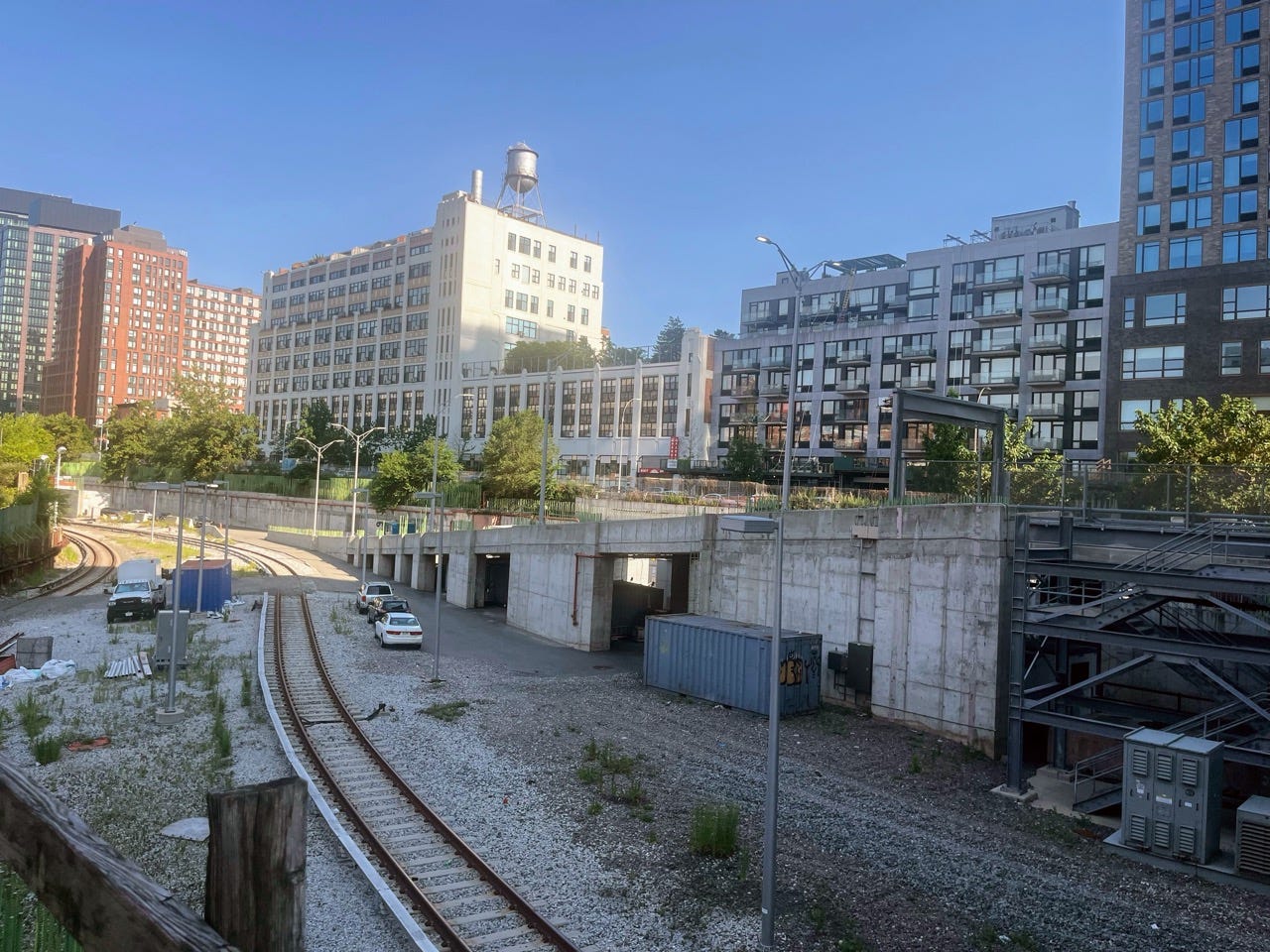
“To maintain necessary clearances, it also results in a 20-foot elevation change at the ground floor of B5,” Tortora said. “All of that must be coordinated with the building’s massing and design.”
In the diagram, the green highlights indicate mechanical ventilation shafts that must be coordinated with the buildings and the open space. The redesign of B6 and B7 locates them just north of those shafts, he said.
The developers also must work around the LIRR’s future fire command station, highlighted in yellow at the bottom right of Block 1120 in the image above.
Community requests & facilities
“We heard from the community the need for safer streets, more greenery, and concerns about wind,” Tortora said, drawing on the four public sessions that helped inform the Community Engagement Report. (My coverage.)


Their proposal, he noted, includes various streetscape improvements. They’re discussing proposed crosswalk changes with the Department of Transportation. “Wind mitigation will also be a focus.” (Well, it has to be.)
They plan three community facility spaces on the railyard blocks.3
An intergenerational community center in the first tower, B6, would include senior services, youth services,4 and childcare—a promise made by original developer Forest City Ratner, which has been incorporated into the state’s Modified General Project Plan.
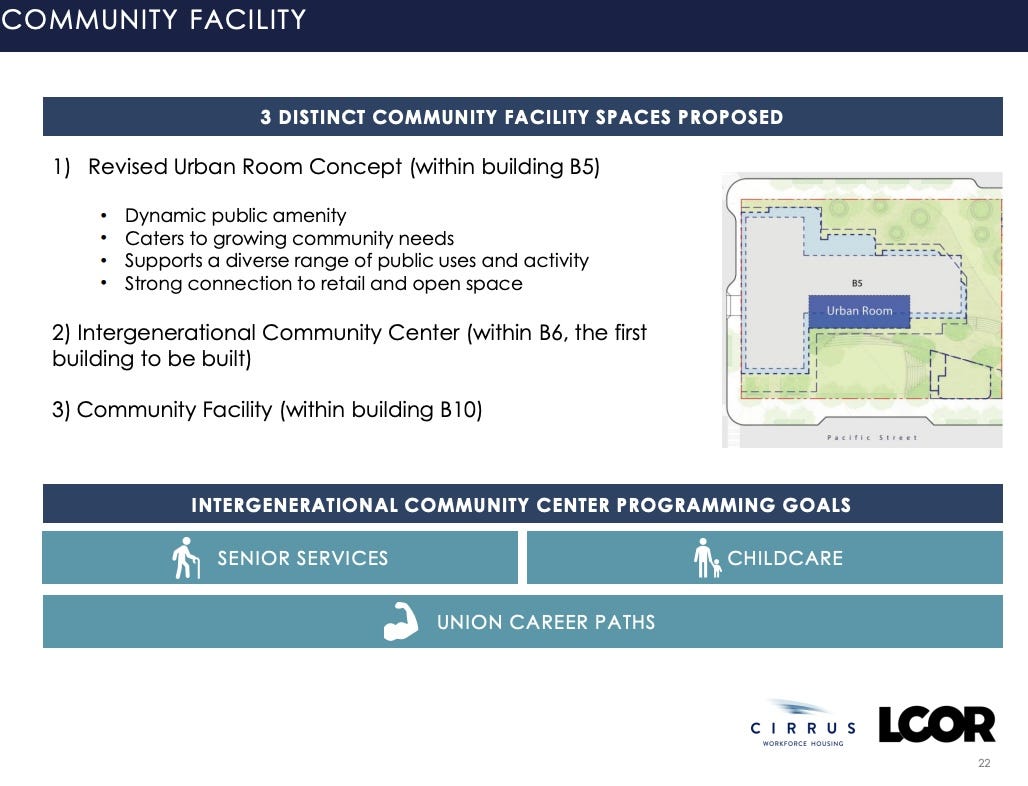
As the slide suggests, Cirrus, given its labor-union connections, also seeks to support union career paths. They’ve talked with the Consortium for Worker Education.5
The B5 parcel, just east of Sixth Avenue, could include “a revised Urban Room concept,” a reference to the atrium once promised for the prow of the unbuilt B1 flagship tower, once slated to loom over the arena.6
That, said Tortora, involves converting the “extremely challenging portion of B5” that includes the MTA access ramp to a “dynamic space with unique views that can be connected to the open space in creative ways.” (A rendering would be useful.)
The final building, B10, could have an “additional flexible community space,” Tortora said. There’s little reason to program that now, since it wouldn’t open until at least 2040.
Bulk and scope
Tortora said their proposal was similar to what was presented at public workshops last year. Well, it was far more fleshed out than the vague image they circulated last November.
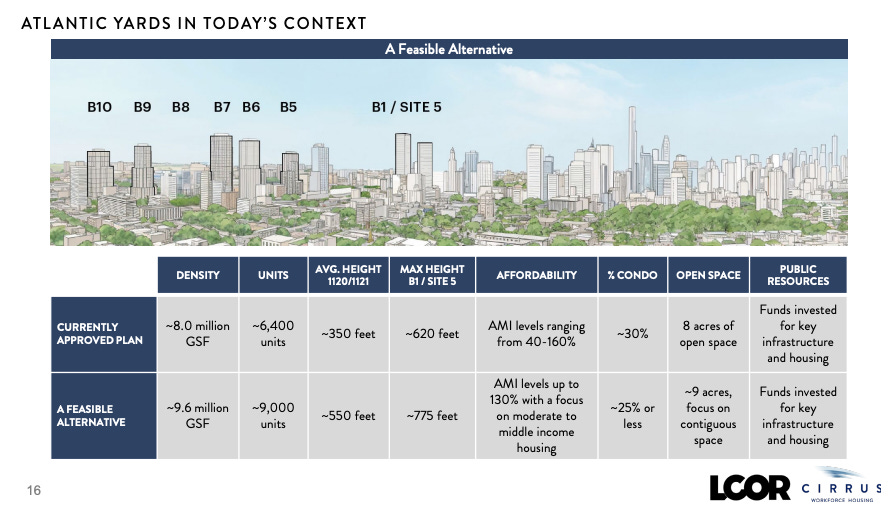
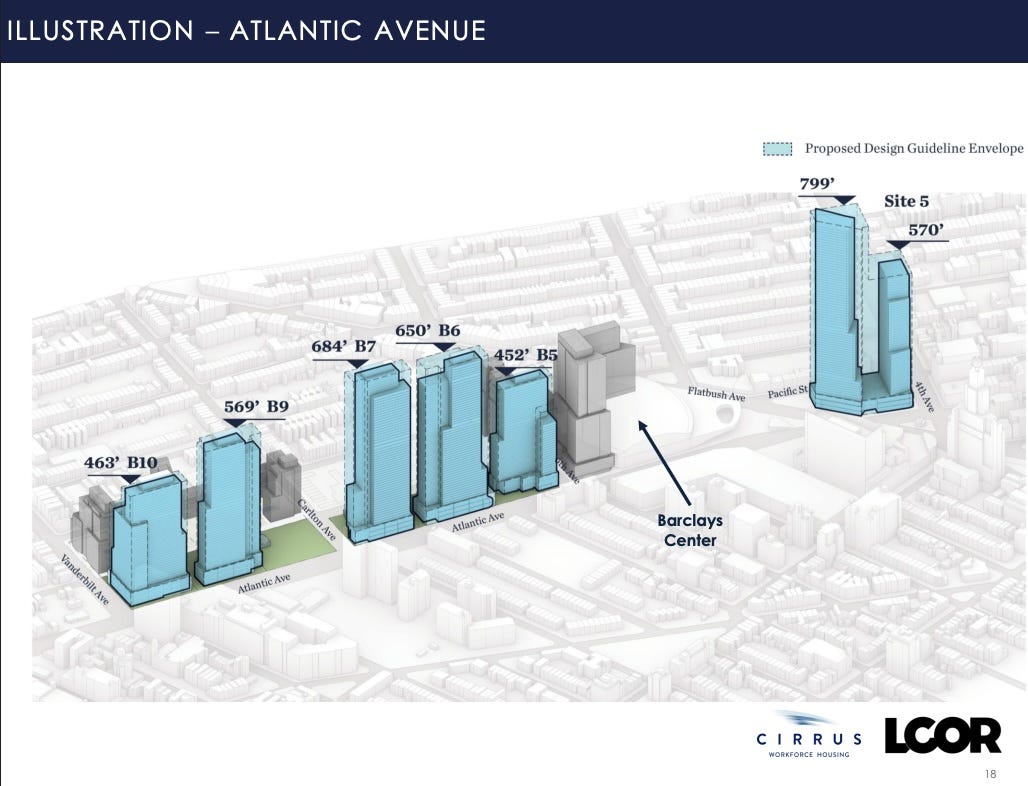
“We’re proposing to increase bulk by 20%,” he said, alluding to the increase of 1.6 million square feet on an overall project approved at 8 million square feet. That’s a self-serving framing, given a far larger bulk increase at the remaining sites.7
Tortora said that while the Atlantic Yards was approved to include 336,000 square feet of office space, “given the need for housing”—and, unmentioned, the lack of demand for office space—they aim to transfer that bulk to housing.8
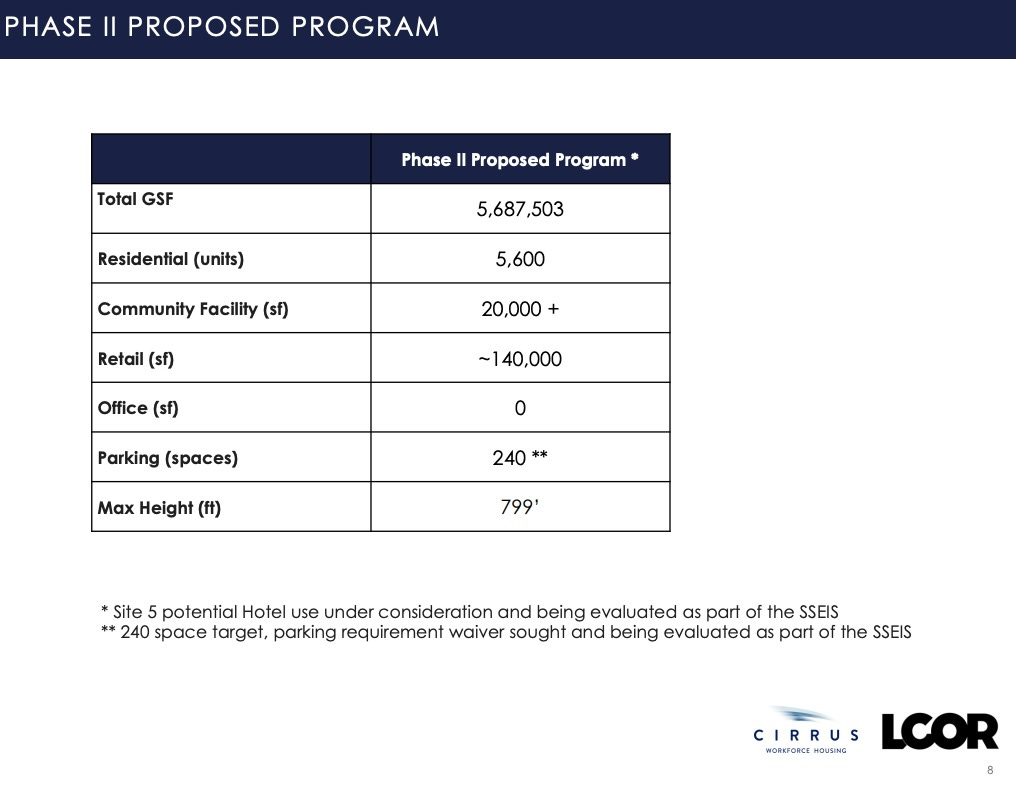
The requirement of 240 parking spaces at Site 5 remains, Tortora said, though “it will be studied” in the environmental review. No one discussed the slide’s statement that the developers will seek a waiver to drop the parking. (That saves money.)
Regarding residential space on the railyard blocks, Tortora said Block 1120 would have about 2.4 million gross square feet (gsf) and Block 1121 about 1.57 million gsf. (Those calculations include things such as corridors and mechanical spaces.)
The 75,000 square feet of retail on those two blocks, observed Veconi, “doesn’t seem like very much.”
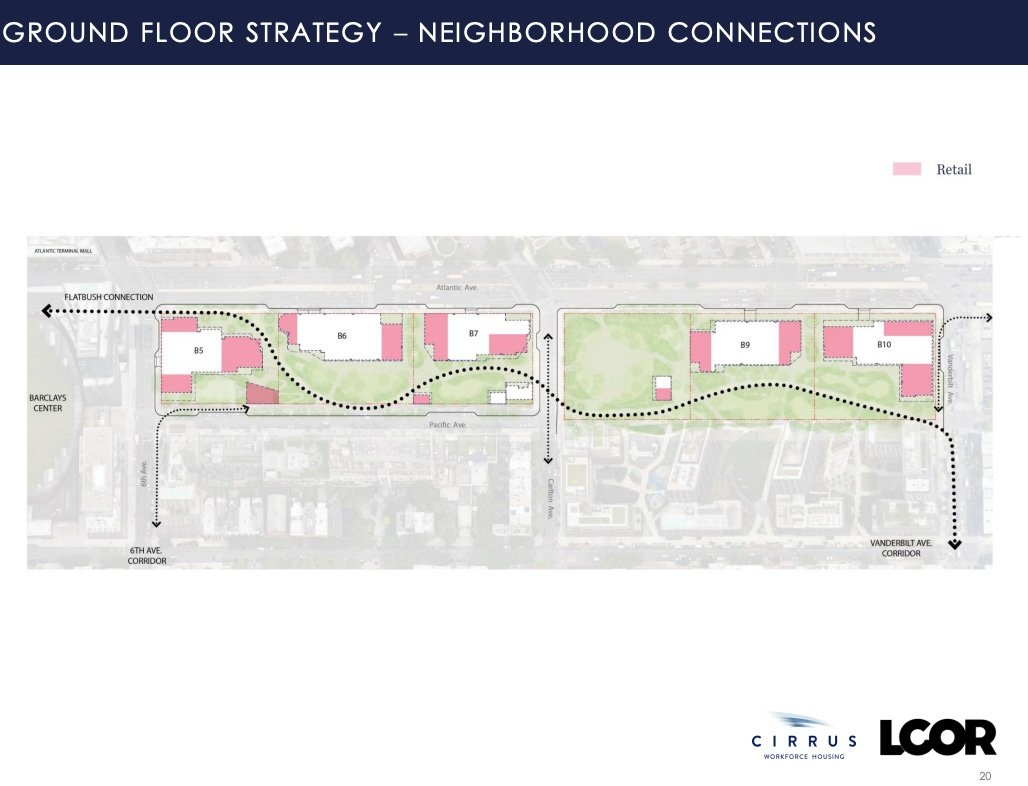
Tortora cited constrained footprints and the need for local lobbies, “but we think that’s sufficient.” Smaller spaces would appeal to local retail, and the layout aims to activate the ground floor on both the front and the back of the new buildings, especially spaces bordering streets.
(Also note the standalone retail planned near Pacific Street.)
The community facility space would add more than 20,000 square feet.
Open space details and math
With their landscape architect, McDonnell said the developers confirmed that the open space—which the previous developer dubbed “Pacific Park,” as with the project’s lame-duck name—could host various community needs, including playgrounds, shaded groves, active uses, and passive uses.
(Unmentioned: a dog run, though another one is already necessary, given the congestion at the existing location.)
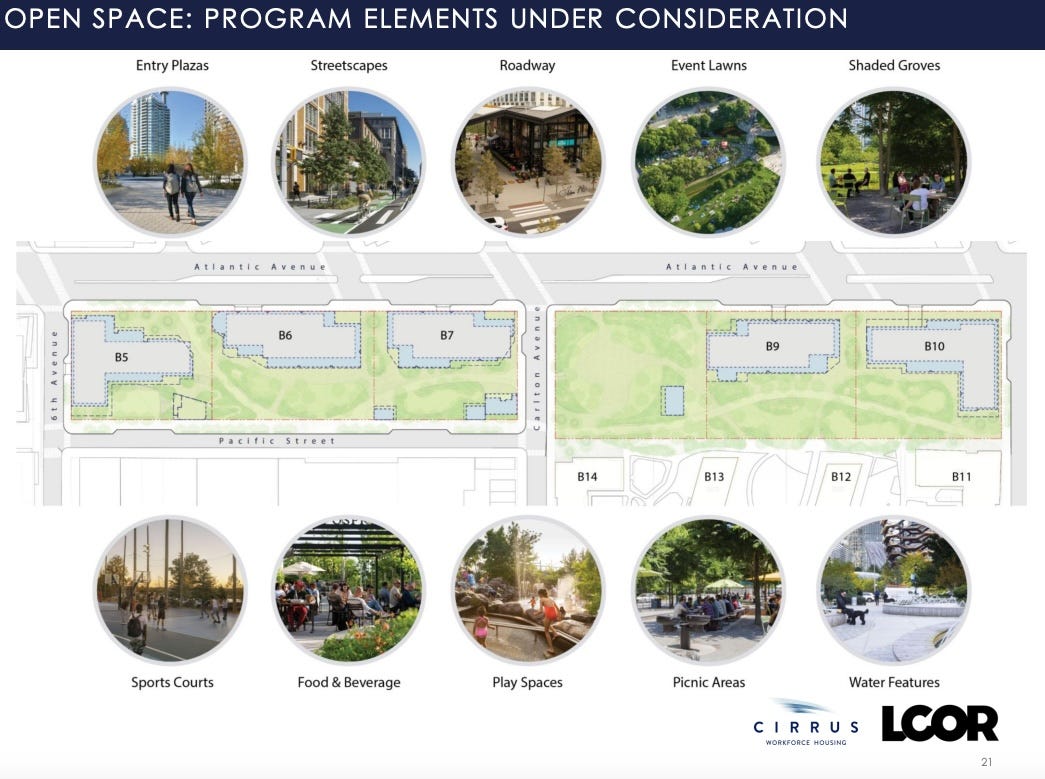
While the developers previously said they’d add an acre of open space, bringing the total to 9 acres, they now estimate 8.5 acres.
Queried by Veconi, McDonnell said the original calculation included the arena site—the plaza?—“so we pulled that out.” That’s confusing, since no one ever claimed the previous calculation of 8 acres included the arena.
They aim to better articulate the tower podiums, McDonnell said, which could “create what I would call more of the Brooklyn scale” and also help with wind mitigation.
The open space, McDoinnell said, now would be “uninterrupted and can be delivered in a rational way.”
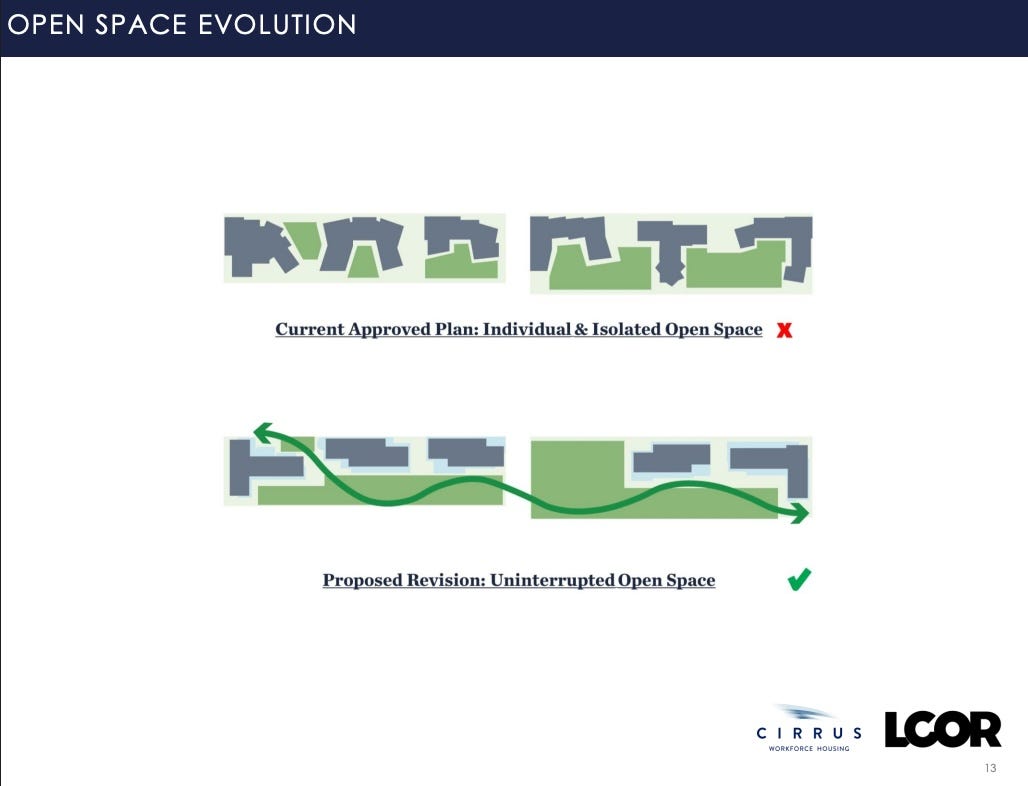
That raises a question. Why did New York State and City officials, overseeing previous iterations of the plan, not object? Why didn’t the architecture critics for the New York Times?
Unmentioned: the open space deficit
Nobody talked about how well the open space could serve the population.
The total project, with 8,812 units, could house 18,505 people, based on the previous metric of 2.1 people per apartment. With 18,505 people and 8.5 acres of open space, that’s approximately .46 acres of open space per 1,000 people.
As I’ve written, the Department of City Planning seeks 2.5 acres per 1,000 residents, including .5 acres of passive space and 2 acres of active space, while the citywide median ratio is 1.5 acres per 1,000 residents.
This new calculation of 0.46 acres is lower than current projections: with 13,760 people and 8 acres of open space, Atlantic Yards was slated to have 0.58 acres per 1,000 people.9

While the state environmental review has waved away concerns, citing the potential to access Fort Greene Park and Prospect Park, those are not quick walks.
Site 5 plans
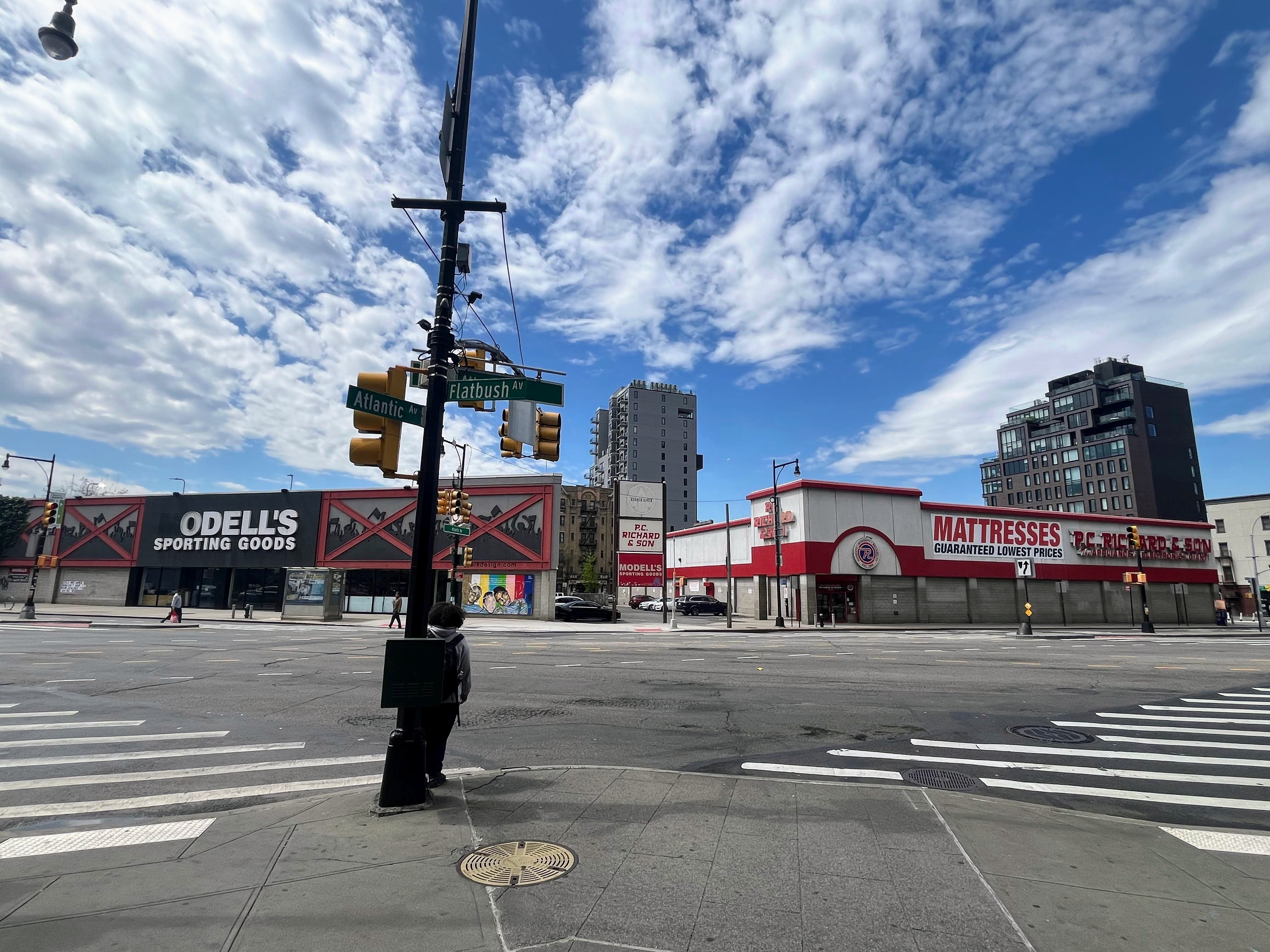
Site 5, longtime home to the big-box stores P.C. Richard and the now-closed Modell’s (now home to the temporary Brooklyn Basketball Training Center), was approved in 2006 as a 250-foot, 440,000 square-foot building.
Since 2015-16, the developers have planned to transfer the bulk of the unbuilt tower slated to loom over the arena (B1, which architect Gehry called “Miss Brooklyn”) across Flatbush Avenue to Site 5, creating a giant, two-tower project.
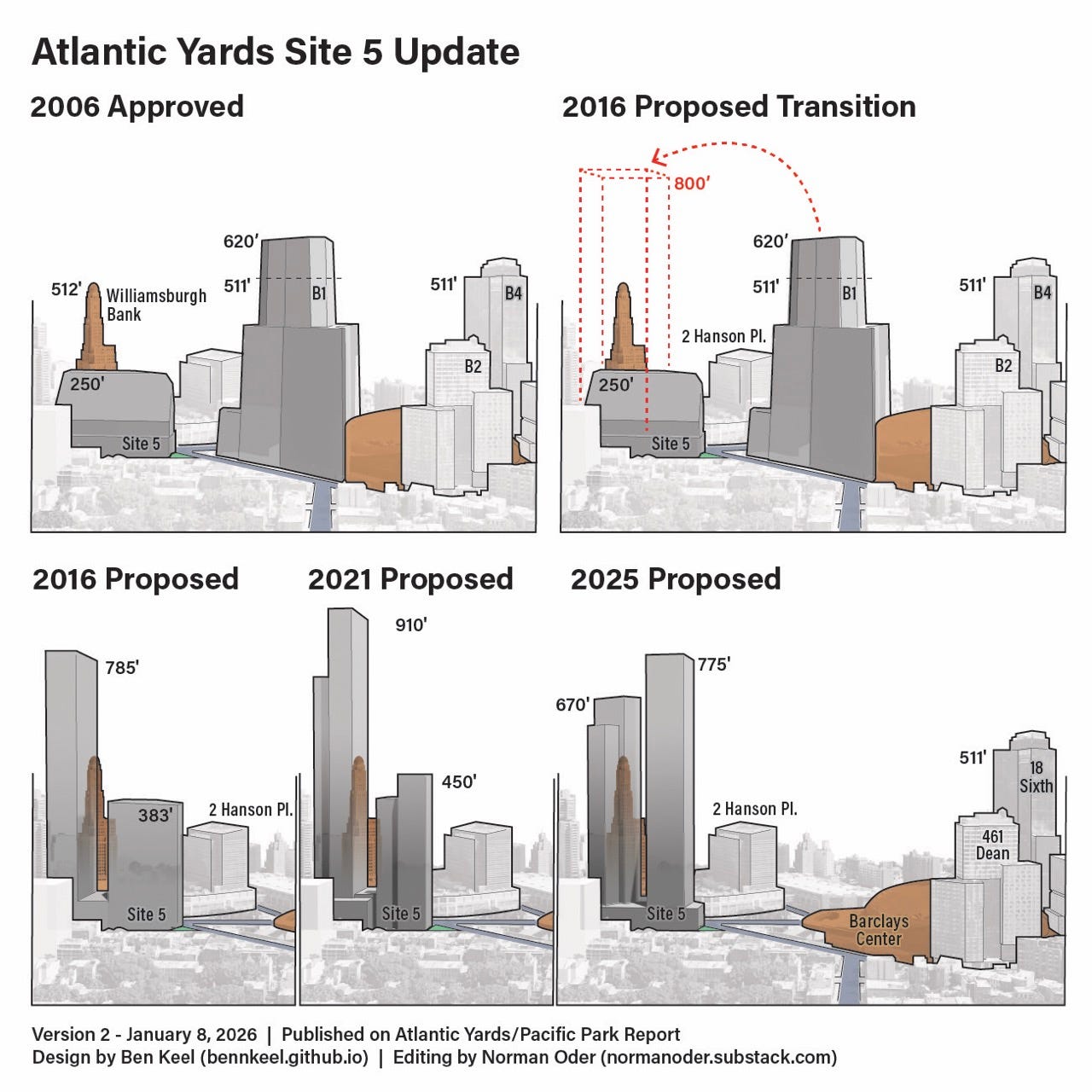
In 2021, ESD signed an Interim Lease with the previous developer Greenland USA, assuming 1.242 million gross square feet of development. The developers now seek to build 1.45 million gsf to accommodate two towers with 1,403 apartments, including 400 condos and 251 affordable rentals.
By my calculation, that’s astonishing density: 1,257 apartments/acre, and an unprecedented Floor Area Ratio of 29.8. FAR is the multiple of a building’s bulk over its footprint.
(It would be modified to a lower number by the conversion of gsf to zoning square feet, but likely would be well above 25, which is the limit in Jersey City’s notably dense Journal Square. Moreover, a FAR over 20 is only allowed there on lots larger than Site 5.)
Perhaps that’s why they provided a site plan for Site 5 but no rendering.
“While at the higher end of the downtown Brooklyn range, the building is significantly shorter than Brooklyn Tower, which is over 1,000 feet tall and shorter than the proposed project at 395 Flatbush, which was recently approved at 840 feet,” Tortora said. He didn’t compare their (lower) Floor Area Ratios.
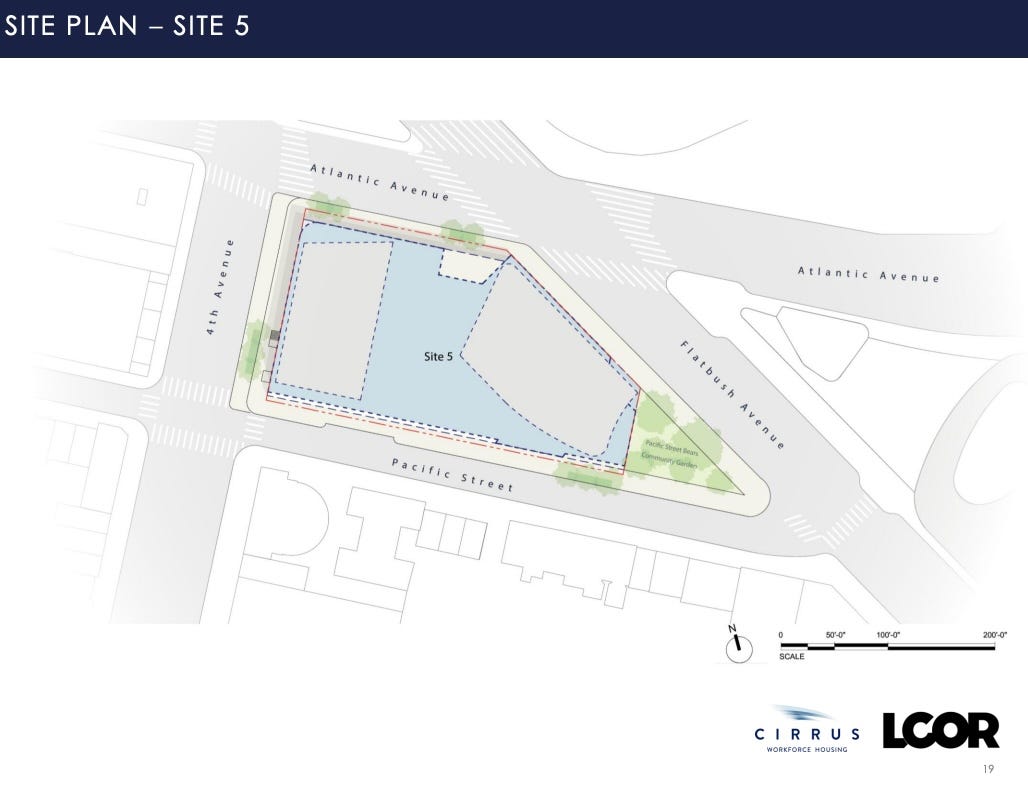
The two towers of Site 5 would be oriented towards the wide streets, Flatbush Avenue and Fourth Avenue, trying “to preserve the existing residential scale of Pacific Street to the greatest extent possible,” he said. (That leaves wiggle room.)
“The proposed bulk of site 5 also represents 6% less bulk than what was originally contemplated for site 5 and B1 combined,” Tortora said. While presented as a sacrifice—they’re not maximizing every shred of square footage—there’s a reason why no one’s previously proposed a tower that large.
(Despite the limited pushback, I suspect the Site 5 proposal is a gambit, from which they can “compromise” to an already acceptable smaller version.)
Site 5 would have a podium, “sort of townhouse in scale,” said McDonnell, some 40 to 65 feet, “with materiality similar to a townhouse versus the current cinderblock big-box stores.
That would transition somewhat to low-rise Pacific Street at the south. It would include retail uses and might have a roof that could be programmed for use.
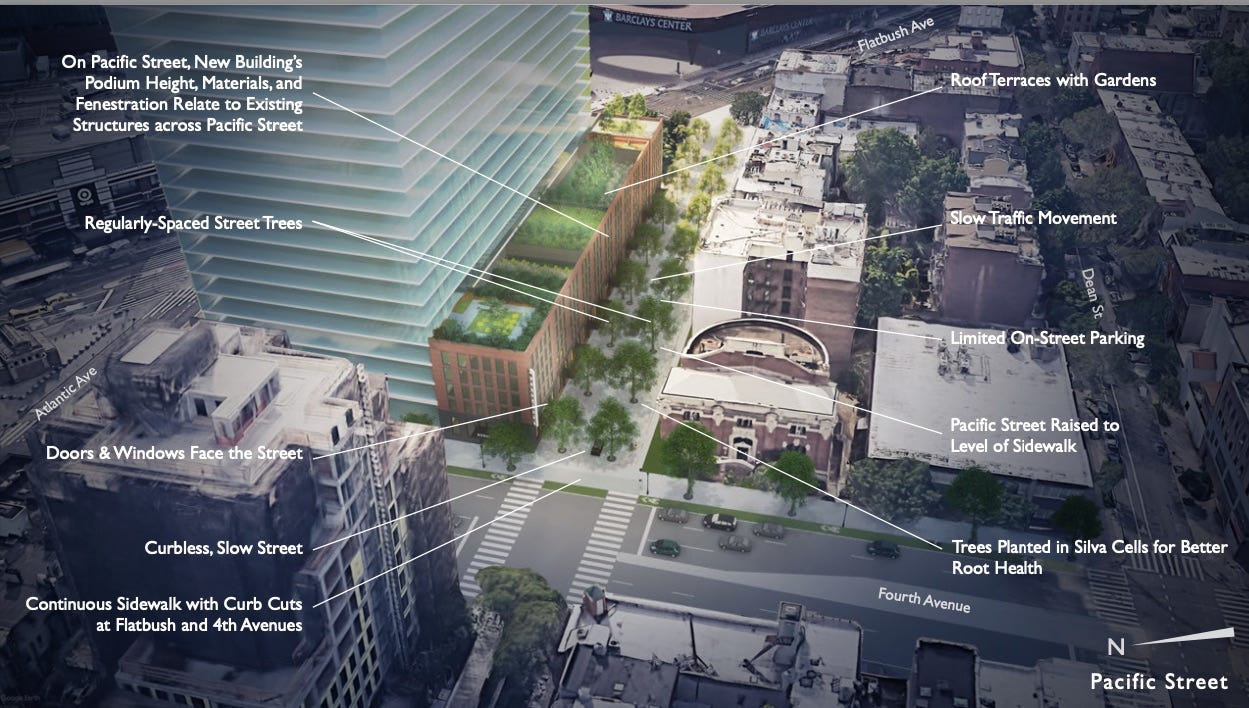
Residential entrances would be on Pacific Street, and street trees would be added. “We’re thinking about interior loading docks so we don’t have trucks idling on Pacific Street all day,” McDonnell said.
A “shared street”?
The city Department of Transportation, he noted, may make Pacific a “shared street,” which the developers support.
A shared street, according to the city, also known as a “pedestrian-priority” street, is a roadway designed for slow travel speeds where pedestrians, cyclists, and motorists all share the right of way.
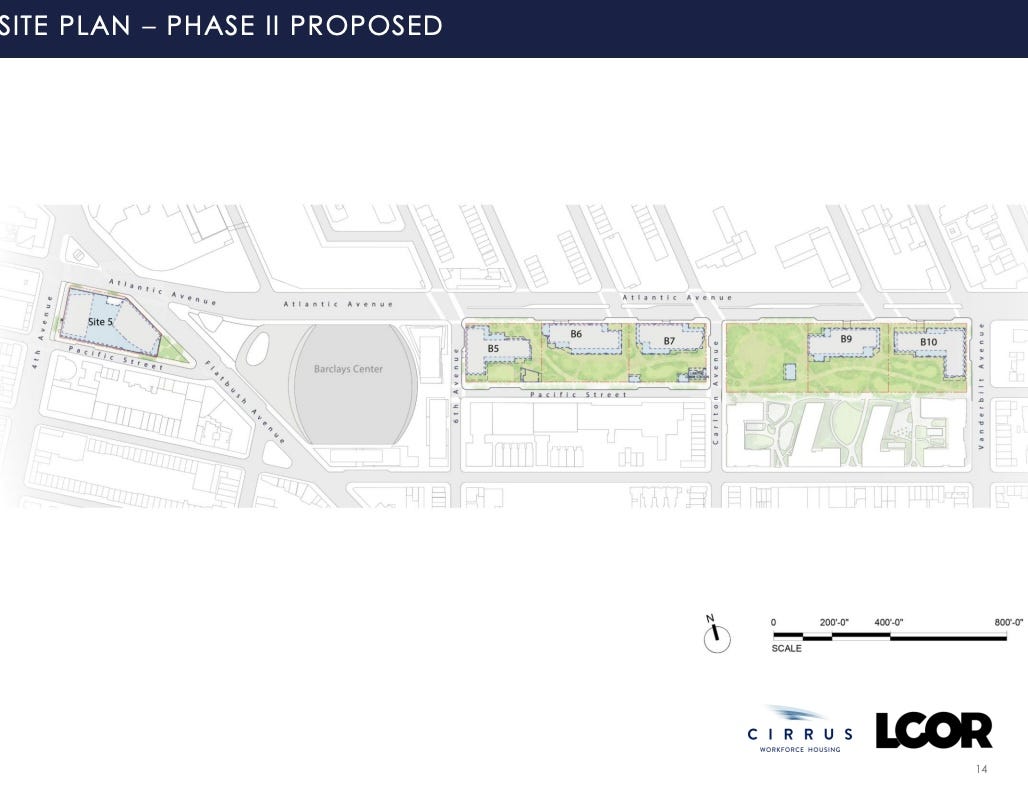
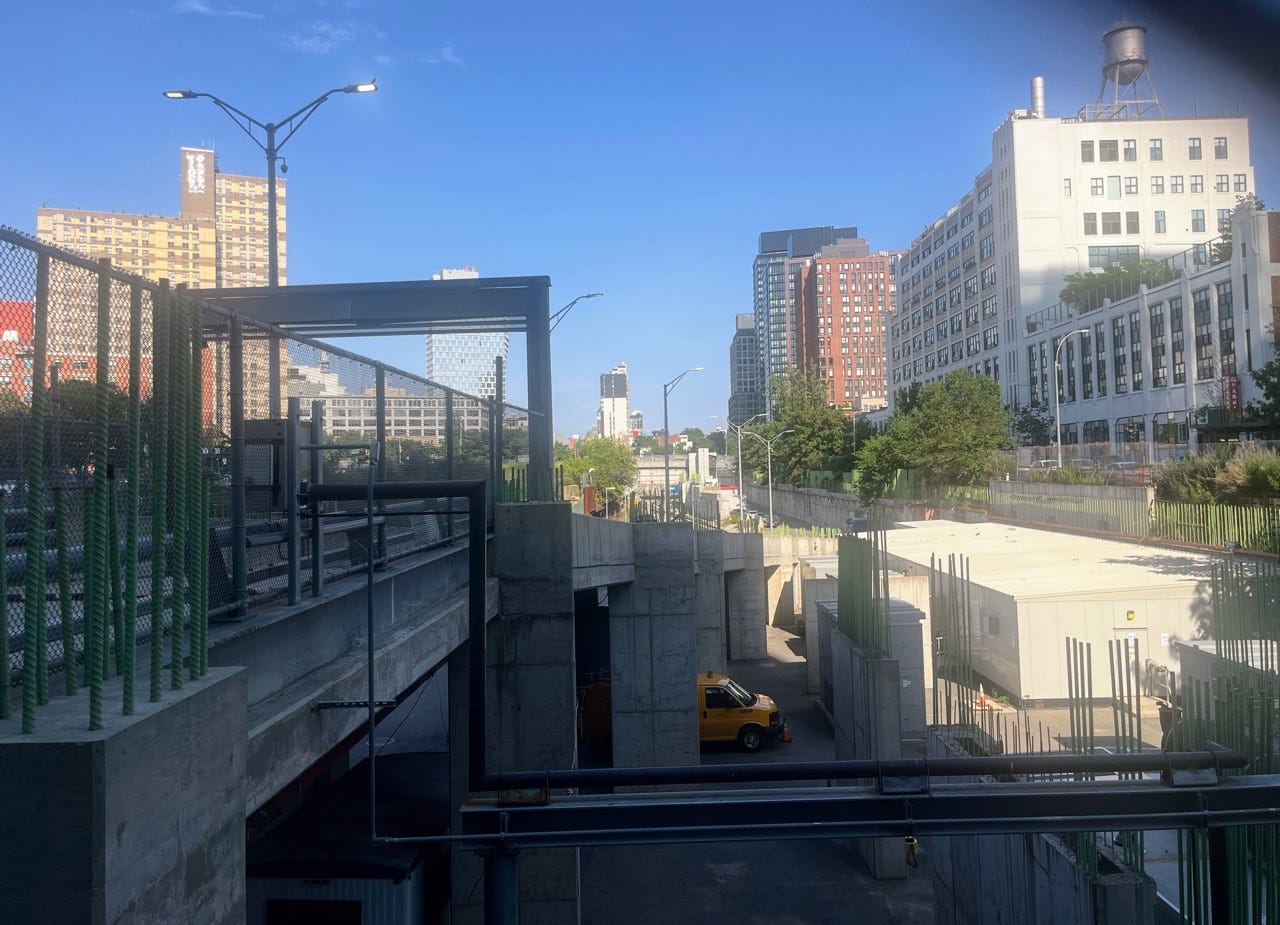
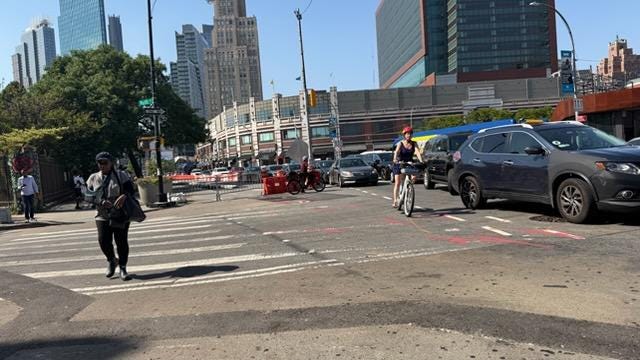
That seems a challenge. Could delivery vehicles—not just to Site 5 but also leaving neaby Chick-fil-A—and ride-shares, for example, really drive 5 mph? Below the somewhat similarly situated Alloy Block, on State Street, I noticed periodic congestion.
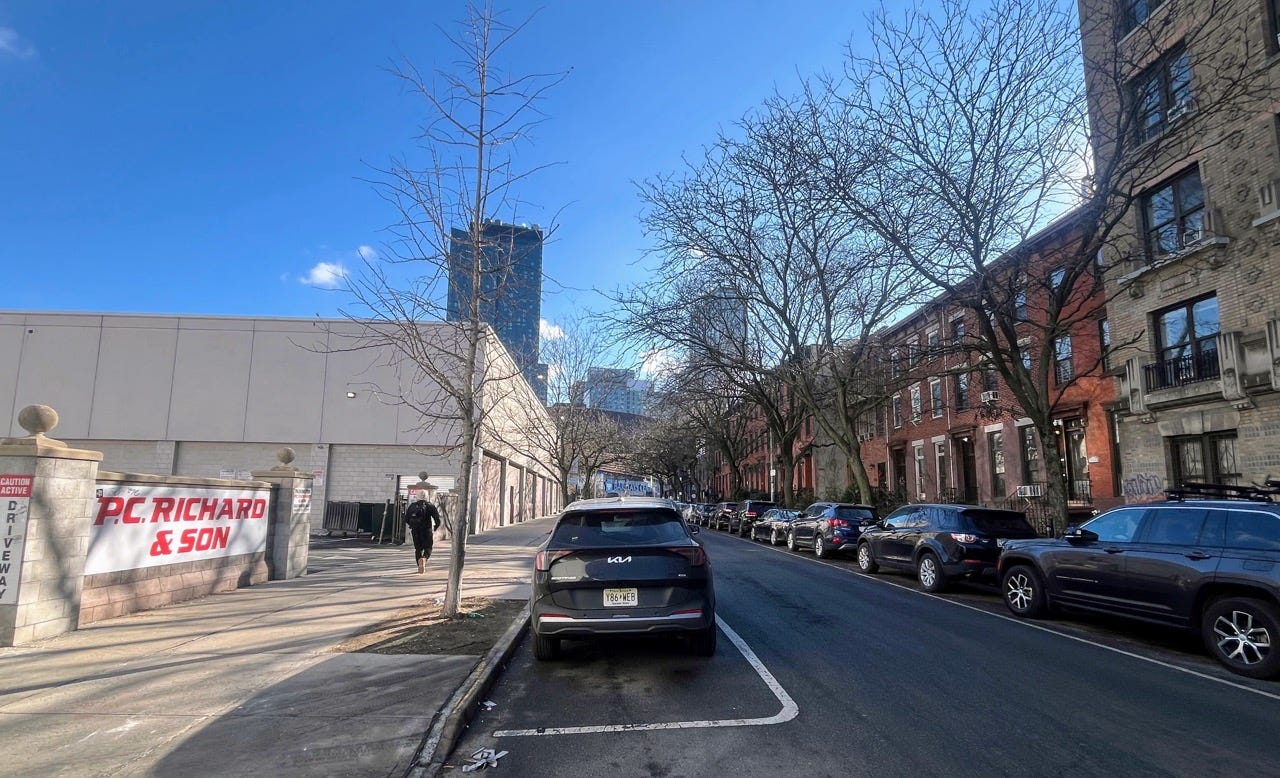
While the Site 5 loading dock is not fully planned, McDonnell said, the diagram (above) shows a curb cut east of Fourth Avenue. That’s a little west of the current entrance to the surface parking lot, as shown in the photo below.
If the city, as contemplated, changes Pacific Street to westbound only, asked AY CDC Chair Daniel Kummer, how might that affect the loading dock?
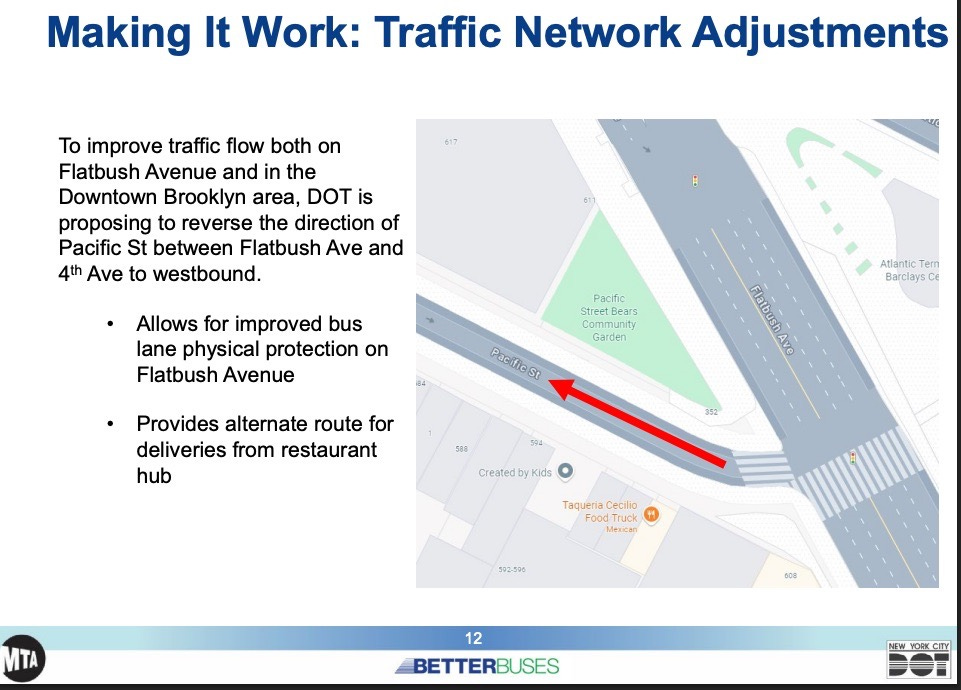
Any southbound truck on Flatbush serving the building, McDonnell said, “can actually make that [sharp] right turn” onto Pacific.
Shiffman questions Site 5
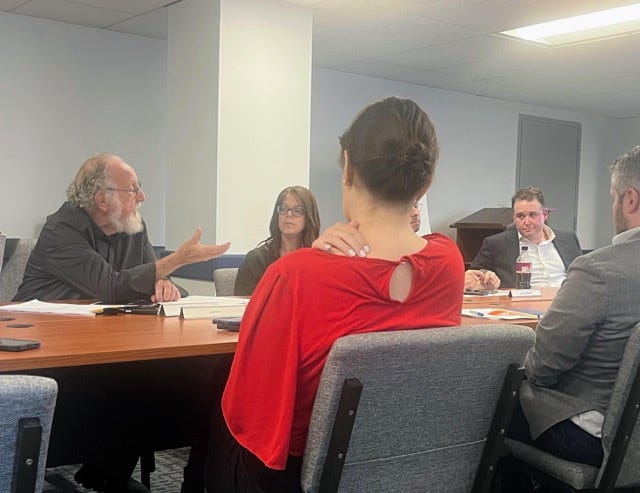
“To what extent do you believe that a family can live and function at that site?” asked AY CDC Director Ron Shiffman, a veteran advocacy planner.
“We’re in the business of delivering viable community facilities and residential communities to accommodate not just single professionals but families as well,” Tortora said. That includes access to open space, connection to essential services, and safe streets. (There’s no room for public open space at Site 5.)
Some people think “vertical living is negative for families” because of past bad designs,” McDonnell said, but with open space, amenities, safe streets, and “elevators with appropriate wait times,”10 such buildings “can be very successful for families.”
“I think a lot of families will actually fight in the lottery to live in these buildings,” he added, “because it is so centrally located.” They might, even if they had misgivings about a building too bulky to build even in development-friendly Jersey City.
Shiffman suggested that the developers provide renderings of the shadows cast by Site 5, plus a wind analysis.
Simon on Site 5
Regarding Site 5, Simon observed. “There’s no there there, right? It’s a very small site.” It’s far denser than the borough’s first supertall, Brooklyn Tower, which the developers had noted was taller, citing a FAR of 25 vs. 15.
“There’s no open space there,” she said. “It’s unfair” to expect a family to schlep over to what someday may be the Garden of Eden that we were promised 20-some years ago. (New York Times architecture critic Herbert Muschamp had unwisely suggested a “Garden of Eden” would emerge in Brooklyn.)
Simon also suggested that traffic and deliveries would cause congestion on Pacific Street. She noted that the Barclays Center loading docks were overwhelmed with certain truck-heavy events.
“You can’t take the [Pacific] Bear’s Garden unless you work out some deal there, right?” she observed of the community garden at Site 5’s tip. (They can’t. It’s part of a land trust. The gardeners would like to see a transition between the new development and the garden.) So Site 5, she said, “is a sticky wicket.”
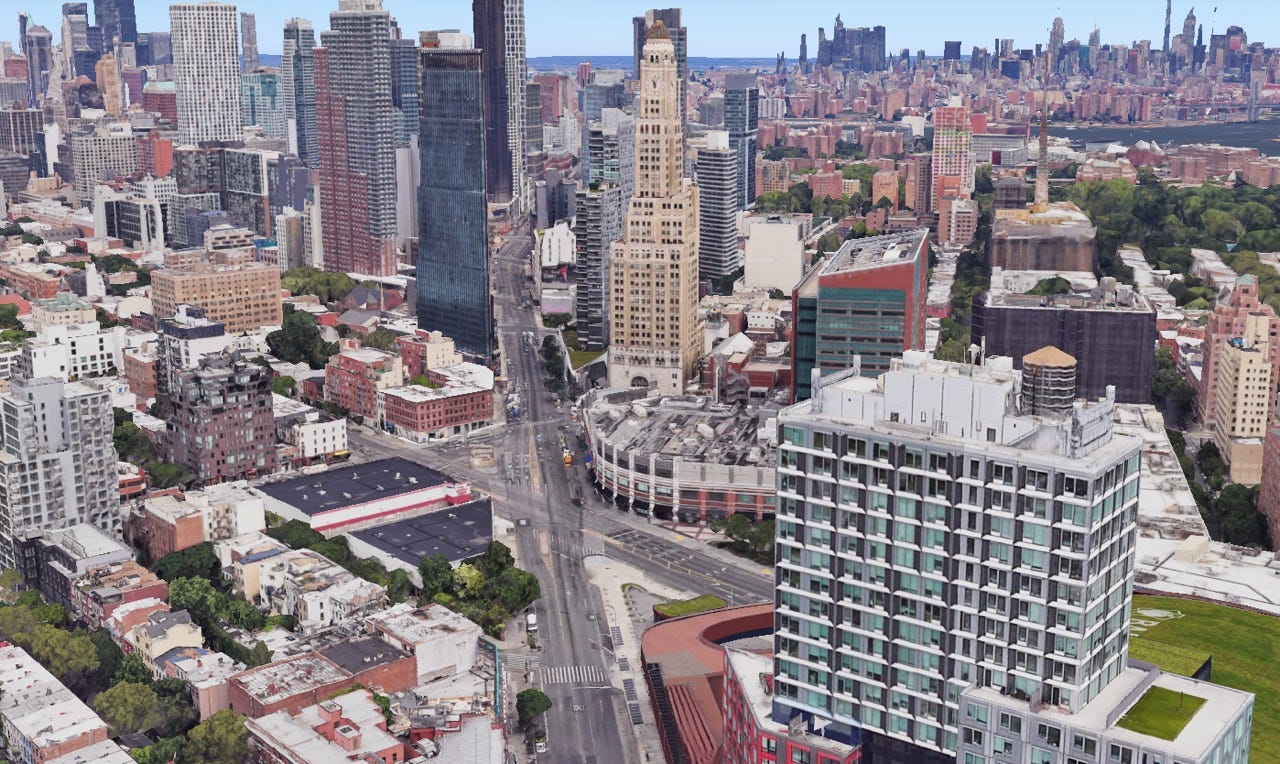
Site 5 details
Queried by Veconi, McDonnell said “we’re envisioning Site 5 effectively taking the bulk that was originally on B1.”
Actually, the two buildings were approved at about 1.545 million gross square feet, more than the 1.45 million gsf they now seek.
The residential square footage, said Tortora, would be about 1.26 million gsf. If a boutique hotel is built at Site 5—serving arena visitors and visiting teams or entourages—the square footage would “slightly reduce the residential,” said McDonnell. (That implies fewer apartments.)
The building would have about 75,000 square feet of retail, less than once contemplated. Retail—including a returning P.C. Richard store, required in a legal settlement—would be accessed on Fourth and Flatbush avenues. (I’d bet the hotel, too, would be accessed from Flatbush, across from the arena.)
The residential entrance would be on Pacific Street.
“And how do you manage the question of folks crossing Flatbush Avenue to the open space?” asked AY CDC Director Marc Jahr. (It’s not right across the street—they’d have to walk around the arena block.)
“Flatbush Avenue is kind of a moat”—Marc Jahr
“Well, I think there’s a broader discussion with DOT going on around changing the public realm here,” responded McDonnell. The developers also aim to improve the surroundings.
“Flatbush Avenue is kind of a moat,” pronounced Jahr succinctly. “It’s a rough site to navigate.”
Timing questions
Site 5, McDonnell said, would require between 12 and 18 months to get started. Given that it’s not on top of a railyard, “Site 5 acts in many ways like a normal site, not quite, but pretty close.” (It is in part over a subway station.)
“We expect to start B6 and the [associated segment of the] platform,” said McDonnell, “not the same day, but in short sequence and then Site 5 to come shortly after that.”
He clarified that “shortly” meant “within six months to a year.”
So it’s possible that B6 could start in early 2028, but Site 5 not until 2029.
Tortora said that a working group meets regularly with an MTA technical team. The developer pays the MTA’s costs. “So part of the cost of the platform,” he said, is “paying the MTA for air rights” and safety personnel. Well, the air rights were bid out two decades ago.

Comments on affordability
The official statement from Gov. Kathy Hochul had not been circulated before the meeting:
”Atlantic Yards is one of New York’s most significant unfinished affordable housing developments, and we are finally moving it toward completion. Brooklyn has waited long enough, and today we are turning a corner from years of delay to new homes, jobs and open space. We will continue our work to make New York more affordable, investing $25 billion in housing and cutting red tape to speed up construction.”
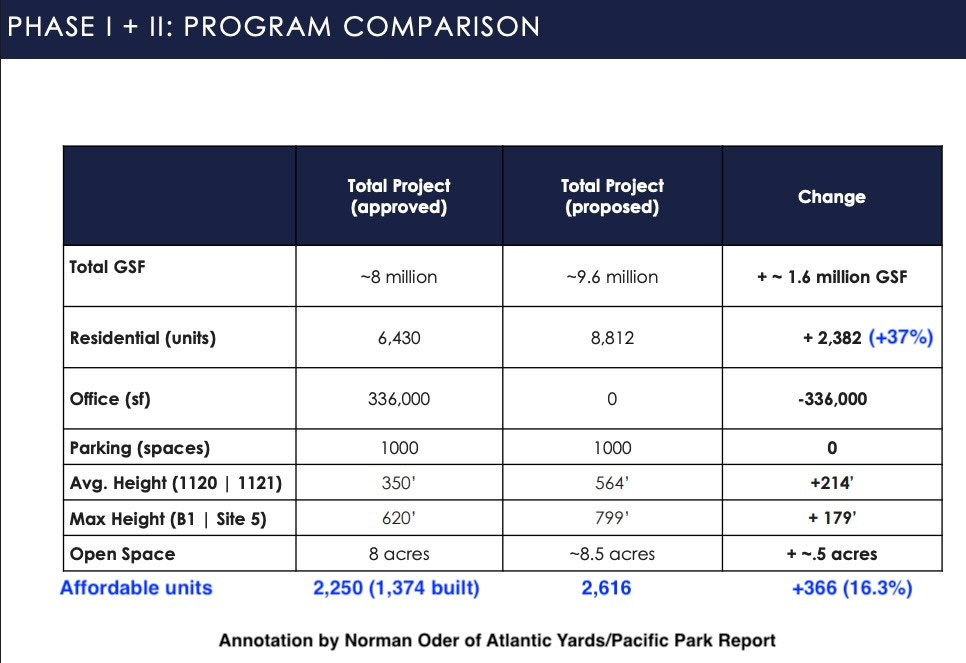
It’s a stretch to call it an “affordable housing development,” especially when the overall percentage of affordability is going down, to 30% from 35%, the percentage increase in overall apartments dwarfs the percentage in below-market units, and when state officials and the developers obfuscated about that housing.
(Hence my annotation of the slide below.)
de la Uz, who correctly noted that the presentation had not compared the affordability plans with previous promises, recommended that the project conform to the city’s Mandatory Inclusionary Housing policy.
“If you want some modification on that, then I think that’s worth the conversation,” she said.
Arguably, it’s in the ballpark, with 27% of the rentals averaging 75% of AMI. That’s seemingly in between MIH Option 1, which requires 25% affordability at 60% AMI, and Option 2, which requires 30% affordability at 80% of AMI.
However, that requires some caveats. As I wrote, it’s a net increase in just 366 affordable units, a far smaller increment than the overall increase. That means the project would have 30% affordability overall, rather than 35% as previously promised.
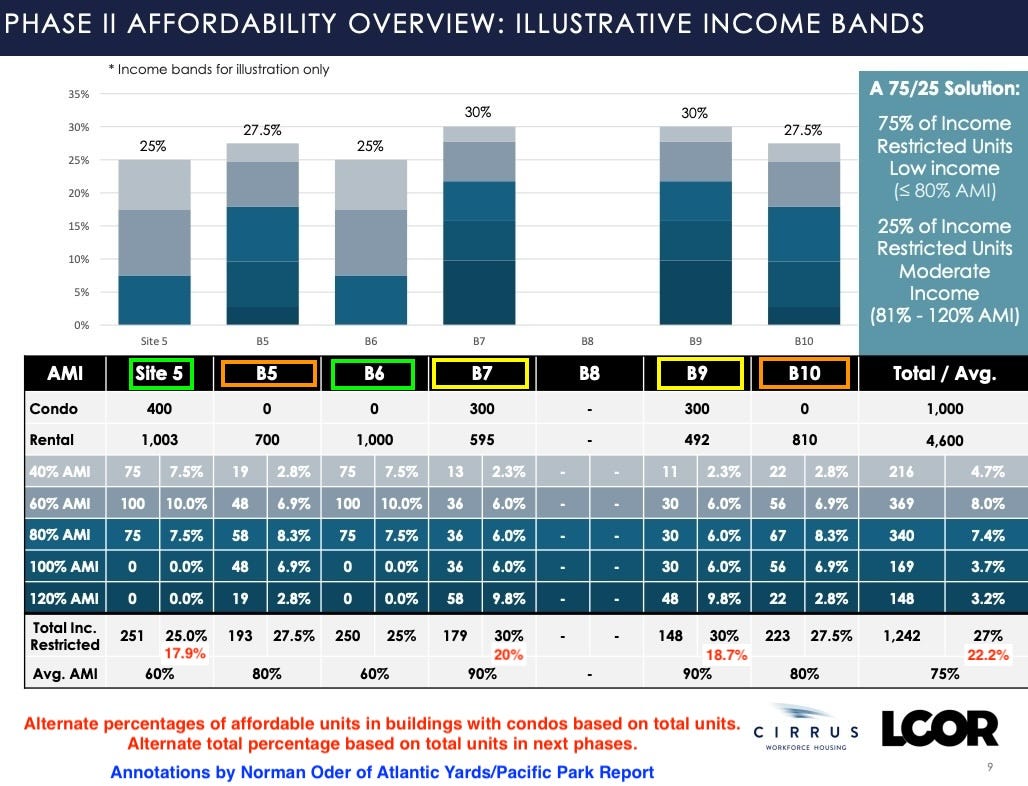
Also, Atlantic Yards has already fallen short. As de la Uz and others in BrooklynSpeaks have argued, the developers should first make up for those “missing” units, some 1,031.
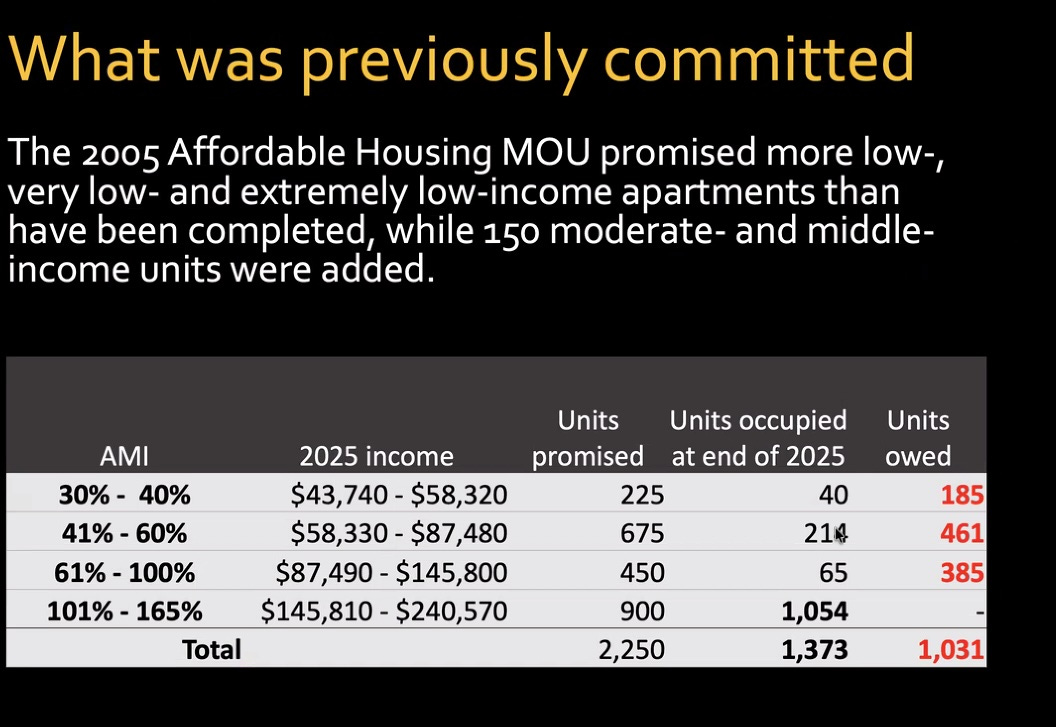
Later, Shiffman observed that the housing’s value must be linked to its delivery timing. “I just want to make sure everybody knows that this housing will come about in 2040.”
That’s misleading. The entire allotment of housing might be completed, at best, by 2040, though the developers target the initial building(s) for 2031. (If the past is prologue, neither target is a safe bet.)
Public criticism
Resident Robert Puca, who co-chairs the Prospect Heights Neighborhood Development Council’s Housing Committee with Veconi, and longtime project opponent, told the board that Atlantic Yards “would be the densest project in the United States”—well, it seems likely, according to Veconi’s research—and the intersection of Atlantic Avenue and 6th Avenue was “just a massive wind tunnel.”
He and his neighbors have borne the brunt of after-hours construction and failure to follow procedures. Puca said the project needs an enforcement unit, “someone you can call immediately in real time that can correct those problems.”
(The only regular public critic at such meetings—who else can get out during the day?—the pugnacious Puca generally gets humored or ignored.)
He contended that, rather than Greenland, the project’s biggest subsidy provider was New York State. Well, not direct subsidies—until and unless you count the now-expected $700 million. But the combination of tax breaks and other assistance easily exceeds $1 billion, especially benefiting the arena.

Puca reminded them, as I’ve contended, that the biggest winners in the project are Russian oligarch Mikhail Prokhorov and Alibaba billionaire Joe Tsai, both owners of the arena company and the Nets, who’ve benefited from the rising value of an NBA team in New York City.
An executive session
Shiffman questioned the plan to go into executive session to discuss the pending Memorandum of Understanding and the work of ESD consultant BJH Advisors.
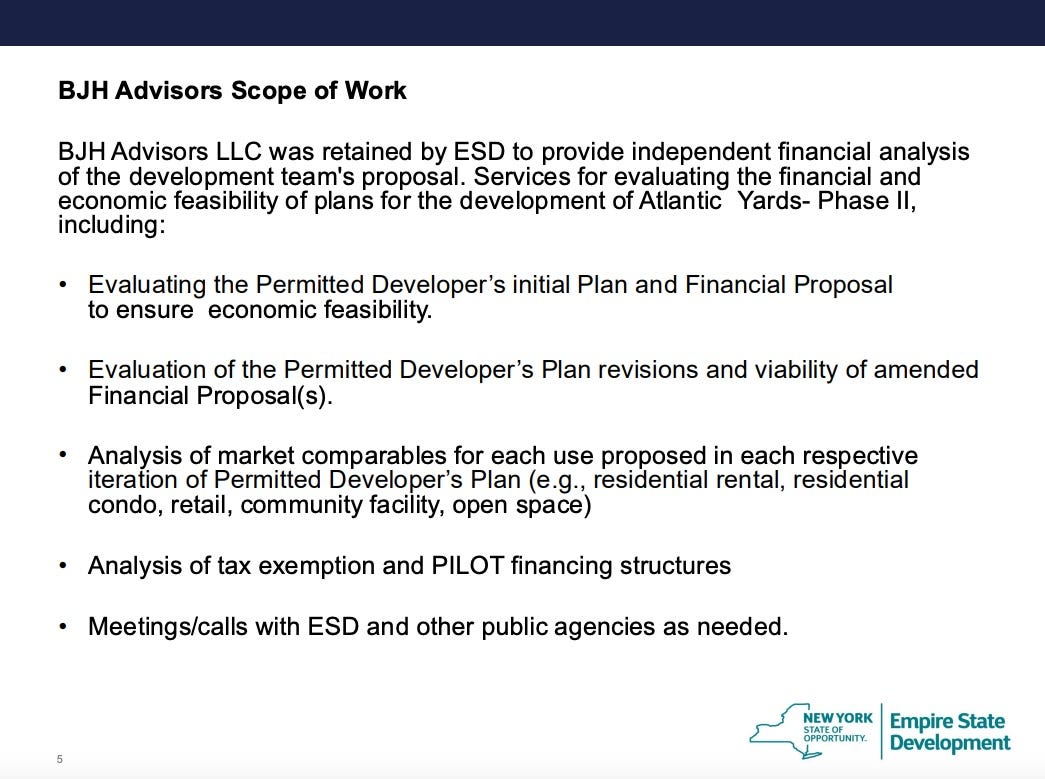
“On what grounds are we really doing that?” Shiffman asked. He said the topics discussed at a previous executive session in May didn’t need to be kept confidential.
Chair Kummer said the MOU “does contain sensitive information.” He agreed that aspects of their previous discussion probably could have been aired publicly, “but it’s hard to like slice and dice that.”
Shiffman was the only director to vote against the motion.
What’s next?
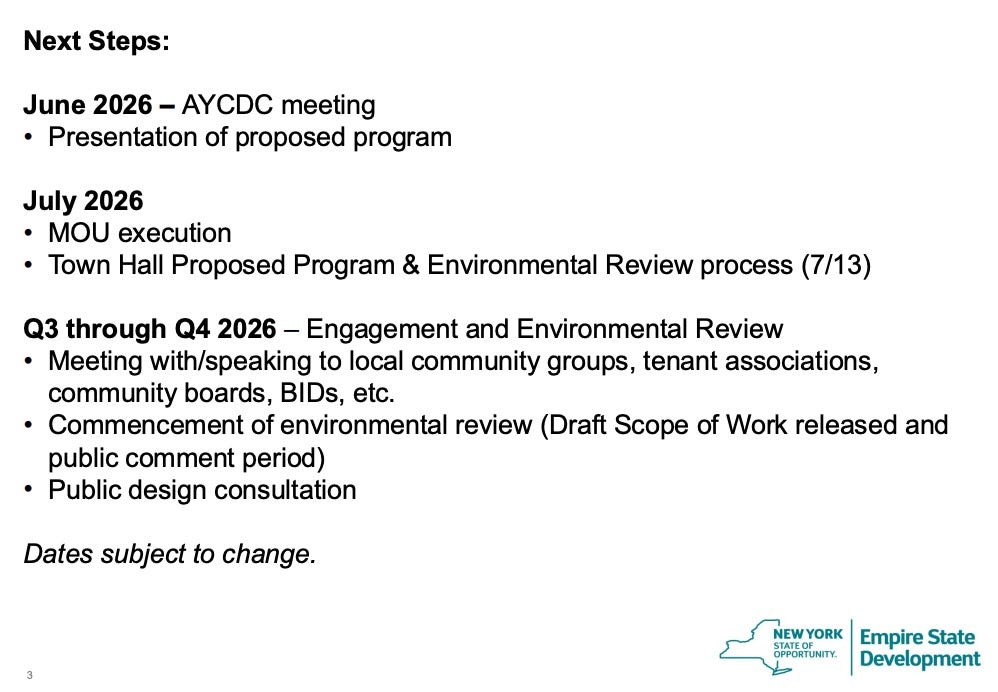
The project clearly has momentum. The MOU is due by July 31. On July 13, a Community Town Hall will be held on Zoom from 6 to 7:30 pm. It will include a presentation of the program revealed on June 29 (and discussed here), with an opportunity for questions. Register here.
After that, the environmental review procedure, which will culminate in a vote by the ESD board, controlled by the governor, could take at least 18 months.
I’ve estimated the value at $320 million.
Henry Elghanayan of Rockrose Development told The Real Deal that a successful developer “must have a super-optimistic view of life. I have an unnaturally optimistic view on life — it’s a sickness. If you understood the real dangers involved in doing a project, you would never do one.”
Apparently, there’s no room at Site 5, which, as Assemblymember Simon has observed, would be a bad place for a school. A somewhat similar parcel up Flatbush, now known as the Alloy Block, has space for two schools but is far less dense than proposed for Site 5.
Not mentioned in the slide below.
Not quite “intergenerational,” at least as articulated by the Rev. Herbert Daughtry of the House of the Lord Church and Atlantic Yards Community Benefits Agreement signatory Downtown Brooklyn Neighborhood Alliance (DBNA), who had wanted a place for seniors and youth to come together. The DBNA suggests the intergenerational center will consist of three freestanding buildings connected by an atrium, but I don’t think that was ever on the table.
The state refused to pursue penalties totaling $10 million for failing to deliver the Urban Room.
He was similarly disingenuous in likening the bulk of the project, as a whole, to individual towers in the Atlantic Avenue Mixed-Use Plan.
Atlantic Yards was once supposed to have four office towers totaling some 2 million square feet of space, enough for 10,000 office jobs. Remember the slogan “Jobs, Housing, and Hoops”?
By comparison, Domino Park is six acres of an 11-acre project with about 3,000 apartments. If there are 2.1 people per apartment—I’m not sure if the metric—that’s 6,300 people, or .95 acres of open space/1000 people.
So again, it’s below the standard. Also, it’s very much a neighborhood resource, but it benefits by bordering the water rather than a congested street.
I wrote about elevators as an issue in Jersey City. Without referencing my coverage, Chair Kummer asked about elevators.
Thank you again for this work.
Wow this is incredibly thorough and well presented, as a local resident and business owner just blocks from this development I can’t thank you enough!