
As Revised Plan Shows (Larger) Tower Dimensions and Affordability Details, State Envisions $700M in Direct Subsidies
A 37% increase in total apartments, but only 16% more affordable units. Union support and affordability criticism at advisory body meeting. Coming: Memorandum of Understanding.

Key points
A new total: 8,812 units, of which 2,616 (30%) would be below-market “affordable”
Given the lag in building promised affordable units, there’d be a net gain of only 366 affordable units overall, and even fewer low-income ones
With construction starting in 2028, the first affordable units could open in 2031, with 25% of the rentals low-income
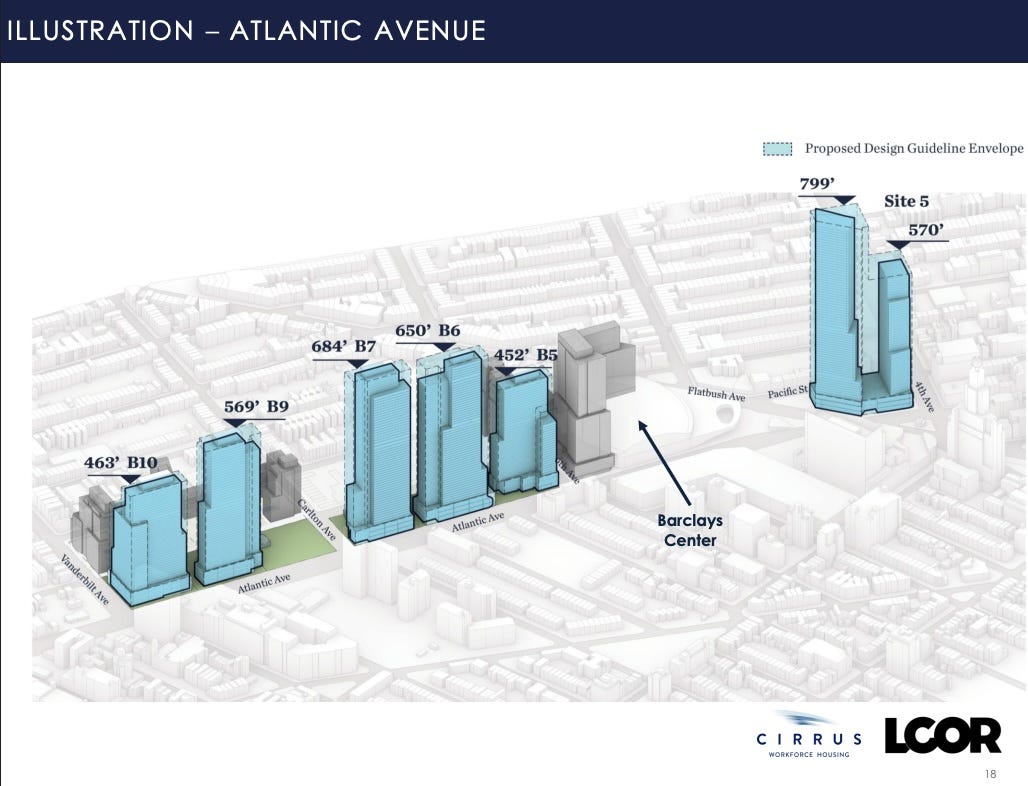
Taller buildings: one Site 5 tower would be 799 feet
Towers over the railyard would average 564 feet, with the tallest 684 feet
While new images show tower dimensions, street-level renderings remain strategically fuzzy
The developers now expect at least $700 million in subsidies to build the platform over the railyard
No structure for accountability was discussed.
Site 5, catercorner to the arena, represents astonishing density: 1,257 apartments/acre, and an unprecedented Floor Area Ratio of 29.81
The New York Times headlined the news as New York Unveils $5 Billion Plan to Finish Brooklyn Mega-Development, downplaying the significant government support: free additional bulk, plus direct subsidies
Gothamist headlined it as NY pledges $700M for Atlantic Yards, new developers say affordable housing ready by 2031, which captured some news—the new subsidies—but an existing timetable claim
Developer Cirrus, funded by labor union pension funds, had union allies at a public meeting to support the project
Critics said the project lags in delivering affordable housing and should do more to front-load public benefits
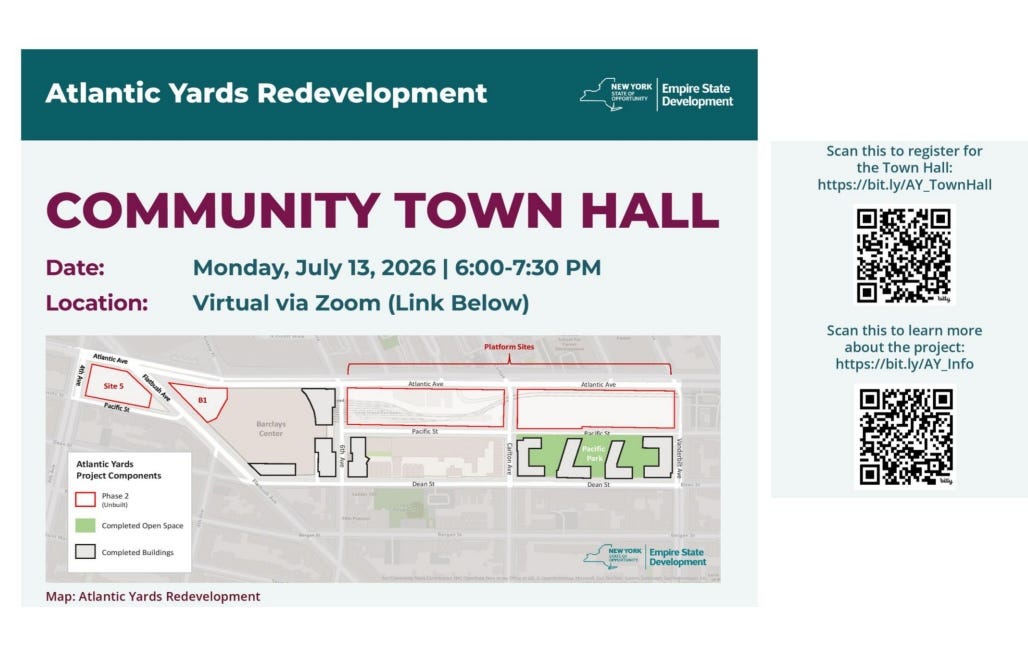
A virtual town hall, on July 13 at 6 pm, will allow public discussion of the latest proposals
More than seven months after the new Atlantic Yards developers announced a “feasible plan” to supersize the project to make it more economically viable, they yesterday released more information about the project’s scale and configuration, while state officials pledged potentially $700 million in direct subsidies, far more than previously discussed.
As revealed in November, developers Cirrus Workforce Housing and LCOR seek 1.6 million additional buildable square feet—free vertical “land” worth perhaps $320 million.
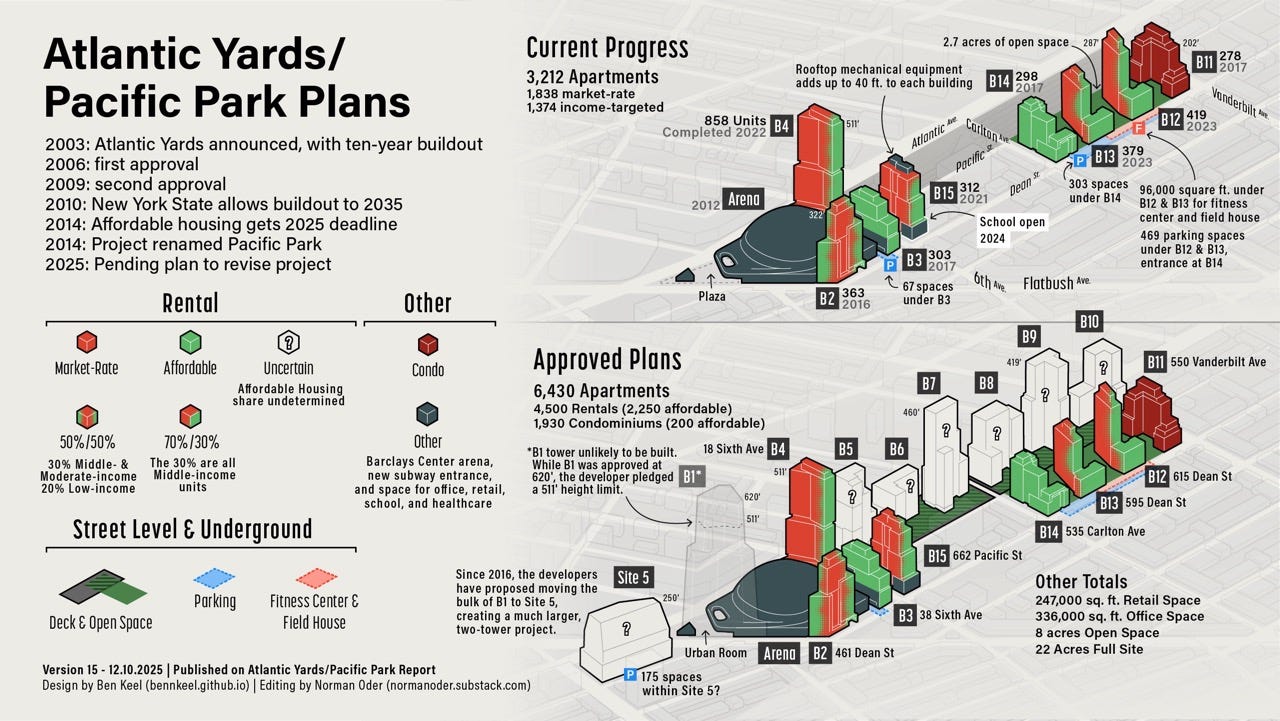
They now plan a total of 8,812 apartments, or 2,382 (37%) more than the approved 6,430 units. (In November, they’d estimated 9,000 apartments.) With 3,212 apartments built, that makes 5,600 more, of which 1,242 would be affordable.
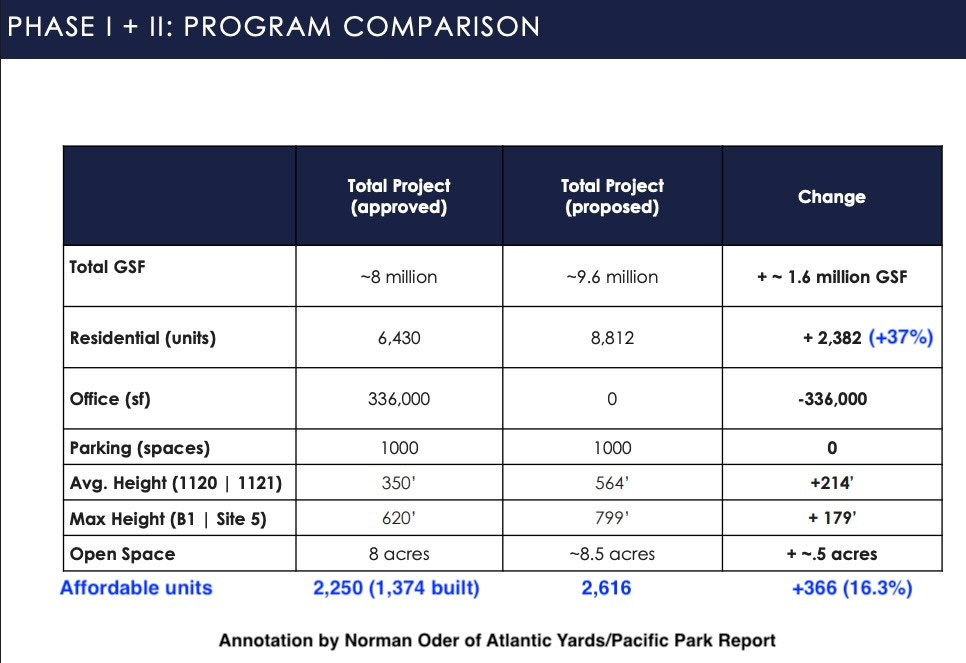
As my annotation shows, the program comparison omitted details about the project’s below-market housing component.
While the developers plan to build 1,242 more income-restricted “affordable” apartments, that represents only a 366-unit increase, or 16.3%, over the approved 2,250 units, of which 1,374 have been built.
The 1,242 affordable units represent 27% of the 4,600 future rentals, or 22% of the 5,600 total apartments. All told, the project would have 29.7% affordable units, rather than 35% as approved in 2006, albeit with more middle-income units.
“It would be helpful to understand how that change happened, considering this project has always been 35% affordable,” said Michelle de la Uz of the Fifth Avenue Committee, an affordable housing nonprofit, in her public comment. She didn’t get an answer.
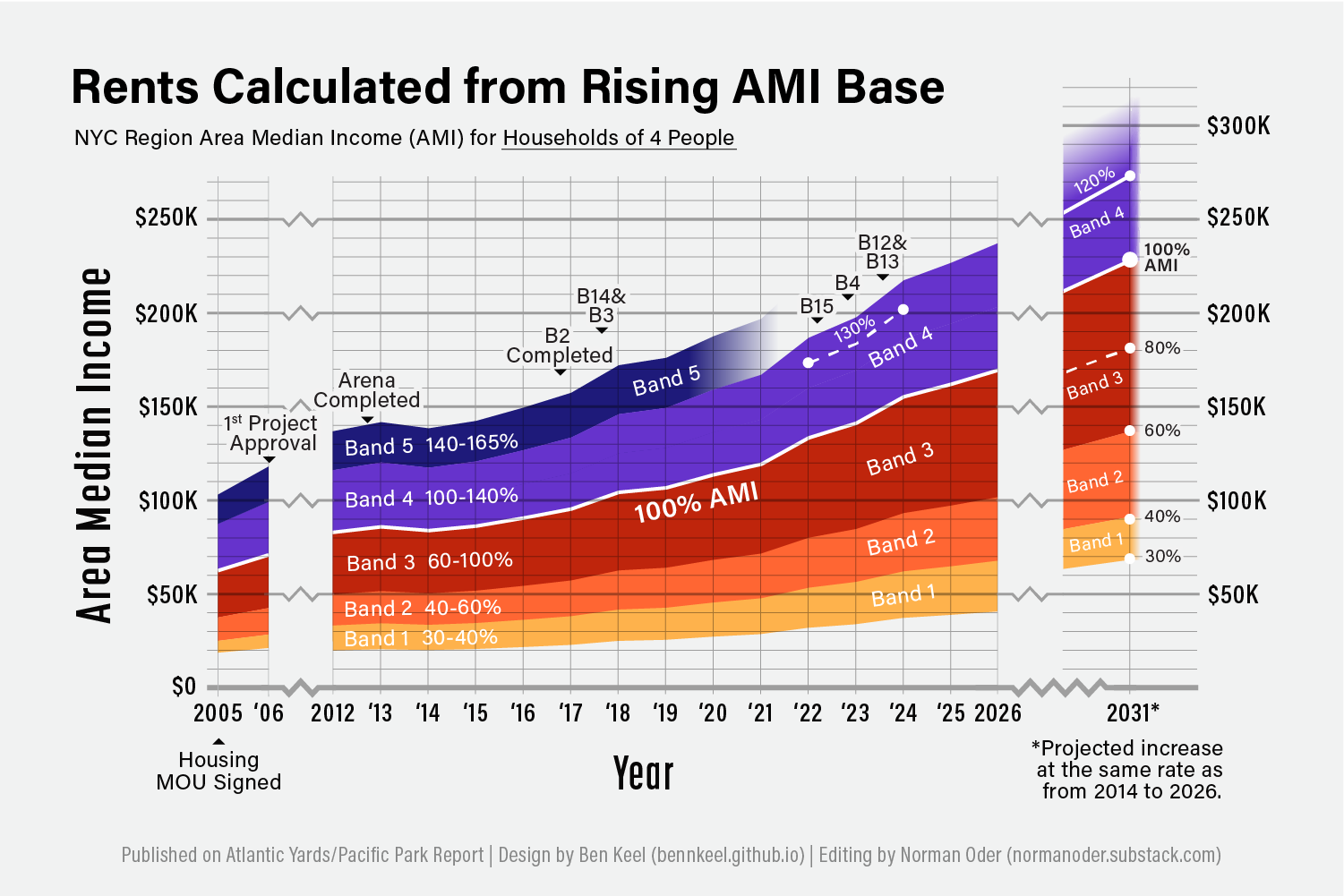
The developers said they plan to build low-income units in the first towers, which could open as early as 2031. However, given the rise in the baseline Area Median Income, used to calculate affordability, some “low-income” apartments could be pricey.
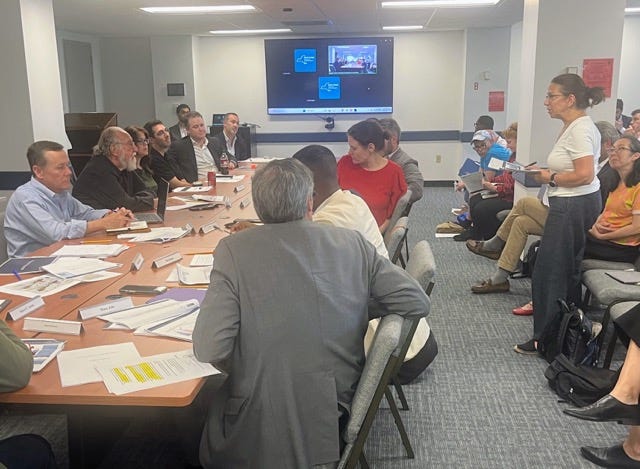
“If we’re giving [the developers] five, 10, 15, or 20 more years, whatever it’s going to be, to actually deliver this,” de la Uz said, “then I think we have to ensure that the public is getting the benefits, whether it’s the affordable housing or the open space.” She’s one of the few active leaders of the BrooklynSpeaks coalition, which has pushed for accountability.
Details were revealed at a little-publicized meeting of the (purportedly) advisory Atlantic Yards Community Development Corporation (AY CDC), which nonetheless attracted several union supporters of the developers’ plans—Cirrus is funded by union pension funds.2
The presentation, from which I’m publishing several slides, is here and here. The meeting was held at the Shirley Chisholm State Office Building in Fort Greene.
Official momentum
The project has momentum. Gov. Kathy Hochul said, as quoted by the Times, “Brooklyn has waited long enough, and today we are turning a corner from years of delay to new homes, jobs and open space.” (She didn’t mention accountability.)
From Gothamist:
Daniel Kummer, board chair of the Atlantic Yards Community Development Corporation, the group that monitors project progress, said he was happy to finally have a new plan in place.
“This is a day we’ve been waiting for for a long time,” Kummer said. “People may have issues with it, but I hope there’s a shared feeling in this room that we’re glad we’re on this next phase.”
Well, there was a “shared feeling,” even among some critics on the AY CDC, that the new developers are trying to make the best of a challenging situation. (I’ll discuss some of their urban design reasoning in a separate article.)
“The work that the development team has done has been terrific in bringing us to this point,” commented AY CDC Director Ron Shiffman, while arguing, fruitlessly, that the board should not go into executive session to discuss a pending Memorandum of Understanding between the developers and the state.
However, the AY CDC can’t do too much to monitor the project, as ESD said the board couldn’t afford to hire an outside consultant, as some directors have sought.3
It was a tad ironic for ESD to claim budget pressures when it’s ready to give the developer $700 million. It’s even more ironic for ESD staff working on Atlantic Yards to claim the $250,000 AY CDC budget for staff time when the money was supposed to help an advisory body monitor ESD itself.
Finally, some (vague) scale
For the first time, the developers, working with the architectural firm KPF, released the dimensions of the individual towers. While in November they suggested the five towers over the railyard would average 550 feet, they now estimate 564 feet, with the tallest at 684 feet.
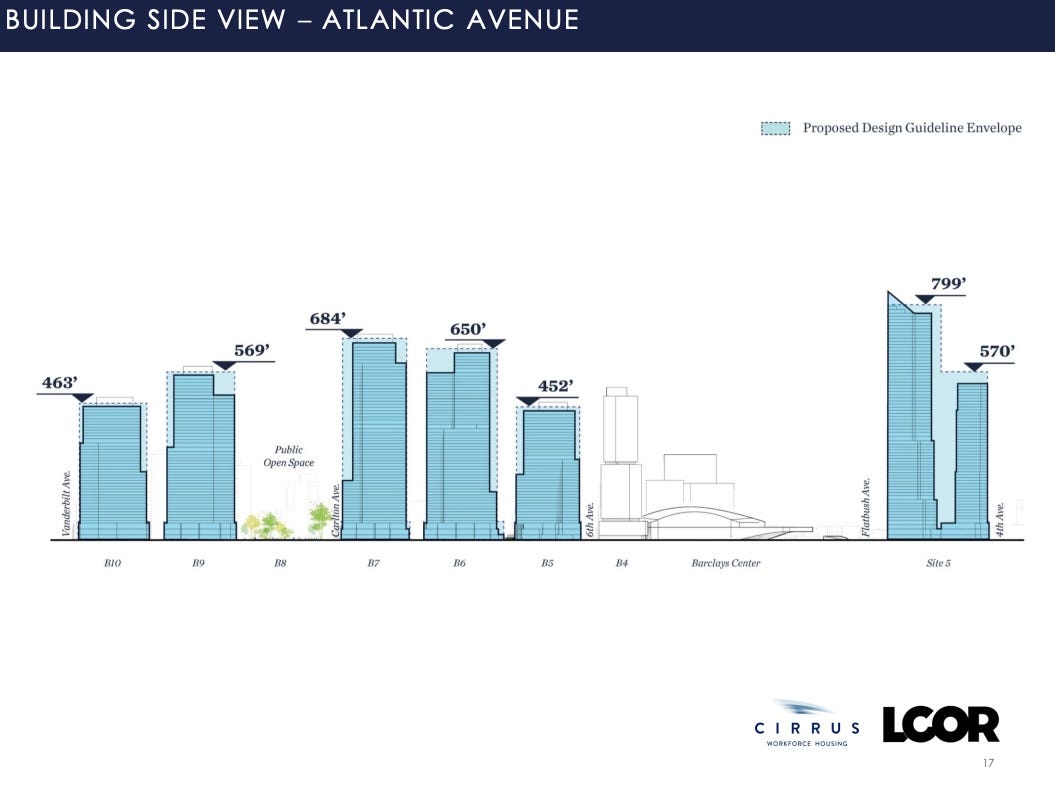
While the taller of the two towers at Site 5, the parcel catercorner to the arena, was estimated at 775 feet, now it would be 799 feet. (Indeed, the previous estimate of 9,000 apartments seemed unlikely to fit in towers of the previously estimated heights.)
Site 5, longtime home to the big-box stores P.C. Richard and the now-closed Modell’s (now home to the temporary Brooklyn Basketball Training Center), was approved in 2006 as a 250-foot, 440,000 square-foot building.
Since 2015-16, the developers have planned to transfer the bulk of the unbuilt tower slated to loom over the arena (B1, which architect Frank Gehry called “Miss Brooklyn”) across Flatbush Avenue to Site 5, creating a giant, two-tower project.
While in 2021 ESD signed an Interim Lease with the previous developer Greenland USA, which blessed that plan, including 1.242 million gross square feet of development, yesterday the developers acknowledged they seek to build 1.45 million gross square feet to accommodate two towers with 1,403 apartments, including 400 condos and 251 affordable rentals.
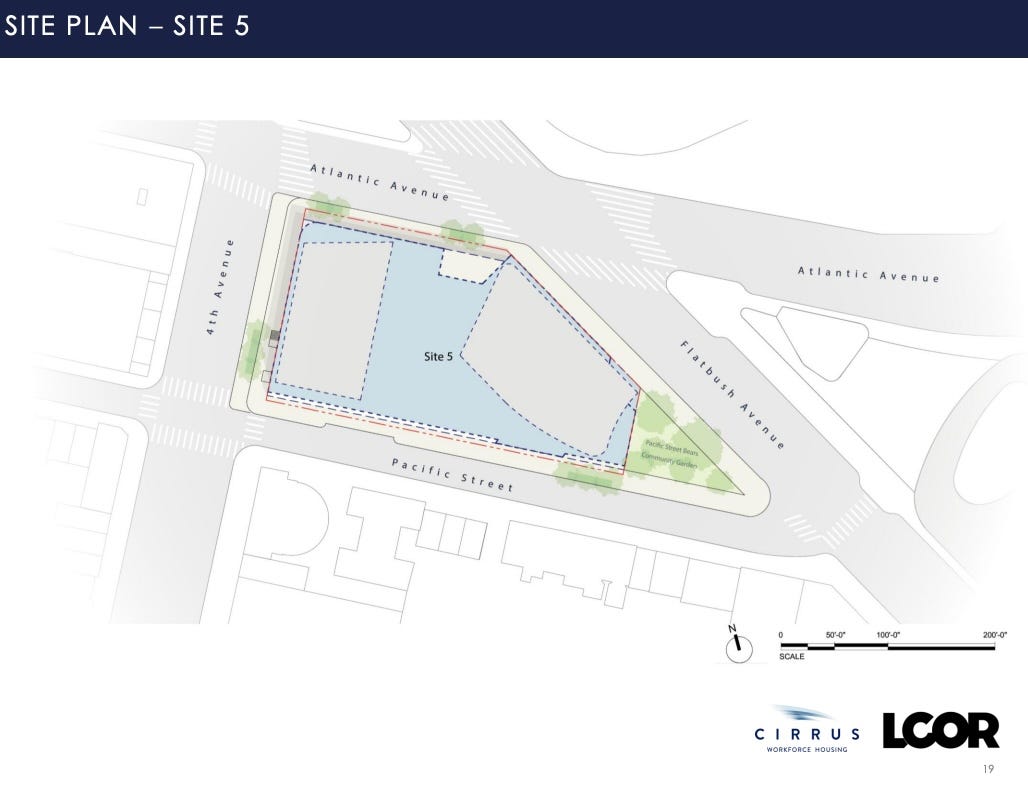
By my calculation, that’s astonishing density: 1,257 apartments/acre, and an unprecedented Floor Area Ratio—FAR, the multiple of a building’s bulk over its footprint—of 29.8.4
Perhaps that’s why they provided a site plan (above) for Site 5 but no rendering. They did say that the street-level podium, perhaps 40 to 65 feet, would be of townhouse scale, aiming to fit a very large project into a block that includes low-rise Pacific Street.
Cagey about scale
While the announcements did reveal more details about the buildings’ proposed dimensions, the developers remained cagey about what they’d actually look like.
Despite the claim by Cirrus Managing Principal Joseph McDonnell that the illustrations below aim to give “a sense of the scale,” they’re deflective and misleading.


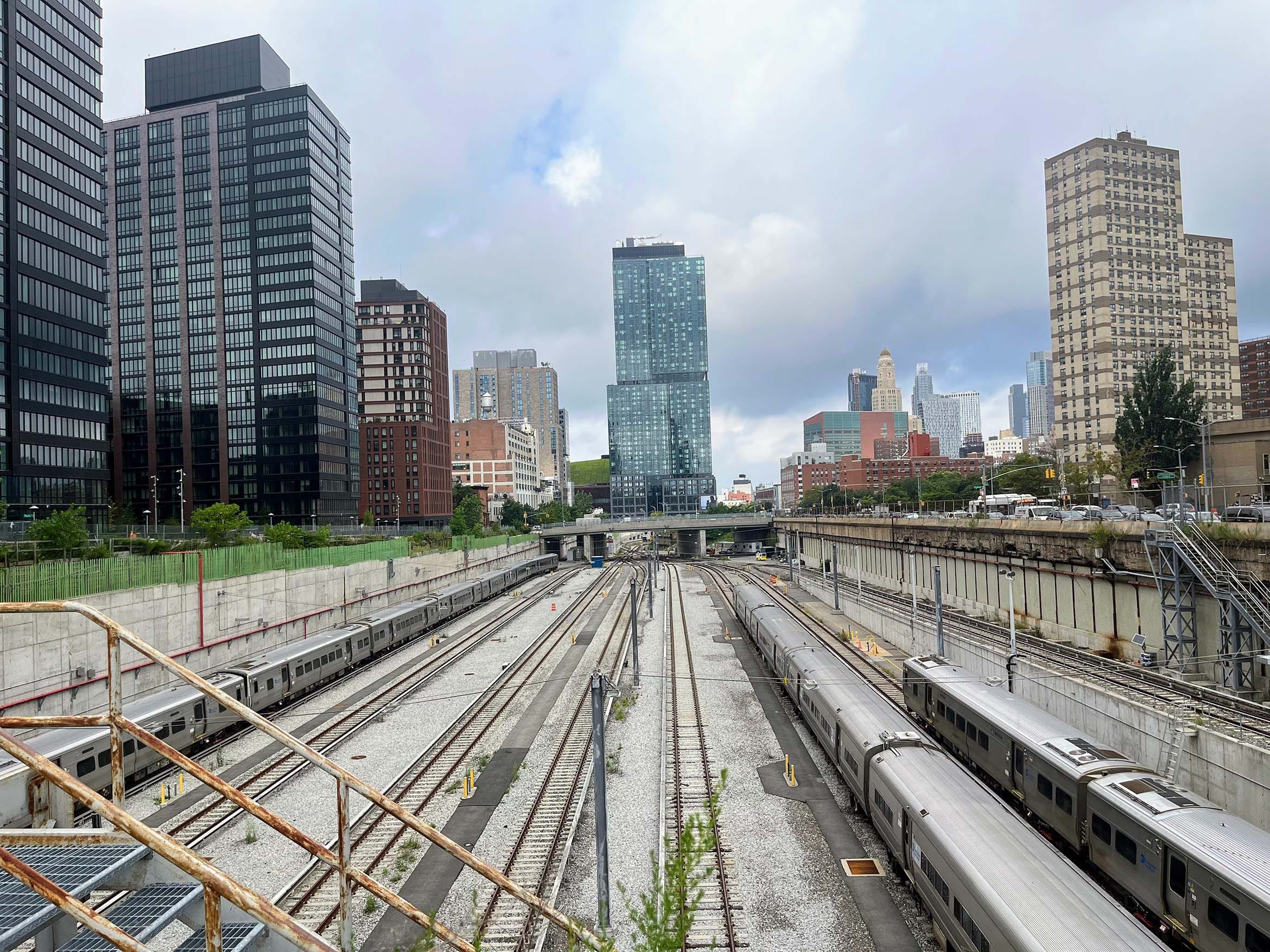
In both cases, as far as I can tell, only tiny slices of new towers are pictured. The main buildings in view have already been built, on the project’s southeast block, and are far smaller than the new buildings proposed. They’re not pictured in full, either.
Three of the buildings would be considerably taller than the 511-foot 18 Sixth Ave. (B4), pictured in the distance below. It has 858 apartments.
The new towers on the railyard—which would be thinner to give more clearance for the railyard—would have 700, 792, 810, 895, and 1,000 apartments.
Neighborhood context?
While the slide below suggested that Atlantic Yards was an extension of nearby Downtown Brooklyn, one resident, Robert Puca, in a public comment, reminded them that the project was in Prospect Heights.
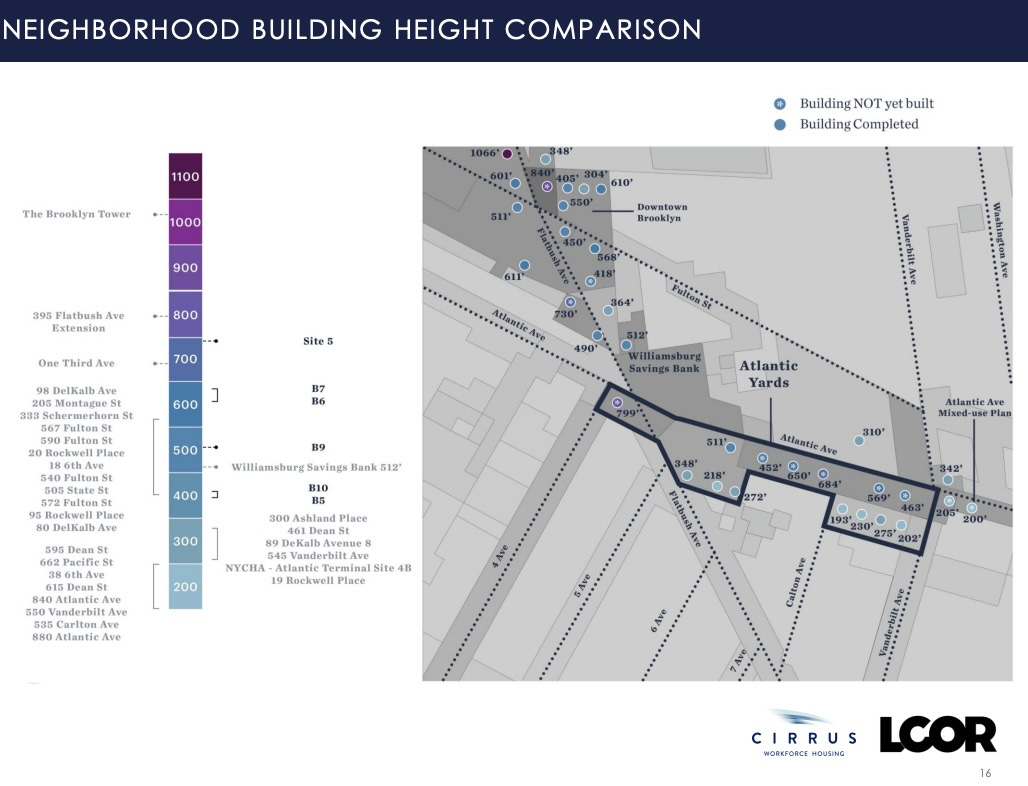
Indeed, there would be a dramatic difference between, for example, the two proposed towers near Vanderbilt Avenue, B9 (569 feet) and B10 (463 feet), and the towers built or approved nearby as spot rezonings or as part of the Atlantic Avenue Mixed-Use Plan (AAMUP).
LCOR’s Anthony Tortora, though, called it a “contextual skyline that aligns” with taller buildings in Downtown Brooklyn, then steps down to the east.
“Interestingly, when looking at the project as a whole, AAMUP to the east contemplates comparable densities along Atlantic, given their much higher lot coverage ratios,” he said.
That was disingenuous. Yes, the individual buildings in AAMUP, in terms of Floor Area Ratio, may match the FAR of Atlantic Yards as a whole, including the open space and the arena.
However, the developers did not—and, apparently, cannot—suggest a project of comparable residential density. With 8,812 apartments over 22 acres, that’s 401 apartments/acre, which is likely unprecedented in the city and country.
The new buildings would be notably dense. The five towers over the railyard, with 4,197 apartments, would average 544 units per acre, by my calculation. As noted, Site 5, with 1,403 apartments, would be 1,257 units per acre.
Timing issues
The meeting came a month before the Atlantic Yards Community Development Corporation’s parent, the gubernatorially controlled Empire State Development, is expected to sign a non-binding Memorandum of Understanding (MOU) with the developers regarding timing, subsidies, and, presumably, accountability measures.
The MOU is due by July 31. Likely before then, on July 13, a Community Town Hall will be held on Zoom from 6 to 7:30 pm. It will include a presentation of the program revealed yesterday and an opportunity for questions. Register here.
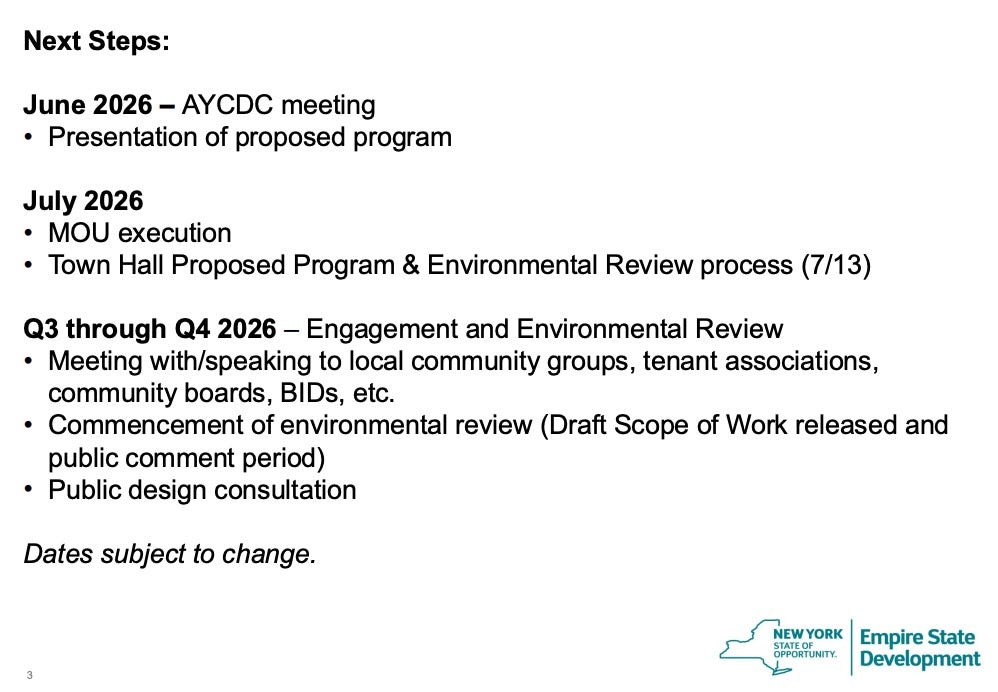
The required—but essentially rubber-stamp—environmental review process, involving public hearings, is expected to begin in September, with a public hearing on the Draft Scope of Work for that review.
State support
A review process, expected to last 18 months, will culminate in a rubber-stamp vote from the ESD board, controlled by Hochul, who, like many elected officials, wants to build. Details are secondary.
That includes, as both the Times and Gothamist reported, potentially $700 million in direct state subsidies to help build the platform needed for vertical development over the Metropolitan Transportation Authority’s two-block Vanderbilt Yard, used to store and service Long Island Rail Road trains between Atlantic Avenue and Pacific Street.
That number was not publicly discussed at the AY CDC meeting, which included a long executive session component during which Directors heard from BJH Advisors, the consultant ESD has hired to assess the plan’s viability. Nor was the remaining project’s purported $5 billion price tag.
Note that an initial request for $350 million in subsidies became a $175 million grant in the latest state budget, leaving room for an additional request for the first of the two railyard blocks, Block 1120, which is between Sixth and Carlton avenues.
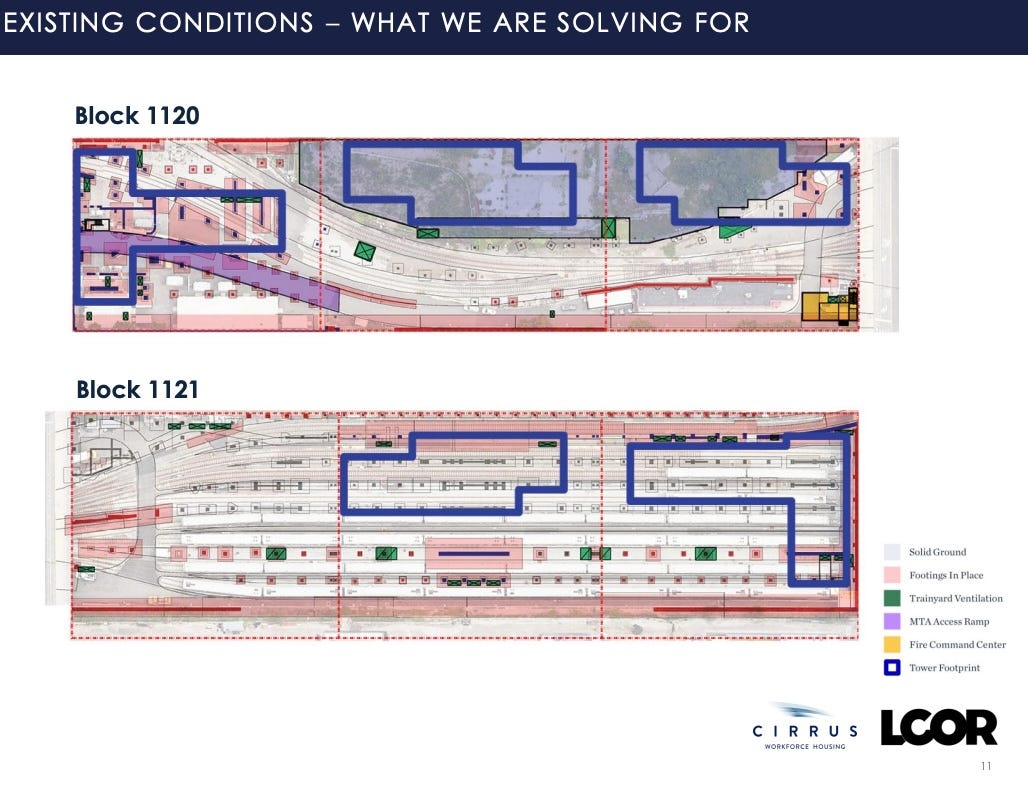
Block 1121, between Carlton and Vanderbilt avenues, does not have the “bump” of terra firma jutting south from Atlantic Avenue.
Given that the Block 1121 platform would be more extensive, it’s reasonable to expect an even more costly platform, with additional subsidy requests beyond $700 million, especially since that platform would be built several years later.
Meanwhile, as shown in the slide below, the developers are touting a $3.5 billion economic impact during construction, 100% union-built construction, and 30% participation by minority- and women-owned businesses.
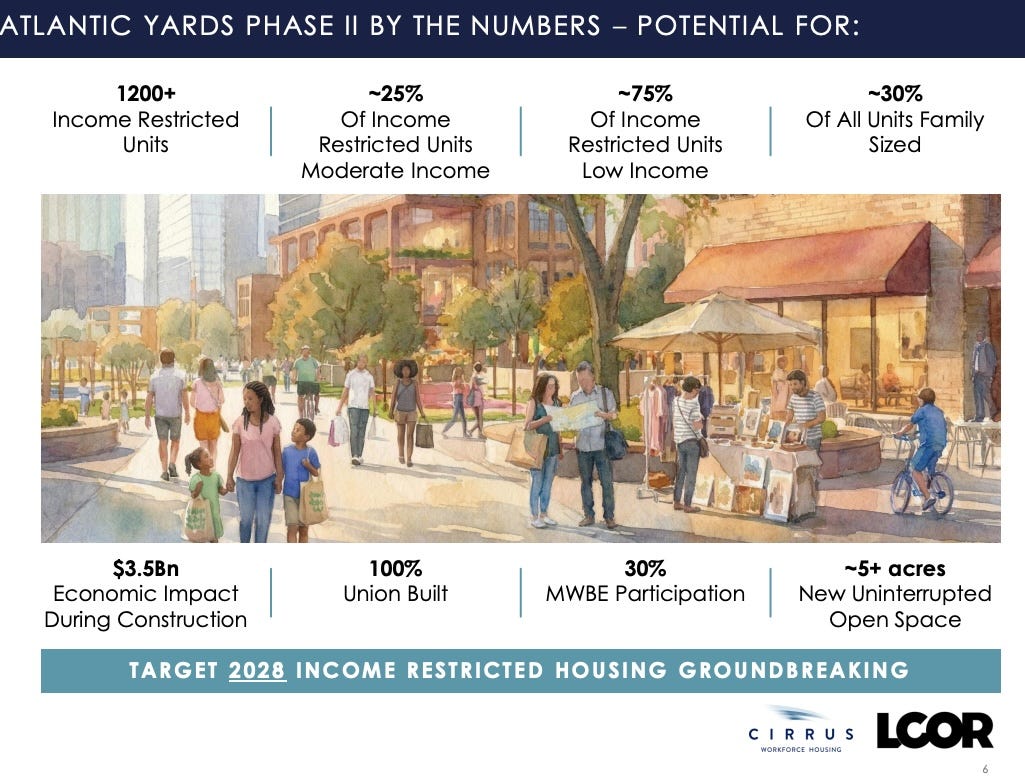
Construction could start in 2028, with the first buildings opening in 2031. If all goes well, the developers have said, the project could be finished by 2040. Given the project’s history, I’d bet against it.
Accountability and affordability
While the state, offering new bulk and direct subsidies, is easing the path for developers, and developers announced new details about promised affordability, there was no information about a new accountability structure.
That’s important, because a 2014 agreement negotiated by Brooklynpeaks to set a May 2025 deadline for the project’s affordable housing was not enforced. Rather than collect $2,000/month for each of the 876 missing affordable units, ESD negotiated a nominal series of payments totaling $12 million.
New York City once negotiated a City Participation Agreement, which could have provided the city with additional payments from the project. Still, it exempted the arena, any residential building with 21% or more affordable housing, and any building "otherwise so designated by the City.”
The question is how to build a structure to assess the balance between public benefits and the developer’s returns, acknowledging their risks and cost basis. That’s why complicated projects deserve a review after several years to assess potential changed circumstances.
Given that the biggest winners in the project have been the operators of the state-enabled arena and the ever more valuable Brooklyn Nets (and New York Liberty), New York State could make Joe Tsai, principal owner of Brooklyn Sports & Entertainment, pay for the privilege—as suggested in the link below—of gaining a permanent plaza outside the arena, but has made no effort to do so.

Sequencing and public benefits
AY CDC Director Gib Veconi and Assemblymember Jo Anne Simon, both leaders of the BrooklynSpeaks coalition, asked if the eastern block of the platform, Block 1121, between Carlton and Vanderbilt avenues, could be built first.
Their argument: it could deliver the key piece of open space east of Carlton in the parcel formerly designated as B8 and show a visible public benefit. (One parallel: in the Domino Sugar plan in Williamsburg, Domino Park—publicly accessible, privately run open space—came first.)
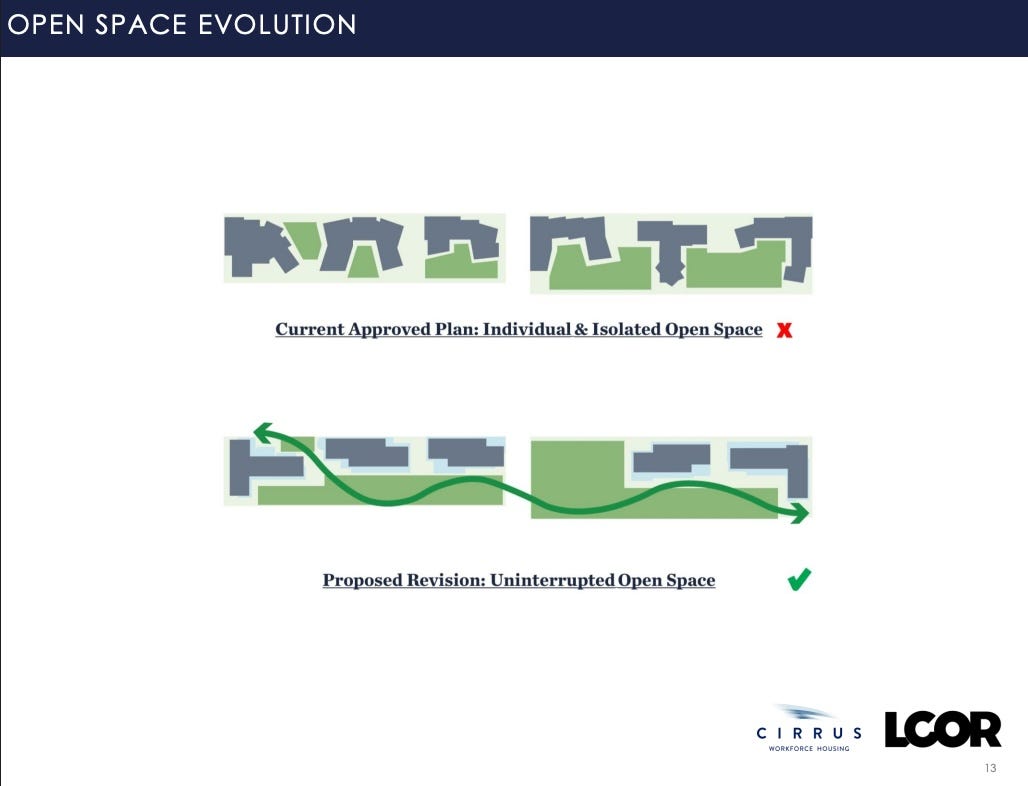
McDonnell said that wasn’t feasible because Greenland, the previous developer, had spent three years permitting that western block. So starting work on the eastern block would delay all construction.
“One of the things we saw, which I referred to at one point as a no-brainer,” he said, was that this was one of the few places in the city where most of the pre-development work, including foundation and infrastructure, has been done.
(I’ve suggested that “no-brainer” also refers to Cirrus’ low cost to enter the project, but point taken.)
The platforms would be financed, said McDonnell, with a mix of private capital and public financing. Cirrus can draw on construction union pension funds.
ESD executive Joel Kolkmann told The Real Deal that Cirrus and LCOR will have a project labor agreement to standardize compensation, which, in the publication’s paraphrase, “will provide advantages that other development teams wouldn’t be able to deliver.”
(Well, original developer Forest City Ratner also negotiated such a PLA, so it’s not impossible.)
Reciprocally, representatives of three construction unions and the teachers’ union all spoke in favor of the project.
Affordability plans
Yesterday, the developers, who’d previously pledged 25% affordable rental units, averaging 60% of Area Median Income (AMI), in the first towers (B6 and the two-tower Site 5), released more information about their plans but offered no guarantees.
There’d be 1,242 future below-market units, which is 27% of the future rental apartments, but 22.2% of all apartments, including condos, as my annotation in red suggests.
First built would be Site 5 and B6, with 501 apartments averaging 60% AMI, conforming to the requirements of the state’s 485-x tax break.
The B7 tower, which would be built in the first phase, and the B9 tower would both have 30% affordable units, though averaging 90% AMI, with more moderate-income units.
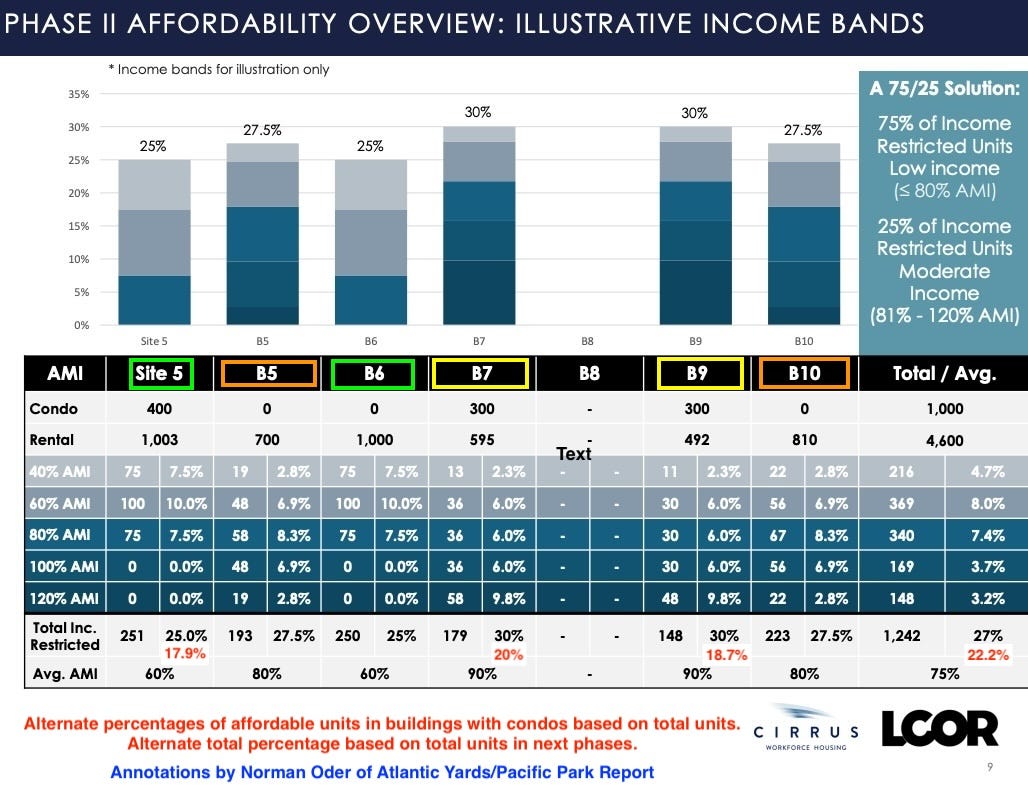
Each tower, closest to the project’s largest expected open space, would also contain 300 condos.
The B5 and B10 towers would include 27.5% affordable units, averaging 80% AMI.
All told, that makes for an average AMI of 75% going forward. That’s considerably lower than the project, as built so far, which averages 131% AMI, given a skew to middle-income units.5
But that deserves several caveats.
Affordability comparisons
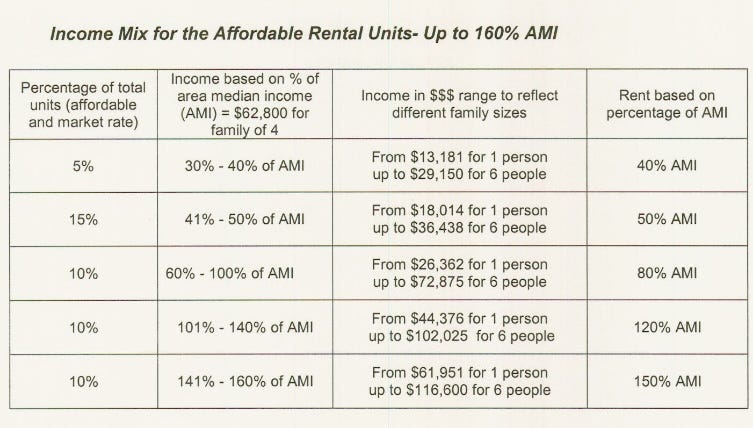
Had Atlantic Yards conformed to the Affordable Housing Memorandum of Understanding (MOU) negotiated in 2025 by the advocacy group ACORN with original developer Forest City Ratner, it would have averaged 102% AMI.6
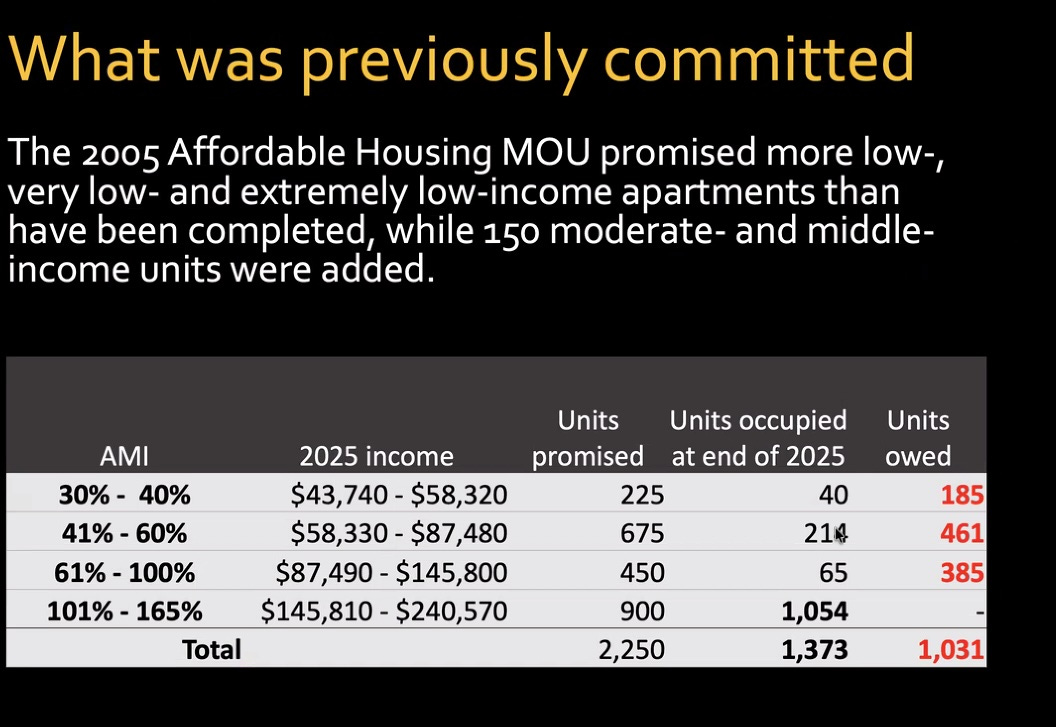
Also, as BrooklynSpeaks contends, the original project promised 1,031 apartments below 100% AMI as part of the initial 2,250 units, leaving a significant deficit in low- and moderate-income units.
In the future, the developers promise:
40% AMI: 216 (so a net gain of 31 over the 185 “owed”)
60% AMI: 369 ( so a net loss of 92 from the 461 “owed”)
80% & 100% AMI: 509 (so a net gain of 124 over the 385 “owed”)
That means a net gain of only 63 low- and moderate-income units, even as the developers gain permission to build far more market-rate units.
Meanwhile, AMI is rising. The Times reported:
But early estimates and this year’s affordability guidelines provide a rough proxy: About 50 units in that building would be affordable to families of four that earn up to $67,840, and more than 150 apartments would be for four-person households earning up to $101,760.
That’s a very rough proxy.
While $67,840 is the ceiling for four-person households at 40% AMI (Band 1) today, it likely would be closer to $90,000 by 2031, as I reported.
A new perspective
After an executive session of about one hour and 49 minutes, the directors returned to a nearly empty room.
Veconi said he’d done some research, finding that the median income for the union members represented by commenters ranged from $43,000 to $99,000—essentially very low-income to low-income, based on current New York numbers.
He said he supported having the project tilt more toward those categories. (Of course, people in households with two people working would have higher incomes.)
Showing the scale?
During the main meeting, McDonnell said, “We’ve prepared two renderings, and I want to emphasize two things: these are not designed—there’s a design process.”
“We actually asked KPF, our architect, to prepare these renderings to give you a sense of the scale, because I think it’s hard to actually envision these things when there are holes in the ground with a railyard underneath them.”
Citing the below image, he said, “This is from B6, sort of looking toward B7, [at] Carlton [Avenue].”
Does it give a sense of the scale of the new buildings? Not at all. We see fragments of the B6 and B7 towers on the left.
Meanwhile, in the back, we see the four already-built towers of the project’s southeast block, starting with the red-brick 535 Carlton, which is less than 200 feet tall but cut off before the top.
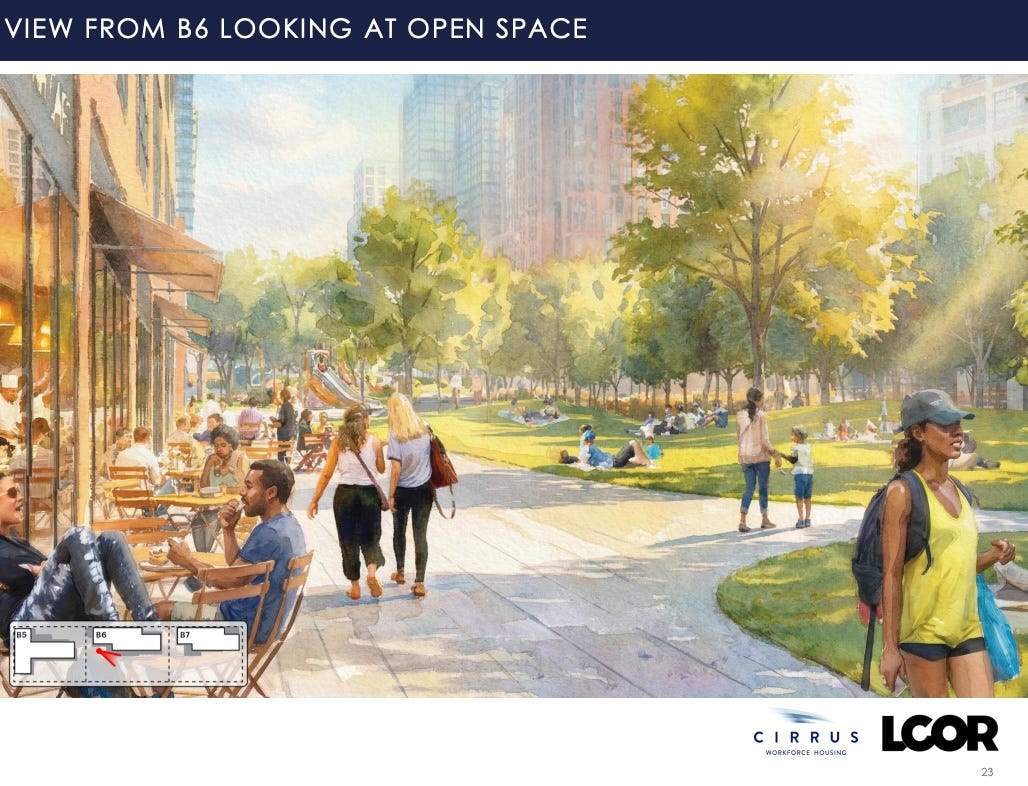
As far as I can tell, the fragment in the top right is part of the Newswalk building at 535 Dean Street, which is not part of the project.
He continued, pointing to the image below, “This is looking across B8,” the parcel once designated for a tower but now for open space.
Again, as far as I can tell, the image is of towers on the project’s southeast block, notably the glass-walled 595 Dean.
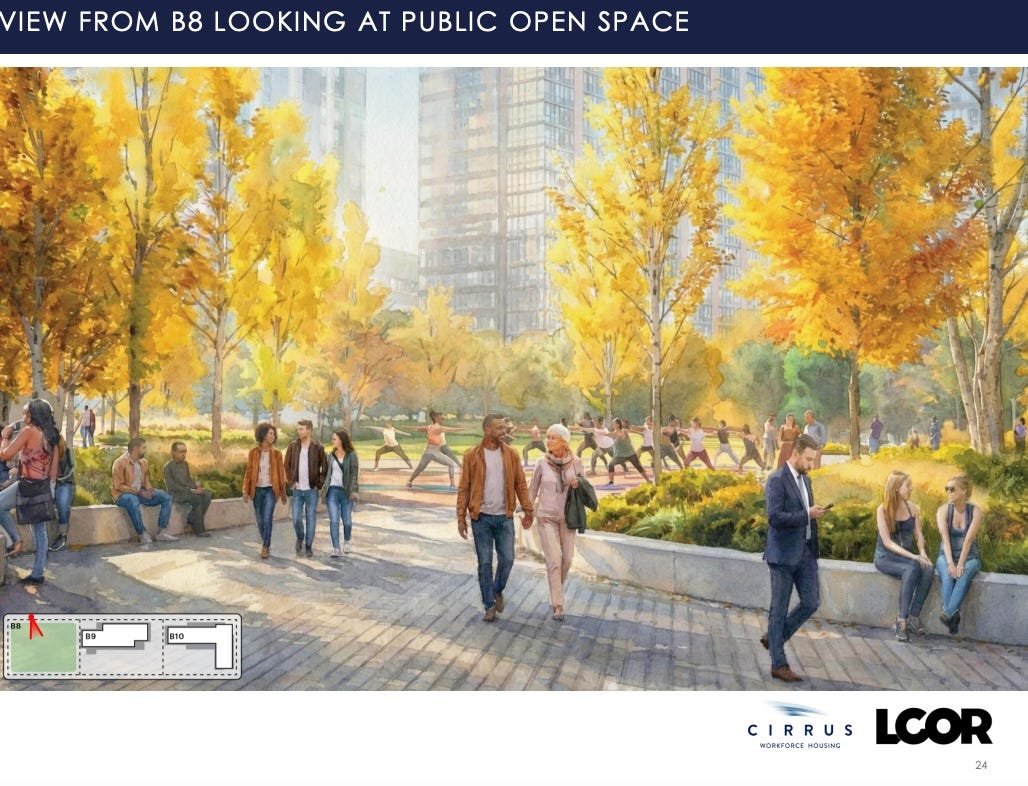
“These are the moves that we made,” McDonnell continued, “which we think makes this kind of a development not just for the folks who are lucky enough to live in the buildings, but for the community as a whole.”
Bottom line: we still have no idea what the new towers might look like from ground level.
Misleading on 535 Carlton
McDonnell, arguing for the inclusion of moderate-income units, said that the 535 Carlton tower (B14) received “per unit the most actual housing applications for moderate-income folks.”
That’s correct, but not so meaningful, given that many people, once they’re registered in the city’s Housing Connect database, simply apply for any building with units in their “band.”
In the video below, McDonnell misleadingly cited my work.
“You actually, and I never thought I would say this, but you can actually go to Norman Oder’s blog, and he actually did an overview of the housing lottery on 535 Carlton,” he said.7 “When you look at that particular development, there were five moderate-income units. It’s a full affordable development of five moderate-income units.”
Actually, there were 15 moderate-income units. Not a lot, but that’s not five. (Go to this document and look for the middle category for each unit size.)
“They had 15,000 applications, right?” he said. “The only class that had slightly more applications was actually low-income, but I think they had 150 units.”
No, there were 90 low-income units. (There were 148 units in the upper middle-income band, and 44 in the lower middle-income band.)
As I reported in my April 19, 2017, article for City Limits, The Real Math of an Affordable Housing Lottery: Huge Disconnect Between Need and Allotment, only 2,203 applicants were eligible for the 148 upper-middle-income apartments.
Meanwhile, 18,680 households applied for the 15 moderate-income units. Nearly 67,000 households—not “slightly more”—aimed at the 90 low-income units.
So yes, there was demand for moderate-income units, and more per unit, given that building’s configuration.
If you look at it another way, though, there were still 18,665 moderate-income households that didn’t get housed, and some 66,900 low-income ones that didn’t, either.
Also, the metrics have shifted. Back in 2015, a single person in a moderate-income unit could earn up to $63,500. Today, after Area Median Income has galloped higher, the ceiling for a single person at 60% of AMI is $71,280. That’s now considered low-income.
Many people’s earnings have not kept pace with the rise in AMI. So it’s plausible that a household that qualified as moderate-income a decade ago might now be classified as low-income, fueling the need for more low-income units.
The town hall
The math is 1,450,000 gross square feet over a 48,655-square-foot site. Even with a recalculation to adjust the Floor Area Ratio from gross square feet to zoning square feet, the FAR likely would be over 25, which even development-friendly Jersey City wouldn’t allow. Plus, Jersey City allows 25 FAR buildouts only on larger sites than Site 5.
From BrooklynSpeaks were Michelle de la Uz of the Fifth Avenue Committee and Assemblymember Jo Anne Simon. The other main person in the coalition, Gib Veconi of the Prospect Heights Neighborhood Development Council, is a member of the AY CDC, so he presumably kept them informed.
Kummer did say that he and AY CDC Director Marc Jahr, a former head of the New York City Housing Development Corporation, had met with the ESD’s financial consultants on the project and the development team itself. I’m not sure how that comports with the state Open Meetings Law.
Again, the math is 1,450,000 gross square feet over a 48,655-square-foot site. Even with a recalculation to adjust the Floor Area Ratio from gross square feet to zoning square feet, the FAR likely would be over 25, which even development-friendly Jersey City wouldn’t allow. Plus, Jersey City allows 25 FAR buildouts only on larger sites than Site 5.
Again, my calculation is based on this chart:
[(40 x 40) + (214 x 60) + (76 x 100) + (718 x 145) + (326 x 165)]/1374 = 131

Here’s my math: [(225 x 40) + (675 x 60) + (450 x 100) + (450 x 140) + (450 x 160)]/2250.
The chart below, from the Housing MOU, is based on 4,500 total rentals, not the 2,250 affordable ones.
His tone was cordial but sounded somewhat snarky to me.
So the state kicks in another $700 million and gets an additional 366 subsidized units?
That's $1,912,568 for each additional subsidized unit. Nice work if you can get it