
Is Jersey City's Journal Square, With Giant Towers, a Template for Parcel Opposite Arena?
Not really, because the sites are far larger. Also, watch out for wind impacts, and elevator problems. The only comparably dense projects to Atlantic Yards may be in Asia, not the U.S.

Note: The meeting on Monday of the advisory Atlantic Yards Community Development Corporation (AY CDC), where the directors, in Executive Session, likely will hear a report from BJH Advisors, a consultant hired by Empire State Development (ESD), the state authority that oversees/shepherds the project, to assess the economics of the proposed deal.
That presages a Memorandum of Understanding (MOU) between the project developers and ESD, which is supposed to be signed by July 31. It’s unclear whether they will discuss the proposed project’s extraordinary density, as discussed below.
Key points
As proposed, the towers at Site 5 would be of unprecedented density in Brooklyn, other than the recently approved 395 Flatbush Ave. Ext., more clearly in Downtown Brooklyn.
While the Journal Square area of development-friendly Jersey City does allow residential towers with a Floor Area Ratio of 25, that’s only on sites larger than Site 5 (or 395 Flatbush Ave. Ext.).
Those new towers in Jersey City have fewer apartments per acre than the number likely planned for Site 5.
Such large development raises questions about elevator availability, wind impacts, and the quality of public and private amenities and open space.
The overall proposed density of Atlantic Yards towers on the railyard blocks, more than 648 apartments per acre, seems unprecedented among projects in the United States, according to a key advocate.
What might Atlantic Yards/Pacific Park look like under the new plan—to develop seven towers, far larger than initially approved, mostly on parcels difficult to build on—from developers Cirrus Workforce Housing and LCOR?
How does it compare to other projects?
We don’t really know, officially. An unofficial rendering is below, though it likely underestimates the scale. The tallest railyard tower is estimated at 630 feet, squeezed to fit the developers’ other stated parameters.
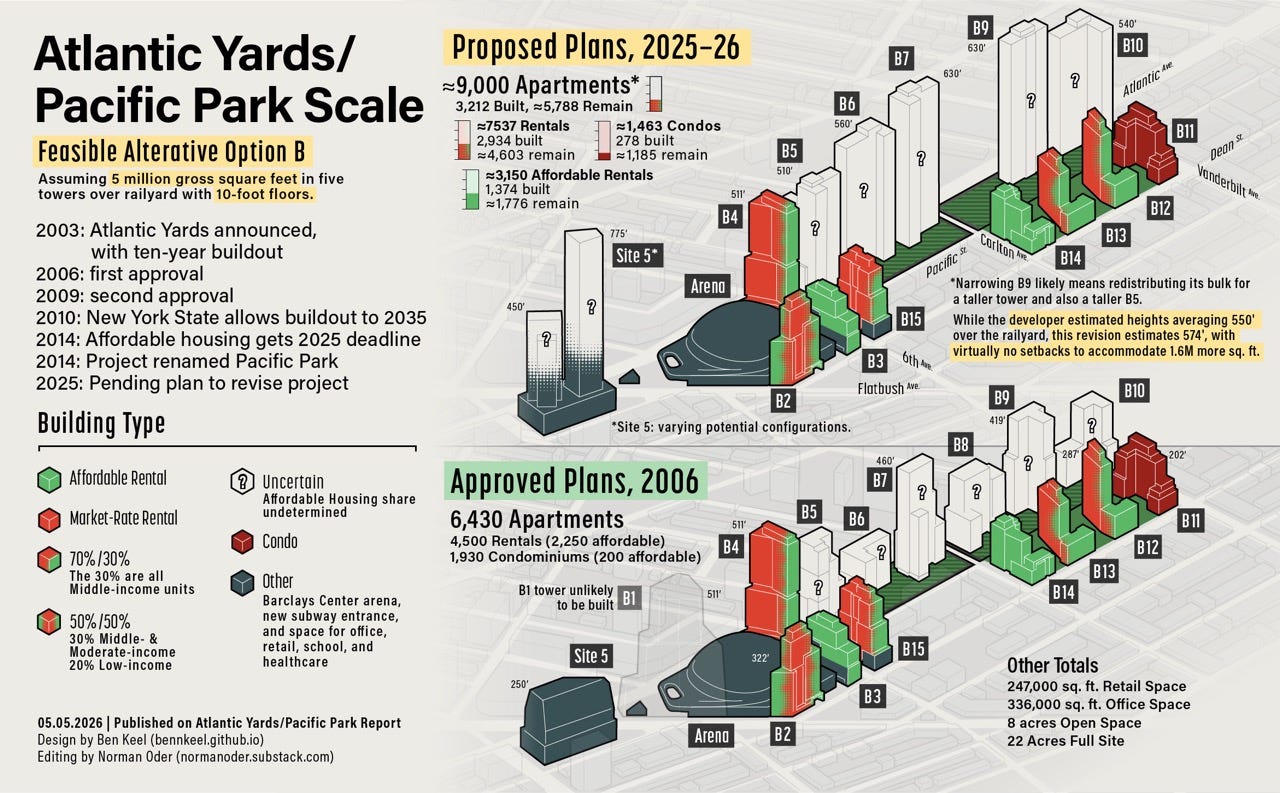
In another modeling attempt, described further below, Gib Veconi—a director of the AY CDC, a leader of the BrooklynSpeaks coalition, and one of the few people paying attention to Atlantic Yards (outside those tasked for it)—estimated the tallest railyard tower at 735 feet.
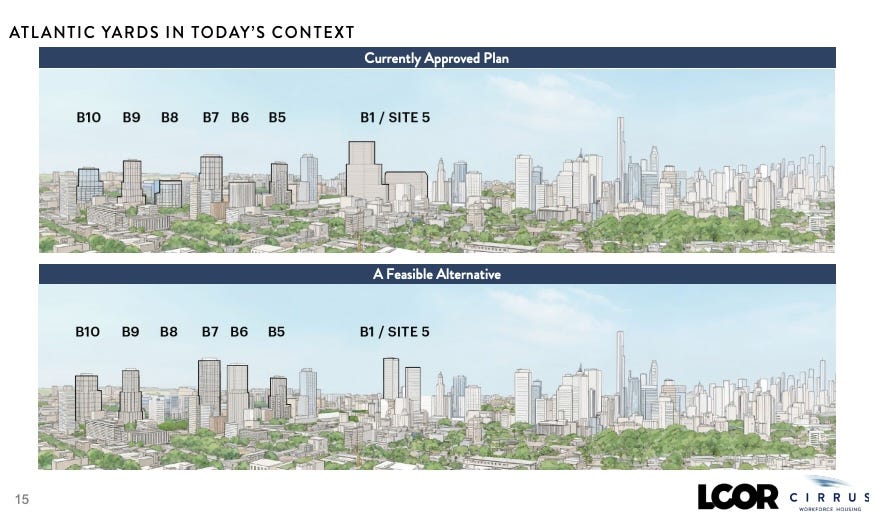
Meanwhile, the developers have been cagey, unwilling to show us what the project might look like. Below is the developers’ fuzzy, misleading comparison of the currently approved Atlantic Yards plan and what they call a feasible alternative.
We should know more.
After all, as a 2017 city-sponsored feasibility study for Sunnyside Yard observed, “While dense and walkable mixed-use neighborhoods are in high demand and often result in increased property values, there is a point where an increase in density negatively impacts the quality and livability of the environment.”
So it’s especially important to envision the likely largest development, Site 51, catercorner to the arena and currently home to the big-box stores P.C. Richard and the now-closed Modell’s (temporarily the Brooklyn Basketball Training Center).
The parcel’s in the center-left of the photo below, adjacent to Flatbush Avenue, with the dark flat roofs.
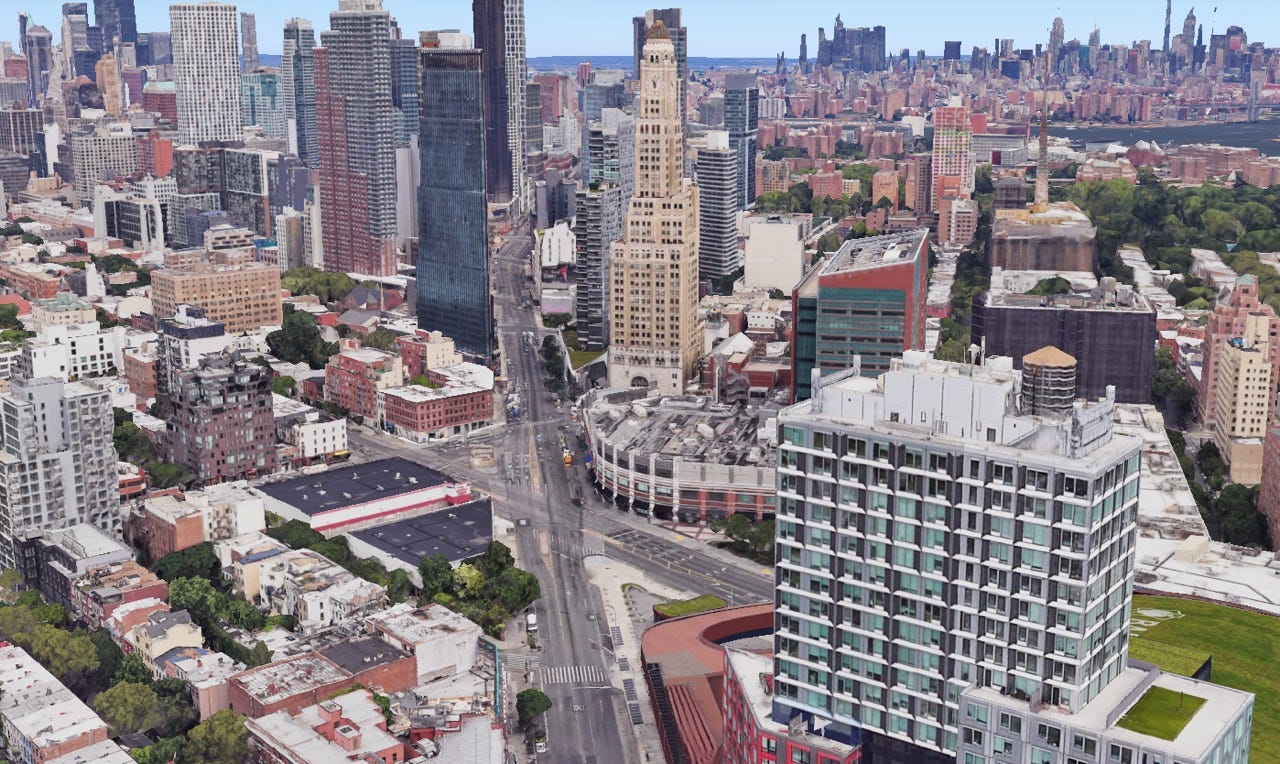
Site 5 has tentative approval for 1.242 million gross square feet in two towers, thanks to an Interim Lease state officials signed in 2021, allowing the transfer of bulk from the unbuilt B1 tower, which original architect Frank Gehry dubbed “Miss Brooklyn,” from the prow of the arena across Flatbush Avenue to Site 5.

That means, I’ve suggested, at least 800 to 1,100 apartments, plus a significant amount of retail—once likened to the Time Warner Center (before that complex was renamed Deutsche Bank Center)—and, likely, a boutique hotel.
The rendering below, produced by my frequent collaborator Ben Keel, can only go so far in showing two towers, one 775 feet and the other perhaps 450 feet.
For context, the taller Site 5 tower would be 50% taller than 505 State Street, of the Ally Block, and One Hanson. (Another Alloy Block tower, however, would be 725 feet.)
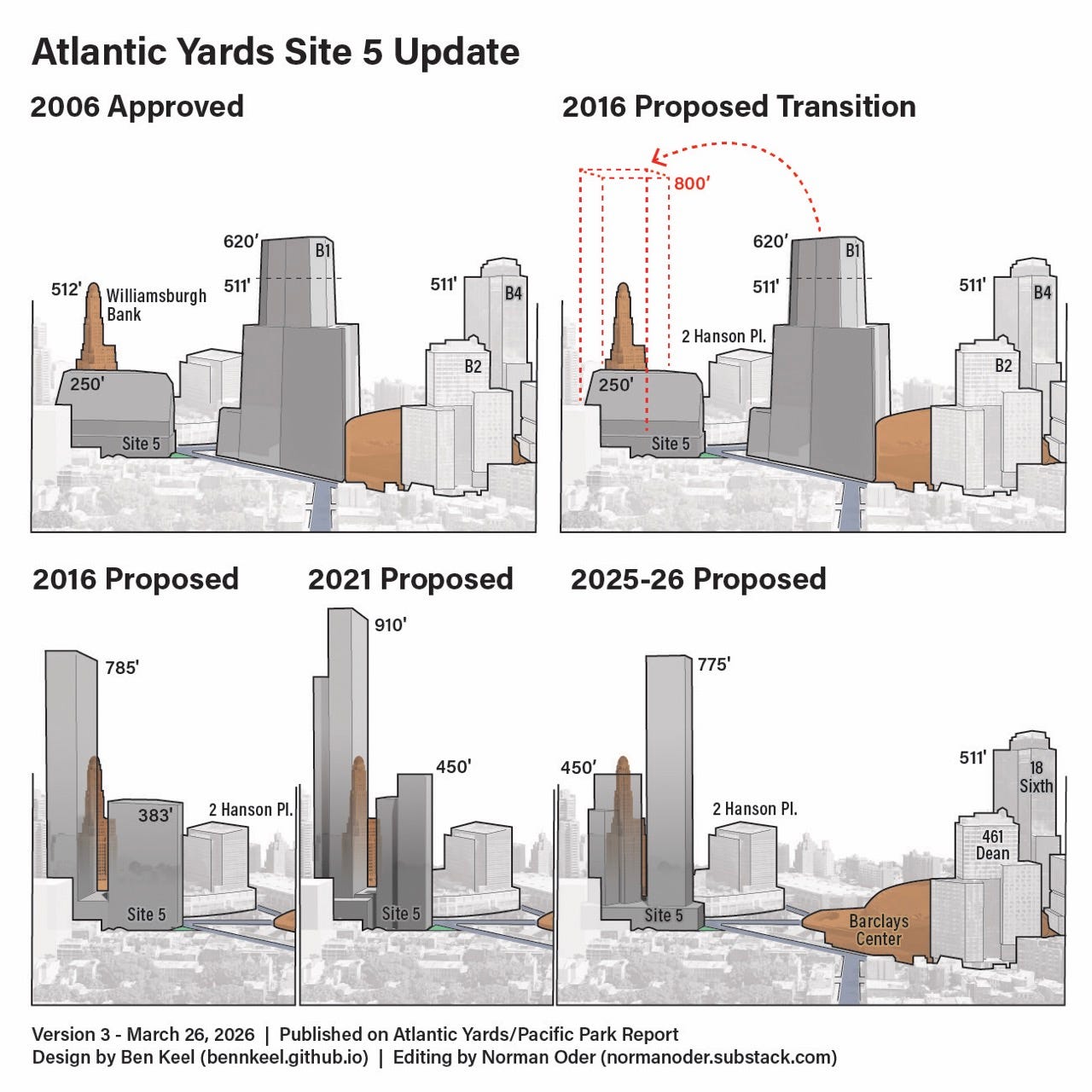
Upon reflection, Site 5 probably would contain at least 1,100 apartments. Consider that the first two developments, the Site 5 towers and the B6 tower, are expected to contain 2,000 total apartments, with one-fourth of them affordable.
It’s hard to imagine that the residential square footage in the Site 5 towers, even after subtracting space for retail and the hotel, wouldn’t be more than in the single B6 tower.
But why should we guess? The state and the developers should explain.
A key metric: FAR
That 1,242,000 gross square feet would be on a parcel of 48,655 square feet2, or 1.12 acres. That suggests an astounding Floor Area Ratio (FAR), a common measure of bulk versus the underlying floorplate, exceeding 25.5.
Keep in mind that Downtown Brooklyn was rezoned to an FAR of 12, while certain parcels have gotten significantly more space. Perhaps the most comparable parcel is the Alloy Block (formerly 80 Flatbush), a block or so north on Flatbush.
It has two towers (one built, one in progress), plus two schools and retail, with a total FAR of 15.75, granted due to the affordable housing and schools.
Given the discrepancy between gross square feet and zoning square feet in New York City, my 25.5 FAR calculation needs adjustment, as discussed below
Then again, the calculation would stand, mostly, under the rules for part of Jersey City, though the Site 5 plan wouldn’t be permitted on a parcel that size.
Site 5, as suggested in the image below, is in a more transitional area than the Downtown Brooklyn project, as it borders low-rise zones on narrow Pacific Street to the south and Atlantic Avenue to the west.
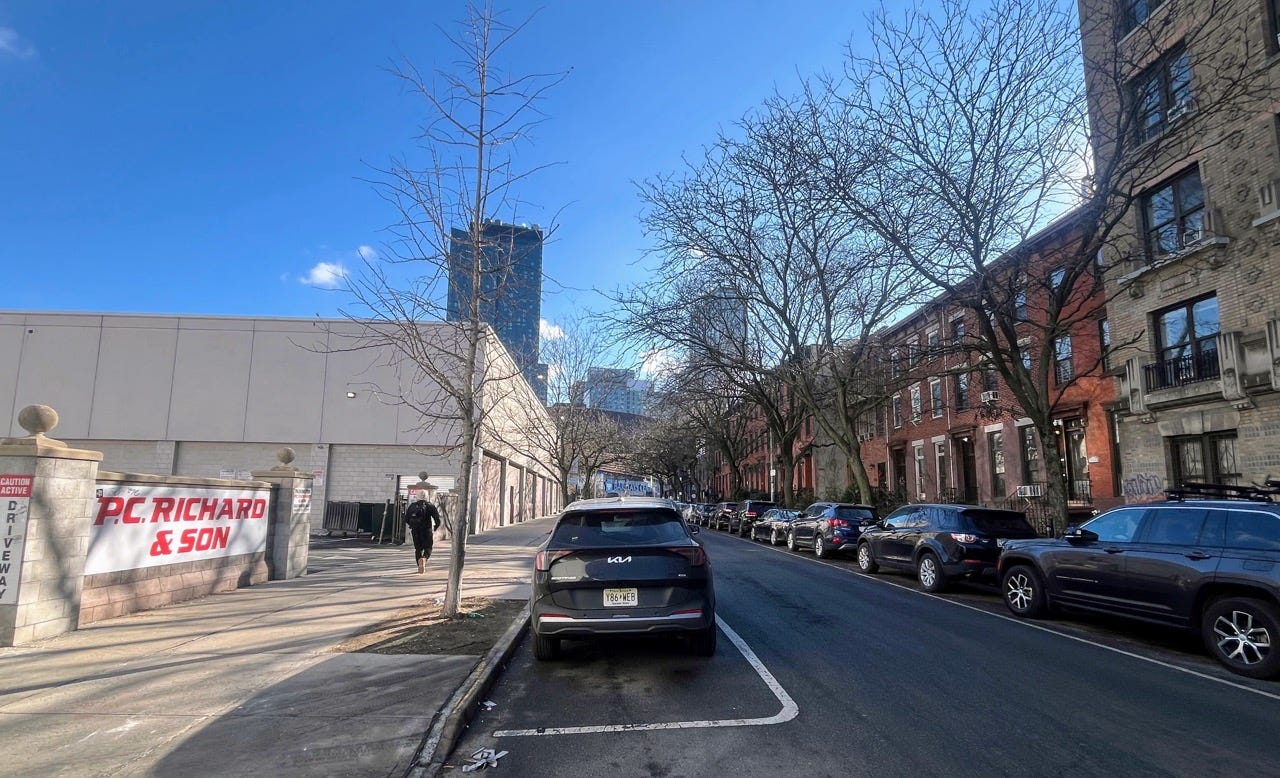
Site 5 also serves as a gateway to the more modest towers, typically 12 to 14 stories, along rezoned Fourth Avenue to the south.
In Jersey City
I went to Jersey City’s Journal Square neighborhood,3 where towers up to 25 FAR are allowed, to see what truly large-scale development looks like. Two key parcels are each nearly twice the size of the Site 5 footprint, well over 2 acres.
The location, as seen in the Google Earth photo below, is partly comparable to Atlantic Yards/Pacific Park, given that Journal Square is an inland rail and bus transit hub.
Meanwhile, the towers in Downtown Jersey City and the nearby waterfront, toward the back of the image, may be more comparable to Williamsburg or parts of Manhattan.
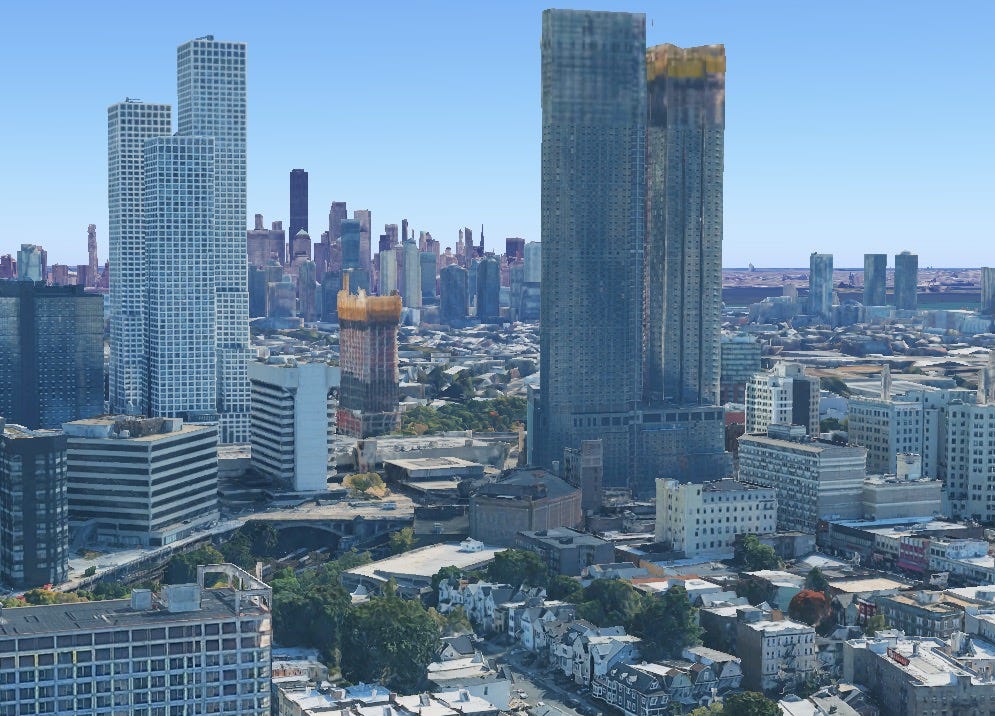
That said, the comparison is limited, given that Atlantic Yards/Pacific Park borders multiple lower-rise, row-house neighborhoods, while the Journal Square area is a more motley shopping/commuter/residential/educational zone, with overall lower rents and land costs.
At the center of the photo below is the two-tower complex called The Journal. Both towers of The Journal are 710 feet and 64 stories. With a .92-acre public plaza, the 2.1 million-square-foot project has an FAR of 21.64, according to the city.
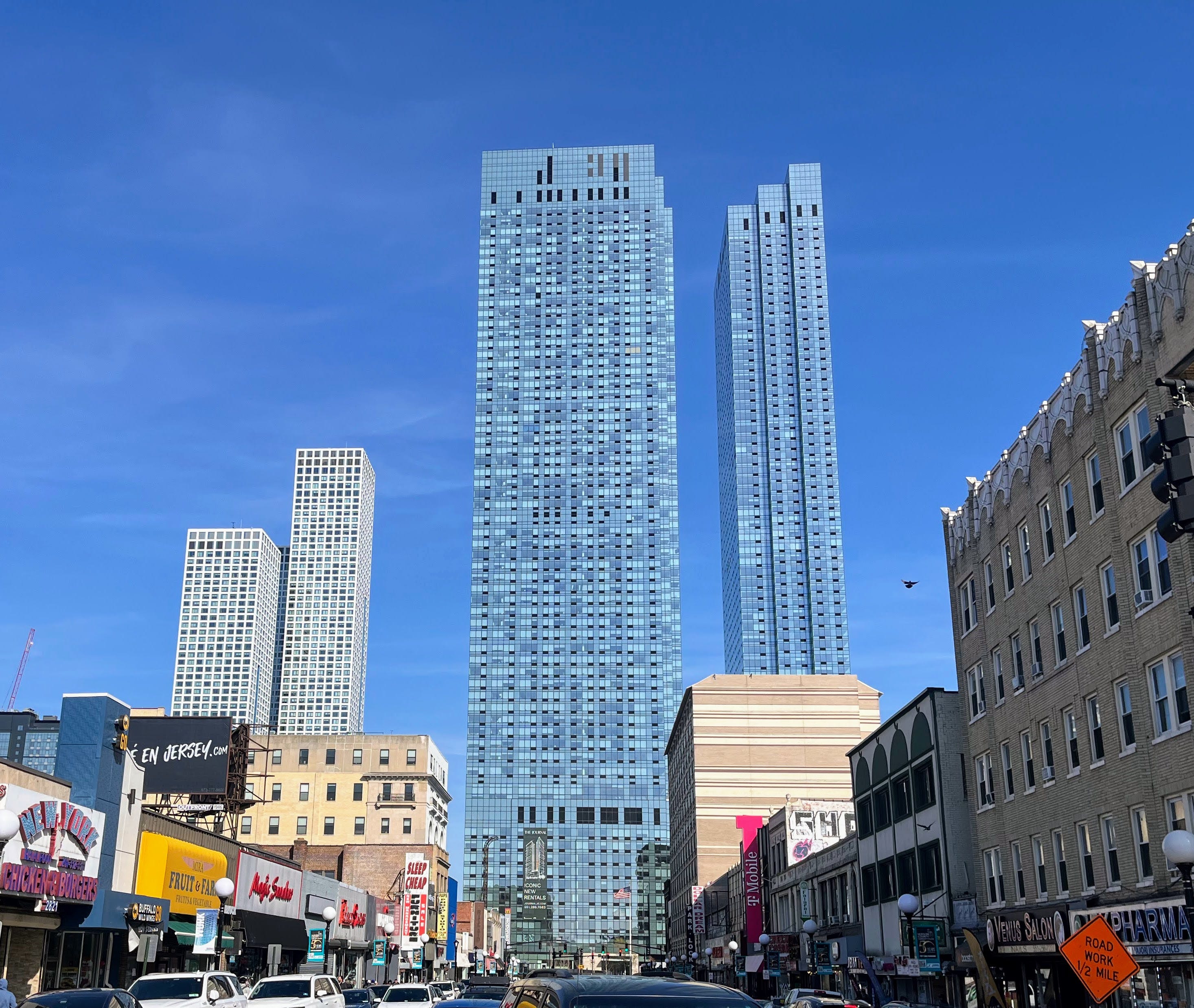
The tallest of the three Journal Squared towers, visible at left with the white facade, is 754 feet tall and 68 stories, while the others are 633 feet and 574 feet. With 2,280,601 square feet, it has an FAR of 23.47, according to the city.4
In other words, Site 5, as proposed, might be more dense.
Some other details
Journal Squared contains 1,840 rental apartments, or about 825 per acre, while The Journal contains 1,723 units, or about 773 per acre. They house many people near a transit hub, which is a reasonable urbanist principle.
Still, while the buildings are striking on the skyline, they’re surrounded by traffic, and the outdoor space is mostly hardscape. They have no affordable units. (Jersey City, aiming to goose development, only recently required 10% to 15% affordable units.)
“Just four blocks away from the station, the rental pricing changes dramatically,” a developer told Urban Land, indicating it’s a bedroom community.
Journal Squared offers “100,000 square feet of unimaginable amenities,” including a spin room, cardio room, rock climbing wall, chef’s kitchen, karaoke lounge, conference rooms, and co-working spaces.
The Journal offers an indoor basketball court, sauna and steam rooms, a screening room, a game room, and a coworking lounge. The complexes, it seems, are built for people to stay home.
Thinking about Brooklyn
What about Site 5, on 1.12 acres?
Extrapolating those per-acre ratios, 825 and 773, to the smaller Site 5 would yield 922 or 864 total apartments on 1.12 acres. But if Site 5, as seems likely, would have more than 1,000 apartments, that’s at least 893 apartments per acre, so it would pack even more people in.
Here’s the thing. Even super-YIMBY Jersey City doesn’t allow buildings that large on parcels the size of Site 5 or, for that matter, the recently approved 395 Flatbush Ave. Extension project.
Why? Well, presumably only larger sites can handle such bulk, leaving room for complementary open space. Where would the Site 5 open space go? Or would it mainly be terraces, available only to residents? We should know more.
According to the Journal Square 2060 plan of the Jersey City Redevelopment Agency, excerpted below, the core area (in red) was designated for the most intense development.
Notably, only lots of at least 60,000 square feet could get a maximum residential FAR of 25, while a parcel between 30,000 and 60,000 square feet—the size of the two Brooklyn projects—would be limited to an FAR of 20.


The Flatbush Ave. Ext. project is in a new C6-12 zoning district, which allows an FAR of 23. Atlantic Yards is a state project with a city zoning override, so Site 5 developers have more leeway.
Some FAR math
The Jersey City FAR calculation includes all above-grade space.5 That seems closer to the New York City concept of gross square feet (gsf), which includes all above-grade space, plus basements, whereas zoning square feet (zsf) excludes lobbies, mechanical spaces, and more.
Remember, 395 Flatbush Ave. Extension is 1,544,875 gsf vs. 1,075,100 zsf, nearly 44% more, with the latter number producing an FAR of 21.87. That’s an unusual drop.
So maybe Site 5 wouldn’t have an FAR of 25.5 by New York standards. Adjusting the Site 5 calculation to zsf with a 15% or 20% cut would result in 1,080,000 zsf or 1,035,000 zsf. That would yield an FAR of “only” 22.2 or 21.2, comparable to The Journal in Jersey City.
Whatever the math, a parcel the size of Site 5 in Journal Square would max out at 20 FAR.
Looking outside
The plaza outside The Journal, at least on the April days I visited, was pretty stark, as was the one outside Journal Squared. I didn’t see anyone sitting outside on the plazas other than other commuters.
“Complementing the residences and retail, a .92-acre public plaza adorned with lush landscaping and inviting seating areas will open onto John F. Kennedy Boulevard, fostering community engagement and enriching the neighborhood’s dynamic urban fabric,” stated a press release from the EB-5 visa packager U.S. Immigration Fund6, which helped get cheap financing for Kushner Real Estate (KRE) Group and National Real Estate Advisors.
It wasn’t much being used, at least on the chilly afternoons I walked around. In the video below, shot around 5 pm on a weekday afternoon, I exit the PATH station at Journal Square and look up at the tower complexes.
At about 1:15, I approach the open space outside The Journal. By the end of the short video, the view is from across the street.
One day was notably bitter, given the whipping wind. The towers create a microclimate, a local told me.
Keep in mind that the area around Atlantic Yards, notably the Williamsburgh Savings Bank, is already known as among the city’s windiest. I reported in January 2025 about some brutally cold winds whipping down Sixth Avenue.
Other challenges
Do the Journal Square towers make for a good place to live? Maybe for those staying inside: The Journal is rated 4.7 on Google and Journal Squared is rated 4.3.


Then again, one reviewer for The Journal cited frequent elevator issues: “I have waited more than 15 minutes several times, which is incredibly inconvenient.” Another warned that one pool is shared among 1,700 apartments.
One reviewer for Journal Squared warned that elevator outages mean you might be stuck like “sardines for more than 5 minutes if you are ‘lucky’.” Another reviewer praised the “spectacular view” and the “super convenient” location, noting a 15-minute trip to the World Trade Center, but also warned that elevators could take 5 minutes.
That’s a concern, especially for families, if Site 5 is supposed to supply some of the coveted but missing Atlantic Yards affordable housing.
The hardscape plaza (top left, two photos, and bottom right) in front and behind Journal Squared was notably empty on my visits, but presumably becomes more lively in warmer weather. A few people, seemingly commuters, were sitting outside The Journal (left-center).


What about Brooklyn?
There’s likely less room, however, for open space outside Site 5, given the size of the parcel. They haven’t shown us the proposed open space.
In a May 28 presentation to the Prospect Heights Neighborhood Development Council, Veconi described the challenges of a very large project, including, but not limited to, Site 5.
Buildings this size require strategies to prevent, redirect, or manage downward drafts, he noted, and must be designed with setbacks and canopies. Shadows increase, as do wind tunnel effects.

Market-rate affordability
Jersey City towers, at least in less-coveted Journal Square, are far more affordable for market-rate renters than Manhattan and Downtown Brooklyn/Prospect Heights. (Rentals at the waterfront and in Downtown Jersey City also offer a price advantage over Manhattan, but not as much.)
That’s thanks not just to the upzoning, but also, according to Urban Land, property tax abatements and a Payment in Lieu of Taxes (PILOT) program to spur development. Several buildings got low-cost loans from immigrant investors under the EB-5 investor visa program.
At The Journal, the cheapest studio is $2,808 net effective rent, with two months free on a 20-month lease, while the cheapest one-bedroom is $3,276. (Omitted, though, are mandatory monthly costs.) At Journal Squared, the cheapest studio is $2,790, while the cheapest one-bedroom is $3,150. Select units get one month free.
Neither complex seems to have many three-bedroom units, though hard numbers are scarce.
“Affordable” in New York City
Let’s compare that to New York.
At 120% of Area Median Income (AMI)—the ceiling for future “affordable” units in Atlantic Yards, according to the developers, who adjusted that ceiling from 130% after criticism—middle-income “affordable” studios in New York City could charge $3,402 and one-bedrooms $3,644.
In other words, comparable to market rent in parts of Jersey City. Still, developers don’t aim for the maximum, since it’s unrealistic.
Consider: in the Rialto West in Hell’s Kitchen, a reasonably coveted location in Manhattan, a studio at 120% AMI rents for $2,319, while one at 140% AMI rents for $2,805.
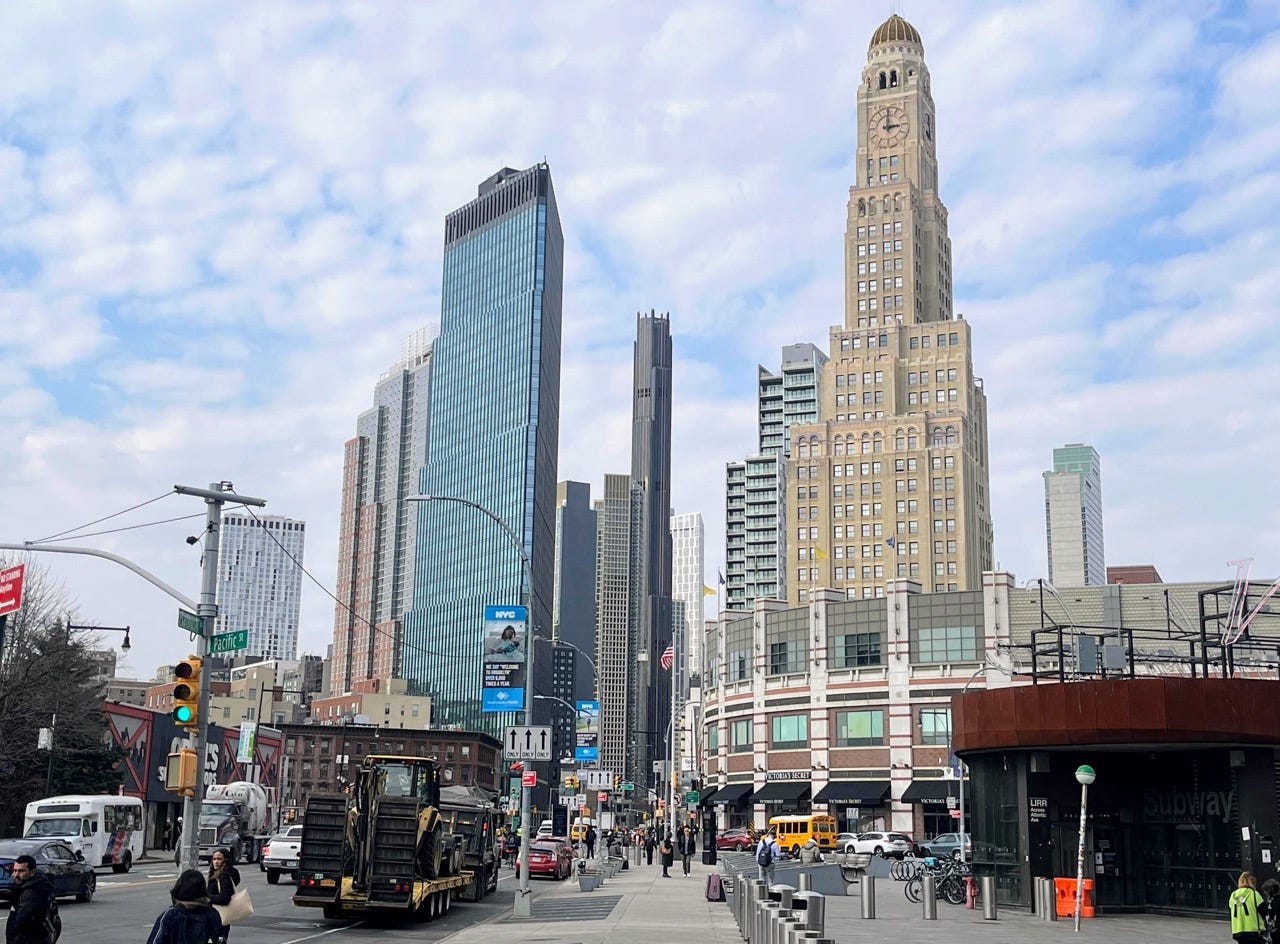
Another take on Site 5
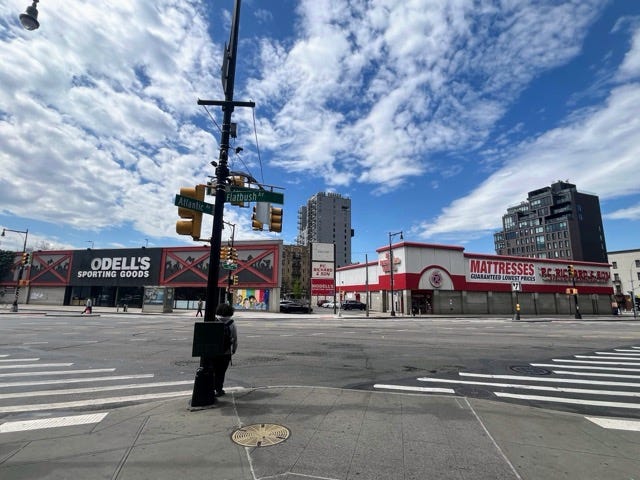
Site 5 is partly visible in the photo above, with the Modell’s building lower left.
Veconi, in his presentation, described his attempt to model the project’s future.
For Site 5, he estimated an FAR of 23.2 and 1,350 apartments, plus 18 to 25 retail stores and 180 hotel rooms, noting that the rendering—with a podium and two towers—was not intended to be realistic.
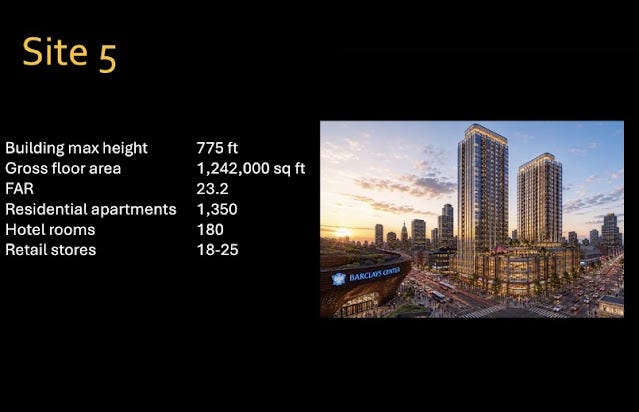
His calculations deserve a few footnotes. The FAR math apparently relies on a larger parcel size, so perhaps it includes the Pacific Bear’s Garden, though it shouldn’t.
Would there be 1,350 apartments at Site 5 and only 650, as Veconi projected, at the B6 tower? We don’t know, but we should.
Still, I suspect that B6, at least as redesigned, might include nearly as many—if not more—apartments as the B4 tower, 18 Sixth Ave., which has 858 units, pictured in the photo below.
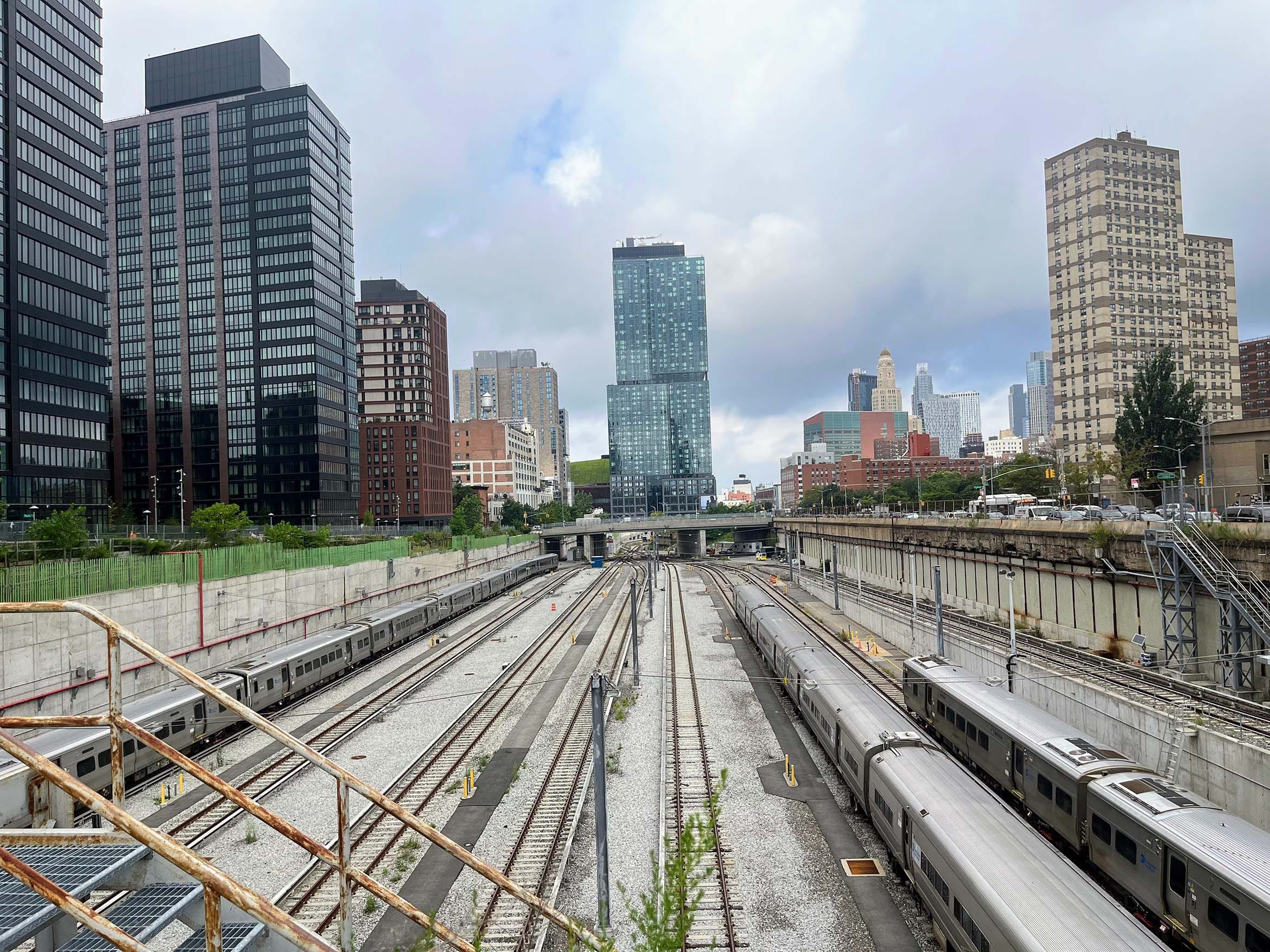
It’s not simple to extrapolate from square footage to the number of apartments.
Consider that the 2006 Final Environmental Impact Statement for Atlantic Yards assessed 6,363,000 gsf for 6,430 units, or 990 square feet per unit, with a note that an unspecified portion of the residential (and retail) space would go to community facilities.
The apartments, of course, have not been that large. Going forward, they surely wouldn’t be, as well.
So the developers and the state should share their calculations.
What about overall density?
What about the project’s overall density, which I’ve estimated at 409 apartments per acre overall, including the towers already built?
The five towers over the railyard, I’ve estimated, would produce 608 to 647 apartments per acre, depending on whether they held 4,688 to 4,988 apartments.
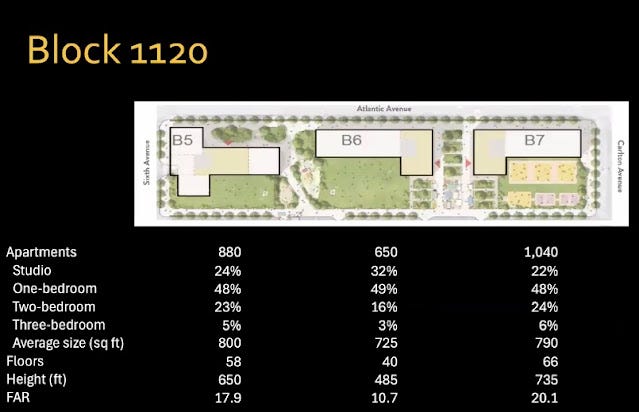
Veconi, in his presentation, similarly estimated a combined density of about 648 apartments per acre.
He called that railyard development potentially “the densest residential development in New York City, if not the United States.”
(He didn’t mention Journal Square, but that’s not a single project. It’s possible that the parcels in the core area, in the red around the transit hub—The Journal, Journal Squared, 505 Summit, and whatever’s next—are comparable, but, if so, they’re a caution as much as a template. Also, the transit hub’s acreage must be factored into the calculation.)
Some comparable projects, Veconi suggested, might be in Singapore and Hong Kong.
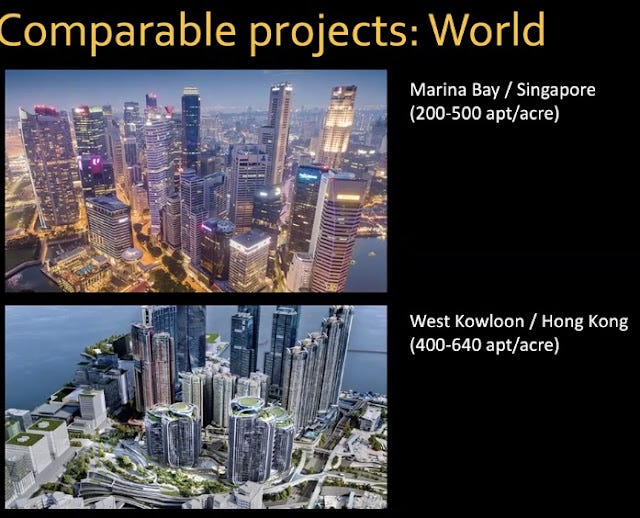
Official silence
Remember, at the Jan. 22 Atlantic Yards workshop, the moderator read my question: what other large real estate projects in New York City have a density comparable to what’s being proposed here, about 409 apartments per acre?
(That referenced the entire 22-acre project. I didn’t share the more dramatic calculation regarding the density of the project’s remaining buildable sites.)
LCOR’s Anthony Tortora, clearly prepared, claimed the proposal was contextual to changing Brooklyn, “Our proposed density,” he said, “is consistent with the Atlantic Avenue portion of AAMUP,” the Atlantic Avenue Mixed-Use Plan, a recent rezoning.
“It’s less than Downtown Brooklyn,” he added, “and there are other examples of this type of density in other neighborhoods, like Hunters Point, Jamaica and Long Island City.”
That dodged the question, as he was comparing the density allowed for buildings in those rezonings, as measured by Floor Area Ratio, with the FAR for Atlantic Yards as a whole, including open space.
(Individual buildings in Atlantic Yards would be far more dense, as my Site 5 calculation suggests.)
My question referred less to bulk than to a concentrated population. I tried to follow up in writing: “My question referred to large real estate projects, like this one, with a projected 9,000 units over 22 acres. What do you see as comparable?”
It was ignored. It shouldn’t be.
Another look at Journal Square
In the video below, I exit the rear of the PATH station and walk around the Journal Squared complex.
More photos
Note the nearby 505 Summit tower, 54 stories and 600,000 square feet, with 605 apartments in the two bottom photos in the gallery below, and also visible in the video above.
It’s on a former parking lot of about an acre, according to Jersey Digs. According to the application, though, it’s 632,980 gsf over a 30,515 sf lot (or .7 acres). That translates into a 20.74 FAR, but the application says 19.86.
So, depending on the metric, it’s 605 apartments/acre, or 864/acre.


Below is another walk, ending at 505 Summit.
It’s offering a grand opening special, with 2.5 months free, on a 24-month lease. So net rent for a studio is $3,041, though it would revert to $3,451, and net rent for a 1-bedroom is $3,225, though it would revert to $3,656.
The name reflects Site 5 of the Atlantic Terminal Urban Renewal Area, or ATURA.
Also see the Design Guidelines.
Yes, I know that Jersey City also has many high-rises near the waterfront. Because waterfront development offers a different setting, I thought inland Journal Square was a better comparison, especially since there’s no equivalent plan for the waterfront.
Here’s an excerpt from a document shared with me:

From p. 37 of this document: “The Floor Area Ratios in Table 3 above are inclusive of all built structures at or above grade including, but not limited to parking decks, lobbies, hallways, building core, common areas, etc.”
Affiliates of the U.S. Immigration Fund now own an unspecified piece of Atlantic Yards.