
State Promises 500 (25%) Initial Low-Income Units. Critics Note It Wouldn't Make Up for Shortfall.
Shift from developers' earlier plan, but still no catch-up. A $3,071 low-income one-bedroom when buildings open (maybe) in early 2030s? Project completion by 2040?

The first two residential projects built at Atlantic Yards should have some 500 low-income affordable units, among 2,000 total units, representatives of Empire State Development (ESD), the state authority that oversees/shepherds the project, said at two meetings yesterday.
Those buildings could open as soon as “the very early 2030s,” under a best-case scenario, added Joseph McDonnell of funder Cirrus Workforce Housing, which, with developer LCOR, now controls the project.
“I think if things go quite well, you could complete this in the late 2030s,” he said of building seven towers at six development sites, involving potentially 5,788 more apartments (for a total of 9,000), along with significant infrastructure, notably a platform over a two-block railyard.
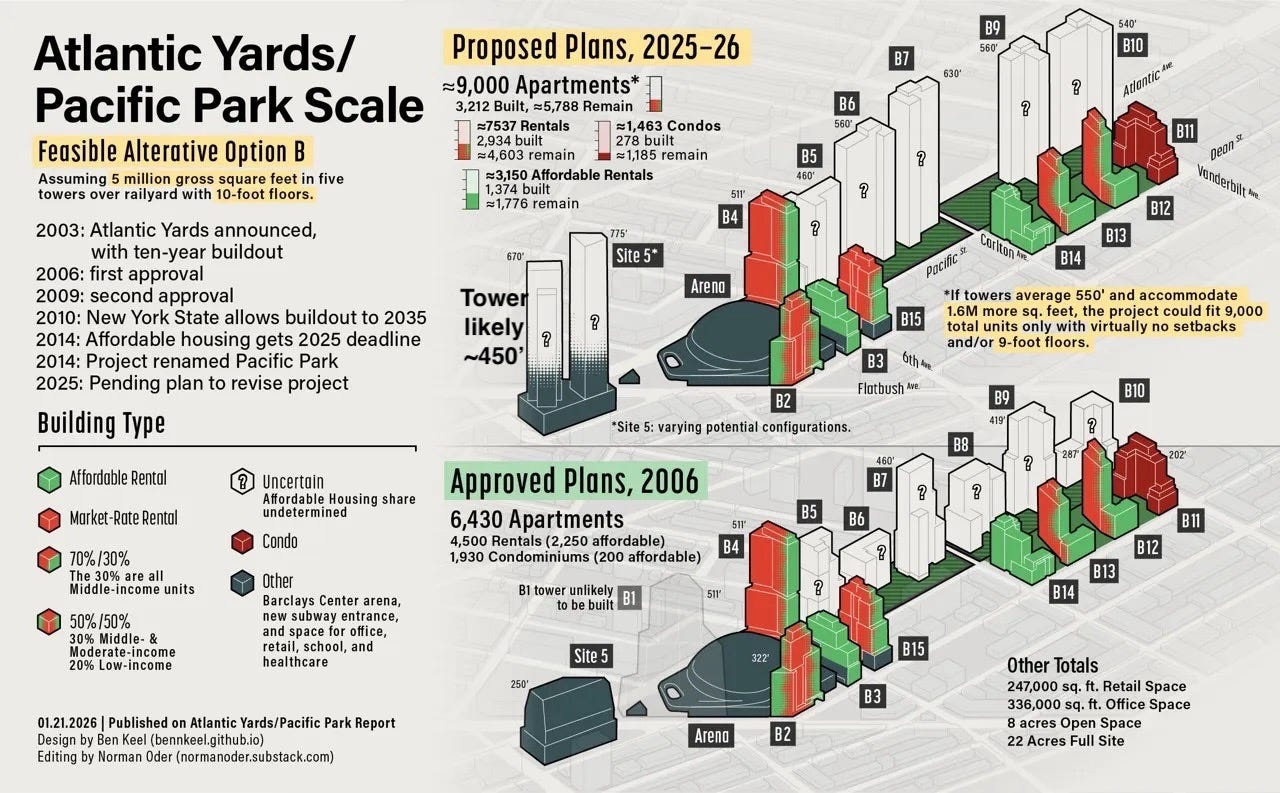
ESD will likely provide a longer leash, as the current “outside date” is 2035, and project documents are being renegotiated. An environmental review process, perhaps starting later this year, would likely last until the end of 2027, after which construction might start.
Building on solid ground
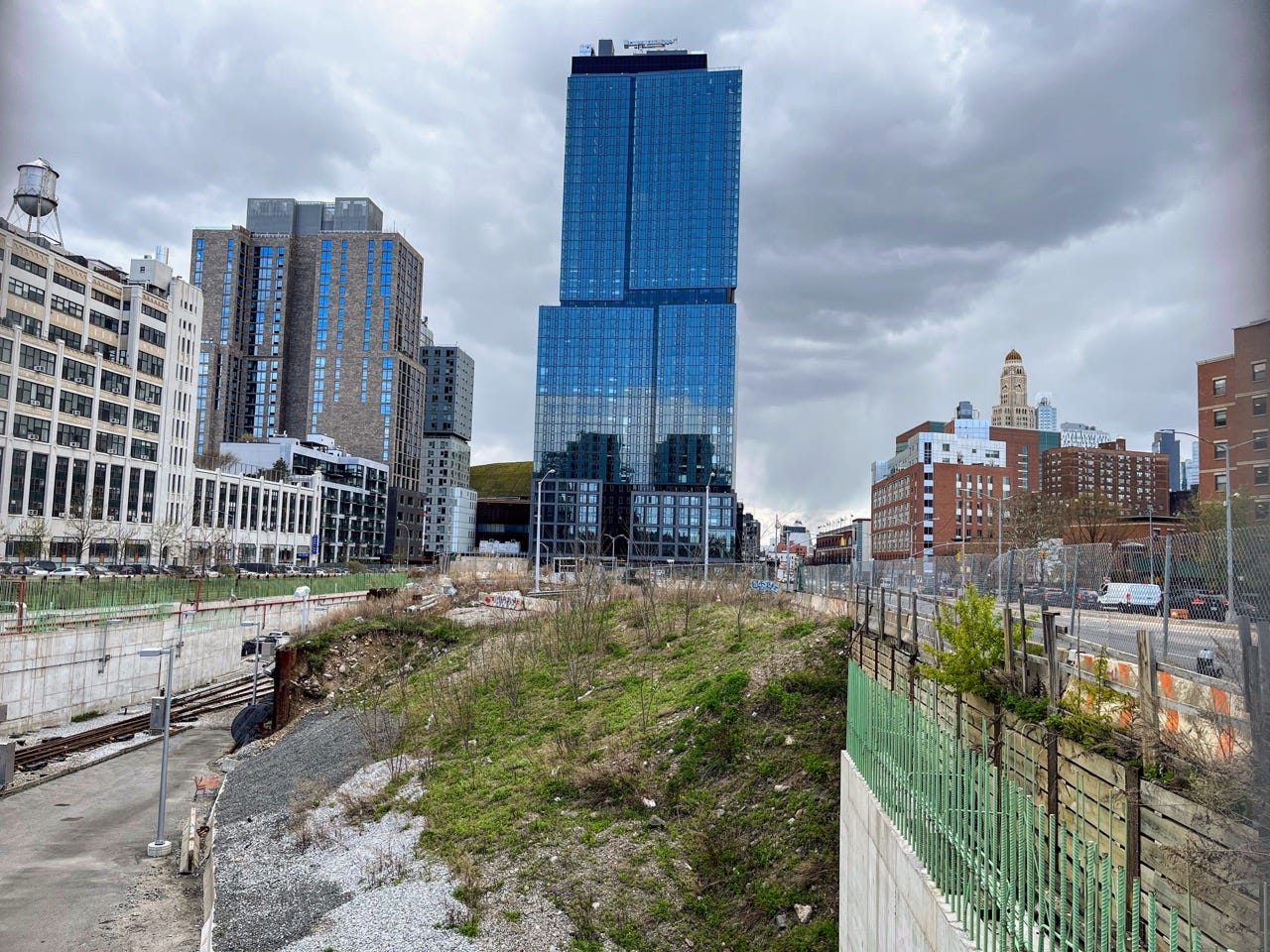
Initial construction, presenters said, would take advantage of terra firma at Site 5, the parcel across Flatbush Avenue from the Barclays Center, long home to the big-box stores P.C. Richard and the now-closed Modell’s, now the Brooklyn Basketball Training Center.
That two-tower project would include bulk shifted from the unbuilt B1 tower, once slated to be built over the arena.
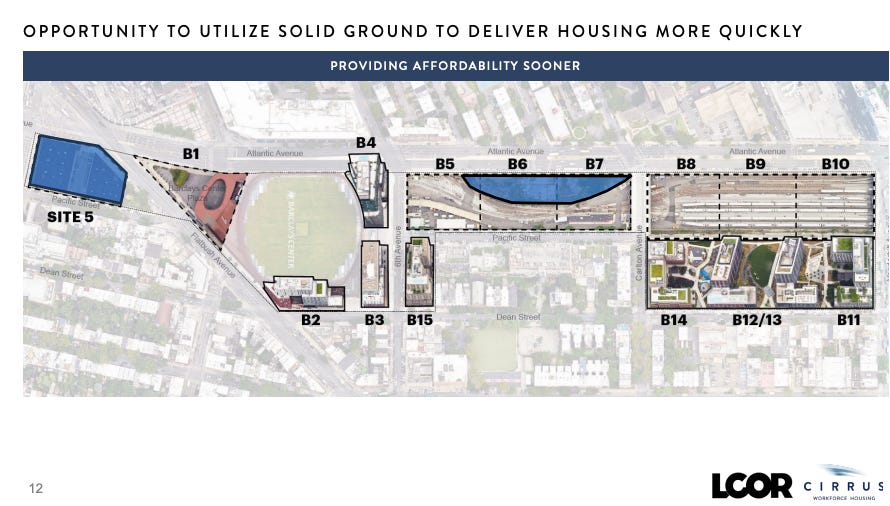
Construction, McDonnell said, also would start at the parcel known as B6, on solid ground jutting south of Atlantic Avenue, between Sixth and Carlton avenues, into the Metropolitan Transportation Authority’s Vanderbilt Yard.
B6 construction would not have to rely on the platform, which might be built at the same time. (That said, those living in that tower might find the construction of the platform and two adjacent towers somewhat trying, with no immediate access to open space but rather Atlantic Avenue.)
Affordability promises
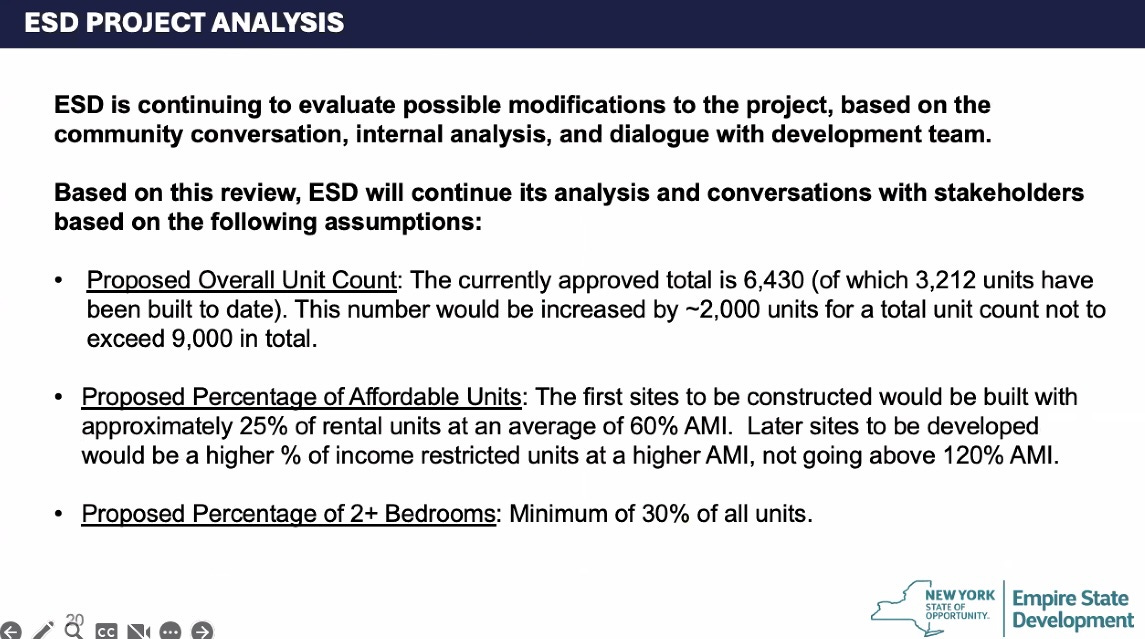
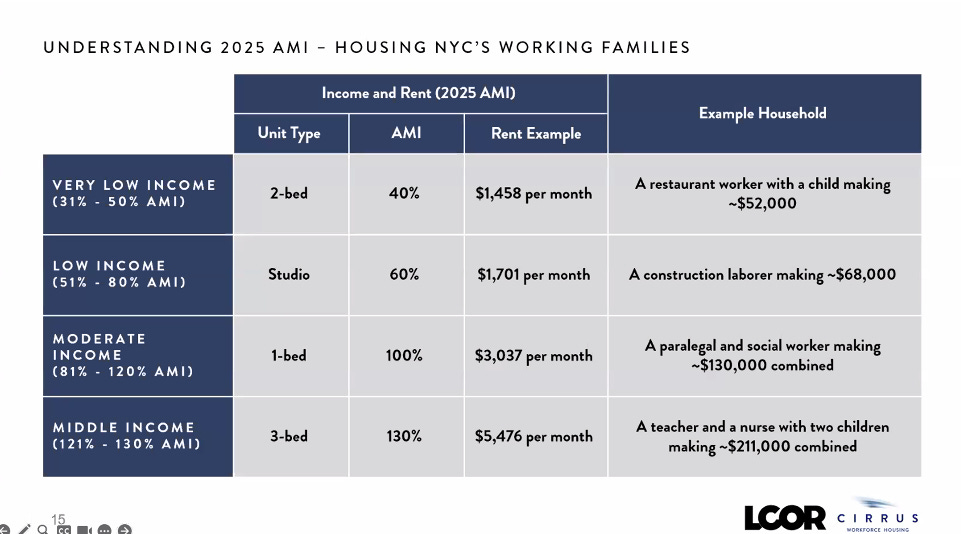
At the first sites to be built, ESD projects 500 low-income affordable units among 2,000 total apartments, averaging 60% of Area Median Income, or AMI.
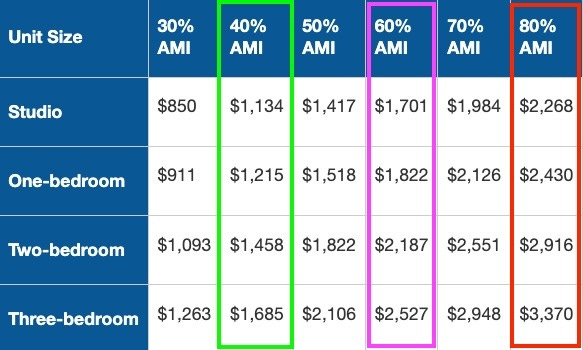
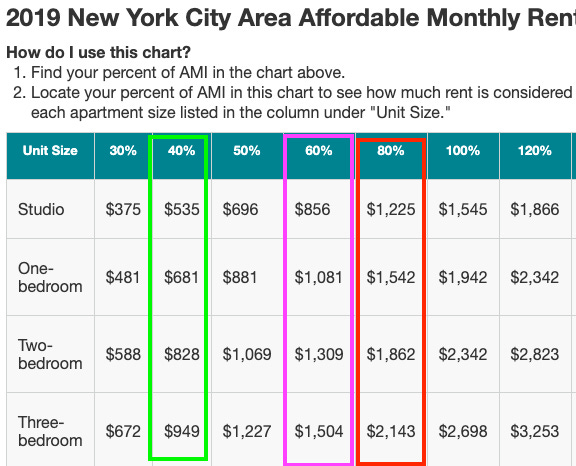
A one-bedroom at 60% of AMI could rent for $1,822 as of 2025, but, based on a similar percentage increase to that over the past six years, could cost $3,071 in 2031.1
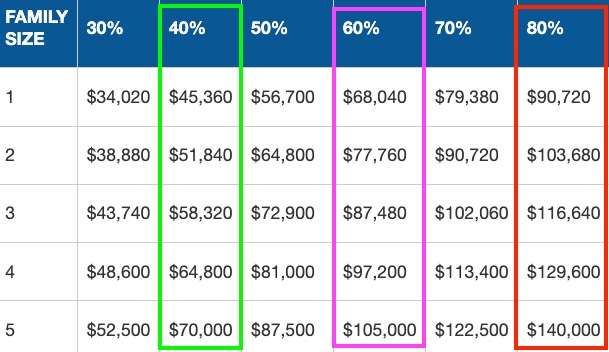
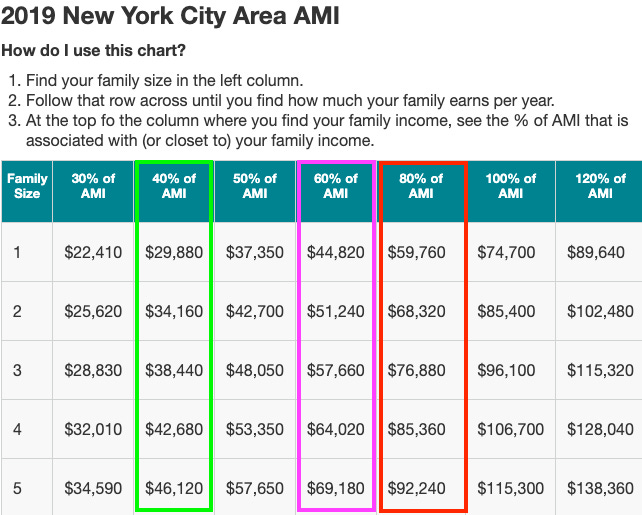
A two-person household at 60% of AMI could earn up to $77,760 as of 2025. Based on a similar percentage increase to that over the past six years, the ceiling could reach $118,006 in 2031.2
(The growth of AMI, which relies on five boroughs and some prosperous suburbs, surely outpaces the incomes of lower-income Brooklynites.)
ESD also promised an unspecified amount of future affordable housing, averaging a higher percentage of AMI (while including low-income units) and setting 120% as the ceiling. That’s a slight departure from the developers’ previously stated cap of 130% of AMI, which is very close to market rates.
A one-bedroom at 120% of AMI, at the ceiling for moderate-income, could rent for $3,644 as of 2025, but, based on a similar percentage increase to that over the past six years, could cost $5,670 in 2031.3
A two-person household at 120% of AMI could earn up to $155,520 as of 2025. Based on a similar percentage increase to that over the past six years, that ceiling could reach $236,012 in 2031.4
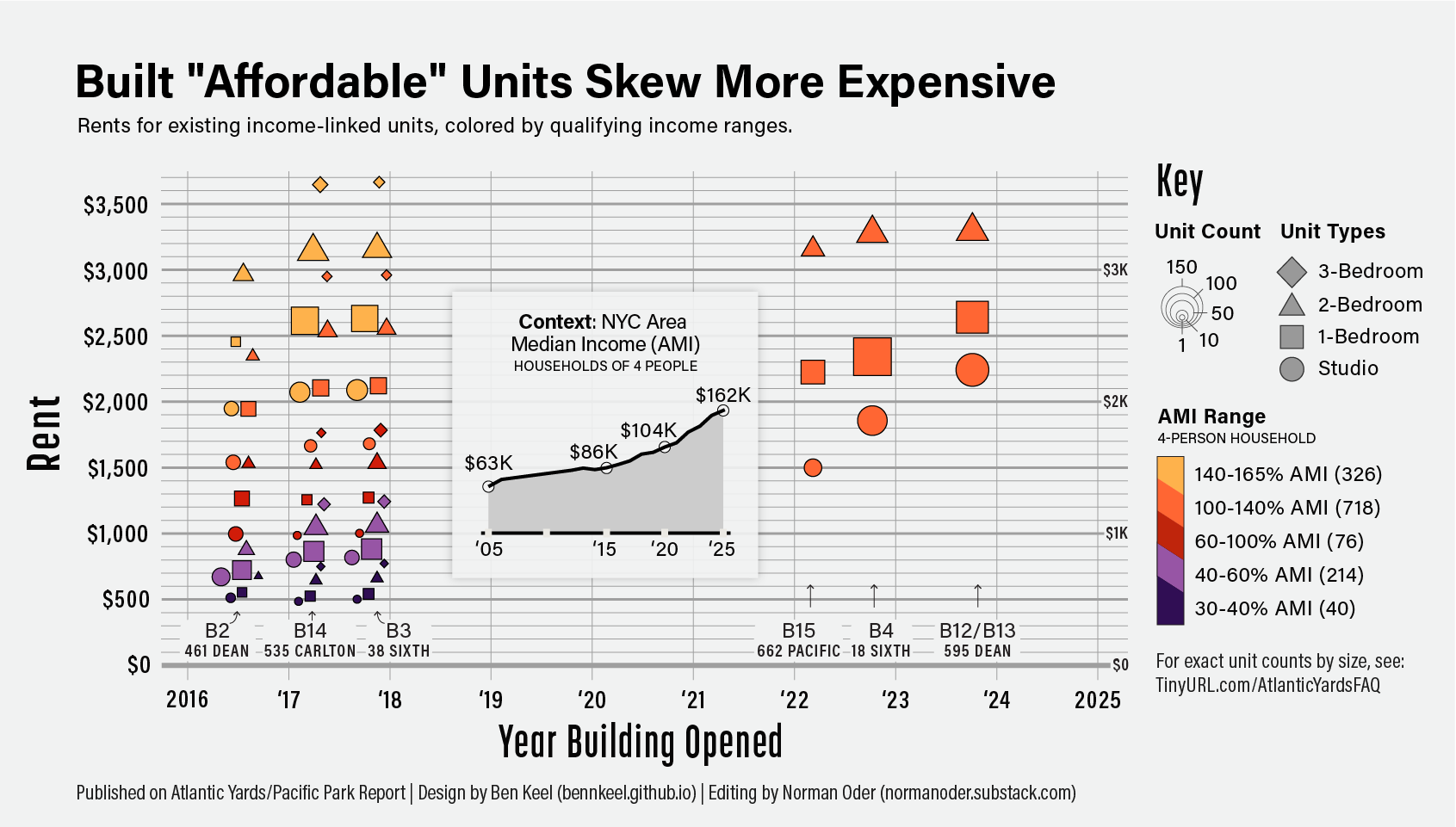
ESD also proposed that at least 30% of all units would be family-sized, with at least two bedrooms. That could be a significant improvement over the recent record, as the last four buildings have included no three-bedroom affordable units.5
Affordability questions
While 500 apartments, averaging 60% of Area Median Income (AMI), would be a departure from the previously stated (and criticized) Cirrus/LCOR emphasis on moderate- and middle-income housing at 80% of AMI and above, and also would reflect the affordability levels in the state’s 485-x tax break, it was criticized as insufficient.
“I don’t think this is right, guys,” Gib Veconi, a Director of the Atlantic Yards Community Development Corporation (AY CDC), said at an afternoon meeting of the advisory body.
He noted that, of the promised 2,250 affordable units by May 2025, 877—or, as ESD counts it, 876—are outstanding.
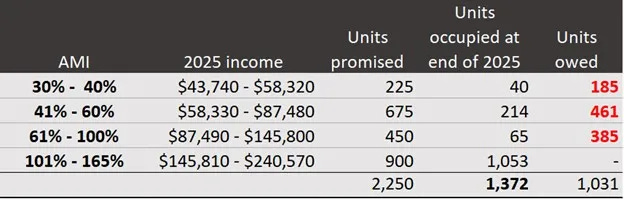
Moreover, the below-market units delivered so far skew toward middle-income housing, with 646 low-income apartments below 60% of AMI not delivered as promised, at least according to a Memorandum of Understanding (MOU) that the original developer, Forest City Ratner, signed with the housing advocacy group New York ACORN. That MOU was later incorporated into a much-hyped Community Benefits Agreement, or CBA.
Meanwhile, Veconi noted, ESD agreed not to pursue the $1.75 million in penalties for the missing housing, negotiated in 2014 by the coalition BrooklynSpeaks, which he helps lead, and instead negotiated payments totaling $12 million.
The penalty funds could be “used to accelerate 100% affordable projects” nearby, he said. “Now we’re talking about only 500 affordable units in this first phase of construction, which is probably five years away from delivery in a good scenario.”
The state apparently supports more costly below-market housing in subsequent buildings, he said. “I have a lot of difficulty with that.”
“We’re not saying there won’t be low-income units” in subsequent buildings, countered Arden Sokolow, ESD Executive VP, Real Estate and Planning.
Veconi said they needed a schedule showing buildings, apartments, unit sizes, and affordability levels: “This is very squishy.”
Sokolow said the information was “what we’re using to start the conversation.”
“We’re not exactly starting the conversation,” Veconi said. “This is March, and we knew in October that we had a [new] development team starting this project.”
AY CDC Director Ron Shiffman, a veteran academic and advocacy planner, stressed the need for “more low-income housing and more housing for families.”
However, he suggested that Site 5 was “inappropriate for a lot of families,” given the potential for living in a 75-story building and exiting to the congested, risky intersection of Fourth Avenue and Atlantic Avenue. (The developers later said they might orient the larger Site 5 tower to Flatbush Avenue.)
Ballpark estimates
With 500 affordable units projected, averaging 60% of AMI, I estimate 300 apartments at 60% of AMI, 100 at 40% of AMI, and 100 at 80% of AMI.
That means some units would be geared to households earning more or less than the 60% of AMI examples noted above, with commensurate rents.
With 30% of the units family-sized, with at least two bedrooms, I guesstimate the following distribution:
40% of AMI: 25 studios; 45 1-BRs; 25 2-BRs; 5 3-BRs
60% of AMI: 75 studios; 135 1-BRs; 75 2-BRs; 15 3-BRs
80% of AMI: 25 studios; 45 1-BRs; 25 2-BRs; 5 3-BRs
Who’s the affordability target?
Later, at an online public workshop set up to respond to the Draft Community Engagement Report, Michelle de la Uz, executive director of the nonprofit housing group Fifth Avenue Committee (and, with Veconi, a leader in BrooklynSpeaks), said that “it would be helpful to prioritize meeting that original commitment sooner rather than later in the early phase.”
Were the project being approved under a city process, rather than the state one, it “would be subject to a racial equity report,” de la Uz noted, citing a 2022 provision regarding land-use actions.
Delivering apartments above 80% of AMI “would basically continue a lot of the displacement pressures that have happened in the neighborhood,” she said, indicating the steady loss of Black households in the four Community Districts near the project site.
The emphasis on middle-income housing cited in the Draft Community Engagement Report, said tenant activist Mimi Mitchell, a member of Community Board 8, did not reflect community needs or what she’d heard at the two workshops she attended, citing the need for “deep affordability.”
“It was shocking and a bit upsetting to see the numbers that I saw,” Mitchell said. (For the 82% of respondents to an online survey who disclosed their income, their median household income is $151,767.)
“We do not claim that the survey responses or even the in-person feedback that we received reflects the entirety of the community,” acknowledged Joel Kolkmann, ESD Senior VP, Real Estate and Planning. “It reflects the folks that participated and engaged.”
Affordable totals, or depth?
Given that the demand in the city’s Housing Connect lottery for middle-income units is much lower than for low-income units, one questioner asked, would ESD consider fewer units at deeper affordability?
“I think that doesn’t quite reflect the feedback that we got,” Kolkmann said, citing the need to provide “units for all incomes here.”
That means “deep affordability” as well as moderate and middle-income affordability, he said. (Technically, 120% of AMI is the ceiling for moderate income. Those at that income level face far less of a rent burden.)
What’s next?
A final Community Engagement Report should be issued next month.
(There was little public discussion at yesterday’s meetings about the “public resources” sought by the developers, including 1.6 million square feet of new bulk, $350 million in subsidies for the platform, and unspecified tax breaks and housing subsidies. The Atlantic Yards Community Development Corporation did go into executive session.)
A non-binding Memorandum of Understanding between the state and the developers is expected to be signed by July 31, laying out the framework for a public review process over the next 18 months, ESD officials said.
Topics will include the project’s proposed housing program, financing, timing, coordination of MTA agreements, community engagement, enforcement, and labor/MWBE/local hiring requirements.
“From where we sit today, we have an EIS [environmental impact statement]” before any construction, McDonnell said at the evening session. “So, I think breaking ground here in 1Q 2028, or 4Q 2027, would be very, very, very fast.”
He said the developers plan to spend pre-development funds—presumably on planning, design, and engineering—for the platform and the first two sites while the EIS proceeds. “Because what we don’t really want is a two-year EIS followed by a year or two of pre-development.”
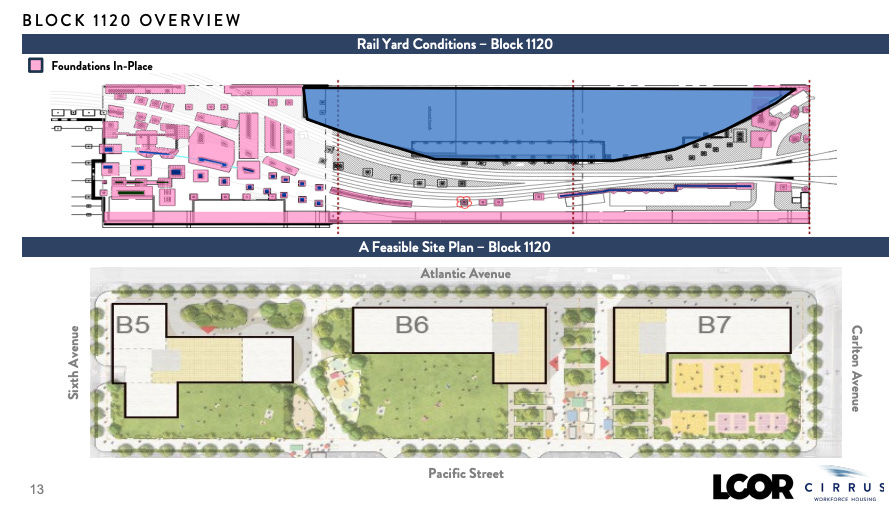
“We think that there is a scenario where the [Block] 1120 platform can be built around B6, potentially, with Site 5 coming shortly thereafter,” he said. “That puts residents in these buildings in the very early 2030s versus the mid- or late 2030s. That’s also why we spent a lot of time converting Site 5 into mostly multi-family residential.”
McDonnell called Atlantic Yards “actually two separate projects… an infrastructure project that becomes a residential development project.”
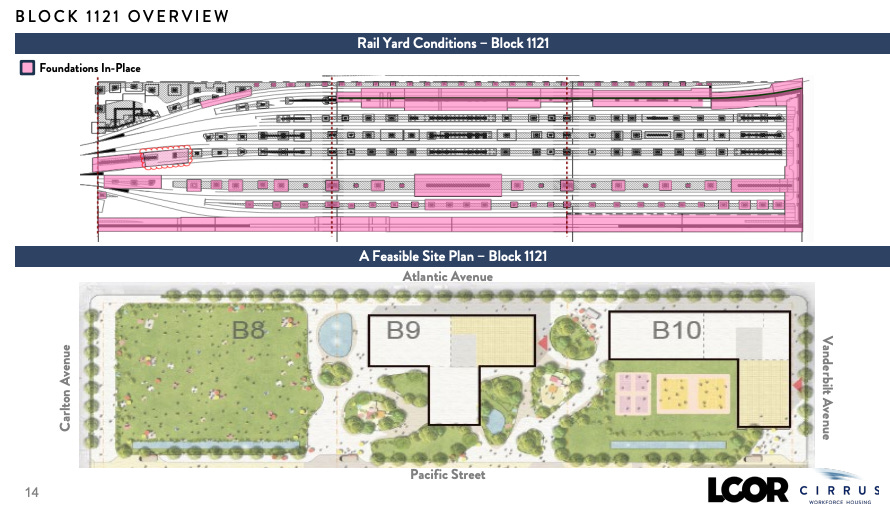
However, as he’s said, a good deal of the infrastructure—the platform precursors—has already been contributed by predecessor developer Greenland USA.
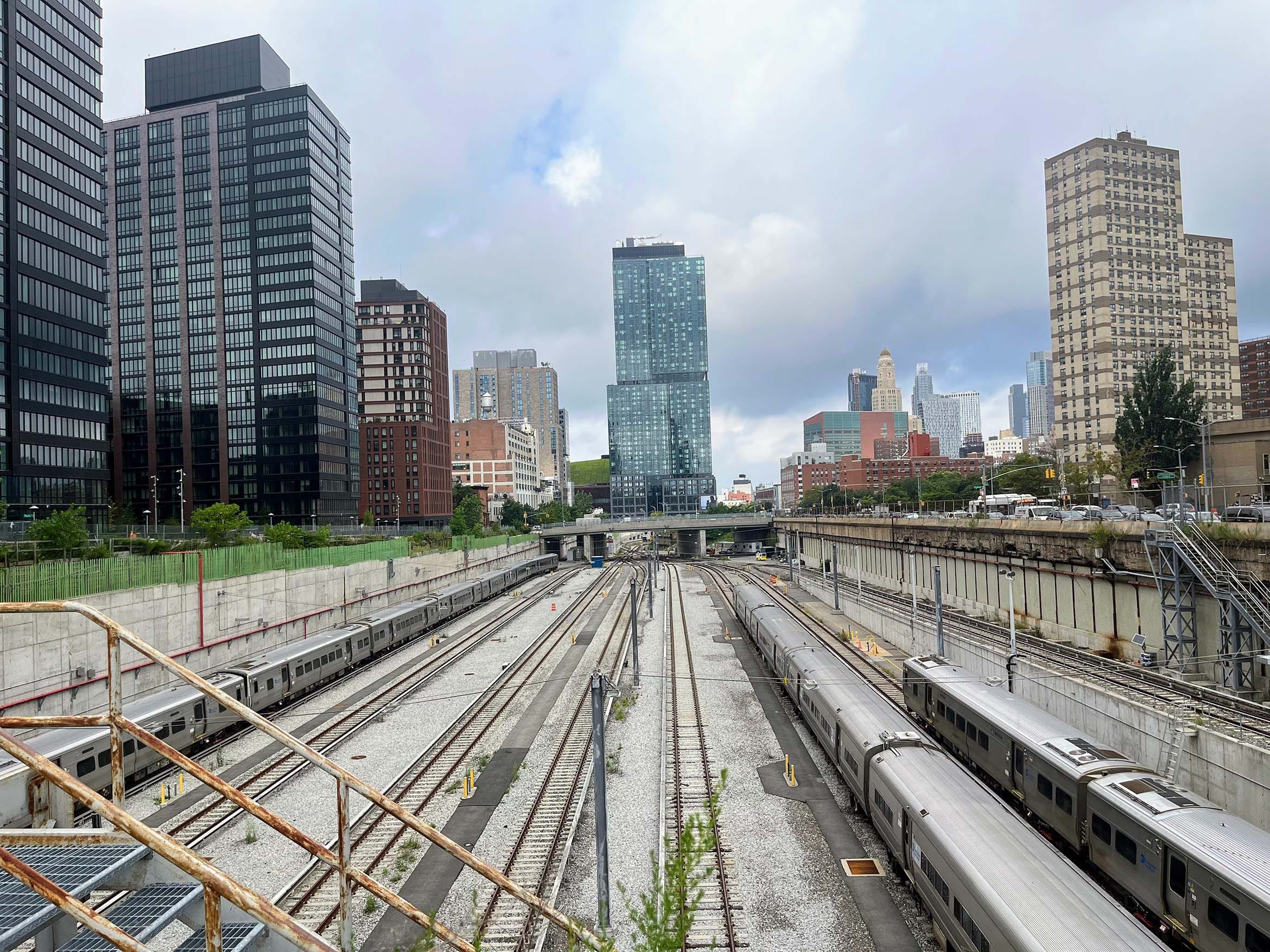
That said, the heaviest lift would be on the railyard block between Carlton and Vanderbilt avenues.
That would include the largest segment of the planned 9 acres of open space, including that just east of Carlton Avenue, once destined for the B8 tower. The construction of that was deemed too complex, given the railyard tracks below.
Project timing
As to project completion, McDonnell said, “If things go quite well, you could complete this in the late 2030s,” recognizing that construction wouldn’t start “for about two years.” (That suggests mid-2028.)
He said that he and his partner, Anthony Tortora of LCOR, “study these types of projects, it’s sort of our job.” While 75% of “urban rail projects globally” are late, he said, “we’re very confident that we can deliver this sort of on the schedule that we put forth,” given previous work completed.
That said, he acknowledged, “there’s a long way to go here. There’s fluctuations, tariffs, and all these things in between.”
Indeed, the history of Atlantic Yards, marked by exogenous shocks such as a global recession and a pandemic, suggests caution in prognostication.
At the online workshop
While the workshop drew 87 people, at its peak, a large percentage—likely a majority—were there as part of their workday, representing: ESD, the consulting firm Karp Strategies, the developers, the developers’ lobbyists, associated consultants, elected officials’ staff, and even three members of the press.
That meant the questions posted, whether by email, in the Q&A function, or orally, were not sufficient to fill the allotted 90 minutes, leading the moderator to pause the proceedings. It also meant several people got to ask multiple questions.
That also meant a drop-off from the previous workshops—two in-person, one online—which, according to the Draft Community Engagement report, drew an average of 136 people. I’ll report on other issues raised at the workshop and the AY CDC meeting in a subsequent article.
One building, 18 Sixth Ave., has 14 market-rate three-bedroom apartments.
Slight update…
While there was public discussion at yesterday’s meetings regarding the “public resources” sought by the developers, including 1.6M square feet of new bulk, $350M in subsidies for the platform, & tax breaks/housing subsidies, the Atlantic Yards Community Development Corporation did go into executive session.
So we don’t know what was said.