
Reckoning with the New Documentary, "Rust & Reckoning: The Legacy of the Barclays Center"
Excited arena patrons and striking architecture vs. unfulfilled civic promises. However, 20 minutes, filmed mostly in 2022, is too short, leaving crucial omissions.

A new short documentary, Rust & Reckoning: The Legacy of the Barclays Center, debuts tomorrow at the Brooklyn Film Festival at 4:30 pm, at 100 Sutton Studios in Greenpoint, along with four other shorts, though it’s already available to stream on the festival website. (Payment got me eight days of access.)
It’s worth a look. The synopsis:
Two decades after the controversial Barclays Center transformed Brooklyn, supporters and critics debate its legacy - was it a beacon of progress or a blueprint for broken promises?
In 2003, an ambitious project was announced to bring the first professional sports team to Brooklyn since 1957, along with a sports arena and over a dozen massive new buildings. Despite community opposition, the Barclays Center opened a decade later to house the Brooklyn Nets, though some of the promises that came with the project have yet to materialize. Over two decades later, perspectives are collected from its critics and advocates in an effort to understand the implications of massive urban development: who wins, who loses, and what is remembered.
Well, it’s not really two decades—the arena opened in 2012. Many interviews were done in 2022, keyed to Barclays’ tenth anniversary, though updates for 2026 would’ve been helpful.
A simple frame?
If you watch the trailer, below, you get a reasonable, if incomplete sense of the documentary’s framing: arenagoers and passers-by (including two French tourists), really like the Barclays Center (sports, events, monument), while one killjoy, the guy at the end, says “there’s a value to say, here’s what you promised x number of years ago, and here’s how it’s turning out.”
That would be me.
So Rust and Reckoning, while interesting and sobering, suffers from trying to address the whole, unfulfilled project while treating the arena as a given and assessing it mostly as a structure/venue, not as a beneficiary of public largesse.
While the overall project falls short of promises, as critics on-screen articulate, that’s portrayed as unrelated to the arena’s financial success, though it’s all intertwined.
In 2012, New York Times critic Michael Kimmelman suggested that arena financial gains should cross-subsidize the project’s affordable housing.
Today, when the arena and its anchor tenants are far more financially successful, that argument should be stronger. However, ownership of the larger project and the arena company has been split.
It’s complicated! Somebody should write a book.1
A larger frame: criticism
Despite the slightly misleading trailer, Director Charlie Hoxie, a staff producer for BRIC TV, tries hard to platform critics of the overall Atlantic Yards/Pacific Park project, so much that they even overshadow credentialed supporters.
They include:
Gib Veconi of the Prospect Heights Neighborhood Development Council notes that a key justification for the project was to remove the blighting influence of the railyard, enabling additional density, an override of zoning, and the threat of eminent domain.
Michelle de la Uz of the housing advocacy group Fifth Avenue Committee says that Atlantic Yards has displaced Black residents in the area and lacks accountability.2
Michael West, once active in the now-defunct job-development group BUILD, with its working-class Black constituency, invokes the late BUILD leader James Caldwell (seen on video) and bitterly notes that the systemic change promised by the project didn’t happen, calling the arena “a betrayal.”
(Note: Caldwell was bitter about the project but still felt it had been good for the community. Go figure.)
A larger frame: support
In juxtaposition are civilian interviewees (two in Brooklyn Nets gear) who almost universally praise the arena for the provision of live entertainment, its re-centering of Brooklyn identity, and its memorable architecture.
One scraggly guy with a European accent pronounces, “The next civilization will be able to read our message.”
Arena admirer: “The next civilization will be able to read our message.”
The supportive talking heads are:
Former Brooklyn Borough President Marty Markowitz tells the familiar story that he noodged developer Bruce Ratner to buy the New Jersey Nets and bring them to Brooklyn, and declares, “Aren’t we worthy of having a major arena that any large city is proud of? We got it!”
Ratner, in a Charlie Rose interview, explains how Markowitz pressured him.
Architect Gregg Pasquarelli of SHoP, who devised the arena’s pre-rusted metal facade, says they aimed to make “an authentic connection,” with the weathered steel “both a nod to post-industrial Brooklyn” and a connection to Brownstone Brooklyn.
Omitted: the developers demolished and renovated industrial buildings, as well as row houses, for the arena.
Lots of history
A news clip from the arena groundbreaking gets us partially up to speed, though it claims, channeling Ratner’s math, that there were 34 lawsuits, rather than that many legal decisions.
I talk about how Ratner chose original architect Frank Gehry, then dumped him for Ellerbe Becket’s cheaper arena, then hired SHoP to rescue the design.
What’s missing?
Missing, for example, are triumphant statements by arena proponents like Ratner’s deputy, MaryAnne Gilmartin, about how some arena opponents have happily attended arena events, or that impacts from the Barclays Center have not been as bad as feared.
Also missing: the arena’s still a headache for its nearest neighbors, due to illegal parking, idling, honking, and crowd surges. As one neighbor put it, “On Barclays event days, things are hard, loud, polluting.”
An alternative take: “On Barclays event days, things are hard, loud, polluting.”
In Rust and Reckoning, the one neighbor filmed is super-jazzed about proximity to entertainment. Another civilian also says, “It’s very, very clean,” which is surprising, given the variable history of mess on the plaza.
Nobody talks, for example, about the semi-public plaza, truncated regularly for arena events, or the malfunctioning escalator to the transit hub that the arena operators are supposed to maintain. How civic is that?
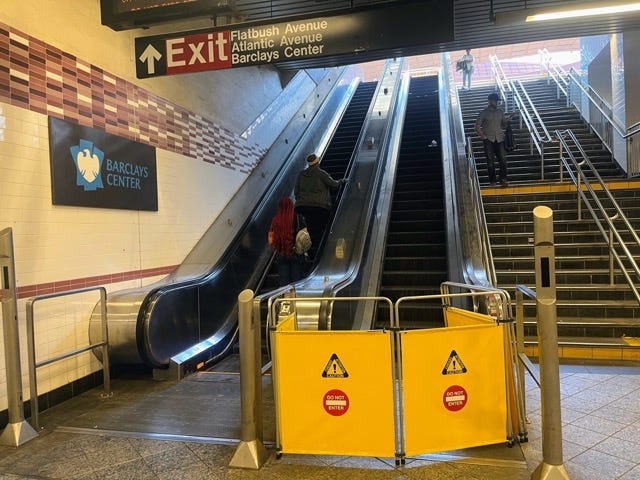
No local elected or appointed officials are interviewed. Nor is anyone from the arena, or its various ownership groups. Nor are any public policy experts.
“You belong here”?
Of course, there’s no time to discuss the “You belong here” neon sign in the trailer's thumbnail image.
Billed as an homage to the #BlackLivesMatter protests in 2020 that temporarily turned the shuttered-by-COVID arena into an “accidental new town square,” the signage also serves, I’ve argued, as advertising.

Coverage of that would involve the Social Justice Fund, the much-promoted philanthropic enterprise of Joe and Clara Wu Tsai, principal owners of the arena company, the Nets, and the New York Liberty. No time for that. It’s complicated.
The filmmaker’s goals
Any documentarian must leave a lot out. (Even the full-length 2011 documentary Battle for Brooklyn faced such constraints, and that was before the arena had opened.)
Here’s the filmmaker’s note:
This project represents an effort to document the complicated history and legacy of the Barclays Center in Brooklyn. The idea came about at the 10th anniversary of the arena’s opening - to speak to those both for and against the project, and consider what fears surrounding it actually materialized. Additionally, we sought opinions from the general public to intersperse amongst those with intimate knowledge of the Barclays Center and the Atlantic Yards Project of which it was a part. The resulting short film is hopefully seen as an honest and entertaining look at the transformation of a borough, and the multitude of opinions that can go along with it. We hope the film will spark a new dialogue surrounding large scale development projects in NYC, and the lessons we as citizens can learn from the Atlantic Yards Project in order to take an active role in shaping the future of our communities.
The arena as a symbol
How meaningful have the Nets been, especially given Markowitz’s goal to bring back major league sports, after the loss he cited of the Brooklyn Dodgers after 1957?
Not too much, especially given their (unmentioned) regular roster changes, from superstar cluster to years of rebuilding, but Brooklyn Sports & Entertainment is trying to build generational fandom with youth sports clinics and jersey giveaways.
Still, a longer documentary might have mentioned the brief juggernaut of a team featuring superstars Kevin Durant, Kyrie Irving, and James Harden.
How meaningful are the Liberty, which, as of 2022, had yet to come into their own? Far more than anyone expected, after winning a WNBA title, filling the arena, and establishing a new fan base.
Those issues don’t get discussed, but we do get a sense that the arena has helped reframe Brooklyn’s identity. Indeed, it’s a new icon, in contrast to some more venerable ones, such as the Brooklyn Bridge or the Soldiers and Sailors Memorial Arch at Grand Army Plaza.
The arena as a business
While the documentary does mention original developer Forest City Ratner and the current development team (Cirrus Workforce Housing and LCOR) that has taken on the larger project, two key names are missing:
Mikhail Prokhorov, the Russian oligarch who bought the Nets and the Barclays Center operating company from Ratner
Joe Tsai, co-founder of the Chinese e-commerce/tech behemoth Alibaba, who bought those properties from Prokhorov, and later bought the Liberty.
In transactions from 2017 to 2019, Tsai paid Prokhorov a seemingly huge premium. Since then, Tsai sold 15% of the holding company, BSE Global (now Brooklyn Sports & Entertainment), to the Koch family (!) at an even larger premium in 2024.
Last year, the Liberty raised capital at a $450 million valuation, but was more recently valued at $600 million.

Such valuations rely not merely on savvy moves by Joe and Clara Wu Tsai, though they deserve credit for reviving the Liberty. It’s due to the rising value of NBA and WNBA teams, thanks to international interest and more lucrative media/sponsorship deals.
Also, it’s due to the scarcity of major league sports franchises, especially in the country’s financial capital, and the desire for the world’s wealthy to invest in them.
Value rests on public assistance
So those lucrative investments rest on the public assistance—direct subsidies, indirect subsidies, below-market public property, tax-exempt financing, tax-exempt site, and the opportunity to sell naming rights—that enabled the Barclays Center.
The billionaires got richer from investments bolstered by public support. I told Hoxie earlier this year that, if possible, he should augment the documentary to acknowledge that, and that I contend it’s a public policy failure not to get any value from them.
If the arena plaza—an officially “temporary” space created by Ratner’s unwillingness to build a once-planned flagship tower looming over the arena—is made permanent, New York State has leverage that it hasn’t used, as I write in the link below.

Catching up, and what’s next
In the film, in interviews from 2022, both Veconi and I expressed doubt about project progress.
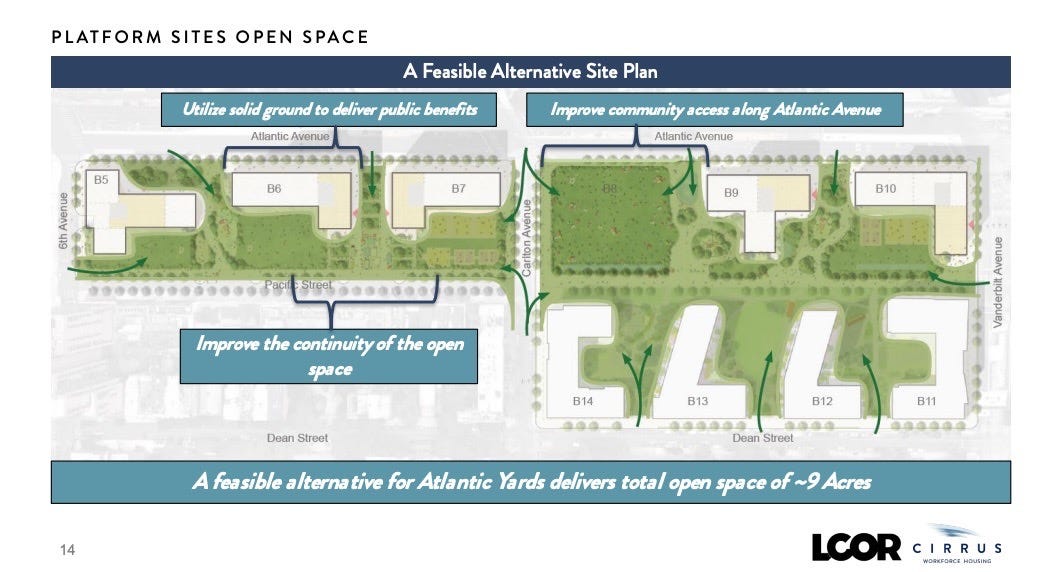
I noted that six towers are to be built over the sunken railyard. That’s obsolete, because the new development team plans to eliminate one tower, adding green space, while redistributing the bulk to the remaining towers.
A final title card explains that the new developers, Cirrus and LCOR3, “agreed to pay a $12 million fine for the delay in completing the promised units of affordable housing.”
Of 2,250 units due by May 2025, 876 were not delivered, despite $2,000/month penalties negotiated by BrooklynSpeaks in 2014.
Unmentioned is that $12 million is far less than the total required, which, per BrooklynSpeaks, today exceeds $21 million, and could easily exceed $100 million.
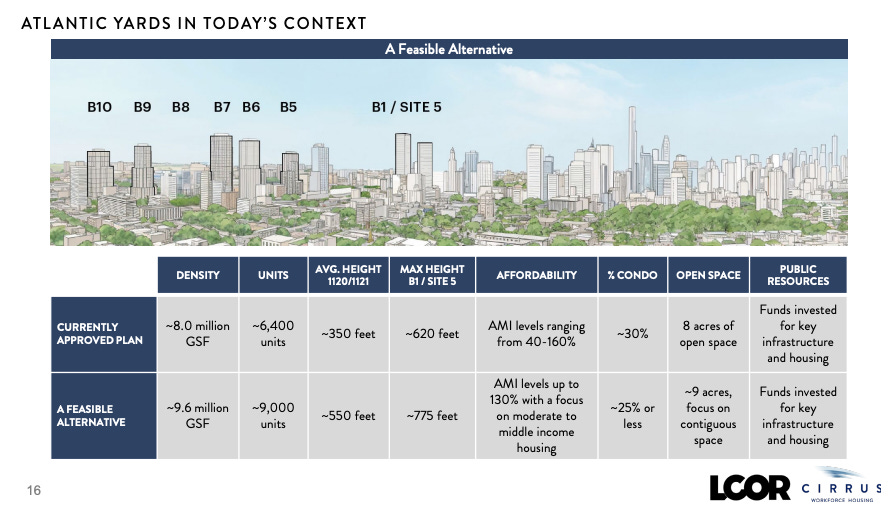
Also unmentioned: the new developers’ plan to make the project viable by supersizing it, adding 1.6 million buildable square feet without payment, and seeking hundreds of millions of dollars in direct subsidies.
The bottom line
The film’s final interview segment involves de la Uz, who asks, “How can we grow equitably?”
Many people, she said, want Brooklyn “to remain a vibrant, thriving place where their long-term neighbors and new people can coexist and do well together, and hopefully it can happen.” She offers a slightly nervous laugh. “That’s certainly what I’m here.”4
That’s not an unreasonable goal. But the record shows that when it comes to Atlantic Yards and the arena, the government has done too little to ensure that equitable growth.
Yup, I’m still working on it.
Along with Assemblymember Jo Anne Simon, Veconi and de la Uz are the three unofficial leaders of the initiative BrooklynSpeaks, which has the ear of local elected officials and support, if not active involvement, of some nearby neighborhood groups. It has supplanted the now-defunct Develop Don’t Destroy Brooklyn as the main civic response to the project.
As far as I can tell, based on a recently acquired document, the responsibility lies with Cirrus and its affiliates.
Another irony is that de la Uz, in an interview, says that, as a task force member, she had just voted to approve the 122-acre Brooklyn Marine Terminal (BMT) project, “and we tried to apply many of the lessons learned for Atlantic Yards.” That remains to be seen, but they do claim more safeguards. While allies on Atlantic Yards, de la Uz and Assemblymember Simon voted opposite each other on the BMT.