
Stonewalling and Secrecy at the Atlantic Yards Advisory Meeting
Yes, the state has committed $175M for the first block of the platform, but it's just a start. MOU coming in July. But the meeting was mostly in executive session.

There wasn’t much news released at the belatedly announced May 28 meeting of the Atlantic Yards Community Development Corporation (AY CDC), beyond:
confirmation that the reported $175 million in direct project subsidies will be only a fraction of the total sought
an estimate that a Memorandum of Understanding (MOU) between the state and the developers will be signed by the July 31 deadline

After all, the Directors of the advisory body met in open session for less than half an hour, while an executive session to learn about negotiations by the parent Empire State Development (ESD) with the project’s new development team lasted more than an hour and 40 minutes.1
The AY CDC is supposed to review proposed changes, monitor developer compliance with public commitments, and make recommendations to improve developer responsiveness to public obligations and increase transparency.
The latter was notably lacking, while the other functions were obscured.
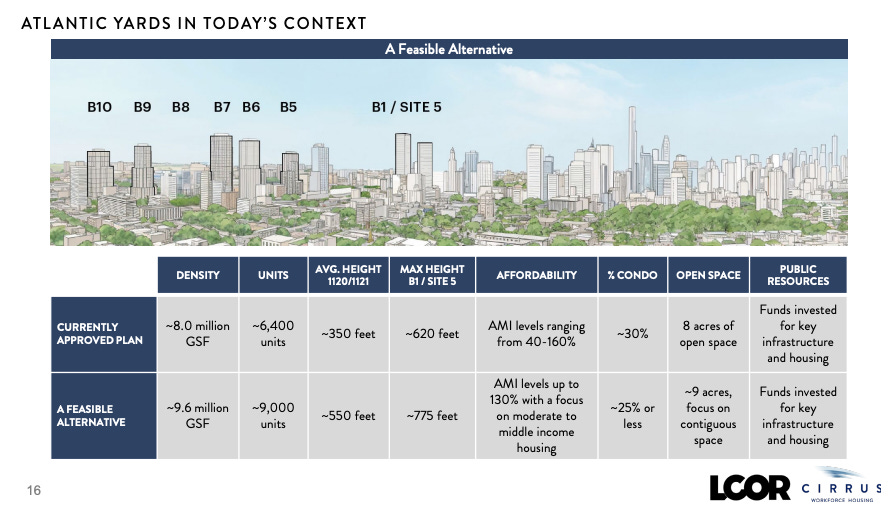
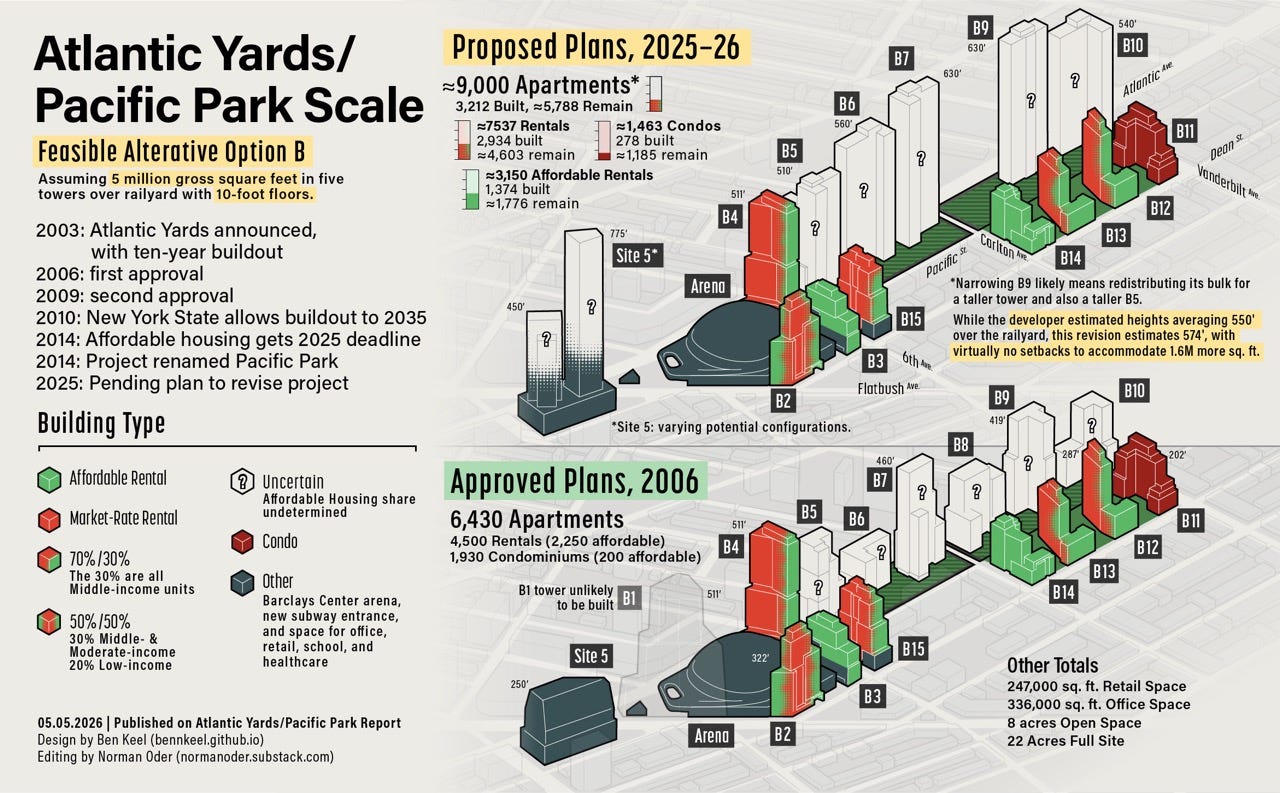
The new developers, Cirrus Workforce Housing and LCOR, want to supersize the project from 6,430 apartments, about half of which have already been built, to nearly 9,000 units, with substantial increases in the scale of buildings, though official disclosure has been vague.
Where on the ladder?
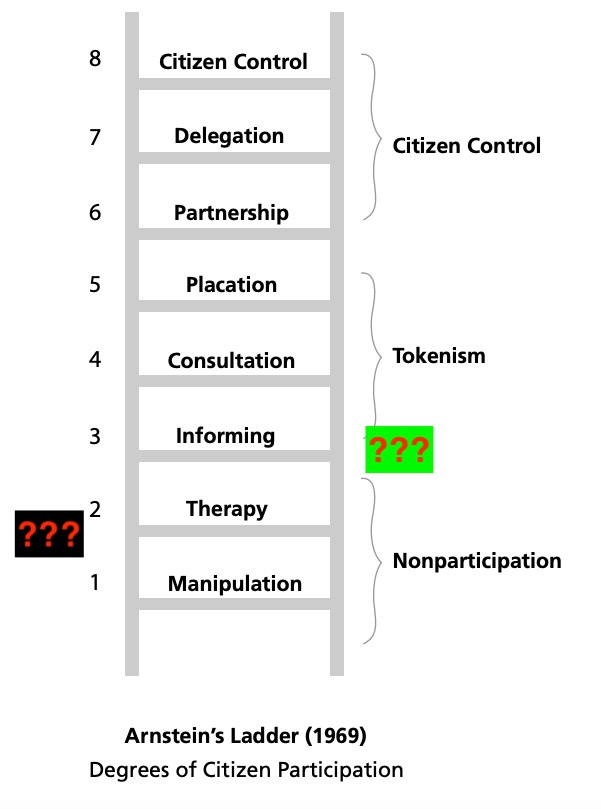
How would the meeting fit into the Ladder of Participation, a noted framework to assess civic legitimacy, devised in 1969 by the planner and policy expert Sherry Arnstein?
The executive session might reflect Placation, a middle rung, which, according to analyst David Wilcox, involves “co-option of hand-picked ‘worthies’ onto committees.”
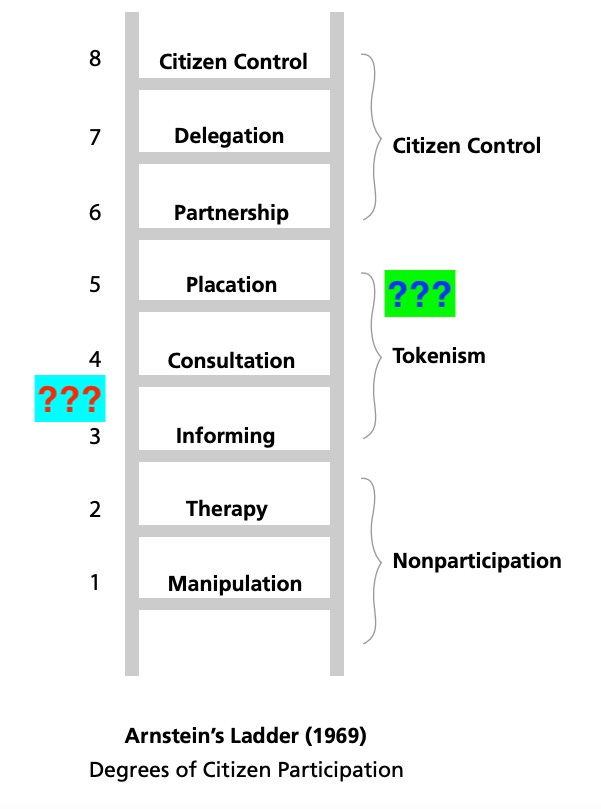
The meeting as a whole, though, was down a few rungs, perhaps between Consultation and Informing.
Perhaps an overarching theme had been delivered a day earlier by Gov. Kathy Hochul, who controls ESD, the state authority that oversees/shepherds the project.


Sure, some NIMBYism, especially in suburbs resistant to housing, is selfish and bad urban planning.
But “LET THEM BUILD,” as Hochul declared, does not necessarily ensure a level playing field—especially if that means “public resources” like 1.6 million square feet of free additional bulk, as the Atlantic Yards developers expect, as well as direct subsidies, without, at least so far, public evaluation.
Subsidy specified
We did learn that New York State has allotted $175 million in the recently passed state budget to help build the platform needed for vertical development over the Metropolitan Transportation Authority’s Vanderbilt Yard.2
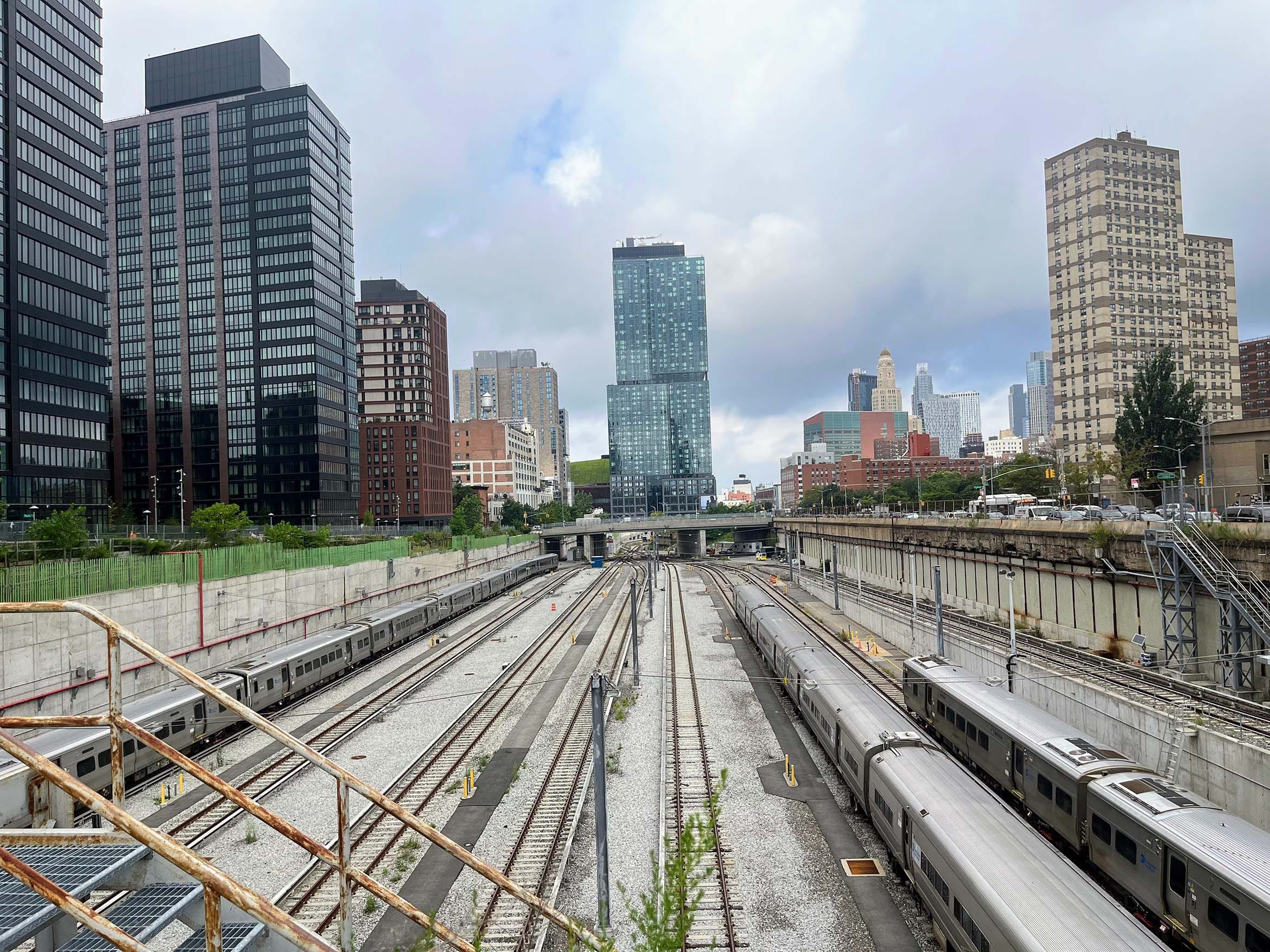
The deck is needed to protect the railyard functions: storing and servicing Long Island Rail Road trains.
While that sum was half the earlier reported $350 million request by developers Cirrus Workforce Housing and LCOR, it left room—as I’d suspected—for another round. “We are seeking additional money--or additional funds will be required,” ESD Senior VP, Community Relations, Anna Pycior told the board.
Later in the meeting, Director Gib Veconi asked whether any contingencies were attached to the subsidy request, such as affordability levels in the lagging below-market housing or a community preference in the housing lottery.
(Those are among priorities articulated by the coalition BrooklynSpeaks, which Veconi helps lead, and local elected officials, notably Assemblymember Jo Anne Simon.)
“I’m not aware of anything,” responded Pycior.
Later, Veconi asked what the $175 million represented. “I think it’s specifically for the platform costs, partial platform costs of Block 1120,” said Joel Kolkmann, Senior VP, Real Estate and Planning.
In other words, just the first block, between Sixth and Carlton avenues, of the two-block railyard, and not necessarily the only request.
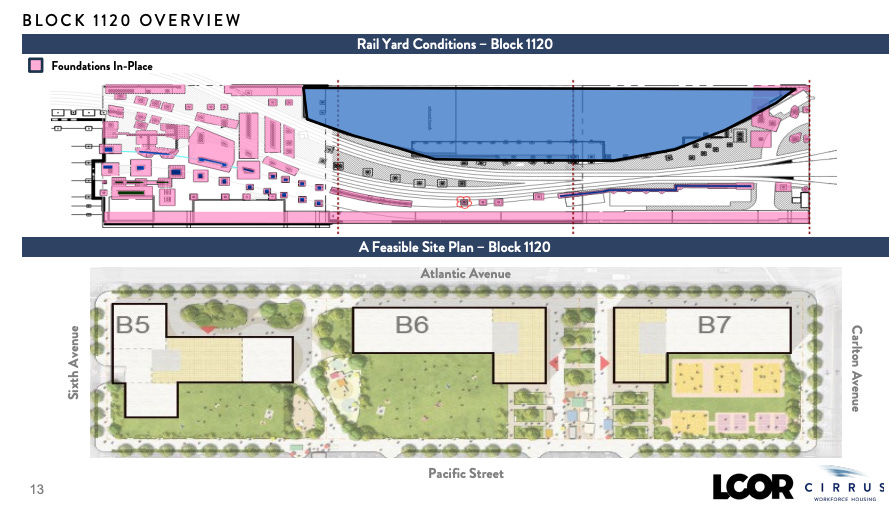
That leaves room for an additional subsidy request for the second block, between Carlton and Vanderbilt avenues, which requires a larger platform. (I tried to query Joseph McDonnell of Cirrus, who was at the meeting, but he declined comment.)
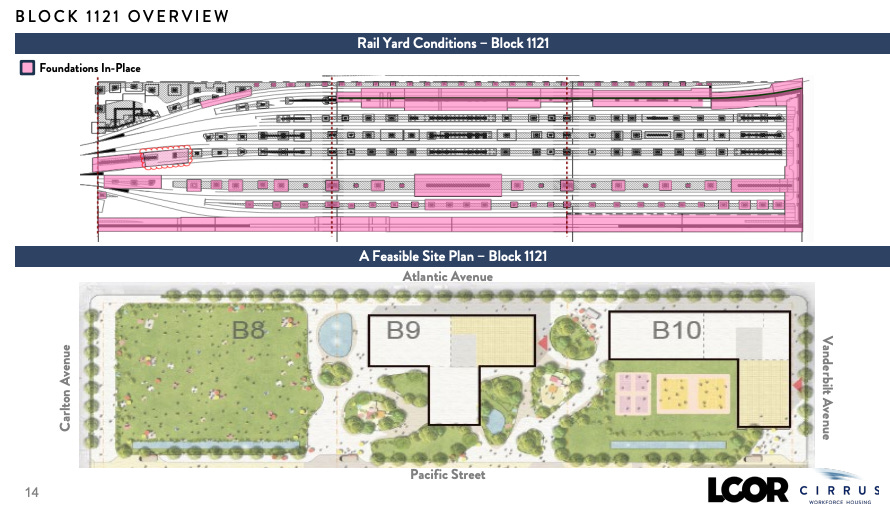
So it’s not implausible that the $175 million might be just a quarter of the state funding eventually sought.
As Simon wrote in an update to constituents, she and colleagues had asked ESD and the Governor to promise deeply and permanently affordable housing and to “prioritize overall accountability and oversight, and other street redesigns and both indoor public space and outdoor public space.”
“The funds provided in the budget didn’t address these requests,” wrote Simon, “but that doesn’t mean they are not being considered. Stay tuned!” Well, they may be considered, but the governor’s power apparently meant that legislators couldn’t attach strings at the main point of leverage.
What’s next?
Pycior also updated the group on upcoming milestones, “which, of course, are subject to change.”
First, ESD wants the AY CDC to reconvene “just a few weeks from now” for discussion—much of it likely again in executive session—of the proposed housing program and the project’s financing.
So, is the AY CDC serving in an advisory capacity, or are ESD staff getting buy-in they can present to the parent board to claim legitimacy?
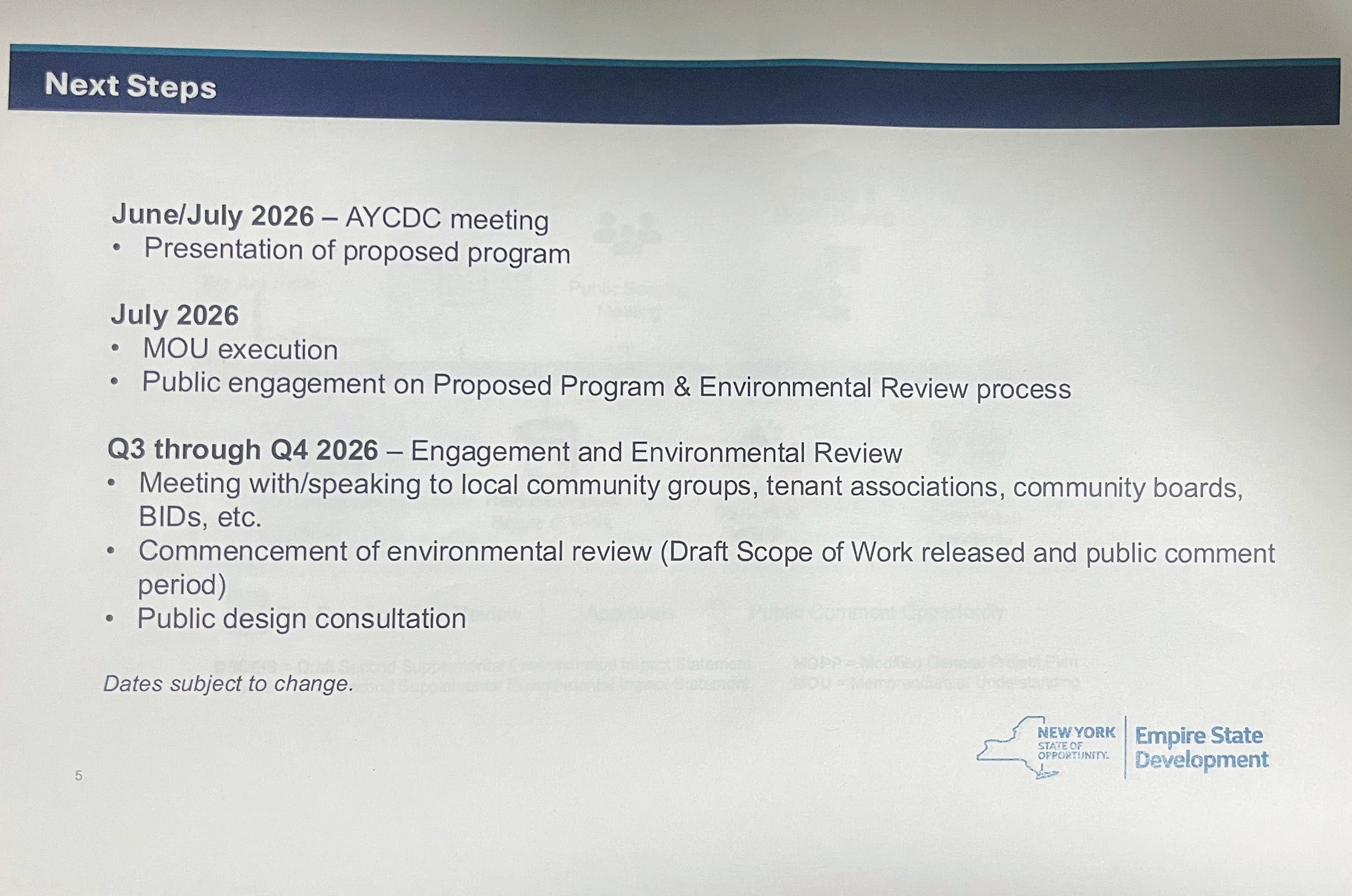
A non-binding Memorandum of Understanding (MOU) outlining project terms such as scale, affordability, and timing should be signed before the state’s July 31 deadline, said Pycior.
After that, ESD will pursue additional public engagement to educate the public about the environmental review process. The latter will include three opportunities for public comment. That could take until the end of 2027.
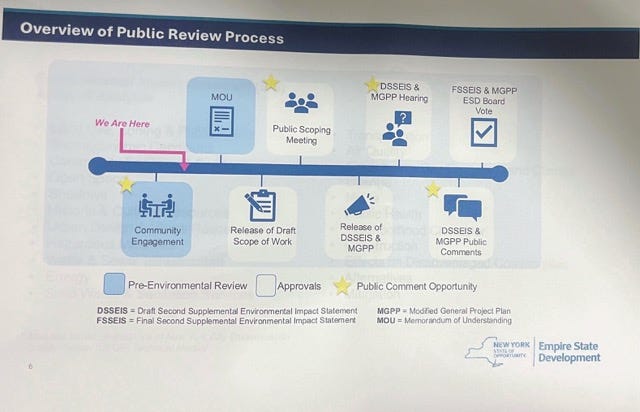
So ESD will reach out to local organizations, tenant associations, neighborhood groups, advocacy issue groups, and others, said Pycior.
“We’re going to take time throughout the process to ‘socialize’ this project,” she said, so “people are aware of the touch points.” (I’m not sure whether that meant simply using social media or, in corporate jargon, to share an idea or proposal to get feedback.)
That includes helping people better understand the Environmental Impact Statement, which, as the slide below shows, addresses a broad range of issues, including open space, community facilities, and socio-economic conditions.
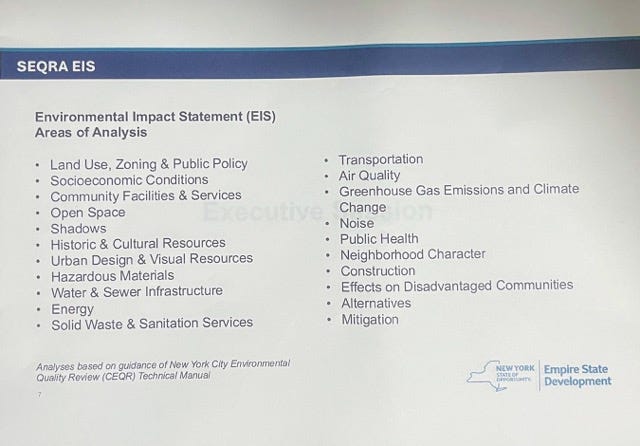
Unmentioned: it’s a disclosure document, with the state supposed to try to mitigate significant impacts, though some may be unmitigable.
“We also will be coming back to the public for input on the public realm portions,” she added, referring to the potential design of the open space and streetscape.
Would that constitute Consultation, on the Ladder of Participation?
Levels of opacity
“Could we review the scope of the MOU?” asked Veconi.
Arden Sokolow, ESD Executive VP, Real Estate and Planning, said it would be covered in the executive session.
Veconi, citing the letter agreement from last October that I recently published, asked if the MOU would address affordability. Sokolow said yes.
To what extent are those terms final in the MOU, Veconi asked. Sokolow pointed to the executive session.
Noting that the MOU would be signed before public engagement, Veconi asked what impact such engagement might have.
Sokolow reminded him that the MOU was non-binding. (That goes both ways, of course; it can both demand more of the developers or become more generous.)
Public input
Director Ron Shiffman, a longtime advocacy planner and academic, asked, “The outreach here is just not to inform the public, but to really and substantively get their input and evaluation of what we’re doing, and seriously consider their recommendations?
Absolutely, responded Pycior.
“On the Ladder of Participation,” Shiffman asked, bringing up the benchmark for the first time, “is it a low rung or a high rung?”
“In terms of?” responded Pycior, perhaps unfamiliar with it.
“Sherry Arnstein’s Ladder of Participation,” Shiffman clarified. “Is there a substantive discussion, or is it just pro forma?”
“It’s not pro forma, it’s absolutely substantive,” she replied.
Well, the history of Atlantic Yards has been the opposite, especially since New York State overrode city zoning and land-use processes, thus diminishing the role of elected officials, much less citizens.
And it’s a bit rich to make that claim when ESD announced that meeting—held in Brooklyn at the Shirley Chisholm State Office Building in Fort Greene—with less than 48 hours’ notice, which meant only two members of the public attended.
“It is a disgrace that this meeting is being held with inadequate notice,” wrote area resident Vince Bruns3, in a comment to the AY CDC he shared with me.4 “Top priority should be for deeply affordable units, no matter what your suspicious figures show.”
Bruns’s “suspicious figures” was a reference to ESD’s engagement report’s conclusion that a top priority is maximizing affordable units “particularly for moderate and middle incomes.”
That relied on respondents to a community survey in which the median household income was $135,256, while lower-income and Black respondents were underrepresented.
That’s pretty close to Manipulation, isn’t it?
More on the Ladder
According to The Citizen’s Handbook:
The ladder is a guide to seeing who has power when important decisions are being made. It has survived for so long because people continue to confront processes that refuse to consider anything beyond the bottom rungs.
While some of the recent Atlantic Yards Community Engagement may constitute Informing and even Consultation, that doesn’t redistribute power.
Would ESD consider upper rungs like Partnership, Delegation, or Citizen Control? That’s preposterous. Powerful government agencies don’t want to share power.
Moreover, the public isn’t always right—hmm, they might need their own experts—and, of course, too much process can bog things down.
Still, as the unofficial image below indicates, the developers’ plans don’t quite add up.
More review?
Veconi recalled that, at a previous AY CDC meeting, directors asked about reviewing the scope of work for the consultant, BJH Advisors, that ESD has hired to analyze the project’s financials.
Kolkmann said the consultant would give a presentation at the next AY CDC meeting, likely in an executive session.
“Is there any reason we wouldn’t just be able to review the scope, which is presumably a written document?” asked Veconi.
“We’re going to share with you in that session—that’s the answer,” Kolkmann said sharply.
“I’m not trying to be tedious here, but if the scope already exists and it’s been executed,” Veconi pressed, “just why would we need to wait a month just to understand what the scope is?”
“I told you what we’re going to be doing,” Kolkmann said. “And I think we should move on.”
(Where’s that on the Ladder of Participation?)
Veconi also noted a related issue: the board had asked if it could authorize additional funding if it sought to conduct its own analysis.
Pycior said they’d get an answer next month.
Will project pro formas, which outline the expected cash flow, be provided? asked Director Marc Jahr, former president of the New York City Housing Development Corporation and now a consultant. (It was his only question, and a trenchant one.)
“To the board, I don’t think so,” said Sokolow, promising an overview of the financial provided and “our analysis of the financial analysis.”
Was the executive session justified?
Prospect Heights resident and longtime Atlantic Yards activist Robert Puca, who is often the only civilian at such meetings, criticized the executive session and suggested it was illegal, citing my analysis.
As I wrote, it didn’t seem to address, as the statute put it, “the proposed acquisition, sale or lease of real property… but only when publicity would substantially affect the value thereof.”
“We’re confident that we have the legal, proper legal basis to go into executive session,” responded ESD lawyer Matthew Acocella. “We are here discussing negotiations with a developer, which will lead to multiple development leases and other real estate transactions for this complicated multi-parcel property... So it’s entirely appropriate to go into executive session to discuss these matters.”
AY CDC Chair Daniel Kummer, a lawyer, concurred.
Upon reflection, ESD has a defensible if not totally convincing case: the subsidies and other agreements would ultimately lead to development leases, given ESD’s formal fig-leaf ownership of parcels, though the “proposed lease” is hardly imminent.
Would publicity “substantially affect the value”? That’s debatable, but the bar is low.
The board had to vote to go into executive session. Shiffman abstained. Director Ethel Tyus voted no.
More comments
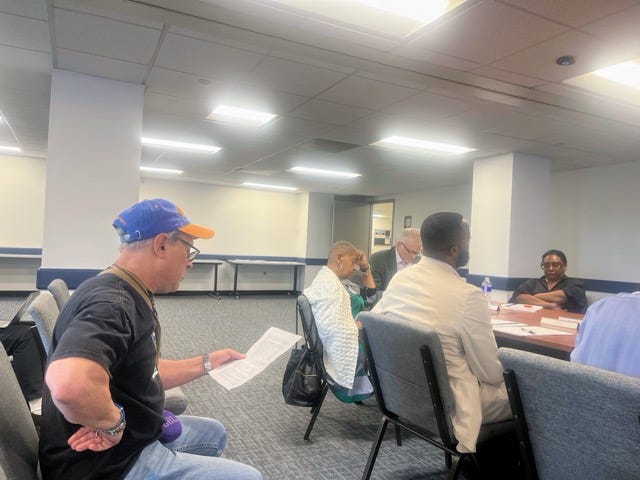
After the executive session, Puca read more comments, taking off from questions I’d posed publicly, like, “Why have no renderings of the contemplated project been released, aside from unofficial sources,” like my publication?5
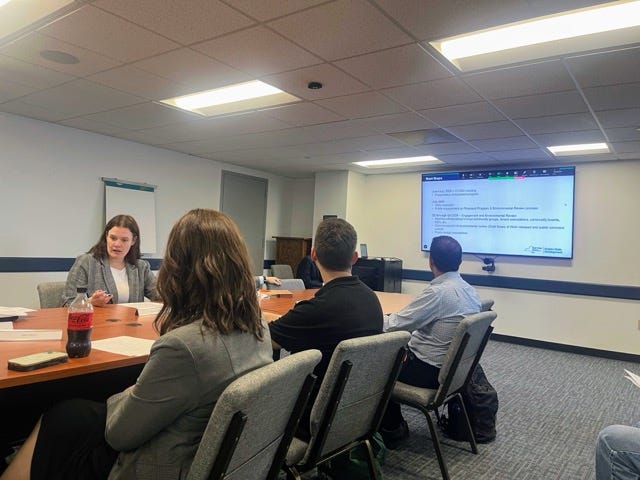
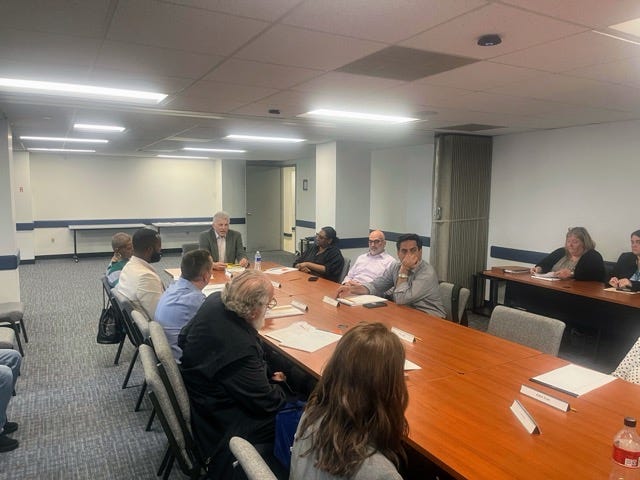
As the photo suggests, the directors—perhaps weary after a long session, and/or tired of a pesky repeat commenter—did not pay much attention.
A qualitative analysis?
At the end of the meeting, Shiffman said he’d like to see “a qualitative analysis of the plan,” just as ESD has pursued a quantitative analysis. “What kind of a community will it develop, and what are the implications of it, pre-environmental review?”
Kummer responded, “I think we’re going to have an opportunity to see the plan. I think it will include qualitative elements. It’s not going to just be dry numbers.”
Well, “qualitative elements” is not necessarily the same as “qualitative analysis,” since a consultant with specific expertise might perform the latter, as former AY CDC Director Jaime Stein once suggested, in the link below.

A new board member
Attending his first board meeting was mayoral appointee Seth Bynum. Senior Advisor for Housing Policy and Development, Deputy Mayor for Housing and Planning. He replaces Anand Amin, who left the Mayor’s office for a real estate advisory firm.
Of the 14 board slots, nine are gubernatorial appointees, while local elected officials appoint the other five. As of now, there are 13 appointees, though one hasn’t attended in a while. The AY CDC website lists the directors without biographical information or the source of their appointments.
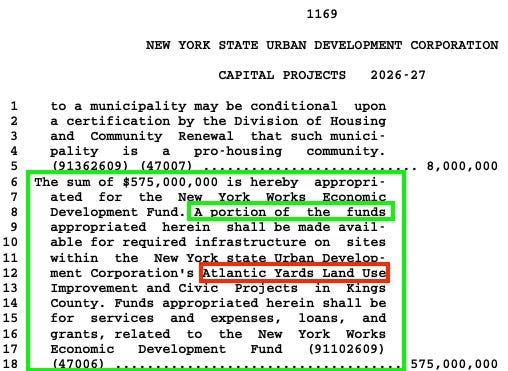
Confusingly, the state budget stated that of the $575 million appropriated for the New York Works Economic Development Fund, a “portion of the funds” would go to Atlantic Yards, without specifying the amount.
Bruns, who formerly owned an apartment within the project footprint, negotiated a buyout with the original developers and moved to Boerum Hill.
All comments submitted to the AY CDC are not only supposed to be shared with the Directors but also posted online. At the outset of the meeting, Chair Kummer said they had received three written comments. As of this morning, more than one business day after the meeting, no comments had been posted, so I asked Bruns for his after seeing him at the meeting. Perhaps it will be posted today.
Puca asked me if he could cite my comments. I said that they’re out there for the public to draw on.
Absolutely this! I’m tired of politicians tossing “NIMBY” slogans onto community input as a blanket catch phrase ,as if, they themselves are not obscuring self interest.