
How Much Money Does Cirrus Workforce Housing Have, and How Long Will it Last?
Cirrus has raised just $137.7M toward a $400M goal. It has some big expenditures, but also $175M in public funds. Also, NY State has signed an MOU with Cirrus but won't make it public.

Yesterday, a representative of Empire State Development (ESD) told me that the state authority had signed a non-binding Memorandum of Understanding (MOU) with Cirrus and LCOR regarding such things as unit mix, timing, financing, and subsidies. ESD would not, however, share it.
I was told I needed to file a Freedom of Information Law (FOIL) request for a copy, which I did. However, that could take months, or years. The document, which should be crucial to public discussion as the project’s environmental review starts in August, should be easily accessible.
As former City Planning Commission Chairman Dan Garodnick recently put it, “But if a single dollar of public money is going into a project, the public should have absolute transparency as to what’s going on.”
Note: a Crain’s New York Business article yesterday, Atlantic Yards developers ink agreement with state to move long-stalled project forward, which appeared after I posted on Twitter/X about the MOU, offers no new details. The development team wouldn’t comment to Crain’s.
Atlantic Yards is a project of Cirrus Workforce Housing, an affiliate of Cirrus Real Estate Partners. Both have been active since 2020, but haven’t built anything yet. The parent Cirrus also buys “overleveraged loans and takes over properties,” as The Real Deal reported in February.
Their public-facing websites don’t offer much detail.
Below is the public-facing website, in full, of Cirrus Real Estate Partners. No staff, no projects, no history.
Its goal: to “generate consistent, attractive returns through identifying investments that offer asymmetric risk-return profiles and significant downside protection.”

What about Cirrus Workforce Housing?
The Cirrus Workforce Housing website is even more sparse, as shown below, though this Cirrus affiliate is currently involved in three major projects, including Atlantic Yards.
(Well, as The Real Deal reported, the firms’ midtown office space “had the feeling of not being fully set up.”)

Murky financials
Cirrus has raised money from various sources, notably construction union pension funds, and used that alliance to make notable progress, launching three development projects.
What’s unclear, however, is how much money Cirrus Workforce Housing has and how long it will last.
Their limited public disclosures, which may be slightly outdated, suggest they’re still far from their private fundraising goal of $400 million. However, they have leveraged significant public support. (They didn’t respond to my query.)
Cirrus is not a publicly traded company like Forest City Enterprises, parent of the original developer Forest City Ratner, which reported quarterly financial results, including funds devoted to Atlantic Yards, and answered questions from generally chummy investment analysts.
So we don’t know what’s under the hood.
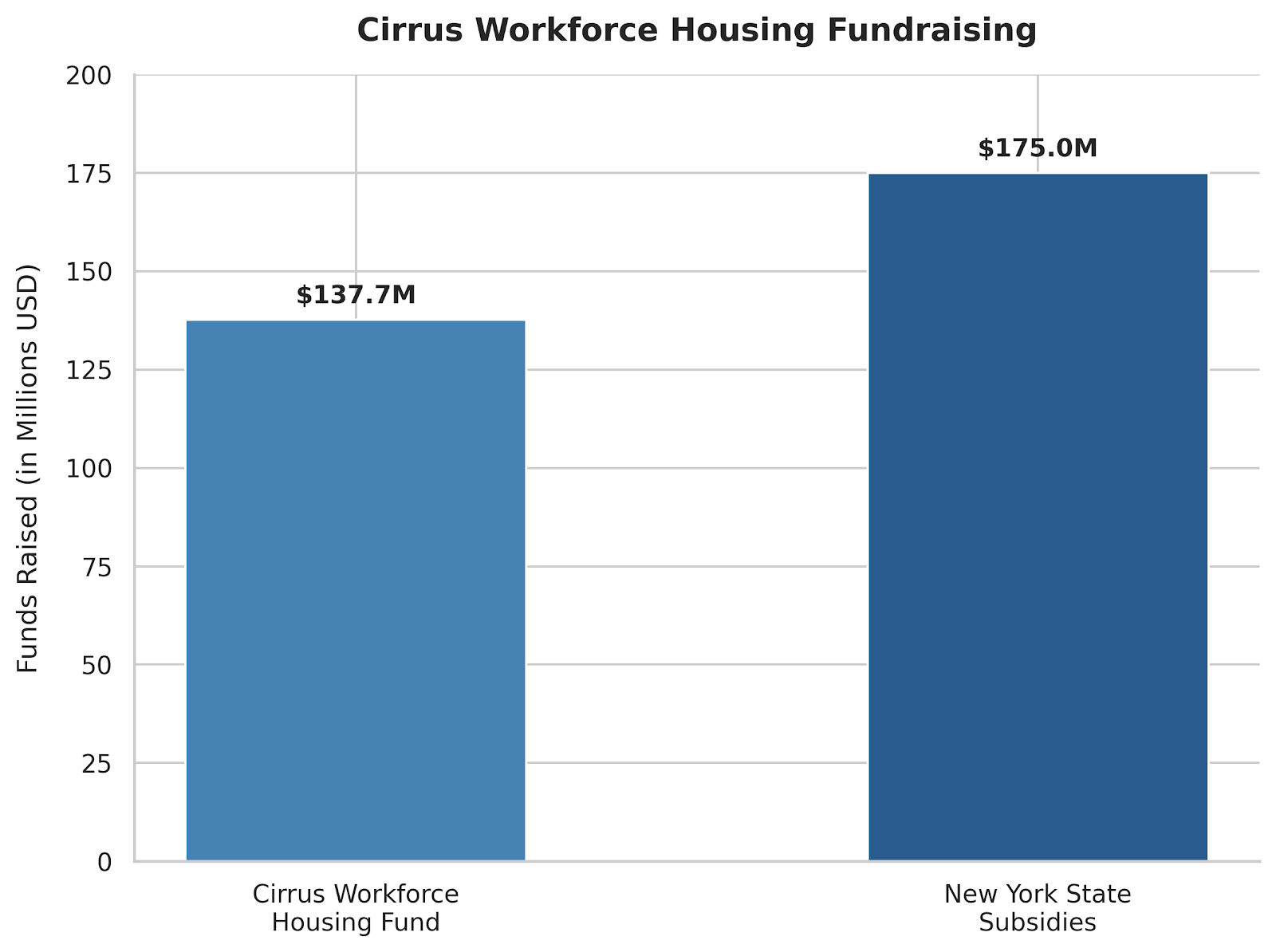
Public documents, as explained below, suggest that Cirrus Workforce Housing has raised less private capital ($137.7 million) than the public subsidies ($175 million) recently allotted in Gov. Kathy Hochul’s budget.
2024 numbers
Curiously, Cirrus did not gain significant momentum after it was approved last October, in concert with veteran development firm LCOR, as the new permitted developer for Atlantic Yards.
Cirrus Workforce Housing emerged more than two years ago, announcing it had raised more than $100 million toward a $400 million goal.
In a March 8, 2024, press release, Mayor Adams, Building and Construction Trades Council [BCTC] of Greater New York, Cirrus Announce First-of-Its-Kind Partnership to Build Workforce Housing in NYC, the Mayor’s Office announced:
Pension funds affiliated with BCTC members and other Building Trades unions, along with Cirrus, have pledged more than $100 million in an initial fundraising stage to invest in a series of multi-family workforce housing development and redevelopment projects in New York City at levels their members can afford. Cirrus expects to raise a total of over $400 million for this initiative.
A month later, on April 9, 2024, Cirrus Workforce Housing Fund I, LP, told the Securities and Exchange Commission (SEC) on Form D that it had raised $102.2 million toward its goal from 13 investors. The minimum investment from an outside investor was said to be $10 million. (Perhaps some investors were paired?)
2026 numbers
Two years later, after some high-profile progress—Bisnow called Cirrus NYC’s Megaproject White Knight—Cirrus Workforce Housing Fund 1, LP marked only modest financial changes. On March 9, 2026, it reported in a Form D amendment that it raised $137.7 million from 18 investors.
That’s an increase of five investors and $35.5 million—not insignificant, but also not huge momentum.
Is it possible that the document is already outdated or doesn’t include other sources of private funding? (If so, they could say so.)
Public money is more
Remarkably, the $175 million recently allotted by Gov. Kathy Hochul to Atlantic Yards, purportedly to build part of the first phase of the platform needed for vertical development, exceeds the amount Cirrus itself has raised.
It’s not clear how restrictive that funding might be, but even if it can only be used for platform-related expenses, that could help pay staff and consultants.
Developer resiliency
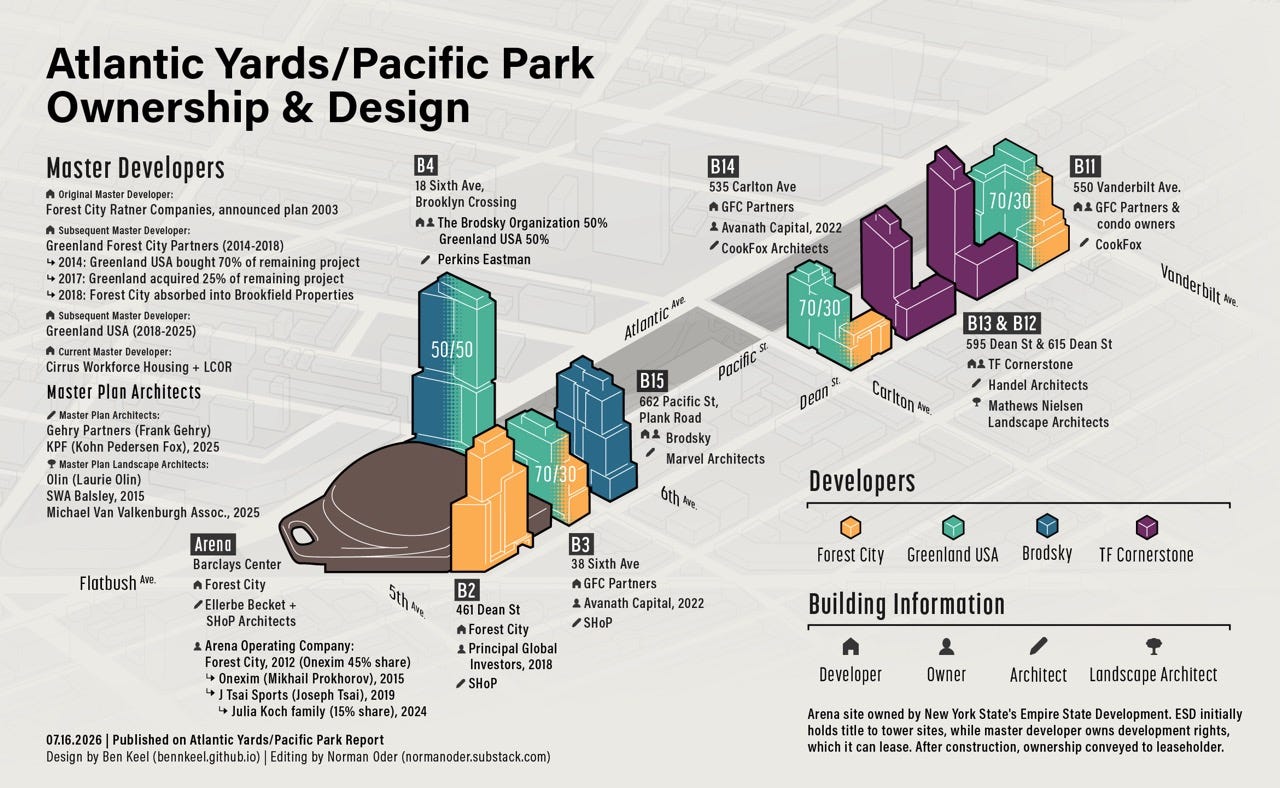
Cirrus’s resilience should be on the table, and part of the Atlantic Yards analysis produced by BJH Advisors, the consultant hired by Empire State Development to evaluate the Cirrus/LCOR plan.
The history of Atlantic Yards urges caution, since past developers have made promises they couldn’t keep.
The original developer, Forest City Ratner, claimed it could build Atlantic Yards in a decade. It also claimed to have “cracked the code” regarding high-rise modular construction.
Successor Greenland USA, which formed the joint venture Greenland Forest City Partners before Forest City exited completely, once claimed that Atlantic Yards could be built in eight years. (Well, it was the CEO of Greenland USA’s Shanghai-based parent.)
None of those were close to true.
Yes, representatives of Cirrus and its partner, LCOR, talk a good game, asserting they’ve worked to make Atlantic Yards feasible and sustainable, for example by redesigning towers to occupy smaller rectangles of land, while dodging or deflecting some questions.
Still, the project is so complicated, and subject to so many variables, that promises and projections need to be treated skeptically.
How much are they spending?
If Cirrus Workforce Housing is responsible for Atlantic Yards, well, it could have some significant costs. Cirrus bought $200 million of Greenland USA’s debt to control the project.
Even at a deep discount, that could have a price tag between $50 mllion and $100 million. It’s unclear if Cirrus had to pay in full or could structure payment in installments.
Meanwhile, they must pay $11 million a year—at least $22 million, so far—to the Metropolitan Transportation Authority for railyard development rights negotiated by original developer Forest City Ratner.
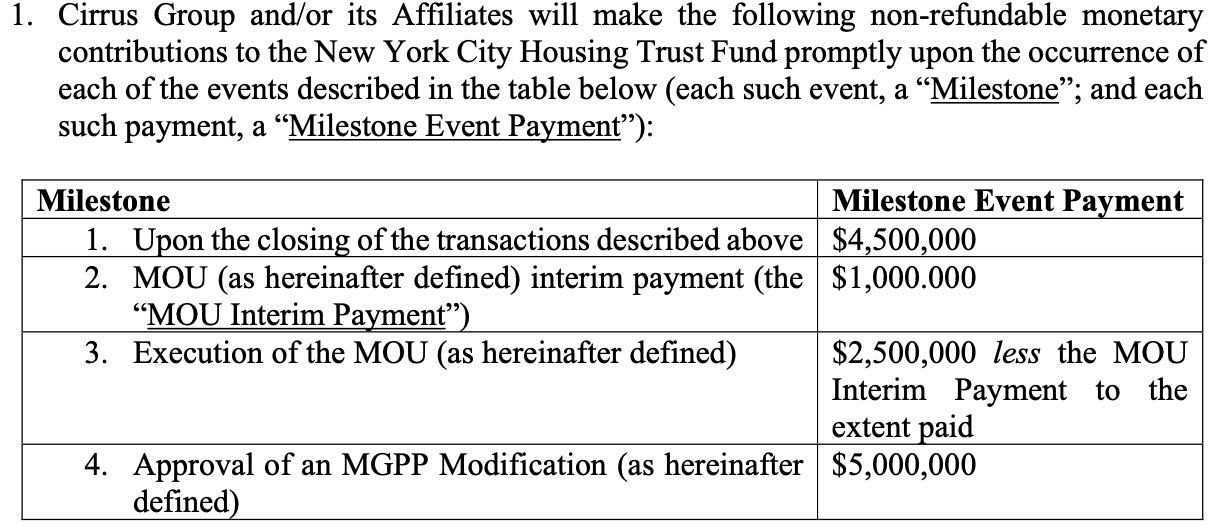
Cirrus, not LCOR, is supposed to have paid a total of $7 million by the end of July—given that a Memorandum of Understanding has been executed before July 31—and a total of $12 million likely by the end of next year for renegotiated Atlantic Yards affordable housing penalties.
Going forward, must reimburse the MTA for various staff time on approvals and must pay for ESD’s environmental review.
It owes professional fees to firms such as architect KPF, landscape architect Michael Van Valkenburgh Associates, and lobbyist Bolton-St. Johns, among others.
The upside for Cirrus could be significant, given New York State’s willingness to allot $175 million toward an eventual $700 million (which surely requires approvals under a future governor) and to allow 1.6 million additional buildable square feet, worth perhaps $320 million.
But they aren’t making any money yet.
Let’s see if they bring in other investors and/or sell off parcels once they’ve achieved their permission to move forward.
Other progress
Beyond Atlantic Yards, Cirrus Workforce Housing and LCOR were announced July 28, 2025, as chosen to develop a project with 3,000 homes and 60 acres of public space on the site of the former Flushing Airport in College Point, Queens.
While that entitlement could surely help them raise equity from investors or secure project-related loans, it doesn’t necessarily provide immediate cash flow.
In June, Cirrus Real Estate Partners and Resorts World New York City were announced as having bought a 1.8-acre development site in Jamaica, Queens, “the first acquisition under the partners’ workforce housing initiative announced in May 2025.”
While Cirrus Workforce Housing wasn’t cited, Resorts World has said the latter entity has formed a partnership to build “up to 50,000 units” of workforce housing.
In that case, presumably deep-pocketed Resorts World is putting up a good amount of cash.
The bottom line, however, is that Cirrus, while having won key permissions with Atlantic Yards and the airport site, doesn’t yet have much income coming in, unless it takes a small percentage of the invested dollars.
That means delays in such projects might make it harder to recover their investment. Or, perhaps, Cirrus, once it gets approved for Atlantic Yards, expected around the end of 2028, will bring in other partners or investors.
Other Cirrus funds
Separately, other Cirrus affiliates have raised money, according to SEC reports.
Cirrus Commercial Real Estate Fund, LP, on Aug. 9, 2023, reported having raised $54.475 million from six investors toward its $400 million goal, leaving $345.525 million to go.
The general partner is Cirrus Commercial Real Estate Fund GP, LLC. Both McDonnell and Anthony Tufariello, the founders of the Cirrus enterprise, were described as Managing Partners of Cirrus Real Estate Partners LP, the management company.
Cirrus Commercial Real Estate Fund Offshore, LP, on Aug. 9, 2023, reported having raised $49.1 million from 14 investors toward its $400 million goal, leaving $350.9 million to go.
This entity had the same general partner, management company, and Managing Partners.
Unlike the Cirrus Workforce Housing fund, the above-mentioned funds have not filed updates.