
From City Limits: How a 35% Affordable Housing Pledge in Brooklyn Was Torpedoed
Two towers on Atlantic Avenue, east of the Atlantic Yards site, promised special benefits in exchange for permission for extra bulk. But things changed. Also, some thoughts on (hyper)local journalism.

Just east of Atlantic Avenue and Vanderbilt Avenue, the eastern border of the Atlantic Yards site, a new, 19-story building, known as Eight80, has risen. Further east, another tower, known as Prosper Brooklyn, is visible.
They result from the last spot rezoning—special permission—to build big in the area, preceding the area rezoning known as the Atlantic Avenue Mixed-Use Plan (AAMUP), led by Council Member Crystal Hudson. Eventually, the scale along Atlantic Avenue should be similar.1
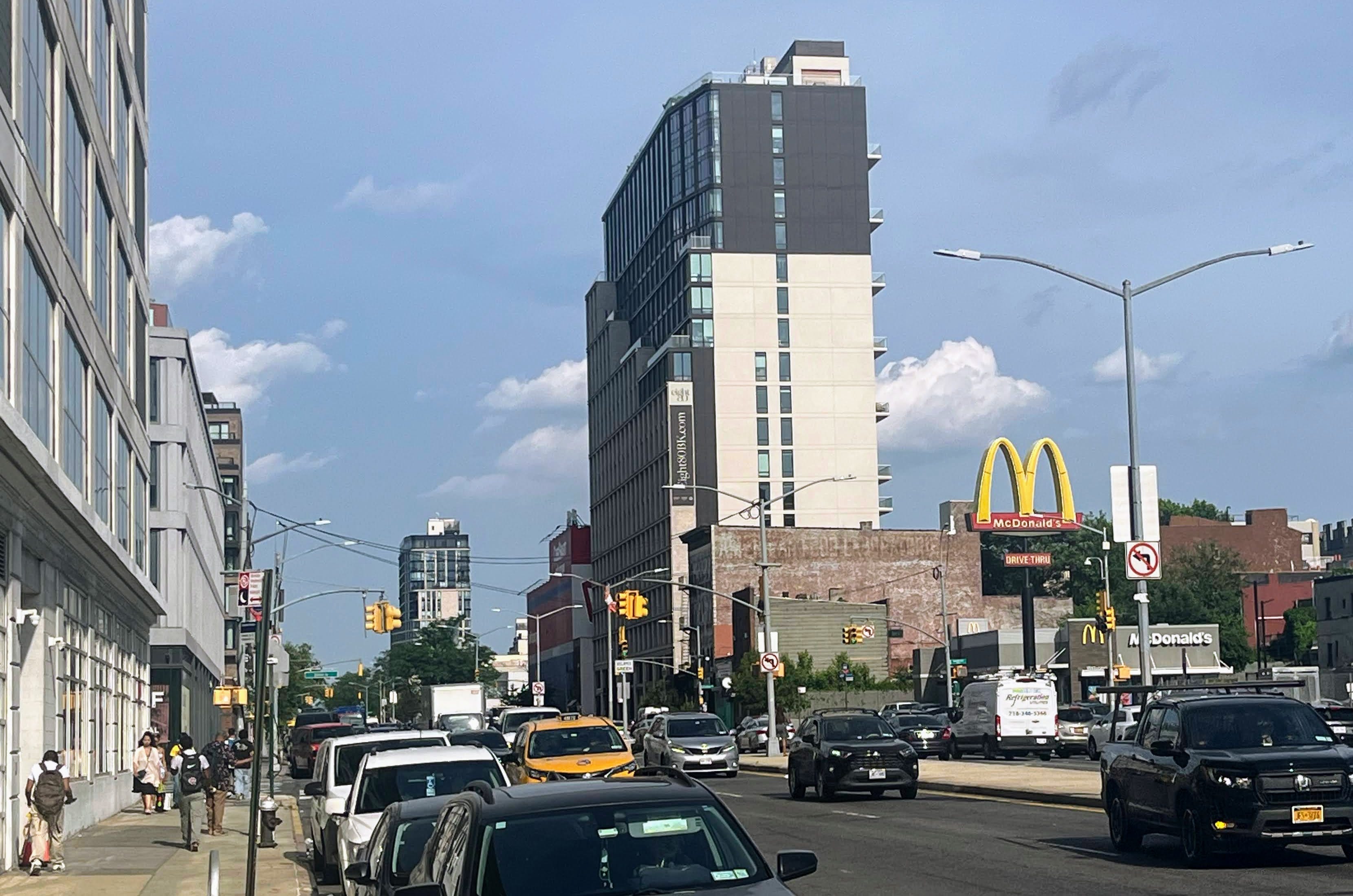
The two towers were supposed to include 35% affordable housing, exceeding the city’s 25% standard, in exchange for getting ahead of other projects.
That didn’t happen, as I reported yesterday for the policy publication City Limits, How a 35% Affordable Housing Pledge in Brooklyn Was Torpedoed.
The subheading: In 2022, developers behind two Atlantic Avenue projects committed to making a “record-setting” 35 percent of the apartments affordable. But after interest rates shot up and the owner cited cost pressures, nonprofit partners recruited by Councilmember Hudson agreed to renegotiate, rather than pursue enforcement.
The “news of a breached agreement is a disappointing development,” Hudson observed, “that shows the limitations of existing legal mechanisms to secure additional affordable housing beyond current requirements.”
About accountability
Indeed, accountability in the process was scarce, as my reporting suggests. The developer didn’t tell the Council Member. The nonprofits didn’t inform Community Board 8. The developer came before Community Board 8, but they didn’t discuss the affordability promise.
It also shows that we have too few journalists keeping track. I had covered these spot rezonings as an outgrowth of coverage of Community Board 8’s M-CROWN initiative, a precursor to AAMUP.
My previous coverage of the spot rezonings for City Limits, as cited in the latest article, noted the difficulty in getting the names of the nonprofit counter-parties to the agreements Hudson negotiated, and then the actual documents.
Was that coverage too negative, as some suggested? After all, the 35% affordability was an achievement.
I wasn’t planning to follow up—I’ve got way too much else on my plate—but, when I saw the Housing Connect ads for the buildings’ affordable housing lotteries, I noticed a discrepancy between what had been promised and what was delivered.
I then went to ACRIS, the city’s property records database, and discovered that the agreement had been quietly revised, including the donation of the site below as a partial substitute.
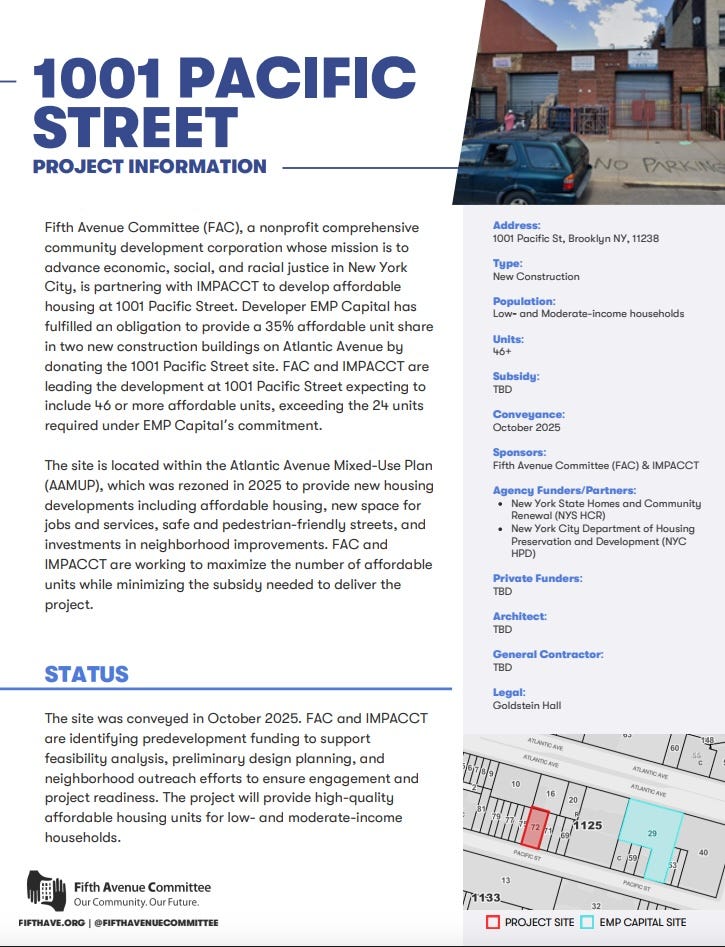
Will the obligation be fulfilled by having the developer donate the site below to the nonprofit Fifth Avenue Committee and IMPACCT Brooklyn, as the page above suggests?
It’s a little more complicated, as my article explains.
The first-mover advantage
A reader questioned why I considered it an advantage for Pariente to get a head start on competitors also looking to build in that area.
Well, some of that seems obvious. First, he was willing to make that deal with Council Member Hudson.
Notably, he’s building into a market before it’s saturated by other new construction. (The market for Atlantic Yards housing, for example, was dampened by competing, lower-cost buildings in nearby Downtown Brooklyn.)
He’s taking advantage of the 421-a tax break, rather than the successor 485-x, which imposes construction worker wage requirements for buildings 100 units or more.
The C6-3A zoning under AAMUP along Atlantic Avenue is the equivalent of R9A zoning, with a Floor Area Ratio of 9.0. So a 20,000 square foot lot would turn into 180,000 square feet—roughly what Pariente built at Eight80, as described below, though there are nuances, such as a bonus from the FRESH grocery program.
(Prosper Brooklyn, which occupies a 24,000-square-foot lot, is roughly the same bulk, but that’s because the parcel extends to Pacific Street, where the zoning offers less bulk.)
Lower costs, too
Crucially, Pariente was able to acquire property at a lower price point. The 888 Atlantic Avenue parcel, aka Eight80, is 20,000 square feet, according to a city map. Pariente paid $20 million, according to city records, or $25.6 million, according to PincusCo.
So, about $1,000 per square foot. Well, that’s the amount paid per square foot for two parcels on Pacific and Dean streets, 962 Pacific and 863 Dean, which sold for $33 million and $16 million.
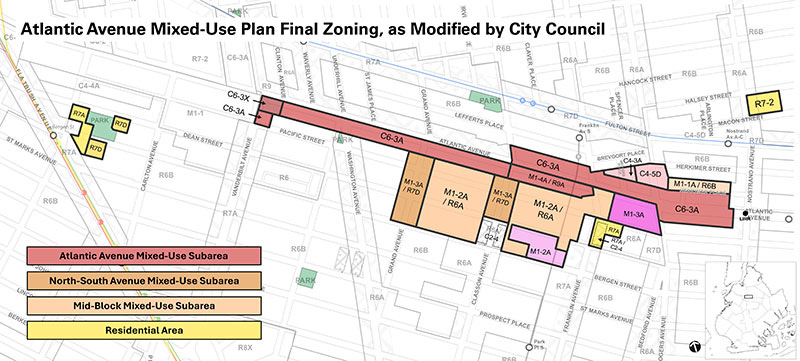
However, Atlantic Avenue parcels can be much bigger, whether via Pariente’s spot rezoning or the Atlantic Avenue Mixed-Use Plan.
For example, the press release regarding 863 Dean announced that the 16,500-square-foot lot offers up to 82,500 buildable square feet. At $16 million for the land cost, that works out to about $194 per buildable square foot.
By contrast, Pariente’s 20,000-square-foot lot turned into a building with 176,673 residential square feet. That square footage was expanded by matching a 7,934-square-foot grocery store, according to the amended MIH Restrictive Declaration.
The building, labeled 870 Atlantic in city records, has 202,889 gross square feet, which is always more than zoning square feet. That involves 191,289 square feet of residential space and 11,600 square feet of commercial space.2
That suggests, roughly, a land cost of roughly $100 per buildable square foot.
Pariente paid only $14 million for the Prosper Brooklyn parcel, which, according to city records labeling it 1034 Atlantic, is 24,000 square feet and has a gross square footage of 206,692.
That involves 187,625 square feet of residential space and 19,067 square feet of commercial space. Or, according to the amended MIH Restrictive Declaration,177,526 residential square feet. That square footage was expanded by matching an 8,379-square-foot grocery store.
Even if the building had only 180,000 square feet, that suggests a land cost of roughly $78 per buildable square foot.
Whatever the math, it looks like Pariente paid far less per buildable square foot than the current market. Maybe that’s why he tried to keep his land purchase under wraps for Prosper Brooklyn, and consummated the 870 Atlantic deal by buying out another developer after the rezoning was passed.
The affordability question
Do the new buildings provide more affordability than would have been required under the Atlantic Avenue Mixed-Use Plan? It looks like a wash.
As Community Board 8’s Gib Veconi pointed out in a comment below, it represents an even larger percentage of deeply affordable units, at 40% of AMI, than are required: 20% vs. 10%.
That said, the AAMUP requires 25% affordable units averaging 60% of AMI. That’s what’s reflected in these buildings.
However, they would not have been permitted under AAMUP, because 5% of the units are at 130% of AMI, which is enabled by the 421-a tax break but not by 485-x for buildings of this size.
Under 485-x, for projects with more than 150 units in certain areas, 25% of the units must average 60% of AMI, with the highest band capped at 100% of AMI.3
Mandatory Inclusionary Housing Option 1, which is what AAMUP requires, does allow the 60% AMI average to include units at 130% AMI. But if they get 485-x, they have to have fewer than 150 apartments to do so.
The bottom line
Should Pariente have been required to fulfill the original deal? Well, he clearly could have argued that circumstances had changed.
The question, though, is how to decide what makes an acceptable compromise. This one was negotiated quietly and without assessment by neutral experts.
For example, if he pretty much fulfilled the AAMUP requirements, plus that additional donation of the parcel to FAC and IMPACCT, why then are others willing to pay far more per buildable square foot?
What the city could do
A 2020 report, focusing on Gowanus, by the Pratt Center for Community Development, Our Hidden Treasure: Recovering Land Value to Repair and Rebuild, suggested ways the public could reap more from such transactions:
A new transfer fee could be assessed that would be triggered when property is transferred from one owner to another in an area where a rezoning study is underway…. Some proportion of the difference between the [current and future] values—perhaps 30%— would be levied on the buyer as a transfer fee.
Another approach would be to impose a City capital gains tax rate for owners of property in an imminently or recently rezoned area. The tax could be calibrated to recover a specific portion of the value conferred by the rezoning, and no more. It would be possible to construct a tax regime targeted at flippers—owners who acquire property for a short-term gain by extracting the value that the market anticipates being conferred by public sector action. Owners who have held a property for only a short period of time could be taxed at a higher rate than owners who have been operating buildings on a site in their currently permitted uses.
About local journalism
I backed into covering this news. Ideally, more journalists would be keeping track. From 2012-2017, the publication DNAinfo, focusing on neighborhood news, sent paid staff to cover community board meetings.
Today, local news has withered. The daily newspapers have fewer metro reporters. DNAinfo is gone.
The local chain Schneps, which owns the Brooklyn Paper, Brownstoner, amNY, and more, doesn’t have the staff for comprehensive coverage and pays its existing staff so little that they’ve just started a union drive, seeking living wages, better health care, and editorial integrity.4
Let’s note one positive but very much incomplete step. Brooklyn—notably gentrified neighborhoods—has recently seen a proliferation of hyperlocal newsletters, almost all on the Substack platform, which helps build audiences with recommendations.5
They’re clearly filling a niche, gaining thousands of subscribers. (See coverage of the phenomenon in The New Yorker.) They include, in alphabetical order:
Grime Square (North Brooklyn & Ridgewood)
South Brooklyn History (reflecting the original Brooklyn boundaries)
The Sunset Post (trilingual!)
Ward 6 Brooklyn (Cobble Hill, Carroll Gardens, Red Hook)7
(Let’s not forget existing neighborhood publications like the Red Hook Star-Revue, Our Time Press (Bed-Stuy, especially), and Greenpointers, as well as publications that cover multiple neighborhoods, like the Brooklyn Paper, Brooklyn Eagle, Brooklyn Home Reporter, and BKReader.)
These hyperlocal newsletters can alert readers to neighborhood changes and happenings, especially regarding retail, aggregate others’ relevant reporting, and help build community. They can also offer service journalism, such as interviews with business owners.
But it’s tougher for such newsletters—mostly one-person enterprises, and presumably part-time—to scale up to more significant reporting.
Sustained attention in journalism isn’t easy. Maybe we need some new funding models.
The parcel involving the drive-through McDonald’s was approved for a spot rezoning under Council Member Laurie Cumbo, Hudson’s predecessor, but that potential 18-story building has been stalled by a protracted court battle.
(If anyone has funding for me to write about it, I could do so at copious length. It’s a very interesting story.)
That document also says the building has only 189 residential units, which is contradicted by the MIH declaration.
This parcel is in the Neighborhood Tabulation Area Brooklyn 0801.
That suggests that editorial integrity can be a challenge. As one reporter put it, they should be “allowed to work without interference from management or consultants.” (Well, managers in journalism can/should “interfere” to improve the quality of the product.)
Another desires a workplace “where reporters are free to cover various topics without fear of repercussion.” That’s ominous.
Thanks to those recommending my publication or citing my work,
The most recent post, though, is from April 30.
This is on the beehiv platform, not Substack.
I appreciate your bringing this situation to light. I would point out that your analysis shows that approximately 20% of the apartments in 880 and 1042 Atlantic are being marketed to tenants earning 40% AMI. That aligns with CB8's resolution to support their private ULURP applications contingent on the developers' commitments to make affordable housing under MIH Option 3 (deep affordability), and represents a higher percentage of deeply affordable housing than ended up in the CBA (20% vs. 15%). It also represents an even larger percentage of deeply affordable units than are required under the AAMUP rezoning (20% vs. 10%).
So while I also would have preferred the renegotiation of the 880 and 1042 CBAs to have happened in an inclusive way, I highlight that the end result is closer to what CB8 had wanted to see both for the private rezonings as well as the neighborhood rezoning.