
Lessons from 962 Pacific: Developer's Warnings May Not be Credible. Deals Will Get Done.
The parcel, after a failed spot rezoning, sold for $33 million after an area plan was passed. A portent for Atlantic Yards?
Real estate is a business. The numbers have to work. If those numbers work well enough, those who achieve their deals might decide to cash out.
So we should take developers’ pious promises and dire warnings during the approval process with a grain of salt.
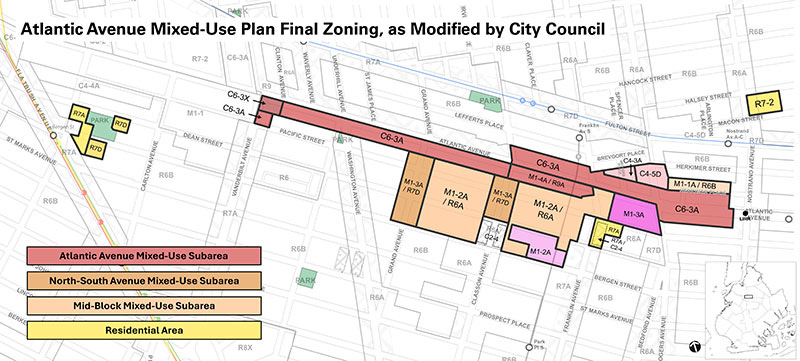
That applies to projects in spot rezonings near the Atlantic Yards site: the “M-CROWN” zone, later formalized into the Atlantic Avenue Mixed-Use Plan (AAMUP).
See, for example, the story of the 1010 Pacific rezoning, in which promises of affordability, cultural space, historic facade, and unit count from the applicant proved hollow—and then they flipped the property for a huge profit.
Since then, as I’ll describe below, a parcel subject to a controversial and unsuccessful spot rezoning nearby has changed hands. The transaction casts doubt on the owner’s past warnings and suggests substantial profits.
The Atlantic Yards angle
The framework applies to Atlantic Yards, too, so we should have similar expectations.
After all, the partnership between Cirrus Workforce Housing and LCOR hasn’t built anything as a team yet. (Cirrus has no track record beyond another approved project.1 LCOR does have a track record.)
State agencies, notably Empire State Development (ESD) and the Metropolitan Transportation Authority (MTA), have long been willing to revise deals with the project’s developers, but, as we’ve learned, have been unwilling to enforce contractual provisions regarding the unbuilt Urban Room atrium and penalties for missing affordable housing.
As I wrote on March 31, a presentation to EB-5 investors, who own a minority stake in the Atlantic Yards platform development, stated, “The developer will continue constructing buildings or sell sub-parcels.”
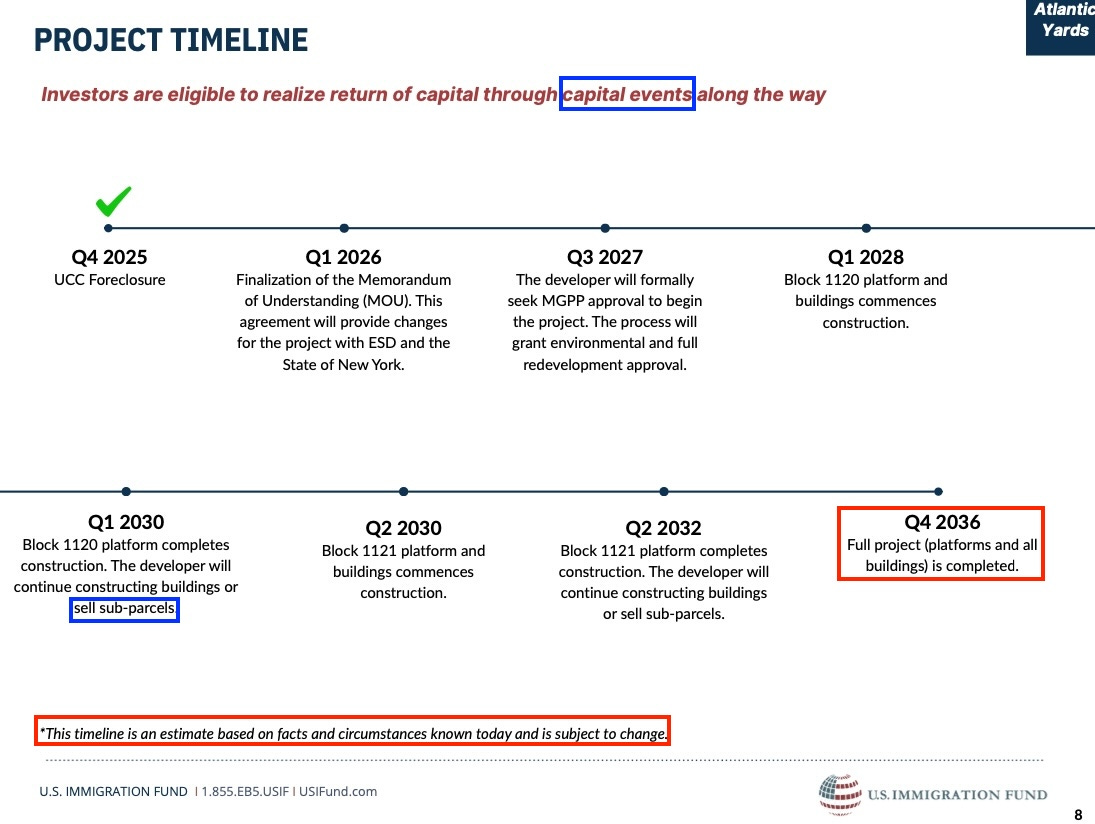
That was apparently an effort to reassure those investors that there would be an opportunity to be repaid.
It also reminds us that, once developers have a project approved and entitled, they have options, especially when contracts are not ironclad.
We’re still in the approval process. A key next step is a Memorandum of Understanding (MOU) with Empire State Development (ESD), the state authority that oversees/shepherds the project, due by July 31. It should outline public support, timing, and oversight.
But it won’t be binding. It precedes a formal public review, though it’s all controlled by Gov. Kathy Hochul.
Will we learn the value of the “public resources” sought, including 1.6 million square feet of additional bulk, yet-unspecified tax breaks, and an expected $350 million in direct subsidies?
The 962 Pacific example
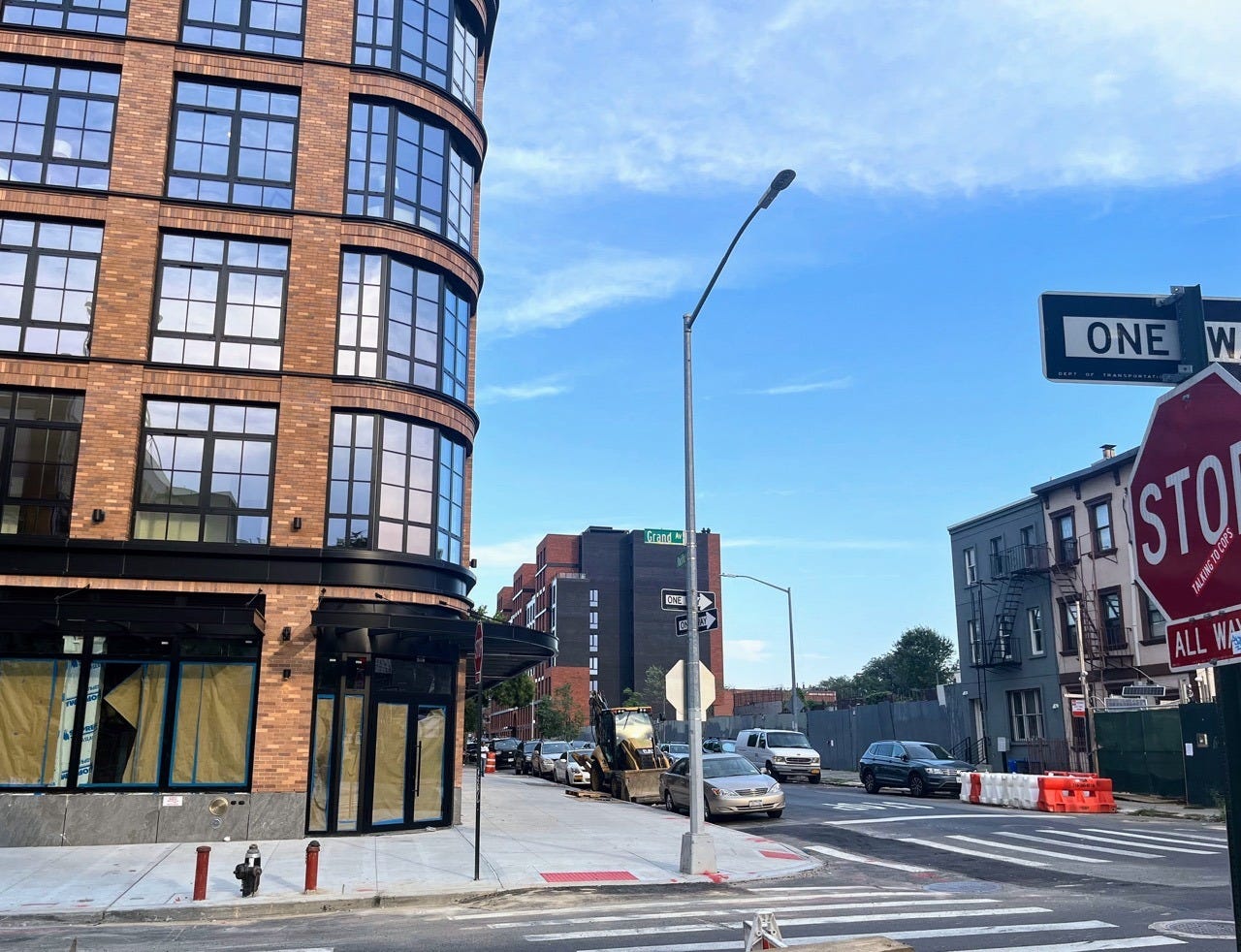
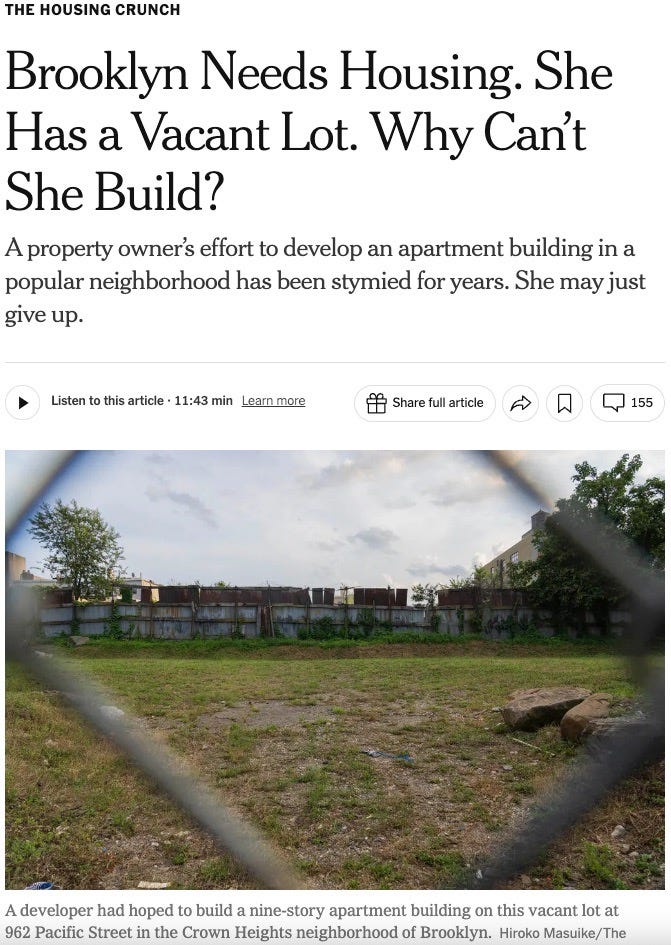
We recently learned that the much-discussed 962 Pacific Street in western Crown Heights, the subject of a complicated and controversial spot rezoning nixed by Council Member Crystal Hudson, will be developed after all, and at a likely huge profit for the landowner.
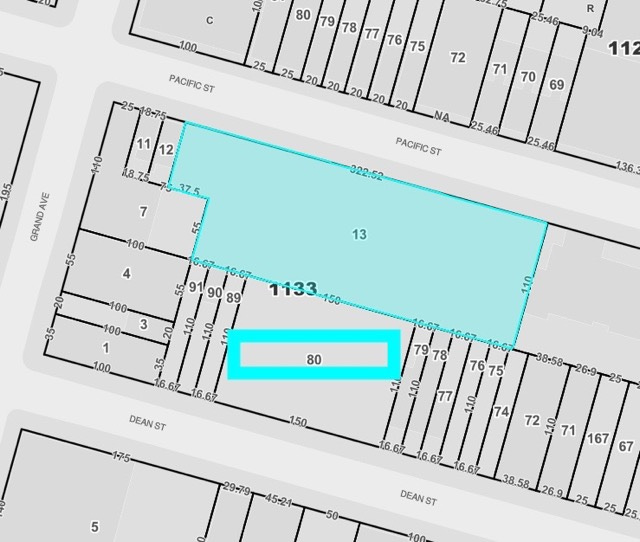
As the Real Deal reported April 21, Avery Hall Investments, the Brodsky Organization2, and contractor Monadnock Construction bought not only 962 Pacific Street (Block 1133, Lot 13) but also an adjacent parcel just to the south, 863 Dean Street (Lot 80), allowing for a block-through assemblage.
The lots are 33,000 square feet and 16,500 square feet, respectively. Presumably, the assemblage gives the developers more design and layout options.
Big bucks
The parcels are within the recently approved AAMUP, which allows new residential density on land formerly shackled by commercial and industrial zoning.
That rezoning clearly goosed interest in those properties, among others. The Real Deal quoted broker Matt Fotis of Marcus & Millchap as saying that 863 Dean drew 15 offers. It sold for $16 million. (Owner Albert Appleton acquired the underlying lots in 1996, 30 years ago, for $68,000.)
While no price was disclosed for 962 Pacific Street, a recently uploaded deed to the city’s ACRIS database discloses that it sold for $33 million, more than double its neighbor’s price.
The contract date was Nov. 18, 2025, about a year after the New York Times quoted owner Nadine Oelsner as saying it might not make financial sense to build her project, leaving its fate uncertain.
As of 2024, I had suggested that the parcel, acquired for just $1,000 in 1974, was worth perhaps around $20 million. That was clearly an underestimate.
That $33 million for Nadine and Bill Oelsner surely justified the $14 million they borrowed, cumulatively, to clear, prepare, and rezone the site.3 (Some of that spending made the site more valuable, preparing it for development. Some of it went to fees for the unsuccessful rezoning.)
Warnings and evasiveness
As I reported, one Brooklyn Community Board 8 member asked Oelsner, “What is the projected sort of margin that you are expecting to have on this project?”
“Let’s come back to the Community Board,” she replied, but their ultimate response was evasive.
Was the question invasive? Well, it was relevant, given claims that they were being squeezed.
Oelsner and her lawyer, playing chicken with the community board, suggested that the failure to pass the rezoning would lead to the construction of a last-mile package distribution center or a bus parking lot, both of which would fuel unwelcome traffic.
“If I can’t get some movement on here, I’m going to lose this property,” Oelsner warned at one Community Board 8 meeting, given that their loan was coming due, I reported in December 2022. Ultimately, they just kept refinancing.
Would the Oelsners, who had no experience in real estate development, maintain a majority ownership in a future joint venture? “We pray to God,” she told CB 8 members, “we can keep this property, and we can have a controlling interest.”
That, I wrote, was hardly definitive. Ultimately, it was piffle.
What might be built
One 962 Pacific plan had 150 apartments and 135,815 zoning square feet (zsf) of residential space. That implies larger apartments.4
The R6A zoning in the Mid-Block Mixed-Use Subarea allows a residential building with a Floor Area Ratio (FAR) of 3.9, plus an incentive to add 1.1 FAR of office, commercial, or manufacturing space, for a total FAR of 5.0.
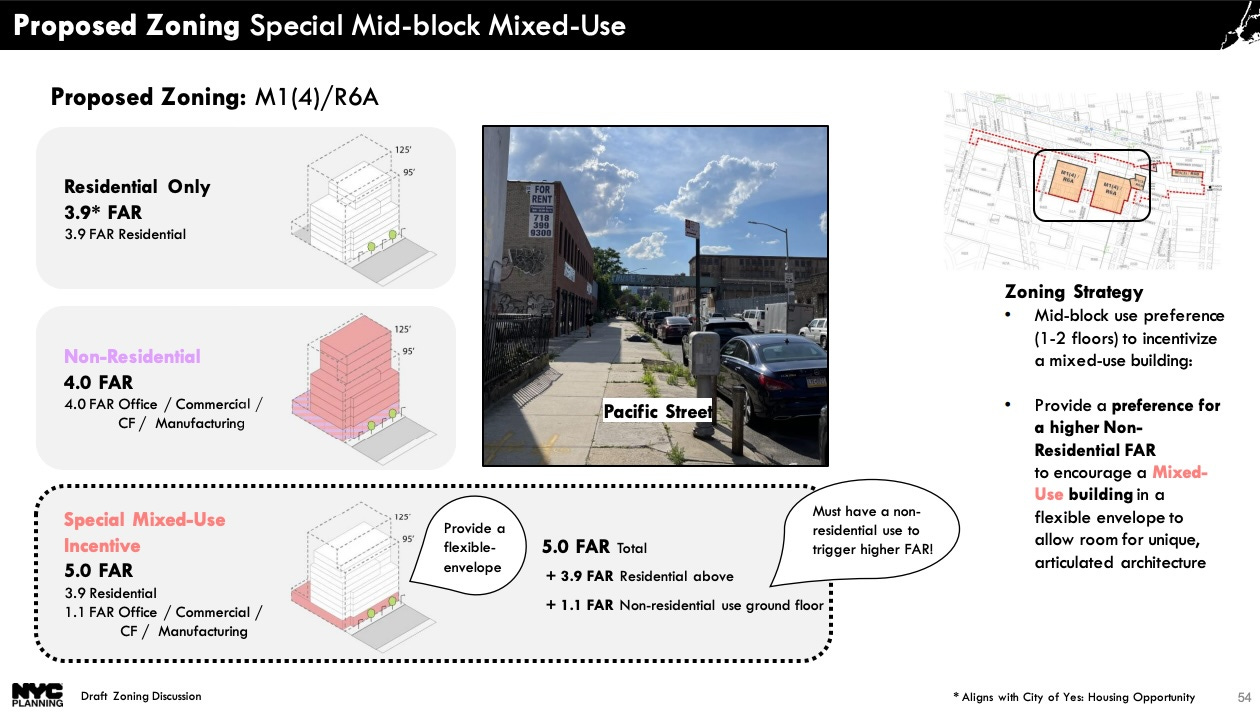
That would allow 193,050 square feet of residential space, or 46.1% more. Does that mean there’d only be 219 apartments, a similar increase? I suspect there would be more, and smaller, apartments.
So, if the new owners spent $49 million for 193,050 square feet of residential space, that’s $254 per buildable square foot. But the site could have a total FAR of 5, which means 247,500 bsf, including lower-value non-residential space. That works out to $198 per buildable square foot.
The developer originally requested an FAR of 4.6, arguing that that was in line with spot rezonings down the block.
Affordable housing
Avery Hall’s Brian Ezra told the Real Deal they planned a project “consistent with the rezoning,” but wouldn’t provide details. The AAMUP allows for Mandatory Inclusionary Housing (MIH) Options 1, 2, and Deep Affordability:
25% of units averaging 60% of Area Median Income (AMI)
30% of units averaging 80% of AMI20% of units no higher than 40% of AMI
[Updated/corrected thanks to comment below from Gib Veconi]
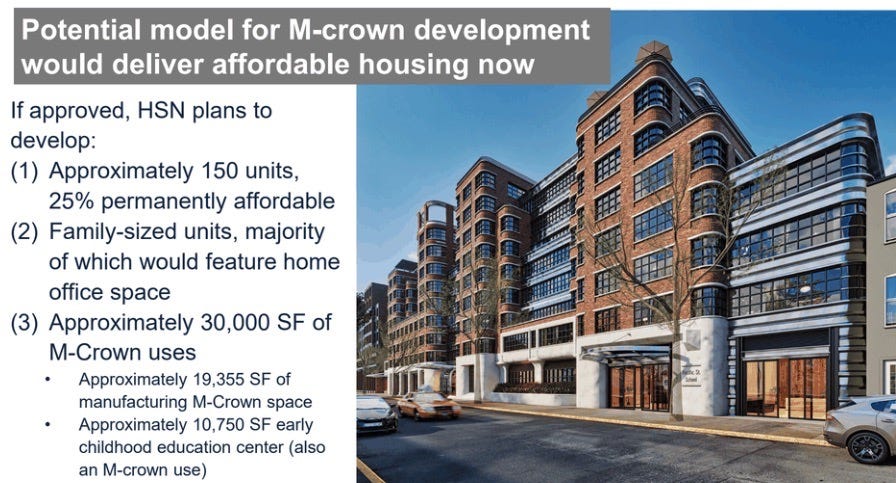
As I wrote, the Oelsners initially offered 25% affordable housing. After Community Board 8’s Land Use Committee sought 35%, expanding the number of lowest-income units, and the developer agreed to 32%, the full Board endorsed that revision.
What happened?
Council Member Hudson, who had declared a moratorium on new projects until the area rezoning had passed, clashed with the Oelsners, whose proposal for a spot rezoning on a block that already had other spot rezonings had been stalled by the pandemic.
Was it arbitrary to oppose this one, especially since the private deal would’ve delivered more affordable housing? Maybe, maybe not.
But it was a lot more complicated a story than the New York Times presented, as I wrote in the link below.

It was appropriate to pressure the Oelsners to include more affordable housing, because they’d get the jump on other developers in the area rezoning. Also, they’d be building into a block where significant construction had concluded.
The real estate publication The Real Deal reported, with dubious sourcing, that Hudson had sought far more from the landowners, including 100 percent affordable senior housing at another site, plus $5 to $10 million in a fund for affordable housing.
Hudson denied it. It’s plausible that some negotiation occurred.
After all, we know there’s big money in an upzoning, whether for a particular parcel or in an overall area. Building bigger makes property more valuable. The numbers have to work.
Its principals have experience in real estate financing, but not with this company.
Brodsky is the sole developer of one building in Atlantic Yards/Pacific Park, 662 Pacific Street, and the lead developer, with former master developer Greenland USA, of 18 Sixth Avenue. Greenland’s former Atlantic Yards point man, Scott Solish, in 2023 left to work for Brodsky as Director of Acquisitions and Development.
That was a consolidated mortgage for two properties, 962 Pacific Street and 975 Atlantic Avenue.
It also had 21,600 zsf of ground-floor space and nearly 30,000 gross square feet of below-ground space, with no zsf counterpart.
I remember very well that Times article by Mihir Zaveri about the Pacific Street lot. It was pretty bad, and I'm sorry to say very typical of his work the last couple of years. He just parrots developer/YIMBY talking points. You would think he works as a spokesman for the Durst Organization or something and just writes Times articles as a side hustle. I remember him uncritically repeating Oelsner's ridiculous suggestion that maybe she will just have to keep it a dusty vacant lot until the end of time unless she gets exactly the spot rezoning that she wants.
I believe AAMUP only mapped MIH Option 1, not 2 or 3. See https://council.nyc.gov/press/2025/05/12/2865/.