
What Has the Social Justice Fund Been Doing for Five Years?
Amplifying their own Impact Summary with a longer list of initiatives. Details on spending are scarce.
This is part of a series on the Joe and Clara Tsai Foundation’s Social Justice Fund, established in 2020 by the billionaire couple who own most of Brooklyn Sports & Entertainment, which includes the Brooklyn Nets, New York Liberty, and the Barclays Center operating company.1
This is a companion to the overview article, headlined The Tsais’ Social Justice Fund: “Lasting Change” or Strategic Brand Management? Below, I’ll go through the Social Justice Fund’s Impact Summary section by section, starting top left, and adding some information not included.
While much of this relies on their website text, I’ve added complementary or analytical information, as well as some SJF responses—not insignificant but not complete—to some of my questions. I’ve also described some pending questions and programs omitted.
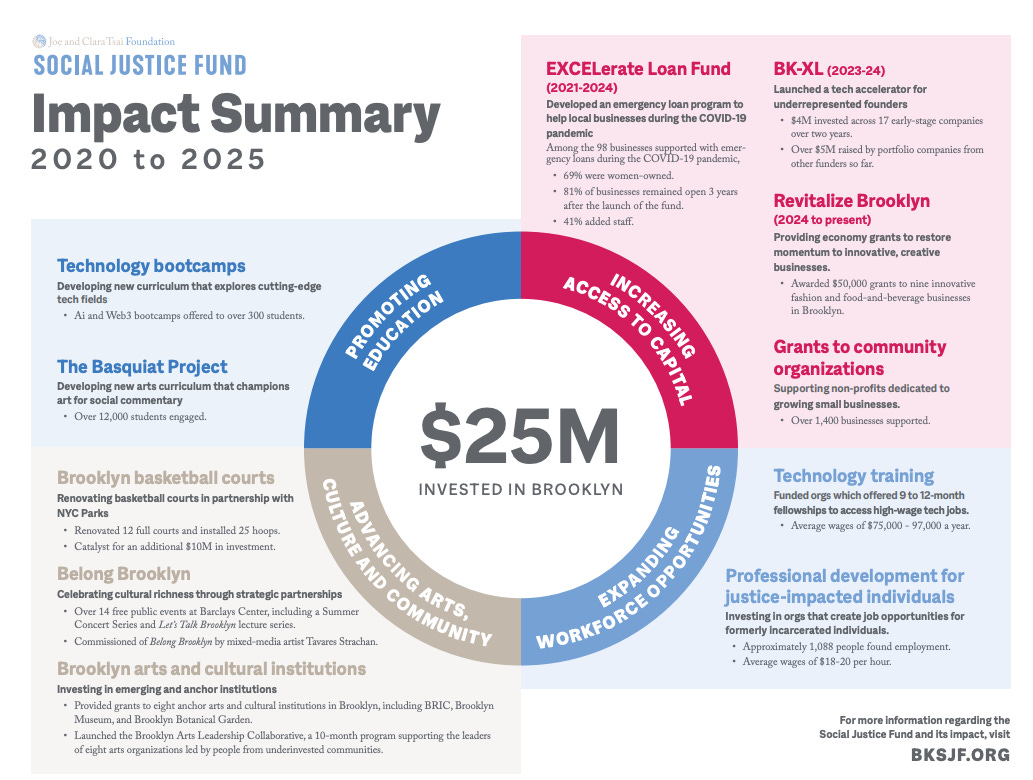
Within the claimed $25 million in spending, the SJF has supported many programs and individuals. We just don’t know how much.
It’s not easy to spend $5 million a year, though, in increments of $25,000 or $20,000, such as for the “Belong/Brooklyn” nonprofit or the Just Brooklyn Prize, both of which involve $100,000 in grants, plus unclear costs for events and public relations.
Nor do we know how much the Tsais pay themselves, such as when the SJF pays for use of the arena.
The overall effectiveness and connection to social justice deserve more transparency, especially since, as described below, the claims remain vague.
After all, though the SJF released a two-page Impact Summary, it does not delineate its grants to the Internal Revenue Service, because, well, the parent Joe and Clara Tsai Foundation, despite its name, is not an actual U.S. foundation as typically understood.
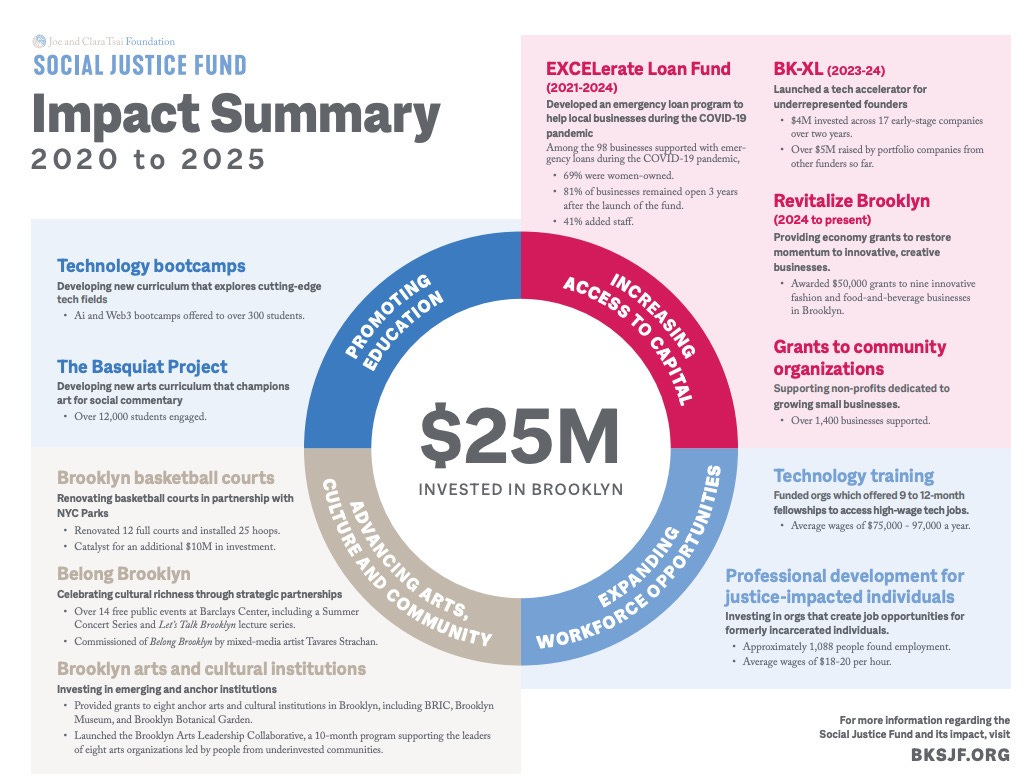
Below, I’ll go into more detail about each quadrant of activity.
The sections, linked below, include:
So you can go to the hyperlinks or skim, looking at the headlines.
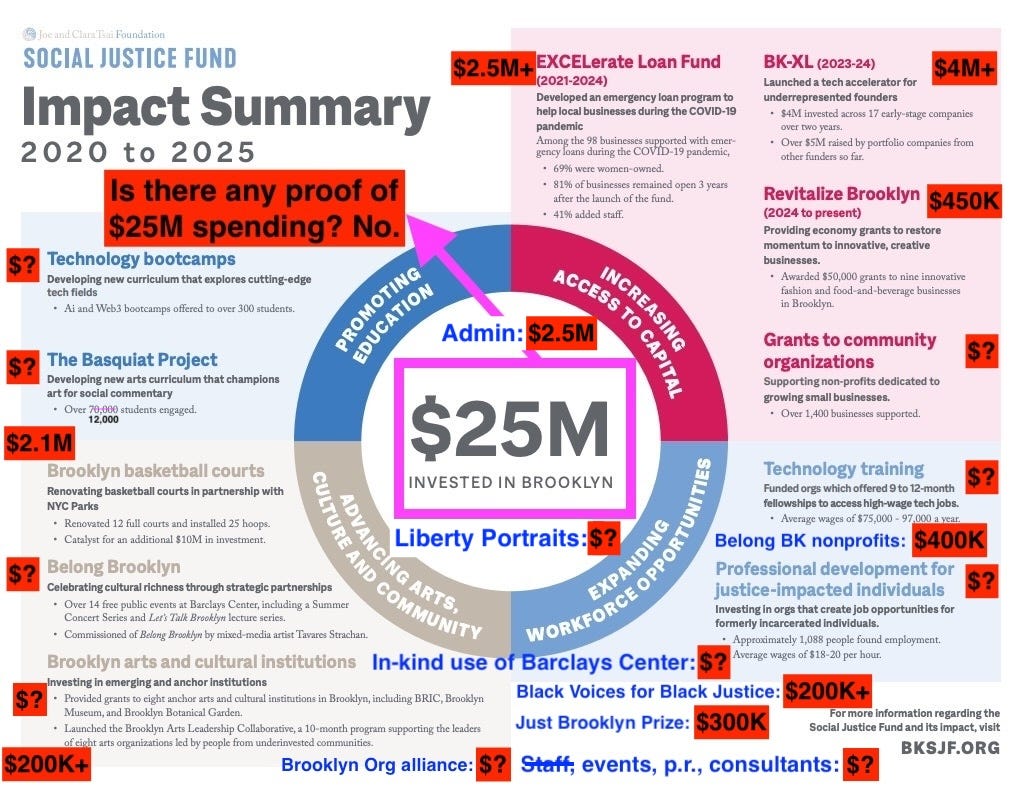
At the bottom, I’ll add information about unmentioned initiatives or spending, such as:
the Just Brooklyn Prize
the Black Voices for Black Justice awardees
the Liberty Portraits
spending on administration
spending on the in-kind use of the Barclays Center
the See NYC program
The bottom line: they’ve spread themselves around broadly if not always deeply, offering useful. They’ve clearly had an impact, though, given their failure to disclose spending, it’s difficult to fully assess. They publicize some initiatives and not others.
Promoting Education
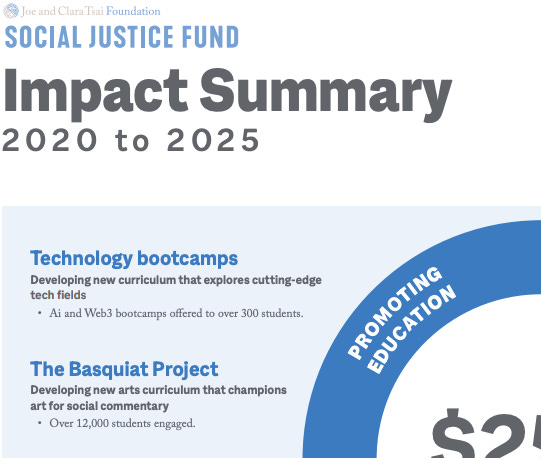
Technology bootcamps
In 2024, according to the website, “the Social Justice Fund launched two transformative bootcamps for New York City high school students, equipping them with the knowledge and skills to navigate the technologies shaping our future.”
“The Web 3.0 Bootcamp introduced 100 students to the next evolution of the internet, focusing on blockchain fundamentals, NFTs, decentralized finance (DeFi), and best practices within the Web 3.0 ecosystem,” the website states.
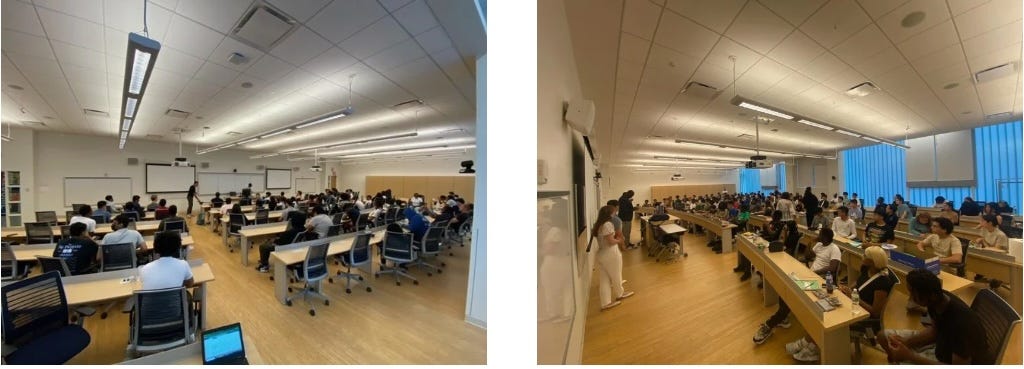
Also, “the AI Bootcamp provided students with a high-level understanding of large language models and their practical applications in real-world scenarios.”
The 2025 AI bootcamp, according to a Yale student instructor, was a five-week program for about 50 students.
Helpful? Surely. Transformative? Tough to tell. The bootcamps have served over 300 students, according to the Impact Summary. That suggests 150 students a year.
SJF Executive Director Gregg Bishop, in an interview last year, called it an effort to position youth for tech careers. If the SJF were part of a real foundation, we’d know how much they spent.
(Also note the connection to Technology Training in the fourth category, Expanding Workforce Opportunities.)
The Basquiat Project
The Social Justice Fund in 2021 debuted a much-lauded student arts curriculum, stating:
The Brooklyn Nets have partnered with the New York City Department of Education (NYC DOE) and the Fund for Public Schools to create an educational arts program about the work of Brooklyn-born artist Jean-Michel Basquiat. The program was funded by Clara Wu Tsai, who established a Social Justice Fund to support racial justice and equality initiatives benefitting Black, Indigenous and People of Color.
So it’s a Brooklyn Nets initiative, but it’s not funded by the team; rather, it's funded by the Social Justice Fund, which Wu Tsai is said to have funded—though the couple announced it and supplied their resources.
It’s another sign of the loose boundaries between philanthropy and business promotion. The goal, Wu Tsai said, was to “show students how Basquiat’s art could inspire change, and provide them with an outlet for self-expression.”
That clearly inspired creativity, as student art shows confirmed. Still, the initial version of the Impact Summary offered exaggerated numbers. After seeing it, I questioned the claimed total of 70,000 students reached, noting a previous social media post (below) that said “4,000+ students.”
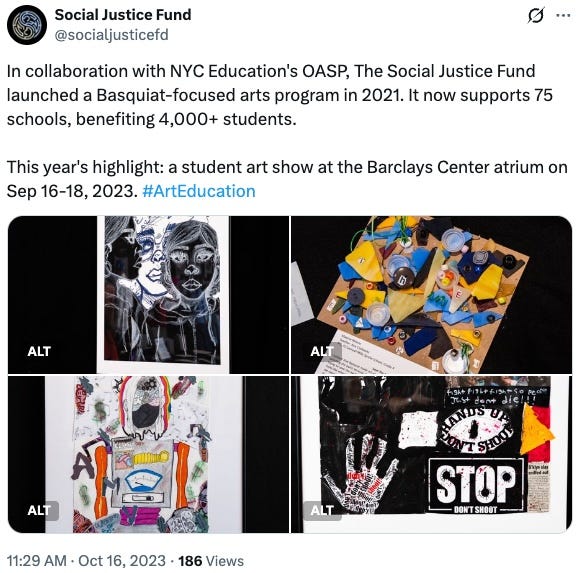
“An earlier version of the impact report was uploaded with an incorrect number of students impacted by the Basquiat project,” I was told in response. “The number is 12,000 students. We are updating the report to reflect this.”
Yes, the Basquiat Project is just one program among many. However, their sloppiness in reporting or willingness to exaggerate—take your pick—calls into question their credibility.
This February, under the banner of the Basquiat Project, the SJF funded a visit of “150+ young student artists and educators” to the Guggenheim Museum, involving “private tours of the exhibit and artmaking activities led by museum educators, in addition to a Q&A with the artist Rashid Johnson.”
Wu Tsai plans to bring a prominent Johnson work to the Barclays Center this fall, part of what is grandly called “Brooklyn Art Encounters.”
After Basquiat, Max Roach
As a successor to the Basquiat program, the Social Justice Fund is supporting a curriculum involving Brooklyn-born Black composer and musician Max Roach.
While the program started too late for the Impact Summary, it’s not even on the SJF website. Still, WBGO reported Oct. 29, 2025. The Social Justice Fund & New York City Public Schools Launch The Max Roach Music Project, “a rigorous initiative aimed to commemorate the legacy of Max Roach by integrating music education and social justice in public schools.”
As 2024 marks the centennial celebration of Max Roach’s birth, the project serves as a timely tribute to his impact on civil rights, music, and cultural innovation. These principles are reflected in the curriculum which features a collaboration with Max Roach Estate and Jazz House KIDS, coaching by professional musicians, and a culminating performance at Barclays Center in Spring 2026.
“Max Roach was a son of Bed-Stuy and a jazz genius who has shaped the genre for generations of musicians,” said Clara Wu Tsai, Founder of The Social Justice Fund. “We are proud to honor him by bringing this musical arts program to thousands of students throughout Brooklyn.”
It will be piloted in seven Brooklyn middle and high schools, as NY 1 reported Nov. 7, 2025, in New pilot to teach students about Max Roach, jazz and activism.
Expect publicity when the arena performance is announced. Don’t expect to learn how much they’ve spent.
Advancing Arts, Culture, and Community
Brooklyn Basketball Courts
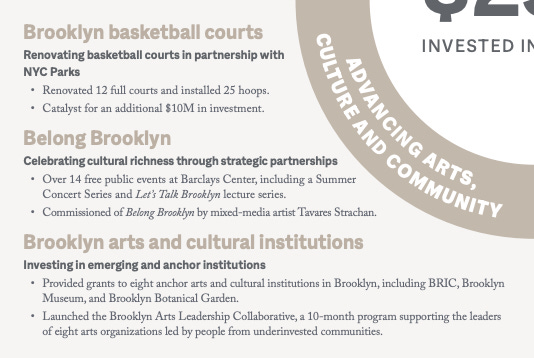
The document cites renovations of 12 basketball courts, in partnership with the New York City Parks Department. The website says it was part of a “collective effort to end gun violence,” given the locations.2
(Such renovations were also supported by the previous owners of the Nets.”3 )
These efforts meld the Tsais’ interest as business owners and philanthropists. Those renovations come with branding—and t-shirts—from Brooklyn Basketball, representing the Brooklyn Nets and New York Liberty, not the lesser-known Social Justice Fund.
Indeed, Oct. 16, 2024, minutes from Brooklyn Community Board 18 state, “The Brooklyn Nets paid for the basketball court renovations.”
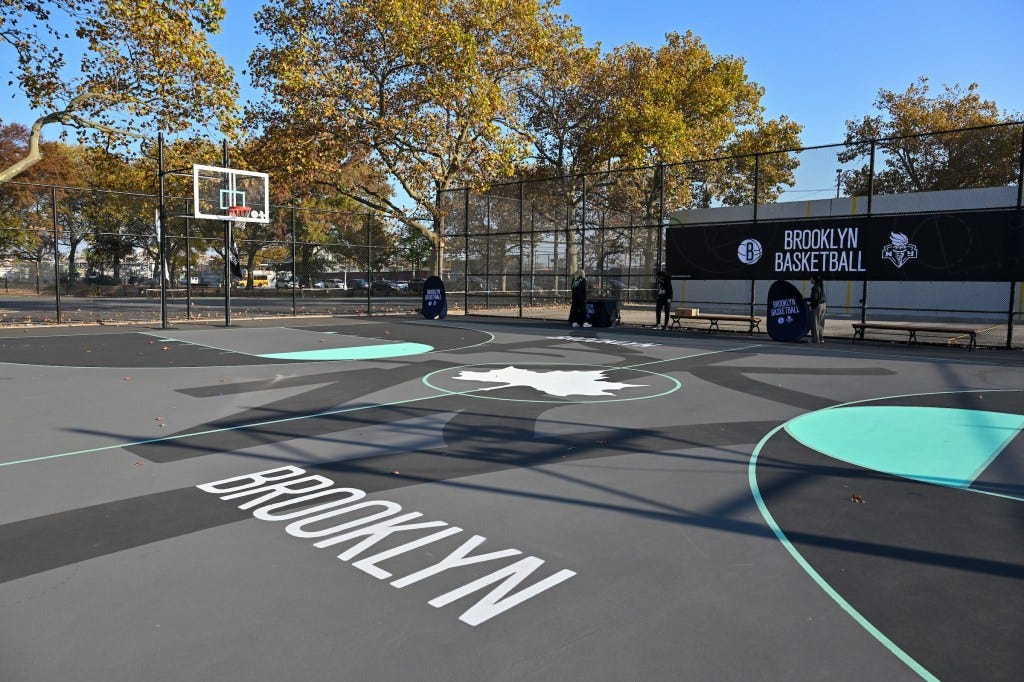
The Impact Summary didn’t cite an investment. I calculated $2.1 million. The SJF later said it exceeded $2 million. It calls the funding a “[c]atalyst for an additional $10 million in investment.” How so? The SJF told me:
Courts are catalysts, signaling that neighborhoods are worthy of care and attract further investment. For instance, our refurbishment of the Breukelen Ballfields catalyzed the Department of Transportation to pave the schoolyard and an additional $5-7 million investment from the city/local councilmember for a capital project consisting of pickleball courts, tracks and synthetic fields. Similarly, in Bed Stuy, our investment in the Jackie Robinson courts has catalyzed another $5 million local investment as well.
I asked the Parks Department about the claimed catalyst, and they deferred to the Social Justice Fund.
Belong Brooklyn
The Impact Summary describes Belong Brooklyn as:
Celebrating cultural richness through strategic partnerships
• Over 14 free public events at Barclays Center, including a Summer Concert Series and Let’s Talk Brooklyn lecture series.
• Commissioned of [sic] Belong Brooklyn by mixed-media artist Tavares Strachan.
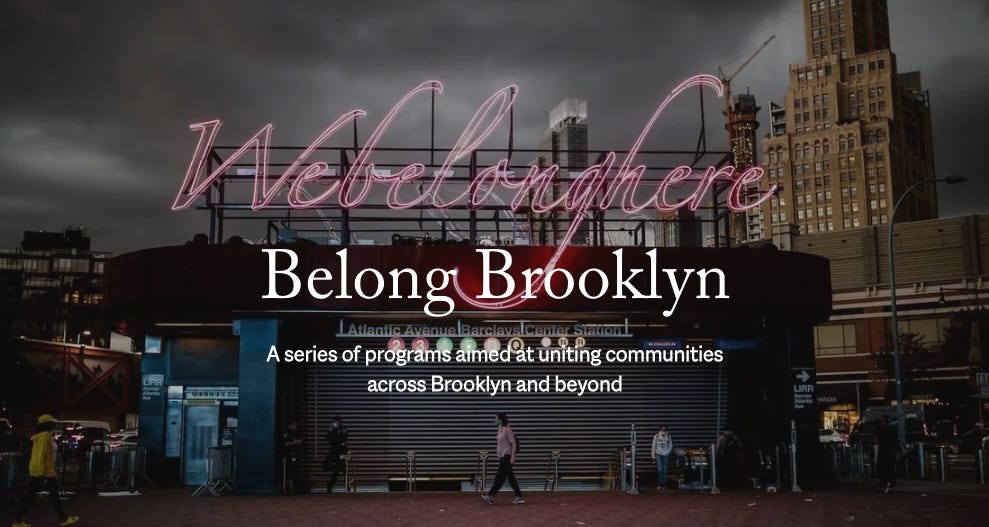
That doesn’t fully describe the broad rubric—“series of programs aimed at uniting communities across Brooklyn and beyond”—cited on the SJF’s Belong Brooklyn page, as well as some $400,000 in support, as I’ve calculated, for various nonprofits.
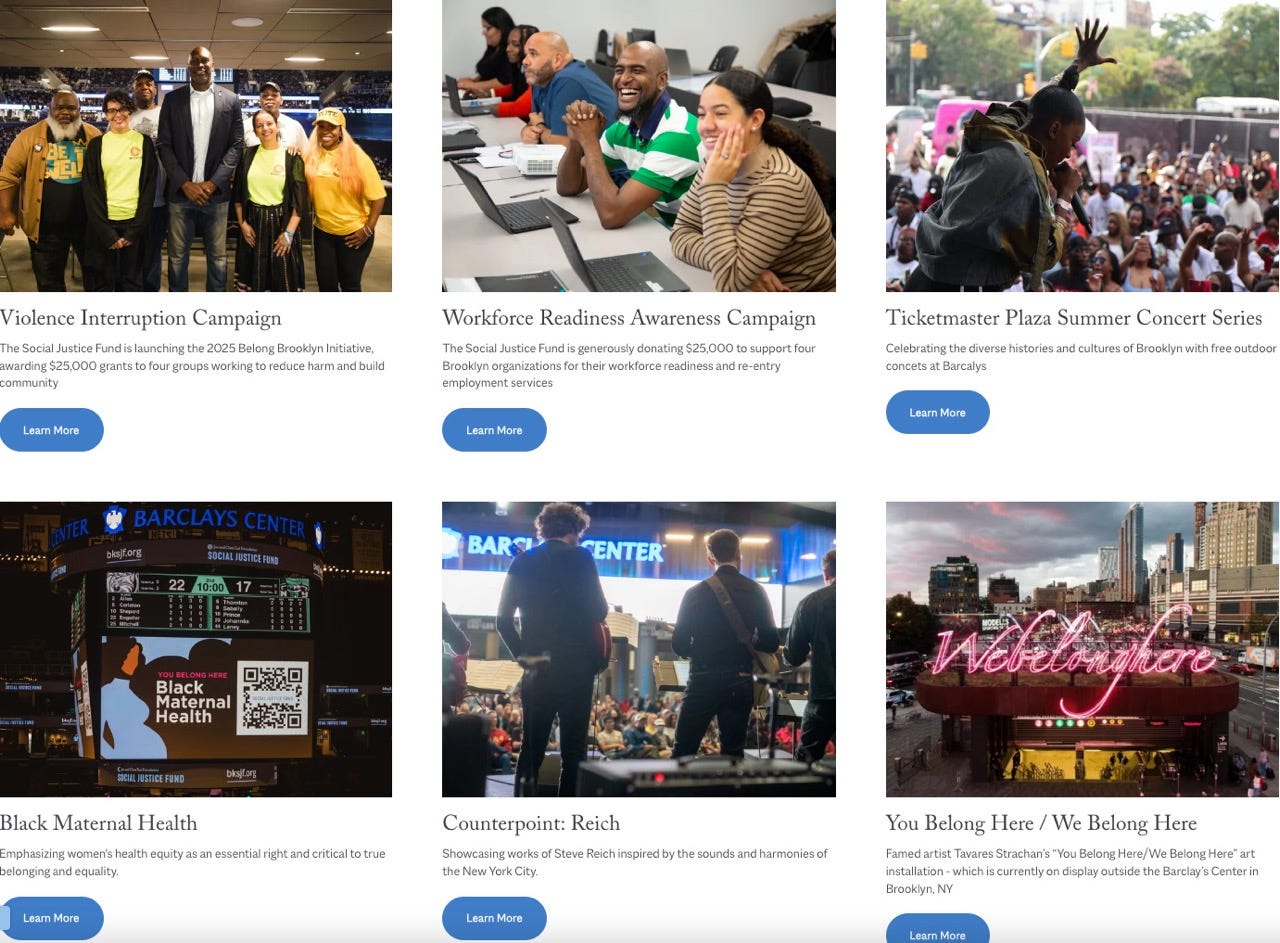
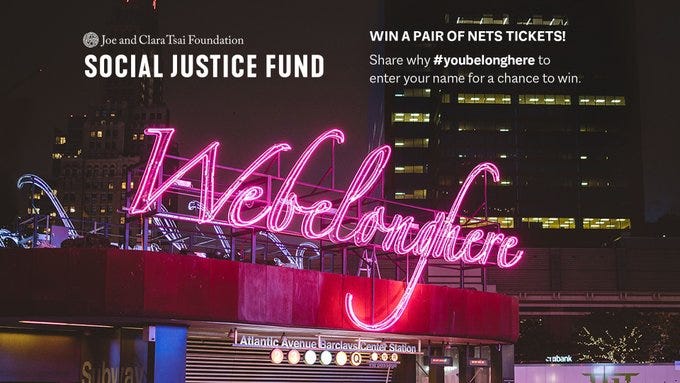
I’ve questioned the neon signage in Art or Advertising? Behind the Tricky “You/We Belong Here” Signage Outside the Barclays Center. The SJF website claimed the signage helped encourage a “sense of belonging”:
The Social Justice Fund’s #YouBelongHere campaign was created to encourage a sense of belonging among people in our community and around the world. Using famed artist Tavares Strachan’s “You Belong Here/We Belong Here” art installation - which is currently on display outside the Barclay’s [sic] Center in Brooklyn, NY - as a visual backdrop, we are encouraging people to share their stories of belonging on social media using the hashtag #YouBelongHere.
The Social Justice Fund’s #YouBelongHere Campaign stated that, for every use of the hashtag #YouBelongHere, the fund would donate $100 to one of five nonprofit organizations (up to $20,000 per organization) working towards racial justice and creating a more equitable society in Brooklyn and beyond:4
Weeksville Heritage Center
Brooklyn Defenders
Children of Promise
Brooklyn United Music and Arts Program
Bard Prison Initiative / Bard Microcollege at Brooklyn Public Library
From what I can tell, the campaign generated little uptake.5
Perhaps because of that, and/or the awkwardness of tying contributions to hashtag promotion, future “Belong Brooklyn” support for nonprofits came without contingencies.
Another promotion offered a carrot: Nets tickets. That also suggests synergy between philanthropy and business.
As shown below, one of the concerts was credited not only to the Social Justice Fund but also to the Barclays Center and various promoters.
While surely a welcome event, it’s hard to see how this constitutes “social justice” more than “community relations.”
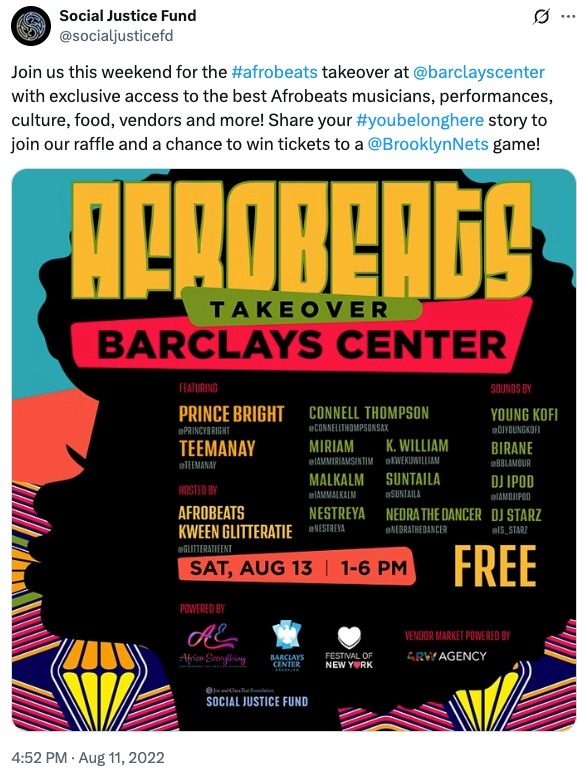
The website claims an “inaugural” series in 2022 and, confusingly, a first annual series in 2023.6
Combining concerts and community support
Over the previous three years, the Social Justice Fund has used a summer concert series to promote cumulative $100,000 donations to nonprofits in particular sectors.
Though surely welcome, the money represents only a small fraction of the claimed $5 million in spending. Was that why the sums were omitted from the Impact Summary?

The 2023 campaign, for Black Maternal Health, emphasized “women’s health equity as an essential right and critical to true belonging and equality.”7
The 2024 campaign, for Re-Entry and Workforce Readiness, emphasized “employment equity, via workforce readiness and re-entry programs, as a means of belonging.”8
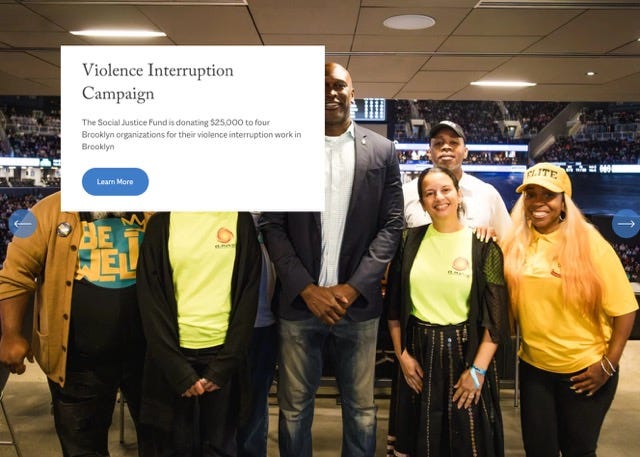
The 2025 Belong Brooklyn Initiative, as it’s now known, awarded $25,000 grants to four organizations working on Violence Interruption—an alternative to police in certain neighborhoods that uses “credible messengers” to mediate conflict.9
As the screenshot above suggests, the Violence Interruption Campaign is a “secondary” screen when scrolling horizontally on the SJF homepage. So it’s odd to see it, and its predecessors, ignored in the Impact Summary.
Author Matt Sullivan, in his 2021 book Can’t Knock the Hustle: Inside the Season of Protest, Pandemic, and Progress with the Brooklyn Nets’ Superstars of Tomorrow, quoted a community organizer working with the Nets: “The NBA, it’s all a business. So some of the policies you can’t get to the NBA are police reform—that’s not safe. Defunding the police will hurt their bottom line.”
The Social Justice Fund has mostly steered clear of public safety issues, but the recent funding of violence interrupters, who are not necessarily embraced by the police, suggests a slight shift.
What about “Let’s Talk Brooklyn”?
Another SJF credibility issue involves the claim of a Let’s Talk Brooklyn lecture series, said to be part of Belong Brooklyn.

Was there a series? The SJF website describes a single event, on Nov. 27, 2023, in which SJF co-founder10 Wu Tsai hosted “GRAMMY Awardee Jon Batiste, and U.S Surgeon General, Dr. Vivek Murthy, discussing social media, mental health, and loneliness on college campuses.”
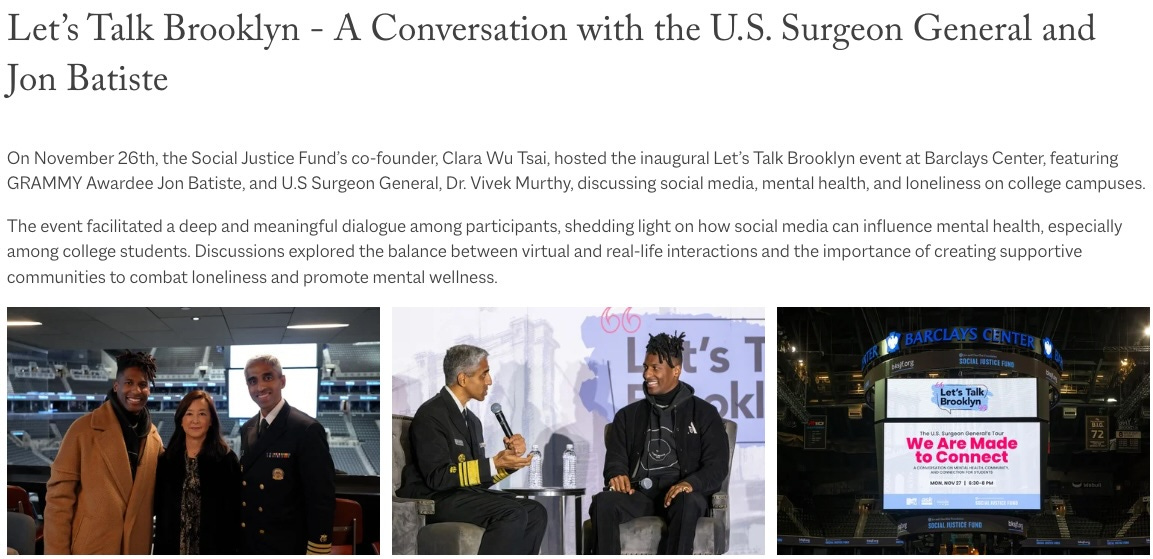
It seemed an awkward effort to bootstrap “social justice” onto Murthy’s national “We Are Made to Connect” tour, focused on college campuses. The crowd barely filled the arena atrium, according to an Instagram video.
Nonetheless, the Social Justice Fund positioned it as the “inaugural” Let’s Talk Brooklyn event, as shown in the above screenshot.
In her introduction, Wu Tsai said, “I’ve been thinking really hard over the last few years about how Barclays could really truly be of service to Brooklyn and to this community. And so I’m really pleased to be able to announce today something that we’re calling Let’s Talk Brooklyn, which is a series of conversations among policy leaders and musicians and actors and authors.”
Queried about subsequent events, a SJF spokesman (from the public relations firm DKC) told me, “For the Let’s Talk Brooklyn series, we recently hosted the Common Dream Summit for 65 kids. It included guest speakers, including Common, focused on how to dream and reach one’s potential.”
That’s a stretch. It involved a musician/actor, but wasn’t a free public event. It was held mostly at the Brooklyn Basketball Training Center, where the youth were given branded Nets swag before attending a Nets game at the Barclays Center.
NetsDaily described it as a partnership with Common’s Free to Dream initiative.11 No one invoked “Let’s Talk Brooklyn.” The SJF’s Bishop cited a “partnership with the Brooklyn Nets.” If the Social Justice Fund compensated Brooklyn Sports & Entertainment for the tickets, that means the Tsais pay the Tsais.
Brooklyn arts and cultural institutions
The Impact Summary cites “Investing in emerging and anchor institutions,” adding, “Provided grants to eight anchor arts and cultural institutions in Brooklyn, including BRIC, Brooklyn Museum, and Brooklyn Botanical Garden.”
After asking for more specifics, I didn’t learn the sums granted but was told:
Grants to cultural institutions in Brooklyn include those supporting Brooklyn Children’s Museum, New Heights, Pioneer Works, Brooklyn Arts Council, Weeksville, Prospect Park Alliance, Gersh Park Community Foundation, etc.
(The website also mentions the Center for Fiction.)
Weeksville Heritage Center was part of the first Belong Brooklyn campaign. Support for “anchor institutions” like the Prospect Park Alliance seems consonant with support from previous arena operators.
For New Heights, a “Non-Profit Sports-Based Youth Development and Education Organization,” benefactor table sponsors for its 2022 Gamechangers Ball included BSE Global, the New York Liberty, the Brooklyn Nets, and the Social Justice Fund. That again suggests an overlap between business and philanthropy.12

I couldn’t find any reference to a Gersh Park Community Foundation, but presumably it supports Gersh Park, the streetball mecca in East New York.13
The Brooklyn Arts Leadership Collaborative
Another element, according to the Impact Study, was “the Brooklyn Arts Leadership Collaborative, a 10-month program supporting the leaders of eight arts organizations led by people from underinvested communities.”
The inaugural cohort, in 2023, included: ARTE (Art Resistance Through Education); Black Girls Sew; Brooklyn United Music and Arts Program; Kyoung’s Pacific Beat; ¡Oye!; Black Trans Femme Artist Collective; Rooted Theater Company; Redhawk Council.
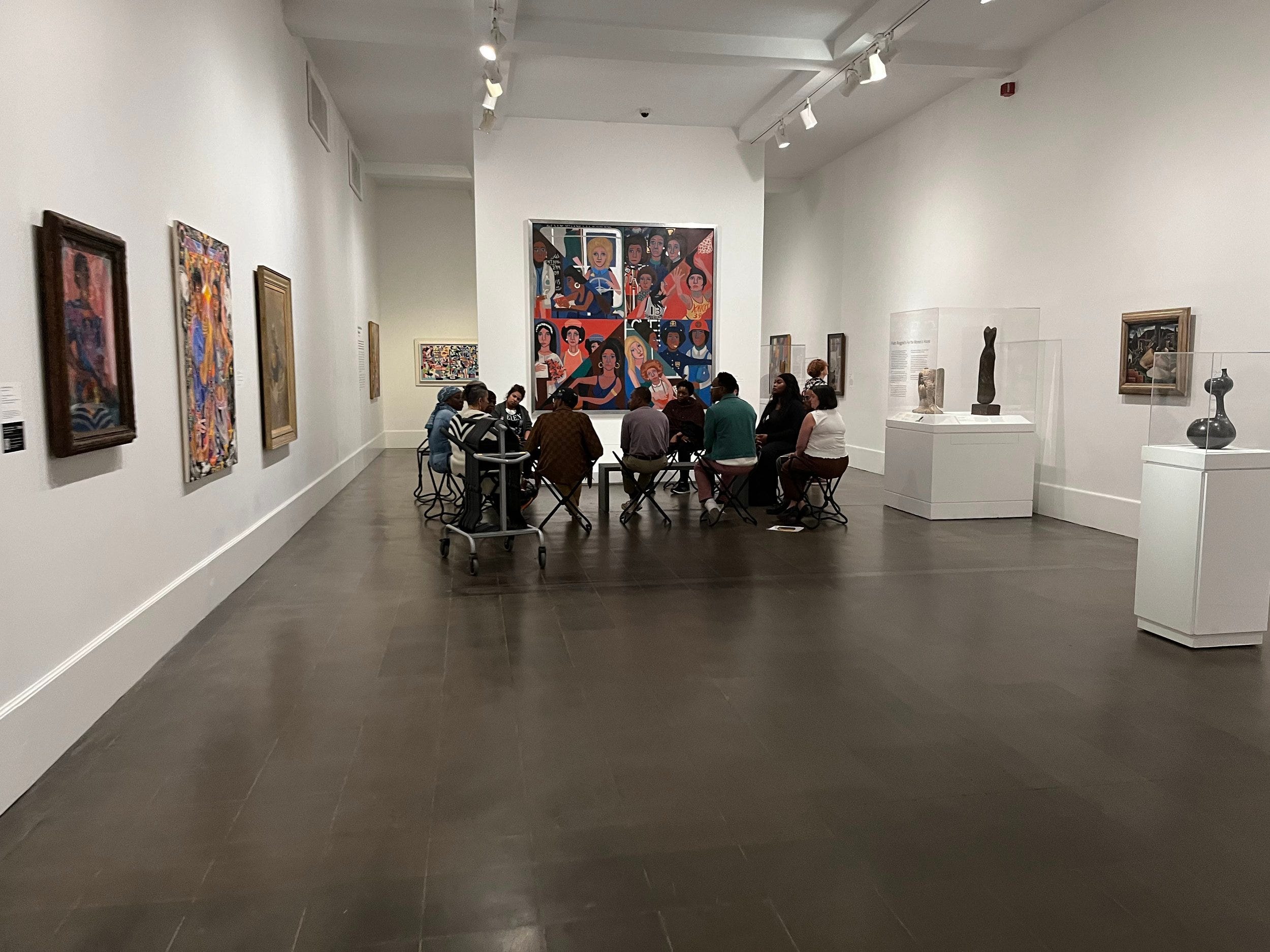
The announcement noted that only 50 of more than 4,000 arts organizations in Brooklyn were led by people from “historically marginalized communities,” so the program aimed to provide “holistic leadership development and strategic support.”
Each organization also received a $25,000 SJF grant. So that’s $200,000 in grants, plus an unknown amount of program expenses, including event space, guest speakers, and videography.14
As shown above, a fireside chat involved Clara Wu Tsai, Ford Foundation President Darren Walker, and Brooklyn Museum Director Anne Pasternak, exploring the theme “The Arts as Catalysts for Social Impact.”
Increasing Access to Capital
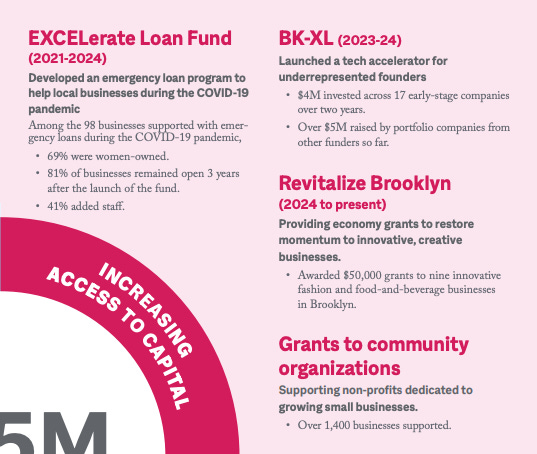
EXCELerate Loan Fund and BK-XL
The next two sections of the Impact Summary involve the EXCELerate Loan Fund and BX-XL, which I address in separate articles.

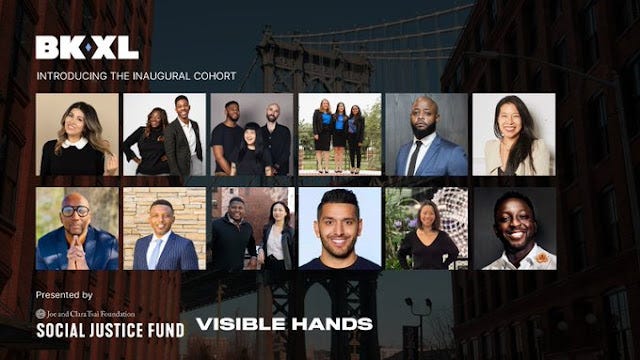


Revitalize Brooklyn
Revitalize Brooklyn, from “2024 to present,” is described as “[p]roviding economy [sic grants to restore momentum to innovative, creative businesses,” specifically “[a]warded $50,000 grants to nine innovative fashion and food-and-beverage businesses in Brooklyn.” So, a total of $450,000.
The website calls Revitalize Brooklyn “a competitive grant program designed to identify and support innovative Brooklyn-based businesses by providing growth capital to help them reach the next level,” given the struggles in Brooklyn’s creative economy post-pandemic.
“The program aims to cultivate a strong pipeline of 30-40 qualified applicants, ultimately selecting 9 businesses with the greatest potential for success and growth,” the website states.
Given that competition wasn’t publicly announced, how were applicants recruited? (After all, as one local commented on a July 8, 2025, Instagram post highlighting one grantee, “how can a creative business apply to this?” That didn’t draw a response.)
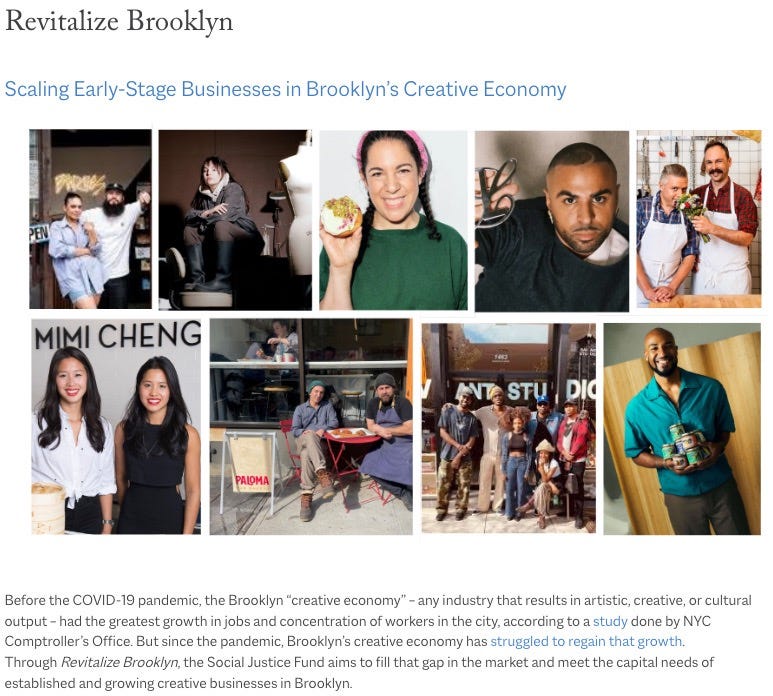
“Revitalize Brooklyn grantees were nominated to apply – and ultimately selected – by a committee of industry experts based and active in Brooklyn,” the SJF told me. “We received over 25 applications and 9 companies were selected. In the next round, we plan to expand to organizations that work with growth businesses to also nominate.”
It’s unclear whether the program offers business counseling, as did EXCELerate, but that would make sense.
In contrast with EXCELerate, there was no emphasis on Black Brooklyn; rather, there was a trend toward businesses embodying the interests and tastes of younger gentrifiers, albeit with a good number of entrepreneurs of color, as I wrote. It seemed a shift—or, perhaps, expansion—in tone.
Revitalize Brooklyn was announced almost backhandedly, emerging in a Jan. 29, 2025, column in the food website Eater, presumably placed as an exclusive by a Social Justice Fund public relations consultant.15
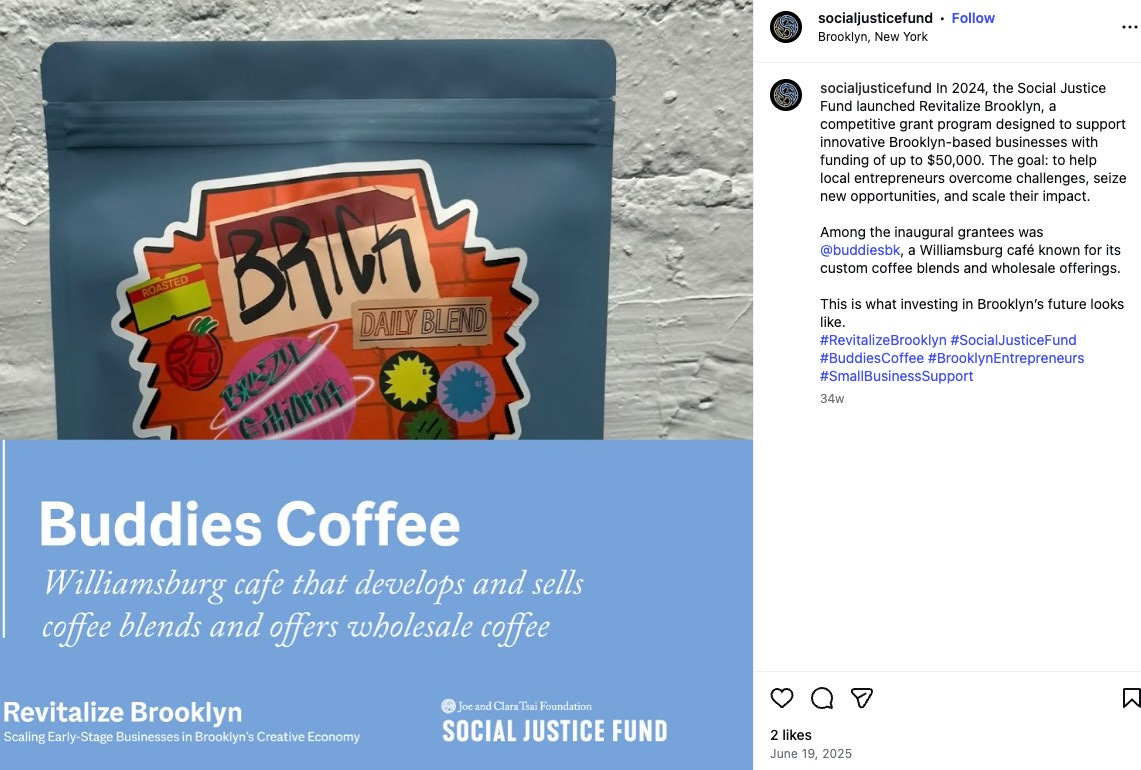
With no press release, the Social Justice Fund used social media: an Instagram campaign from June 19, 2025, through July 8, 2025, featured five recipients.
One of them, Buddies Coffee, had already closed its Williamsburg location, though it promises a new home, and was selected to provide coffee for six weeks at Meta Lab NYC, the company’s Manhattan retail space for AI glasses and VR headsets.
The SJF told me they aim to “invest more in grants to medium size businesses to be a catalyst for growth.”
That suggests an expansion of Revitalize Brooklyn. Think about it. Instead of putting $2 million, for example, into start-ups, they could deploy $1 millon to help 20 medium-sized businesses.
Grants to community organizations
The next section, grants to community organizations, states that, by “[s]upporting non-profits dedicated to growing small businesses,” that means “[o]ver 1,400 businesses supported.”
Well, did the SJF funding directly support 1,400-plus businesses, or was it part of funding for organizations supporting them?
The answer I got points to the latter. “Our goal has always been to be authentic, not performative, through our connections with local organizations that we believe can create lasting impact,” the SJF told me. Their examples:
CAMBA, which serves central Brooklyn, helped 760 entrepreneurs start, grow, and manage neighborhood businesses in 2023
Bridge Street Development Corporation helped 600 neighborhood businesses in Bed-Stuy survive the pandemic by connecting them with funding opportunities and attracting visitors to business districts.
Hot Bread Kitchen trained 107 new food-related small business owners, incubated eight businesses in its commercial kitchen, and helped 11 scale through connecting with CDFIs for loans up to $50,000.
Again, without knowing the SJF’s spending, it’s tough to assess the significance of its role.
Expanding Workforce Opportunities
Technology training
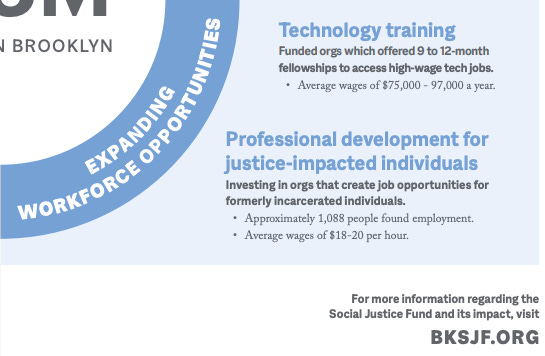
Under the category of Technology training, the SJF says it “Funded orgs which offered 9 to 12-month fellowships to access high-wage tech jobs,” with average wages of $75,000 - 97,000 a year.”
Which organizations? How many fellowships have been funded?
“The Marcy Lab School offers a free, one-year alternative to college, training high school graduates as software engineers and data scientists,” I was told. The number of fellowships wasn’t disclosed.
On a July 19, 2023, panel hosted by Brooklyn Savvy, Creating Economic Mobility with Gregg Bishop, the SJF Executive Director said it had funded Marcy Lab School, which is based in Industry City, and also helped Hack.Diversity expand into Brooklyn.16
The Boston-based nonprofit Hack.Diversity opened its nine-month fellowship program in New York, according to a July 1, 2024, article in Crain’s New York Business, engaging 15 fellows for paid internships in the first year, then 17 in the second year.
Hack raised about $2 million annually in contributions and grants, according to the article, with the “Clara Wu Tsai Social Justice Fund,” as it was misleadingly described, among the top five donors. The latter’s contribution was not specified.
Last April, Hack announced it would wind down as of August 30, 2025, citing fewer job openings and “the current backlash against DEI programs.” Perhaps that’s why the SJF doesn’t mention it.
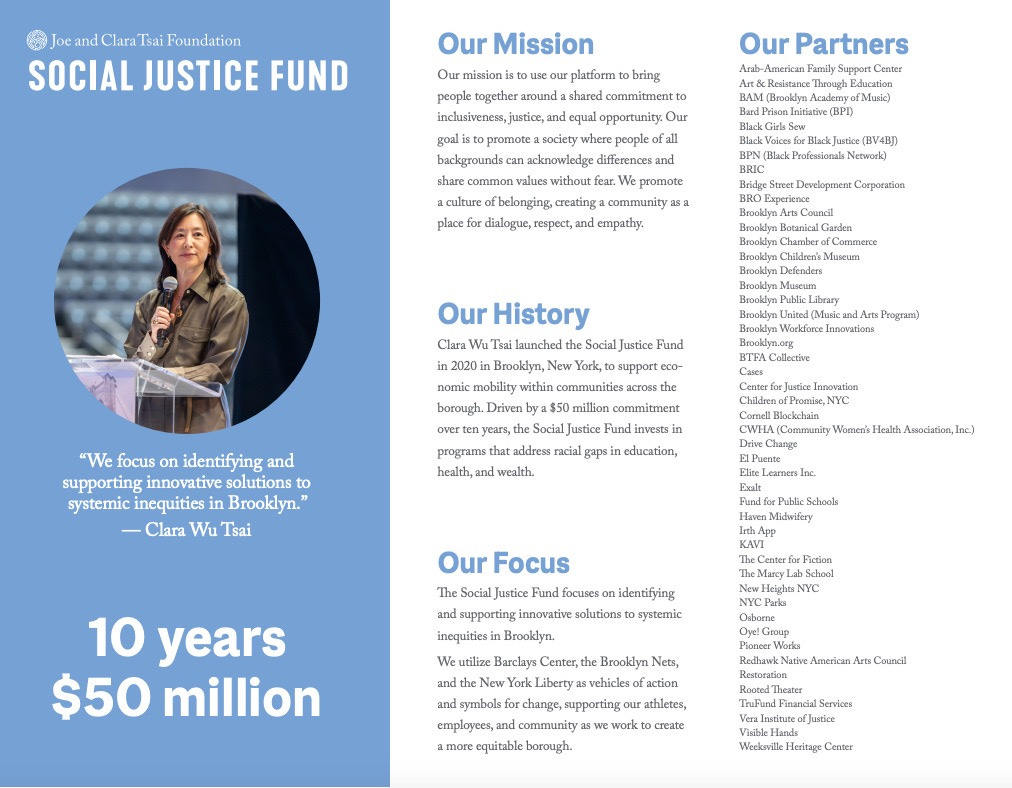
As with the article about Hack.Diversity, the Social Justice Fund, as shown in the screenshot above, has pivoted to credit the philanthropic effort solely to Clara Wu Tsai, rather than to both her and her more controversial husband.
Professional development for justice-impacted individuals
The final section, at the bottom right of the graphic, focuses on “Investing in orgs that create job opportunities for formerly incarcerated individuals,” with results described as “Approximately 1,088 people found employment” and “Average wages of $18-20 per hour.”
I asked about whether the SJF's investment directly supported the claimed number of jobs, but didn’t get an answer.
Which organizations? They include, I was told, those in the Re-Entry Workforce Readiness Campaign, a $100,000 commitment that was part of Belong Brooklyn: $25,000 to the organizations Brooklyn Workforce Innovations, Drive Change, Cases, and Osborne Association.
That announced investment also includes funding for the nonprofit Strive, though SJF’s website doesn’t mention it. Strive in March 2024 said its expansion in New York City from its flagship East Harlem location to Brooklyn was “fueled by a generous donation” by the SJF. The amount was unspecified.
“The grant will focus on building the Career Path program, STRIVE’s signature five pillar model of workforce training and preparedness, offering career readiness and occupational training, job search skills and placement assistance, with emphasis on the robust healthcare sector in the Metro New York area and priority for justice-involved Brooklyn residents,” the announcement said.
In July 2024, “STRIVE celebrated the graduation of 20 students from its newest location in Brooklyn,” the organization said.
The Brooklyn pilot of STRIVE’s Career Path: Nonclinical Healthcare Support program was launched in partnership with Brooklyn Communities Collaborative, which aims to promote health equity in Brooklyn, and involved employer partners SUNY Downstate Medical School and Maimonides Medical Center.
In March 2025, the SJF’s Bishop appeared with Strive’s Chief Program Officer on a panel, “Alternative Trade School for People Facing Systemic Barriers,” at SXSW EDU.
Unmentioned Initiatives or Spending
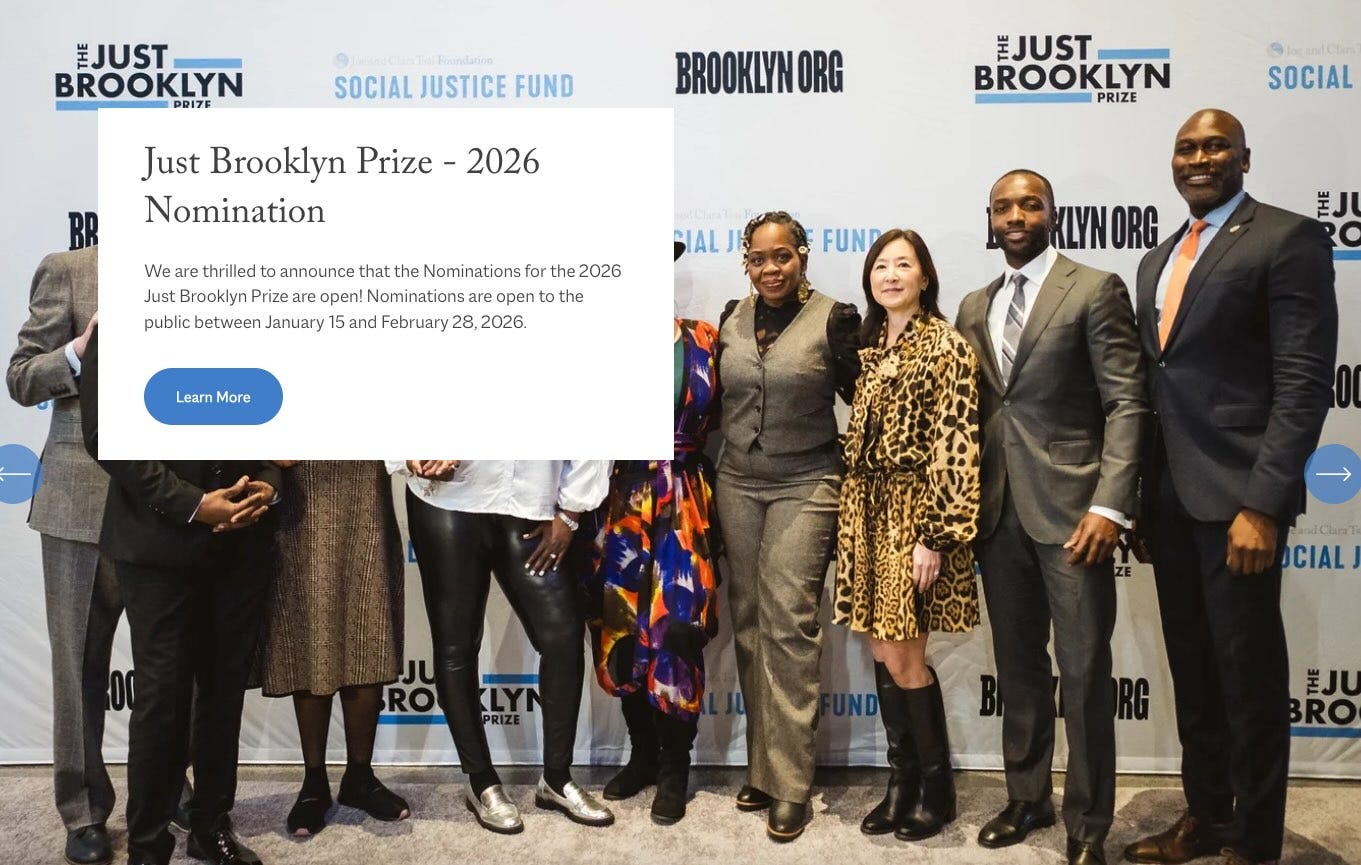
Unmentioned: The Just Brooklyn Prize
The Just Brooklyn Prize, launched in 2023 by the SJF in partnership with Brooklyn Org, was, according to an April 21, 2023 version of the website, “awarded to five BIPOC (Black, Indigenous, and People of Color) changemakers annually who are dedicated to strengthening and building power within Brooklyn’s communities.”
Honorees include an activist against displacement in East New York, a supporter of Haitian refugees, the founder of Domestic Workers United, and the Co-Founder of Family and Friends of the Wrongfully Convicted.
The website today omits the term BIPOC, saying the prize is “awarded to five changemakers annually who are dedicated to strengthening and building power within Brooklyn’s communities.” Each gets an unrestricted $20,000 grant.
In reality, all the 2025 winners, celebrated at a Nov. 14 award ceremony, fit the original goal of BIPOC leaders, as did the previous winners.)17
Oddly enough, the Just Brooklyn Prize, which Wu Tsai at that Nov. 14, 2025, ceremony called one of the Fund’s “most important and most gratifying programs,” was absent from the two-page Impact Summary.
“The Just Brooklyn Prize gives us the opportunity to shine a light on some of Brooklyn’s most dedicated and inspiring leaders,” Wu Tsai said at the ceremony. “People who are working tirelessly for this community with limited resources and recognition. And coming together to honor you is truly one of the highlights of my year.”
Why omit the Just Brooklyn prize, especially since it represents a homegrown initiative”? (Could it be because the $100,000 in annual prize money represents just 2% of the claimed $5 million in spending?)
“No particular reason the Just Brooklyn Prize is not specifically called out in the impact summary,” I was told in response to my query. “It is included among our community grant programs.”
Unmentioned: The Black Voices for Black Justice Awardees
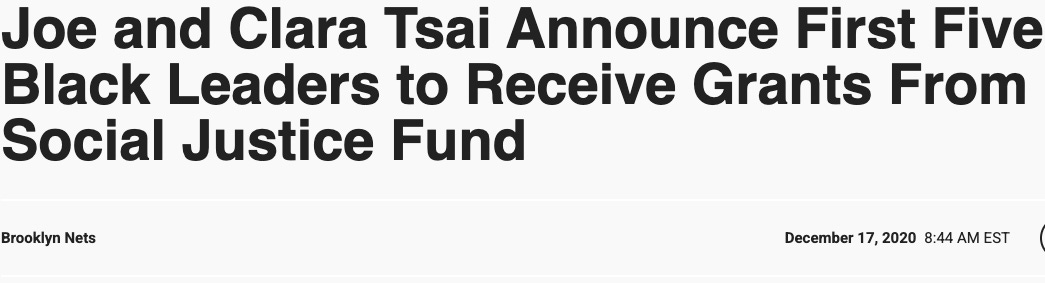
The first SJF grant recipients, announced Dec. 17, 2020, were five “Brooklyn-based Black leaders tackling the root causes of racial disparities in healthcare, climate policy, education, journalism, and the criminal justice system.”18
The Brooklyn awardees’ work, the announcement said, “will be amplified via The Black Voices for Black Justice Fund (BVBJF) to support Black leaders addressing systemic racism at the national and community level.”
For example, Next100 policy entrepreneur Chantal Hinds, according to the BVBJF, "conducted interviews and focus groups of 75 current and former foster youth, parents, and adoptive and/or foster parents to gather their views on how New York state can improve its education system to better support young people in the foster system.”
Why wasn’t this program mentioned in the Impact Summary? Unclear, especially since a fuzzy initiative like Let’s Talk Brooklyn was mentioned.
It’s notable that the press release, issued before the SJF had a website, was issued by the Brooklyn Nets. In this case, unlike with the later Just Brooklyn Prize, the Tsais outsourced the selection process to the BVBJF. When the second round was announced, it got a page (archived) on the SJF website.
While the $50 million total was highlighted in the press release, the dollar value of each grant was unmentioned. I couldn't get an answer when I inquired, but the BK Reader reported that the initial grants ranged between $20,000 and $50,000.
Indeed, the Black Voices for Black Justice Fund’s three- year report later explained, “Each awardee is provided with a grant – either $20,000 or $50,000 – to use at this pivotal moment to expand their voice and grow their solutions for building an anti-racist America.”
Two years later, in 2022, five more awardees were named, with the amounts again unspecified. Though the Black Voices for Black Justice awards are no longer19 linked from the SJF’s Initiatives list, the website has a page—findable via a web search—with the 2022 awardees.20 That first round is also cited on the News page.
The separate Black Voices for Black Justice website lists all ten awardees.
Unmentioned: Liberty Portraits
The Art at Barclays Center page first credits The Liberty Portraits: A Monument to the 2024 Champions to Brooklyn Sports & Entertainment; it also says it was commissioned by the Social Justice Fund. That credit was not part of the initial press release last July.
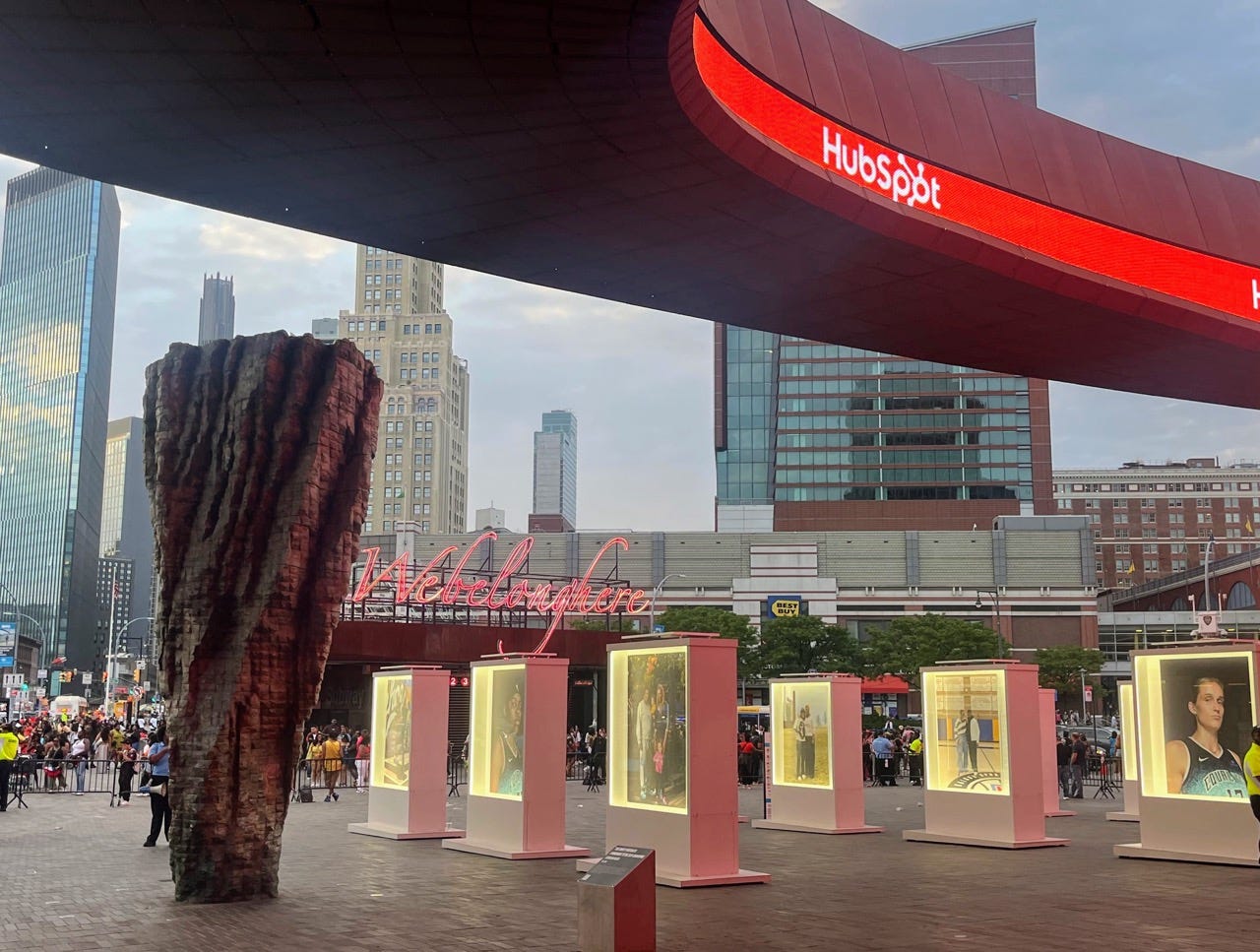
I had written last July 6, Art, Promotion, or Both? The “Liberty Portraits” Are a BSE Global Power Move. Now we know it’s also classified as social justice and, presumably, claimed against the $5 million spent last year.
The project is not mentioned in the 5-Year Impact Report or on the SJF website.
Unmentioned: spending on administration
In response to my question, I was told that 10% of spending goes to “administrative and operational costs, which is standard for philanthropic organizations.” Actually, that’s relatively lean, but this is a small organization.
Large legacy foundations like the Ford Foundation, which are heavily staffed, spend 20% on overhead, as David Callahan reported for Inside Philanthropy.
If the Social Justice Fund might, for example, share Brooklyn Sports & Entertainment offices at Industry City or use Tsai family office personnel for financial administration, well, they might save on overhead.
The NBA Foundation, which exists mainly to make large grants rather than innovate programs (as Ford does, and the Social Justice Fund does only in part), in 2024, distributed nearly $41.6 million in grants, while spending $1.84 million in compensation and $1.06 million in other expenses, according to its Form 990 report. So total expenses were below 7%. Then again, most SJF grants are smaller.


Unmentioned: spending on the arena
“The arena bills SJF for costs associated with using the facility for our events,” I was told.
So the Tsais apparently pay the Tsais for using the plaza for concerts, and the atrium for annual ceremonies for the Just Brooklyn Prize, concerts, a “Let’s Talk Brooklyn” discussion, as well as for displays of student art in the Basquiat program.
Then add spending to host two “Demo Days” for the BK-XL cohorts. That cumulative value, likely significant, remains unspecified.
Was the Social Justice Fund the sponsor of the New York City Department of Small Business Services’ (SBS) annual procurement fair, held at the Barclays Center in 2022? It seems likely.
“We are honored to be hosting the 2022 procurement fair at Barclays Center,” said Clara Wu Tsai, described as founder of the Social Justice Fund, in the press release. “Our arena’s business diversity program is a priority for us and has been a great vehicle for recruiting M/WBE vendors. We are big believers in the transformative impact that this procurement fair can have on economic mobility.”
The SBS also hosted a Contracting Summit at the Barclays Center this past January. Was it sponsored by the SJF? Unclear, but the organization’s Bishop was a speaker.
Unmentioned (maybe): $1M for Essential Workers night, $1M for more
On Dec. 22, 2020, the Nets announced they were honoring essential workers at their 2020-21 NBA Season Opener. Along with Barclays and other donors, they raised more than $2 million for COVID-19 Relief Efforts, to be donated to Coalition for the Homeless, The Campaign Against Hunger, Good Shepherd Services, New York Cares, and United Way’s COVID-19 Community Response and Recovery Fund.
According to the FY 2021 Form 990 for the Brooklyn Nets & New York Liberty Foundation, the single largest donor was the “Joe [&] Clara Tsai Foundation,” said—like all the donors, apparently for convenience—to be located at 168 39th Street, the BSE/Nets headquarters.
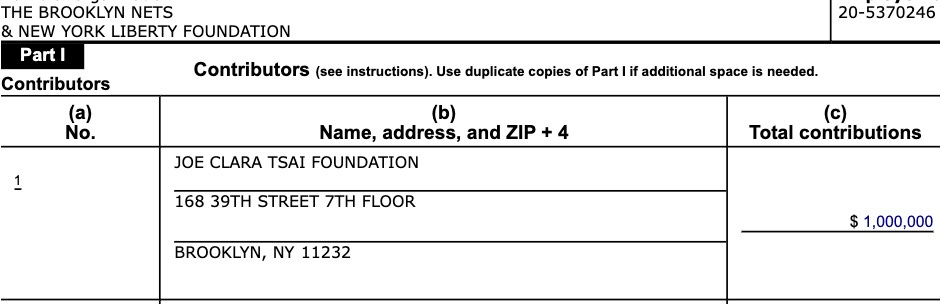
(By my calculation, as I’ll explain separately, the Brooklyn Nets and New York Liberty Foundation contributed $902,460 of the stated “more than $2 million raised,” while Barclays contributed $1 million.)
Three years later, the “Joe [&] Clara Tsai Foundation” again gave $1 million the Brooklyn Nets & New York Liberty Foundation, according to the latter’s FY 2024 Form 990.
In that year, the Nets/Liberty Foundation gave $200,000 for the National Museum of African American History, and $100,000 for Hudson Link for Higher Education in Prison, both of which comport with Clara Wu Tsai’s priorities and might be considered “social justice.” Not being local, however, the spending can’t be attributed to the Social Justice Fund.
The role of the Joe and Clara Tsai Foundation is confusing. While the Tsais’ family office and the Social Justice Fund have offices at that location and presumably operate in association with the platform they call the “Joe and Clara Tsai Foundation,” the La Jolla-based Joe and Clara Tsai Foundation reported no expenditures for those periods, nor at any other time.
Unmentioned: REFORM Alliance job fair
On March 20, 2023, REFORM Alliance hosted the “first Brooklyn Job Fair in partnership with BSE Global at Barclays Center,” according to an arena announcement. It was aimed at “returning citizens, currently unemployed, single parents, veterans, and members of poverty alleviation and workforce development programs.”
More than 2,200 job-seekers and 42 employers attended, according to the Brooklyn Reader.
A Business Insider interview with Wu Tsai, who helped found the criminal justice reform group, noted that the event was “in partnership with the Joe and Clara Tsai Foundation’s Social Justice Fund.”
Does that mean, for example, that the provision of the arena was charged to the SJF?
(Madison Square Garden two years earlier similarly hosted a job fair sponsored by Roc Nation and REFORM Alliance, with a supportive quote from Richard Constable, Executive Vice President, Global Head of Government Affairs and Social Impact, MSG Entertainment. With MSG, “social impact” is apparently a portfolio within the company, not a separate not-quite nonprofit.)
Unmentioned: See NYC
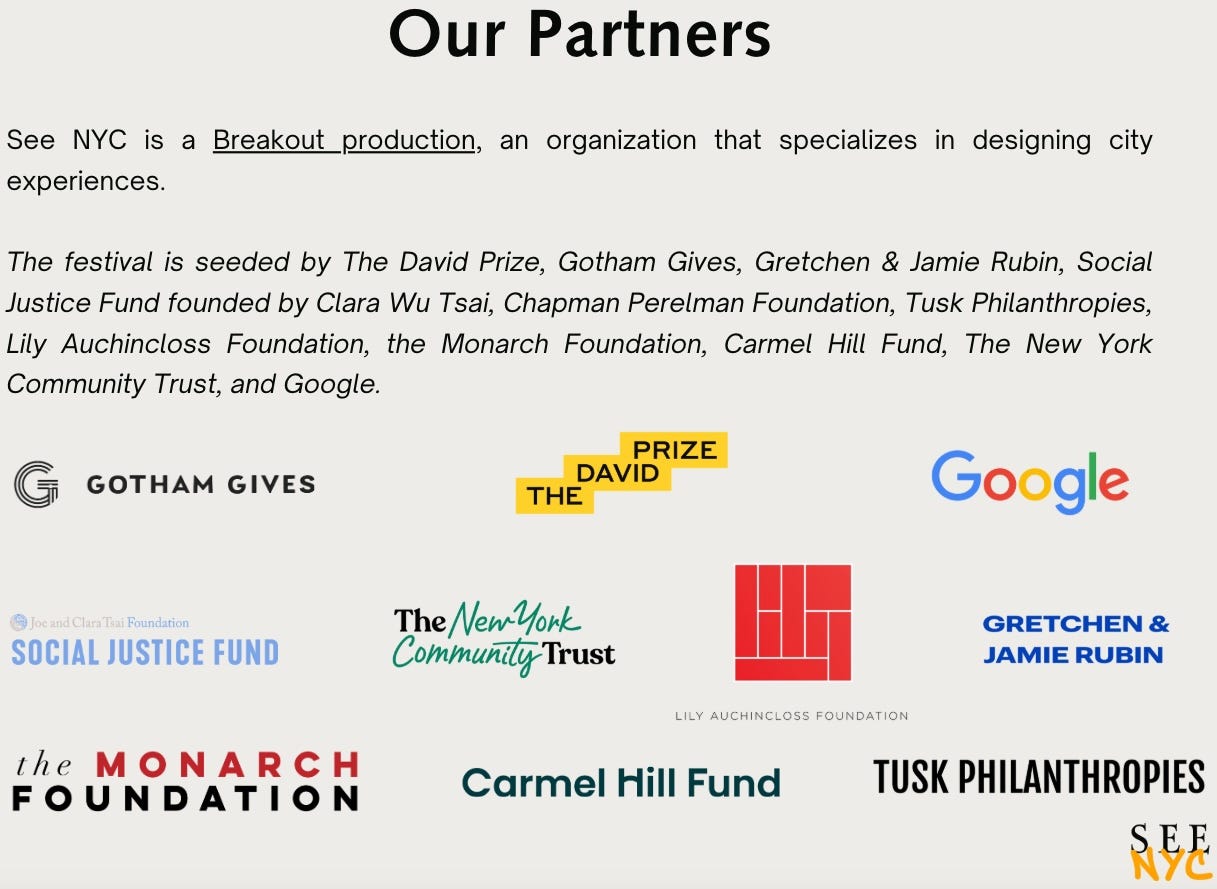
Unmentioned on the SJF website, or in the Impact Summary, is the SJF-supported See NYC, which last October brought together “150 people shaping the city’s future for a summer camp-style experience focused on connection, creativity, and collective action.”
As shown in the screenshot below, one of five groups on Day 1 could tour the Brooklyn Basketball Training Center “to demo cutting-edge technologies and learn about their goals for the community and the sport.”
That sounds like an advertisement for the new training center.
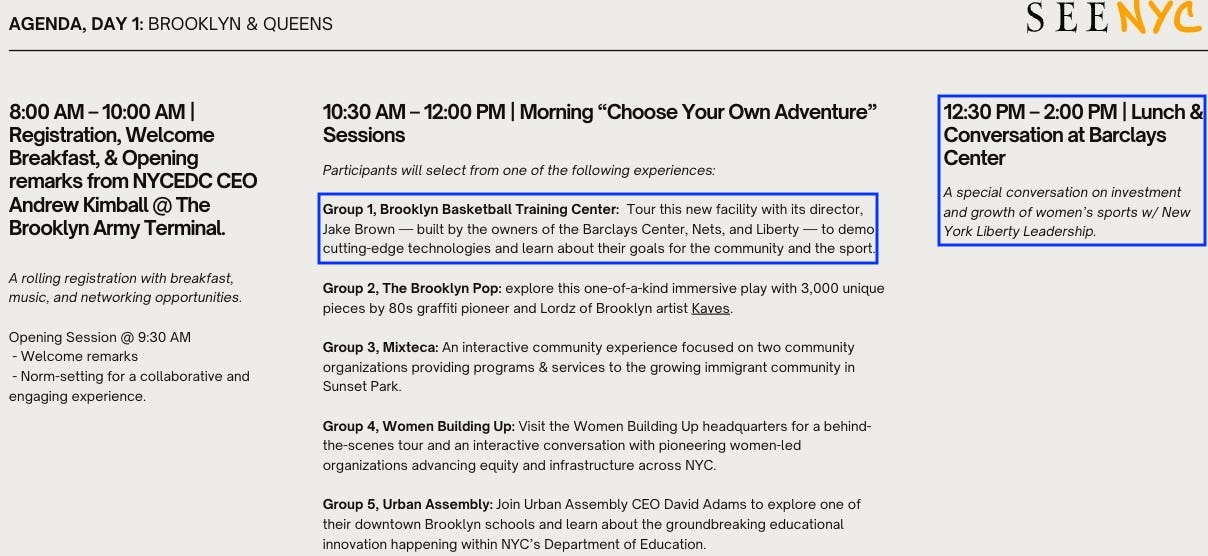
Then all the groups could gather for lunch and conversation at Barclays Center with the New York Liberty leadership regarding the investment and growth of women’s sports.
The hyperlink includes all articles tagged with the Social Justice Fund, including an initial one Feb. 4, 2026, headlined Has the Tsais’ Social Justice Fund Really Invested $25M “In Brooklyn” Since 2020? The series only includes those with the logo “Eye on Joe and Clara Tsai Foundation Social Justice Fund.”
The New York City Parks Department stated, in an Oct. 6, 2023, press release, “The three sites were selected in consultation with NYC Parks as part of the Social Justice Fund’s racial justice initiative. By targeting these investments in neighborhoods with acute levels of gun violence, as well as in the Social Justice Fund’s corporate backyard of Sunset Park, NYC Parks and the Social Justice Fund aim to provide a new resource for local gun violence prevention initiatives. Anti-gun violence programming will be provided at the courts by Foster Park Sports, expanding healthy and safe opportunities for local youth.”
Starting in 2008, the Barclays/Nets Community Alliance helped fund eight playground renovations, sometimes claiming the lion’s share of credit, though Barclays, the Nets, and developer Forest City Ratner were not contributing the largest share. The Alliance pledged to spend $1 million a year over five years to help youth through sports.
Also, the foundation connected to the arena, dba Barclays Center Cares, and the Brooklyn Nets Foundation funded and renovated courts at Nicholas Naquan Heyward Jr. Park in Gowanus.
Those weighing in were mainly from people with ties to the arena or affiliated entities.
They included Council Member Lincoln Restler, Brooklyn Nets host Ally Love, SJF public relations firm DKC News (and its principal Joe DePlasco), as well as the esteemed filmmaker Ken Burns, a longtime DKC client, and his collaborator Lynn Novick. DePlasco was the original “dark genius” behind the promotion of Atlantic Yards, working for the original developer, Forest City Ratner.
The text below is from the SJF website.
2022: The inaugural Belong Brooklyn Summer Concert Series Launched at the New York Liberty home game on July 28th:
AfroBeats / August 13
Angela Yee Day / August 27
2023: The 1st annual Belong Brooklyn Summer Concert series, promoting Black Maternal Health, in partnership with the Festival of NY:
The Lay Out / July 30
AfroBeats / August 13
Angela Yee Day / August 27
2024: The 2nd Annual Belong Brooklyn Concert Series, promoting Workforce Readiness:
Counterpoint: Brooklyn Raga Massive / July 21
AfroBeats VS Amapiano Takeover / August 4
Angela Yee Day / September 1
2025: The 3rd Annual Belong Brooklyn Concert Series, promoting Violence Interrupters:
Counterpoint: Steel Pan Féte / July 27
AfroBeats Takeover: Summer Soundclash / August 17
Angela Yee Day / August 23
So the Social Justice Fund promised to “match all donations, up to $25,000, to four organizations dedicated to improving health outcomes for pregnant people of color in Brooklyn.” They included:
On Oct. 30, 2024, Brooklyn Communities Collaborative Grants nearly $1M to Brooklyn-Based Organizations to Address Maternal Health, the organization announced, including $250,000 to the Brooklyn Perinatal Network and $125,000 to the Caribbean Women’s Health Association, among ten groups.
“A community-led, multi-disciplinary review committee — comprised of nonprofit leaders, maternal health care providers, doulas, OBGYNs, and local residents — reviewed applications and awarded grants to 10 organizations committed to advancing maternal health outcomes,” BCC said.
The Social Justice Fund pledged $25,000—no match required—to these Brooklyn-based organizations:
The 2025 Belong Brooklyn Initiative, as it’s now known, involved $25,000 grants to four organizations working on violence interruption:
Note: In December 2025, the Bro Experience Foundation honored the SJF’s Bishop, among others, at its fundraising gala.
The ceremony shown in the video below, at a New York Liberty game, didn’t generate much audience response.
She’s no longer described as a co-founder.
Free to Dream thanked its partners at the nonprofit American Student Assistance (now known as Britebound) for “making this event possible.”
New Heights’ 2021 Annual Report cites the Joe and Clara Tsai Foundation as a supporter, while the 2022 Annual Report cites the Joe and Clara Tsai Foundation Social Justice Fund.
In June 2018, well before the Social Justice Fund launched, a Brooklyn Nets contingent “visited East New York to be at Gersh Park Opening Night.” Last September, the Nets’ “annual Practice in the Park, presented by Ticketmaster,” included a game involving the Gersh Park league.
Leaders in nonprofit management and philanthropy were guest speakers, among them Jocelynne Rainey, President of the Brooklyn Community Foundation (now Brooklyn Org), a frequent collaborator.
Here are four videos promoting the participants.
The Brooklyn Museum issued a separate press release, headlined "The Brooklyn Museum and the Joe and Clara Tsai Foundation’s Social Justice Fund Launch the Brooklyn Arts Leadership Collaborative," which included a supportive quote from NYC Cultural Affairs Commissioner Laurie Cumbo.
These businesses include:
Buddies Coffee - Williamsburg cafe that develops and sells coffee blends and offers wholesale coffee [also part of a “Brooklyn Way” video produced by the Nets]
Elena Velez - Fashion designer and entrepreneur whose work is known for its non-traditional synthesis of metalwork and high fashion.
Fan Fan Doughnuts - Artisanal handmade donut bakery
Luar - A luxury fashion brand specializing in ready-to-wear, accessories, and lifestyle goods for all gender identities
Meat Hook - Animal butcher shop, sourcing regeneratively raised meat from the Hudson Valley
Mimi Cheng’s - Wholesale premium frozen dumplings showcasing family recipes and specialty flavors
Paloma Bakery - Specialty coffee roaster and bakery based in Greenpoint
Savant Studios - BedStuy-based design studio, clothing store, and creative hub
Spoonful - Offering eco-friendly grab-n-go overnight oats
Bishop was named to Hack’s board in September 2024. Hack co-founder Jeff Bussgang, who also teaches at Harvard Business School, was among three co-authors of Harvard’s first case study of the SJF.
The text below relies on the SJF website. The 2023 Just Brooklyn Prize recipients:
C. Zawadi Morris is the founder of the Original Media Group and BK Reader, a digital daily news site committed to sharing Brooklyn’s local news and offering media representation to all residents. It’s the state’s first Black woman-owned independent daily news site. [BK Reader has regularly posted content related to the Social Justice Fund, before and after the award, often by posting (unlabeled) press releases, but also with some original reporting.]
Chanel Porchia-Albert is the founder of Ancient Song Doula Services, a Brooklyn-based organization that provides comprehensive support to pregnant people, new parents, and families.
Debra Ack is a founding member of the East New York Community Land Trust, a community organization working to stop displacement in their neighborhood.
La’Shawn Allen-Muhammad is the Executive Director of the Central Brooklyn Economic Development Corporation, which works to build pathways to self-sufficiency in the local economy.
Samora Coles is the founder and director of The Alex House Project, an organization that supports young parents in Brooklyn.
The 2024 Just Brooklyn Prize recipients:
Carolyn A. Butts has devoted 32 years to creating an arts institution that addresses equity in the film and writing industries. She is a filmmaker, artist, and founder of the Reel Sisters film festival and African Voices Magazine.
Chino Hardin is the founder and co-ED of the Center for NuLeadership, which is deeply rooted in Bed Stuy and has worked for over 20 years to fight mass incarceration and criminalization.
Ninaj Raoul is the founder and director of Haitian Women for Haitian Refugees, which provides support to thousands of families who are seeking asylum in the U.S. after being persecuted in Haiti.
Christine Yvette Lewis is the founder of the Domestic Workers United. She is a worker-leader and multi-disciplined performance artist who pulls from her calypsonian roots and skill as a steel-drum player, spoken-word artist, author, and poet to get the message out and build power for domestic workers.
Derrick Hamilton is the Co-Founder of Family and Friends of the Wrongfully Convicted, which he founded behind prison walls when he was serving a life sentence for a crime he did not commit.
The 2025 Just Brooklyn Prize recipients:
Shneaqua Purvis is a Brooklyn native from Bedford-Stuyvesant who turned the tragic loss of her sister, Maisha “Pumpkin” Hubbard, into a lifelong mission to end gun violence. She is the founder of Both Sides of the Violence, an organization committed to working with both victims and perpetrators of gun violence in Bed-Stuy.
Olaronke Akinmowo is a library worker, community activist, interdisciplinary artist, and the creator and director of the Free Black Women’s Library, a social art project and love letter to Black women writers, libraries, and the people of Brooklyn.
Crystal Clarity is a third-generation Puerto Rican artist and activist from Brooklyn, NYC, dedicated to using art as cultural sustenance for BIPOC communities and as a tool for social justice. She is the founder of Medicine Walls, an organization and studio space that hosts community art builds and workshops for artists and activists.
Cathie Wright-Lewis is a Brooklyn speculative fiction author, long-time educator, and activist from Brownsville. In 2016, she founded The Power in the Pen, an organization that fosters literacy, empowerment, and community transformation in Brownsville.
Derrick Nkosi Cain is a dedicated leader, advocate, and mentor with over 15 years of experience in organizational leadership, team building, and restorative justice. He co-founded and served as the Executive Director of Touchdown NYC, a digital platform designed to provide mentorship and support to formerly incarcerated individuals.
The 2020 Black Voices for Black Justice awardees were (to excerpt the announcement):
Dr. Uché Blackstock (@uche_blackstock) is an ER doctor who worked out of a Brooklyn urgent care center at the height of COVID, and the founder and CEO of Advancing Health Equity, which partners with healthcare organizations to combat bias and structural racism in the healthcare system.
Dr. Ayana Elizabeth Johnson (@ayanaeliza) is a Brooklyn native, the founder of Urban Ocean Lab, a think tank dedicated to advancing equitable climate policies in coastal cities, policy expert, and author of the Blue New Deal..
Natasha S. Alford (@NatashaSAlford) is a journalist and storyteller committed to amplifying untold stories impacting Black America and is the Senior Correspondent and VP of Digital Content for TheGrio.
Rafiq Kalam Id-Din II (@Rafiq610) is the founder of Ember Charter Schools, a Black-led charter school in Bed-Stuy focused on African and African-American culture and dedicated to anti-racism and justice for Black students.
Michael “Zaki” Smith (@Zakithebarber) is an activist and policy expert who works to dismantle the barriers in employment, education, and housing that prevent formerly incarcerated Americans like himself from fully reintegrating into society.
Here is one earlier link and another, via the Internet Archive.
The 2022 Black Voices for Black Justice awardees were (to excerpt the website):
Afua Atta-Mensah, Executive Director of Community Voices Heard, a multi-racial nonprofit led by women of color and low-income families in New York City who are building power to secure racial, social and economic justice for all New Yorkers.
Bernell Grier, Executive Director of IMPACCT Brooklyn, a non-profit fighting against tenant displacement and advocating for affordable housing.
Chantal Hinds, an advocate for students in the foster care system, working to ensure they have the educational support they need to succeed.
Kei Williams (they/them), a queer transmasculine organizer, artist, and historian, is a founding member of the Black Lives Matter Global Network and Movement Netlab — a decentralized training network.
Leslie-Bernard Joseph (educator, attorney and social impact leader) is the CEO of Coney Island Prep, a K-12 charter school that serves over 1,100 scholars across four campuses.