
How Has the EXCELerate Loan Program for BIPOC Brooklyn Businesses Worked?
The Social Justice Fund offered $2.5M in loans, lifting 98 businesses. Its Impact Summary, however, omits key details. Why downplay EXCELerate 2.0?

This is part of a series on the Joe and Clara Tsai Foundation’s Social Justice Fund, established in 2020 by the billionaire couple who own most of Brooklyn Sports & Entertainment, which includes the Brooklyn Nets, New York Liberty, and the Barclays Center operating company.1
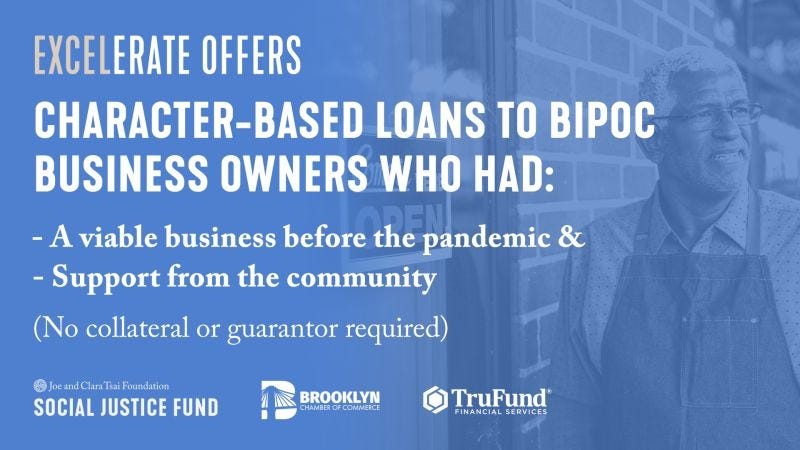
The Social Justice Fund’s first big splash came in June 2021, when it announced EXCELerate, an ambitious new emergency loan program—without requiring collateral or a guarantor—aimed to help Brooklyn’s BIPOC small business owners, who historically have had trouble accessing capital, recover from the pandemic.

It also announced an Executive Director: Gregg Bishop, a former New York City Commissioner of Small Business Services (and a Black man raised in East Flatbush), with a history of commitment to equitable workforce development.
“We know that there is no social justice without economic opportunity,” said Clara Wu Tsai in the press release, which described her as Co-Founder of the Joe and Clara Tsai Foundation. (Now they call her “Founder,” steering attention away from her husband.)
An impactful initiative
The loan options ranged from micro ‘Rapid Recovery’ loans with no interest up to $15,000, to ‘Restart’ loans with 2% interest up to $100,000, aimed at businesses that had closed or reduced operating hours and faced barriers.
Operating from 2021 to 2024, at least in its initial iteration, the EXCELerate Loan Fund was the SJF’s widest-ranging and, perhaps, most impactful initiative, albeit not a sustainable one.
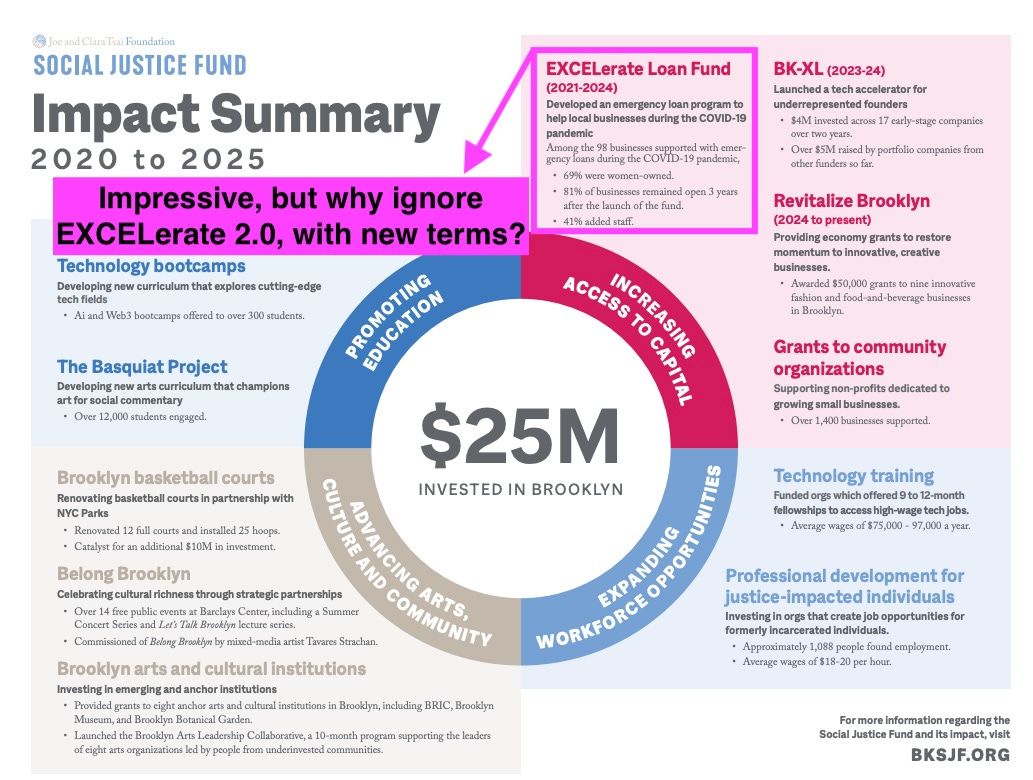
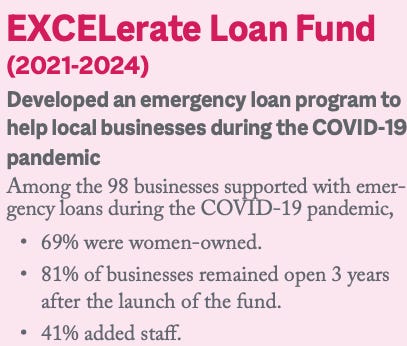
According to the Impact Summary, among the 98 businesses supported with emergency loans:
69% were women-owned
81% of businesses [79] remained open 3 years after the launch of the fund
41% added staff [though I couldn’t find out how that translated into FTEs, or full-time equivalent jobs]
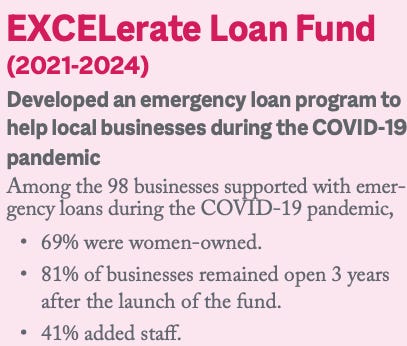
From Impact Summary
As shown in the SJF-produced video below, Kidada Fields, founder of Fields of Qi Acupuncture in Fort Greene, explained how the loan helped her hire a virtual receptionist and a practitioner.
“The application process helped me to really pick apart what I needed help with,” she said, also citing SEO optimization to improve her website.
Some complications
The Impact Summary doesn’t explain, as the top image conveys, that EXCELerate was aimed at BIPOC businesses and was “character-based,” seeking evidence—not acceptable in more traditional lending—that a borrower was a worthy bet.
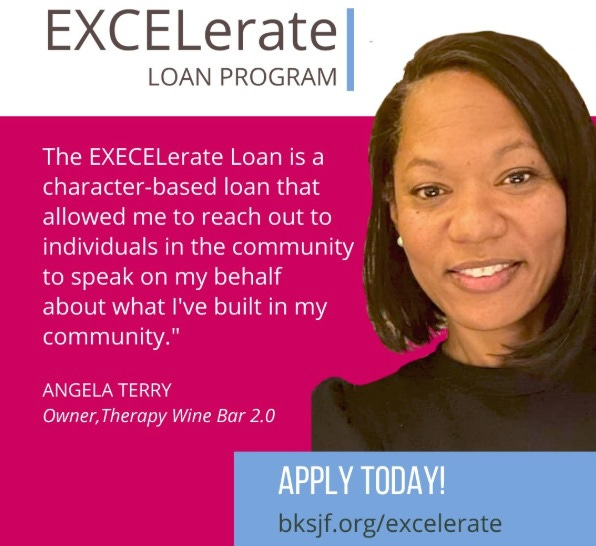
There’s more to it. As the SJF said on Instagram, the funds would “only be available to applicants with credit scores under 620.” (The SJF told me 50% had credit scores below 670; 6% had no credit history.)
The program offered not just a loan but also marketing expertise, business plan help, and mentoring sessions. So a suite of services might make such a program successful, albeit at an additional cost.
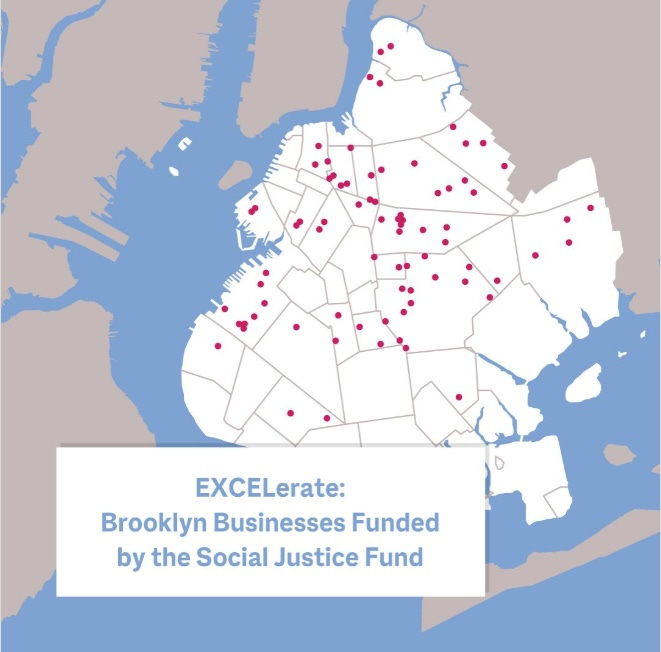
The image below shows loans granted across several parts of Brooklyn, with an emphasis on Central Brooklyn neighborhoods with large Black populations, such as Bedford-Stuyvesant, Crown Heights, and Flatbush/East Flatbush.
Also, a decent fraction were in Fort Greene/Clinton Hill/Downtown Brooklyn, plus a few in East New York and Bushwick, and a cluster in Sunset Park, with Chinese and Latino communities.
While the summary says 81% of businesses remained open, it didn’t say that 18% of the loans went into default—acceptable in an emergency philanthropic effort, not a commercial enterprise, but surely worthy of discussion.
(Consider, though, that the vastly larger federal Paycheck Protection Program involved 10.5 million loans nationally, with $755 billion in public funds forgiven, as of October 2022.)
I got a statement from the SJF:
Philanthropy is society’s ‘risk capital.’ EXCELerate was an intentionally risky program that could act fast and respond to the moment. It encouraged below-market interest rates and took higher-than-usual underwriting risks but did so to meet the urgency of the moment. Private lenders likely would not have been able to take the same sort of risks. Government programs such as the Paycheck Protection Program and New York Forward intended to reach the same audience, but EXCELerate was more accessible to Brooklyn’s ‘mom-and-pop’ business owners with its shorter application and decision-making cycle.
Indeed, in an April 11, 2023, Brooklyn Reader article, Coping Through Crisis: A Look at the State of Brooklyn’s Black-Owned Restaurants, Pt. 2, Joseph Adewumi of the Downtown Brooklyn restaurant Amarichi praised the SJF loan program as more responsive than other pandemic-era programs that required more barriers or paperwork.
A big question
Curiously, the SJF website and Impact Summary cite only the original EXCELerate program, not the successor EXCELerate 2.0, which offers slightly higher but still generous interest rates to keep the initial funding in perpetual circulation.
That raises questions about the Tsais’ plan to “fund pilots and programs that are scalable.”
Such character-based lending, however new to Brooklyn, is not unique nationally, as noted below.
So, rather than simply celebrate a seeming success, as the SJF’s Bishop does in periodic public appearances, a better understanding of the program still awaits. If the SJF only promotes the original program, that suggests that public relations credit is a priority.
Origin story
Wu Tsai and Bishop did some homework, meeting with various stakeholders—including the Brooklyn Chamber of Commerce and the Brooklyn Community Foundation, now known as Brooklyn Org—and learning that BIPOC-led businesses needed support.
“Because of redlining, because of a number of other things that have really robbed the Black community from generational wealth,” Bishop told Inside Philanthropy on July 12, 2021, “whenever a Black entrepreneur starts a business, it’s usually bootstrapping… it’s usually, ‘I’m going to max out my credit card.’”
“We learned the biggest problem was access to capital, and we seized on it,” Wu Tsai told Forbes. “We didn’t want to waste time designing a complex program, but to start something that could make an impact quickly.”
The SJF didn’t distribute the money. It—well, some entity associated with the Tsais—provided $2.5 million to be managed by TruFund Financial, a Community Development Financial Institution (CDFI), and Brooklyn Alliance Capital, the Brooklyn Chamber’s CDFI.
(A CDFI specializes in lending to under-resourced communities, offering not just low-interest rate loans but also business support. I asked what entity actually supplied the funding, but didn’t get an answer. The Joe and Clara Tsai Foundation does not list any grants. It appears to be a shell for the Tsais’ philanthropic efforts.)
The initial press release included kudos from Darren Walker, President of the Ford Foundation, and Jennifer Jones Austin, CEO of the Federation of Protestant Welfare Agencies, who said the program “is modeling what good citizenship looks like.”2

EXCELerate apparently ramped up fast. As of Feb. 16, 2022, according to a Social Justice Fund Instagram post, it had “approved $1.6 million in loan funds for Brooklyn BIPOC businesses in the past six months.”
Big buzz
The program launched with strategic promotion, such as a June 24, 2021, CNBC article: Brooklyn Nets owners will use character, not credit scores, for a $2.5 million loan program that helps Black businesses.
A Sportico article that day, Nets Owners Begin $50 Million Social Justice Pledge With Business Loans, noted, “With its $2.5 million commitment, the SJF hopes to aid between 110 and 120 businesses in Brooklyn.” (The number was 98.)
“We really want to address as many systemic issues as possible,” Wu Tsai told Sportico. “With an eye to that and also hearing that Black businesses closed at twice the rate as white businesses during the pandemic, I saw a real opportunity.”
Clara Wu Tsai’s EXCELerate is a ‘win-win-win-win’ for Brooklyn and Black business, a New York Daily News sports reporter declared June 24, 2021, in an article that bannered across two pages.

“What we’re trying to encourage is keeping that $2.5 million investment circulating within the black community in Brooklyn,” Bishop told Sportico.
Exactly who?
There could be tension between the designations BIPOC and Black, given that the former encompasses a much broader set of businesses, some led by people with a different history of access to capital.
In an Oct. 21, 2021, podcast interview, Bishop, revising his words on the fly, called it “a fund that’s focused on helping Black-owned—BIPOC-owned businesses—through the pandemic.”
As of an Oct. 17, 2022, Instagram post, the SJF said 73% of loans had gone to Black-owned businesses, a similar percentage to that in the Twitter/X screenshot below.
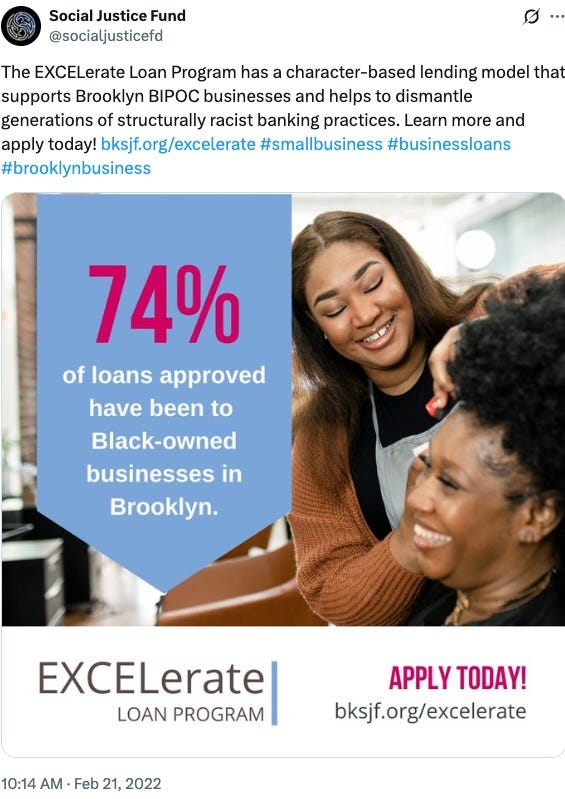
Though the SJF website still touts loans to “Brooklyn’s BIPOC business owners,” the Impact Summary ignores race, part of a notable shift—likely in response to national trends—in which the Social Justice Fund has downplayed race-based remedies while using terms like “under-resourced” or “underinvested” as a rough proxy.
In response to my query, the SJF said that all the borrowers were Black, Indigenous, or People of Color (BIPOC)-owned, 69% were women-owned, and 57% were Black women-owned. (It’s still unclear how many were Black-owned.)
“Data shows that obtaining capital is the biggest challenge for growing businesses in underinvested neighborhoods, and so that is where we have put our efforts,” stated the spokesman, from the public relations firm DKC.
In response to my queries, I was told:
66 businesses received no-interest loans of $15,000 or under from Brooklyn Alliance Capital.
32 businesses received 2% interest loans between $15,001 and $100,000 from TruFund Financial Services.
If loans in the first category averaged $15,000, that totals $990,000, leaving $1,510,000 for 32 businesses, or about $47,187 each. If the first category average was $12,000, that totals $792,000, leaving $1,708,000 for 32 businesses, or $53,375 each.
How did it go?
“We do measurement and evaluation,” Bishop said in a July 19, 2023, Brooklyn Savvy podcast interview. “Over the next three years, we’ll see how this program goes... [The goal] is to actually present the findings to the financial markets.”
He cited some other nonprofits making similar loans, but only up to $10,000, “because it’s risky.” (Others offer larger loans, including the Seattle-based Community Credit Lab, which offers quarterly investment reports and annual financial statements.)
“As a foundation, we are not actually looking for return for those dollars,” Bishop said, suggesting the funds would circulate within the community, and that peer pressure would drive “the repayment rates that we’re seeing.”

“We have an individual… evaluating everything that we’re doing,” Bishop said in that 2023 interview, “and we’re going to release a one-year report.”
They didn’t, but Harvard Business School Professor Archie Jones led two case studies regarding “Clara Wu Tsai and Brooklyn Loan Innovation,” one from March 2022 (revised January 2023) and the other from November 2024. (Wu Tsai got her MBA at Harvard.)
I was unable to get a copy, but the abstract suggests an admiring perspective:
Philanthropist Clara Wu Tsai is committed to racial equity and investing in Brooklyn-based minority business owners. In the wake of the George Floyd murder, she decides to create a new initiative called the Social Justice Fund and commit an initial $50 million over 10 years to benefit the BIPOC (especially Black) community. Now she must determine how to deploy that capital and who to partner with in order to maximize impact.
Big picture
Describing EXCELerate at the Smart City Expo 2025, Bishop said that, prior to the SJF’s involvement, the maximum loan available from the Brooklyn Chamber’s CDFI was about $20,000. Now they are “able to do loans at a much larger scale. So strengthening a CDFI that’s focused on Brooklyn is one of the byproducts of that program as well.”
Indeed, loans are now available up to $50,000—but, as described below, the program is barely promoted.
At a June 3, 2025 symposium (below), Bishop described how “patient capital” and philanthropy could do something banks couldn’t do. “Four years later, we did our evaluation and four out of the five businesses that received a loan from us are still in business today,” he said, and “40% of those businesses actually hired people.”
The “not so good news,” he acknowledged, was that their default rate was about 18%. That, he said, would deter bankers, but was why “philanthropy needs to step in.” (The SJF didn’t answer my question about the default rate.)
The 98 recipients had a typical three-year loan term, according to Bishop, though on a podcast, he said, “In certain cases, we can go a little bit more.”
Interviewed Aug. 29, 2024, by host Angela Yee, Bishop said, “We’re going to be putting out a report later on this year” regarding “how to build programs like that.” That didn’t happen.
How sustainable?
Oddly, while the Social Justice Fund still promotes the original, COVID-era program on its website, the Brooklyn Chamber of Commerce separately, and with little promotional push, offers EXCELerate Loan Fund 2.0, which references “growth capital,” rather than pandemic recovery. It offers below-market but slightly more demanding interest rates:
Loans of up to $50,000 are available to established businesses seeking growth capital, with interest rates ranging from 2% to 5%. The Brooklyn EXCELerate Loan Fund, supported by the Social Justice Fund of the Joe & Clara Tsai Foundation, targets BIPOC-owned businesses in Brooklyn, providing loans to support equitable economic growth in the community.

Is this still character-based? Is it limited to BIPOC-owned businesses, or just targeted to them? How long are the loan terms? Why doesn’t the SJF promote EXCELerate 2.0?
I couldn’t get answers from either the Social Justice Fund or the Brooklyn Chamber. The program launched sometime between December 2024 and March 2025, according to the Internet Archive.
I did get an explanation for one change. “One lesson from this first round,” the SJF spokesman told me, “was that such deeply discounted interest rates could not cover administrative costs and make up for potential losses. To maintain the sustainability of the program in the future, EXCELerate 2.0 offers slightly higher rates -- but still below-market -- to offset administrative costs and any potential losses.”
That’s reasonable. Other questions remain.
A new program
“Regarding the future of BK-XL, based on our analysis of the business landscape in Brooklyn – especially businesses in underserved communities – we have determined that loans and grants have the most impact,” the spokesman told me. “We have thus focused our resources towards strengthening local CDFIs to lend more flexible capital to small businesses and invest more in grants to medium-sized businesses to be a catalyst for growth.”
Indeed, on March 10, the Social Justice Fund announced a partnership with The Asian American Foundation, Renaissance Economic Development Corporation (Renaissance), and the State of New York for the NYC Elevating Business Loan Program, a $5.5 million citywide initiative—with $1 million from the SJF—in small business loans, coupled with free financial counseling and multilingual training services.
This seems a departure from the “for Brooklyn” mantra and the focus on Black Brooklyn.

It offers an 8% interest rate, well above either EXCELerate example but still below market rates.
It’s significantly less than the 13.5% rate at the Brooklyn Cooperative Federal Credit Union, which Next City profiled in December 2023 as The Tiny Credit Union Powering Brooklyn’s Economy.3
That said, the government can play a far larger role. The $80 million NYC Future Fund, recently expanded by Mayor Zohran Mamdani, now offers loans from $25,000 to $500,000 at a 7.5% annual interest rate, with flexible principal repayment terms based on business revenue, enabling small businesses to focus on growth. It requires a credit check and a personal guaranty.
Loans circulating?
The money for EXCELerate 2.0 comes from repayments by recipients of the original loans. An FAQ (archived) for the original program from the Brooklyn Chamber includes Why is this a loan and not a grant? The answer:
The Social Justice Fund believes in supporting the community. The Brooklyn EXCELerate loan is a $2.5M investment in the Brooklyn BIPOC business community. Similar to a sou-sou [an informal savings club used by Caribbean and African women], the fund wants the $2.5M invested to stay circulating within the BIPOC community. As businesses repay the loans, that money is then lent out to other businesses who also needs help. This keeps the investment circulating within the community.
That FAQ is no longer live, but it raises questions about how much has been recirculated.
BAC and TruFund issued the 98 loans between June 2021 and July 2024, with many still within their three-year repayment period, the SJF spokesman told me. As of July 2025, over $1.4 million (56% of the initial $2.5 million loan fund) had been repaid. That includes 32 loans paid off in full, and partial repayments for other loans, but we don’t know how much has been recirculated.
Brooklyn Alliance Capital and TruFund received their funds as grants, “with the understanding that all repaid funds would go back to BAC and TruFund to be recycled for future lending until the funds are exhausted,” the spokesman told me.
So, how long will this last, and how many will be served?
The program likely has some staying power, but the SJF’s lack of transparency—especially compared to some other loan programs—makes it difficult to assess.
Synergy with the Liberty
To highlight the New York Liberty’s 2023 schedule, mascot Ellie the Elephant visited four (Black woman-owned) businesses that had received EXCELerate grants, as shown in the video below.
“The SJF helped as the funds took care of her debts,” NetsDaily’s Brian Fleurantin wrote about one recipient, Donna Prescott of Donna Prescott Beauty, “which allowed her to maintain operations during the pandemic, and maintain a sense of normalcy.”
The article profiled the four businesses, reporting, for example, that EXCELerate funding helped Jones Family Touch Day Care expand to offer evening child care for healthcare workers.
“Thanks for sharing this story,” one reader commented. “The Tsais are going above and beyond in their work for equity and social justice.”
My take: the money surely makes a difference, but equity might require a far greater commitment, like the arena company paying taxes, which could help support larger enterprises like the city’s loan program.
Some EXCELerate recipients
A full list of loan recipients has not been released, but some, such as those listed below, have been announced publicly.
Fields of QI Acupuncture, Fort Greene, as featured by the Social Justice Fund
Therapy Wine Bar 2.0, Bedford-Stuyvesant, as featured by the Liberty and NetsDaily (and on the Social Justice Fund’s Instagram)
Donna Prescott Beauty, Crown Heights, as featured by the Liberty and NetsDaily
Under Her Empire, a creative agency, as featured by the Social Justice Fund (and on the SJF’s Instagram)
Natrabella Skincare, Flatbush, as featured on the SJ’s Instagram
The Amulet Fairy, as featured by the Liberty and NetsDaily
Ebaata Skincare, Flatbush, as featured on the SJF's Instagram
Jones Family Touch Day Care, as featured by the Liberty and NetsDaily
Amarichi Restaurant, Downtown Brooklyn, as featured on the SJF’s Instagram (but which later closed)
Jade Chi, a clothing line, as featured on the Social Justice Fund’s Instagram
I checked, and found that only a few had received PPP (Paycheck Protection Program) federal loans (which were forgiven): Under Her Empire ($19,608); Donna Prescott ($467 and $5,553); and Ebaata Skincare ($1,327 and $6,851).
So EXCELerate clearly filled a need.
The hyperlink includes all articles tagged with the Social Justice Fund, including an initial one Feb. 4, 2026, headlined Has the Tsais’ Social Justice Fund Really Invested $25M “In Brooklyn” Since 2020? The series only includes those with the logo “Eye on Joe and Clara Tsai Foundation Social Justice Fund.”
Good citizenship might also include paying taxes on a tax-exempt arena site, which enables tax-exempt financing. Or ensuring 2,000 low-cost tickets to Brooklyn Nets games, as originally promised.
As Oscar Perry Abello wrote, the credit union underwrites loans even when borrowers lack collateral, have credit scores below 650, and even lack Social Security numbers. In 2024, its average business loan was $29,000. It’s the most prolific lender in Brooklyn approved by the federal Small Business Administration to provide government-backed loans.
In 2007, the credit union launched Grow Brooklyn, which offers free tax preparation, housing counseling, financial coaching, and direct legal services.