
December Digest: Workshop on the Public Realm, Discussion About Megaprojects
The project is complicated; a look at some other press coverage reinforces that.

Before my 2025 roundup article—coming by year-end!—let me catch up on the last few weeks of coverage, by me and by others, about the emerging plan for Atlantic Yards, as well as bigger questions about megaprojects.
Dec. 10: Workshop on Public Realm, Retail, and Community Facilities Crowdsources Input, but Some Big Gaps.
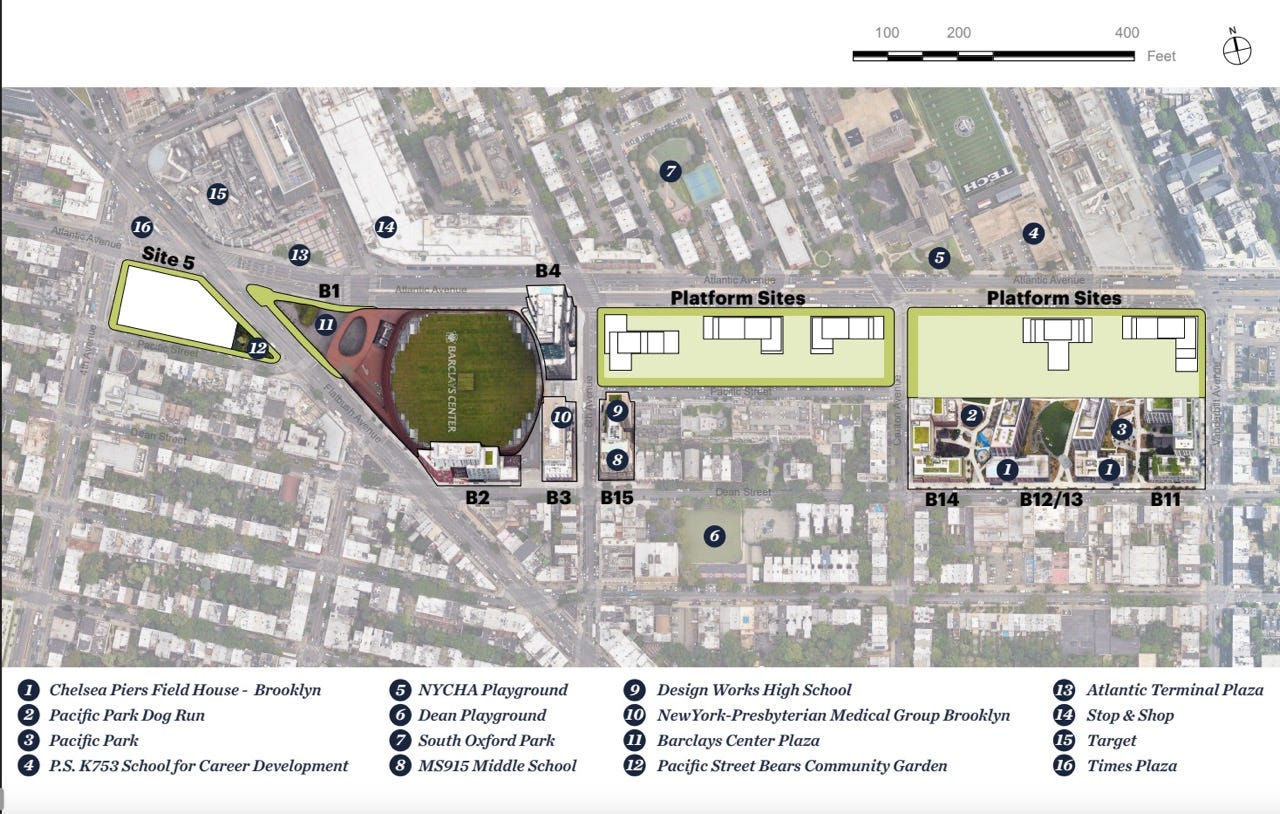
Would “signature open space” be “transformative,” given boost in apartments? How long would it take? What about loading docks, parking issues, Site 5 retail (& LED lighting), and value of arena plaza?
Dec. 23: Former Assemblyman Roger Green calls for new homeownership agenda to stem loss of Black population. (What about Atlantic Yards affordable condos? Maybe that will re-enter the discourse.)
How to fix megaprojects
Dec. 15: Previewing Panel on “How to Fix Public-Private Development.” One of the panelists wrote an essay titled “No More Atlantic Yards!” Well, some things might be done now, but it takes political will.
Dec. 18: Can Public-Private Development Projects Be Fixed? Well, maybe, according to the panel.
But it requires better monitoring, new procedures (approve in phases?), and better execution. Plus, legislators and the public must step up. The press, too.
Around the arena
Dec. 20: As New York Liberty named world’s most valuable women’s team, a new partnership with Alipay+, owned by Tsai-led Alibaba. Plus a sponsorship deal for Sabrina Ionescu deal—maybe a salary supplement?
Dec. 21: What I Noticed at the Barclays Center. Yes, I go periodically.
“The Fighting Spirit of Brooklyn” (via Modelo), a Coney Island boardwalk homage (!), and the obscured Meditation Room. Plus unsurprisingly pricey concessions.
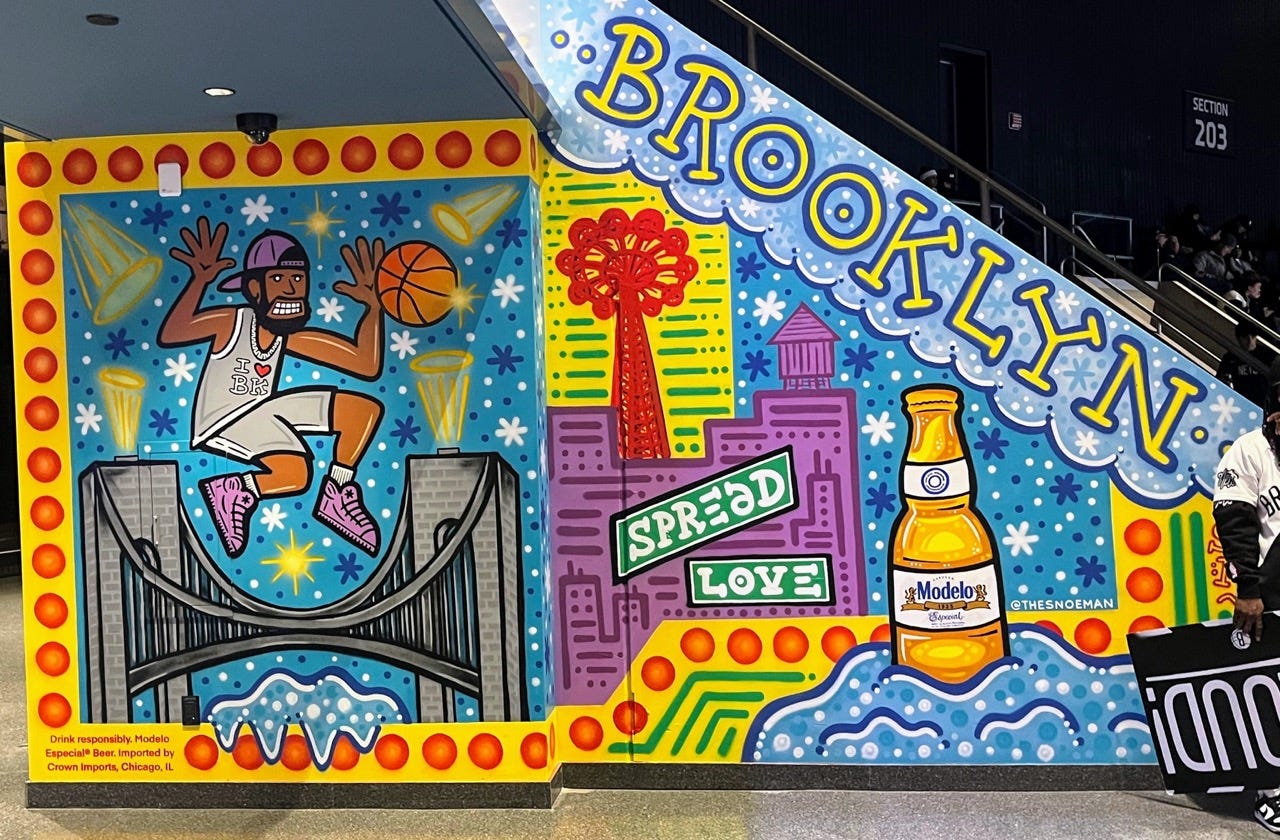
The loaded word here is “authenticity.”
Others’ coverage
I’m glad some others are covering Atlantic Yards, which has been ignored by the “major” daily newspapers.
I take no pleasure in pointing out—nitpicking?—flaws in others’ coverage. After all, reporters and editors all have other obligations and relatively recent histories with the project. And I have my own lapses.
For the record, though, it’s worth noting a few mistaken facts, assumptions, and framing in some recent coverage:
The CITY, Long-Stalled Atlantic Yards Project Could Be Revived in New Plan
(Dec. 2)Gothamist, New Atlantic Yards housing plan takes shape, with taller towers, higher income levels (Dec. 8)
Hell Gate, Two Decades of Broken Promises at Atlantic Yards (Dec. 9)
News12, $4K per month rent for ‘affordable housing’ has residents pushing back on proposed Atlantic Yards revival (Dec. 11)
WNYC, A New Plan For Affordable Housing at Atlantic Yards (Dec. 12)
Smaller buildings, or larger?
What’s been proposed?
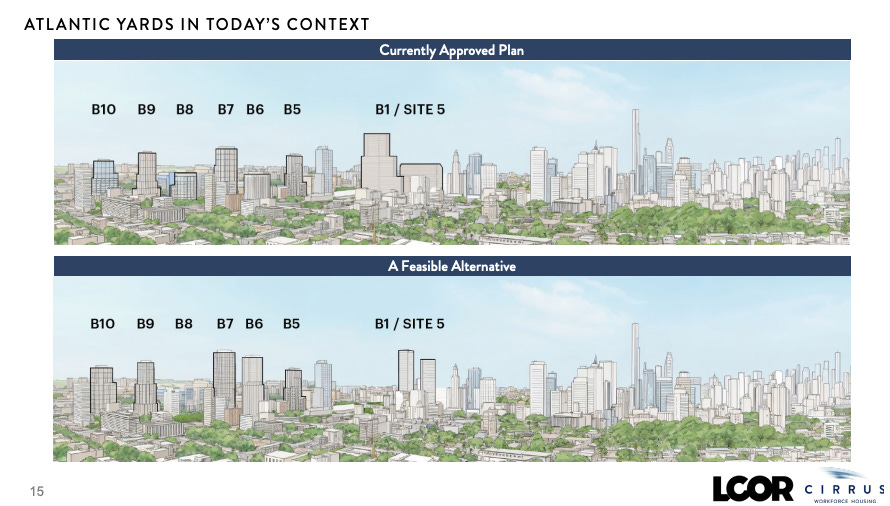
“But the proposed buildings in some areas over the railyard would be smaller, opening up more areas for open space,” The CITY reported.
News12 reported that the new developers want more buildings—though they’ve proposed eliminating one—“while using less space.”
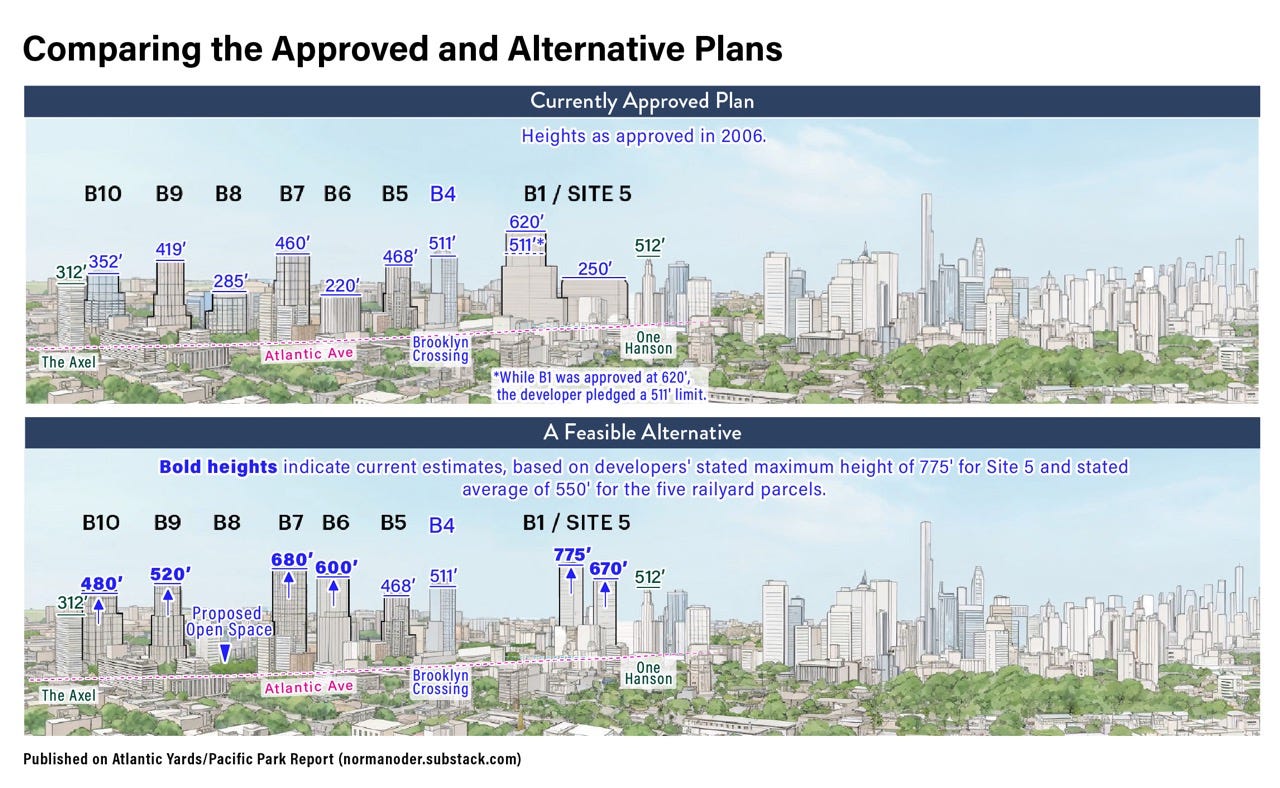
The phrases “smaller” and “less space” apply only to the buildings’ footprints. The towers would be taller and, ultimately, far bulkier, with 1.6 million square feet in additional bulk requested. So the buildings would be larger, not smaller.
What the meetings were about
While The CITY accurately cited “public meetings,” News12 on Dec. 11 called the Dec. 8 workshop the “first in a series of public hearings.” It was not a public hearing. And it was the second of two workshops.
Gothamist also described the ongoing events as public hearings—events where public input is formally welcomed—rather than workshops, in which that input was carefully managed.
Though Gothamist called that second workshop “a community feedback session on affordable housing,” that description applied to the earlier workshop last month. (Yes, affordable housing still came up.)
What’s affordable?
“The development team,” reported The CITY, “floated building affordable housing for households making up to 130% of the area median income [AMI] — or $189,540 for a family of three — while the original plan had affordability levels geared toward people making much less: as low as $58,320 for a family of three.” (The latter figure is 40% of AMI.)
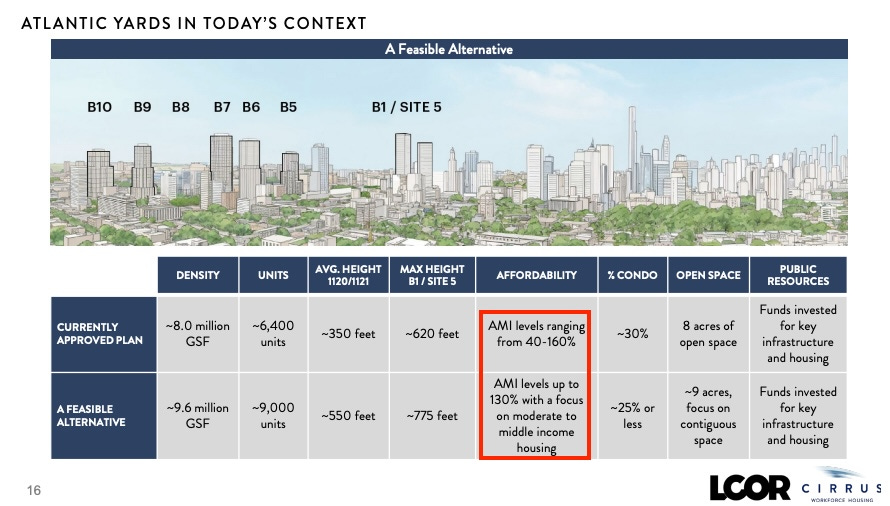
That’s misleading. Yes, the new developers presume a focus on moderate- to middle-income housing, which means fewer low-income units below 80% of AMI.
However, the original plan contemplated affordable housing for housing up to 160% of AMI, which today is an unrealistic figure. Given the steady rise in AMI, even a unit at 130% of AMI would cost far more than one at 160% of AMI eight or nine years ago.
Consider the potential rents for one-bedroom units, if delivered in 2025 (which is impossible), at various AMI levels, as shown in the graphic below.
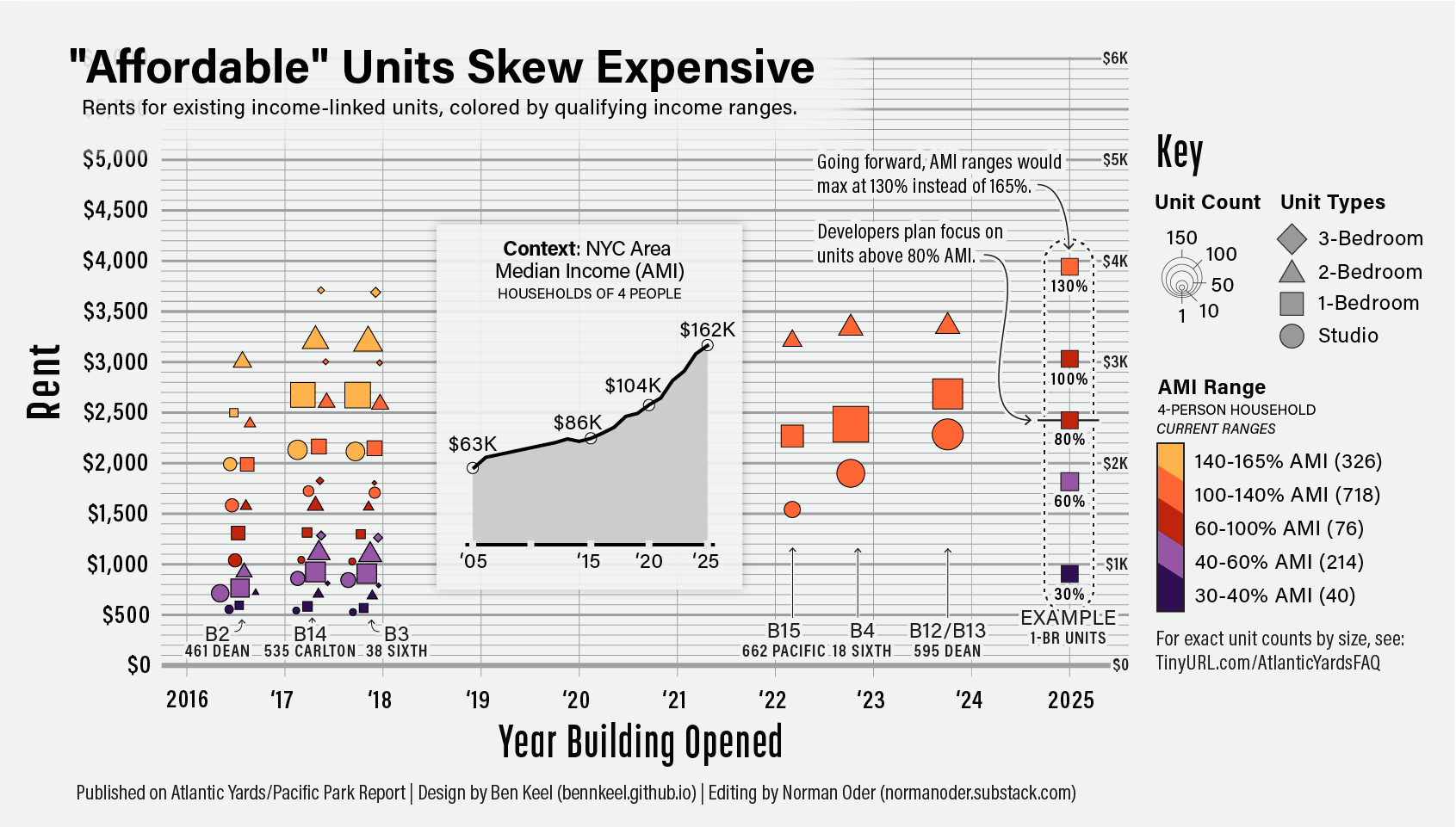
At 130% of AMI, the maximum monthly rent would be $3,948, well above the rents, at 130% of AMI, in the most recent buildings, and at 100% of AMI, it would be $3,037, again above those rents. At 80% of AMI, it would be$2,430; at 60%, $1,822; at 30%, $911.
Gothamist, paraphrasing the developer, said the affordable units [would be] reserved for higher-earners than the original plan, in order to make economic sense.” Well, higher-earners due to the rising AMI, but not in terms of percentage of AMI. In fact, the developers have even claimed credit for not seeking even higher AMIs.
That said, what makes “economic sense” deserves more transparency and scrutiny.
What next?
Perhaps the endgame, though, is the pursuit of more subsidy to make units more affordable.
Hell Gate quoted Cirrus’s Joseph McDonnell as not ready to confirm the AMI ranges.. “We’re soliciting community feedback on that,” he said. “We wanna build housing across the income spectrum and that’s real.”
As I commented on Gothamist, a key to the pending plan is not merely taller towers, but that extra 1.6 million square feet of bulk, which might be seen as free land worth about $320 million. We don’t know what other “public resources” the developers seek, such as funds for the platform, to make the project viable.
“You’re going to have to earn more to qualify for the fewer affordable units inside,” News12 reported. Well, yes, you’d have to earn more for the commensurate income “band,” given the rise in AMI. But there should be more, not fewer, overall affordable units since there would be more units overall.
About open space
The Hell Gate article, which was appropriately skeptical, closed with a telling anecdote that deserved more illumination:
Back at my table, Brooklyn resident Jason, a member of Local 79 who wore a t-shirt with a logo of a raised fist and the phrase “Laborers Rising,” had already grabbed the red stickers and started slapping them on the map. “This plan sucks,” he said. “Closing off Pacific Street, to do yoga? Makes no sense to me.” …
Someone pointed out that Pacific Street between Carlton and Vanderbilt Avenues was already closed off due to construction. “It’ll open up again. It should be a through-road,” Jason told the facilitator of our group. “Are you allowed to reroute the City streets?” The facilitator looked tired. “It would be hard, not impossible,” he replied, handing Jason a pink Post-It. “If you have an idea, write it down.”
That does get to the challenge of crowdsourcing suggestions.
The facilitator, perhaps because it would’ve been impolitic, did not say that the stretch of Pacific Street between Carlton and Vanderbilt avenues would not reopen as a street. It will first serve as a staging area for construction and then supply a crucial amount of the promised open space.
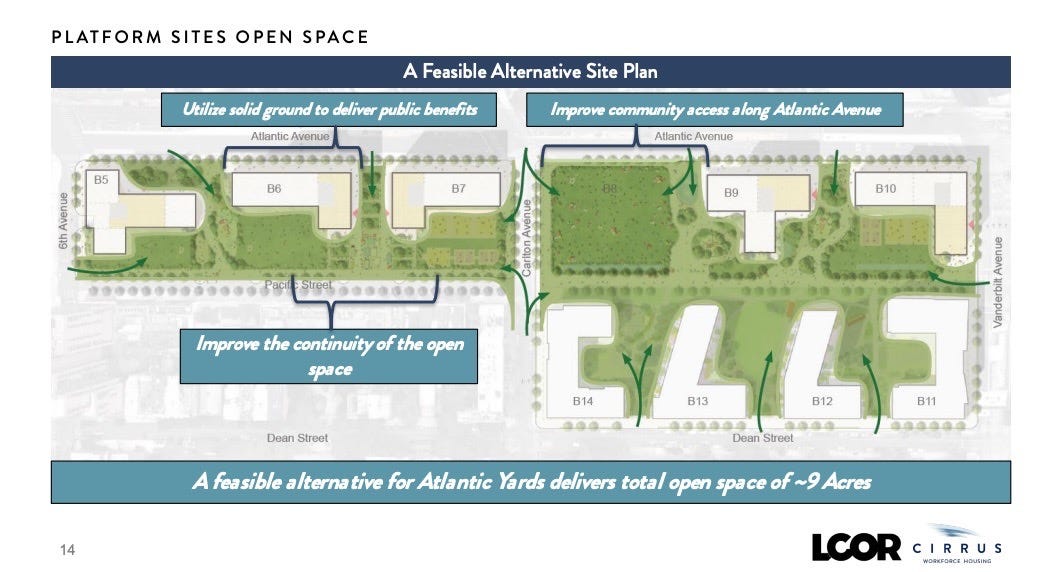
In other words, it would not merely be “hard” to reopen that street. It would be impossible. But candor is not key to the process.
The radio discussion
Perhaps because in-the-moment discussion is more fraught than writing, the WYNC discussion got more wrong.
The WNYC host described Atlantic Yards as “an example of the city’s failure to deliver on affordable housing,” when it’s really the responsibility of the state—and the developer.
Moreover, the backstory was wrong, claiming, “Back in 2003, developers promised nearly 900 units of affordable housing by May of 2025.” Not so. In 2006, they promised 2,250 total units in a projected ten years, but a state contract signed in 2009 offered no deadline.
In June 2014, after being threatened with a lawsuit on fair-housing grounds by the BrooklynSpeaks coalition, the state agreed to set a May 2025 deadline for all 2,250 units, of which only 181 were under construction at the time. Of that total, 876—OK, nearly 900—were not delivered.
Note: there wasn’t an actual lawsuit, as WNYC suggested, nor was a suit in 2016, as News12 recounted.
More housing “encouraging”?
Gothamist/WNYC reporter David Brand observed that “the landscape has shifted. There’s more of an acknowledgement that we need a lot of housing at all different income levels. So it’s encouraging that this project is going to have even more apartments.”
He was wise to cite the shifting landscape and the new push for supply. But saying it’s “encouraging that this project is going to have even more apartments” is a loaded statement.
How encouraging is it to pack 9,000 apartments in 22 acres—less if you count the parcel occupied by the arena—without sufficient open space, among other things?
Greenland’s finances
Both The CITY and Hell Gate mistakenly reported that Greenland USA had defaulted on nearly $350 million of loans, referencing coverage by The CITY, which relied on a Real Deal article, that ignored how some $63 million had already been paid back, leaving about $286 million in default.
Sure, it’s a relatively small issue, but a reminder that, even though a fact may have been published, it may not be accurate. (I’ve omitted that repayment in the past.)
Similarly, both Gothamist and WNYC said Greenland had gone bankrupt (a legal proceeding initiated by the debtor to protect assets), while instead it had faced foreclosure (initiated by a lender, to control the assets offered as collateral). due to its inability to repay those loans.
Getting weird
News12 described Gib Veconi of BrooklynSpeaks as “a Brooklyn Heights activist,” while he’s from Prospect Heights.
The News12 article attributed this quote, “The developer already got this whole project for a song. At least keep with what was negotiated,” to “Brooklyn Heights resident Frampton Tolbert.” In reality, as shown on screen, the quote came from Prospect Heights activist Raul Rothblatt.
It’s worth noting that “what was negotiated” in the original housing agreement and Community Benefits Agreement was never enforced, as ESD gave the developer a long leash.
News12 suggested, wrongly, that the “original plan” was to have the housing and area open at the same time.
The bottom line
Veconi told News12, “I see a place that was used as an excuse for a developer to get a lot of entitlements who never really thought about how to make good on the promises.”
I don’t disagree, but it was also something more, since the developer did build an arena, home to an increasingly valuable NBA team—and now a WNBA one. The bottom line is the message I sent to WNYC, which did not get any attention:
The original developer, Forest City Ratner, and the next one, Greenland USA, both lost money.
The big winners with Atlantic Yards have been the second and third owners of the Brooklyn Nets and the arena operating company, first Mikhail Prokhorov and now Joe Tsai.
If the project now proceeds as planned, Joe Tsai will get free permanent use of the arena plaza. He should be required to pay for the privilege, and the money used to subsidize the rest of the project.
The developers speak
A spokesperson for the developers Cirrus-LCOR gave News12 a statement after publication:
“This is an incredibly large and complex project poised to further transform Atlantic Yards. As such, we are focused on gathering as much community input as possible at this early stage. We appreciate all of the feedback received to date, and we look forward to continuing to work with the community to finalize a feasible plan to complete the balance of the project.”
Yes, it’s large and complex, but the “feasible plan,” for now, remains murky.