
In Aborted Live Nation Antitrust Trial, the Barclays Center Has a Key Cameo
Arena's former CEO alleges "veiled threat" from Ticketmaster parent, which later bypassed Brooklyn for certain concerts. Trump's DOJ settles; states resist.

Unrelated, but published yesterday: Expanding its ambit, the Tsais’ Social Justice Fund joins Asian-American groups & NYS in funding (w/$1M) new citywide business loan program. Barclays synergy, too.
In early 2023, the New York Times broke the news that the Barclays Center, barely 15 months into a 7-year contract with ticketing partner SeatGeek, would return to Ticketmaster, the industry leader, despite much grumbling from fans and venues.
Less than two weeks later, a Senate hearing focused on the reputed ill effects of Ticketmaster’s huge market share, given its ownership by the concert promoter Live Nation. Problems with Ticketmaster — most notably bots invading a Taylor Swift presale — had prompted Congressional interest.
At the hearing, SeatGeek CEO Jack Groetzinger revealed that Barclays had sought to keep his firm — an upstart with a mobile-first approach — to sell tickets for Brooklyn Nets games, while returning to Ticketmaster for concerts, a strong suggestion that they believed restoring the connection was needed to book Live Nation shows.
That didn’t happen. (An alternate take, from Billboard and likely fueled by Live Nation, cited problems in selling tickets to certain concerts.)
Suit, 2024
In May 2024, when the Department of Justice (DOJ), under President Joe Biden, sued Live Nation and Ticketmaster for monopolizing markets across the live concert industry, the Barclays Center was referenced in the complaint, though unnamed.
“Live Nation,” the DOJ alleged, “threatened retaliation against a venue that had decided to switch from Ticketmaster to SeatGeek for primary ticketing” and re-routed concerts to other venues. As I wrote, that was a murky issue, given the emergence of the competing UBS Arena in Nassau County.
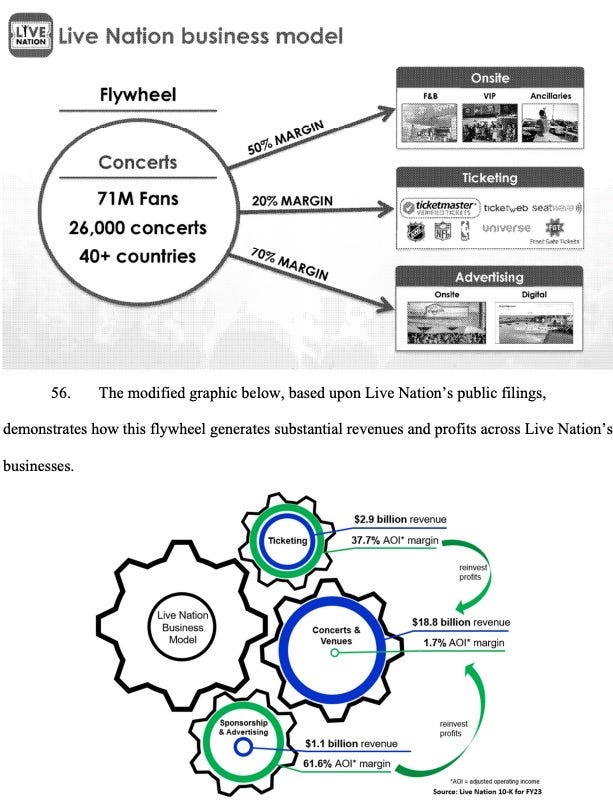
The suit had sought to force Live Nation to divest from Ticketmaster, whose 2010 merger with Live Nation had been allowed by President Barack Obama’s DOJ.
Settlement, 2026
This week, President Donald Trump’s Justice Department, less concerned about antitrust issues and allegedly influenced by a Live Nation lobbyist, agreed to what critics see as a generous settlement.
That came after the Barclays episode, and more were aired in court. The testimony provided a damaging—if not completely damning—portrayal of Ticketmaster and Live Nation, which is why it deserved a jury.
It also prompted allegations of some troubling, self-serving behavior by Barclays’ brass, though other arena representatives were not called to respond.
(I wasn’t in court. As indicated by hyperlinks, my summaries rely on multiple reports.)
The case might not be over. New York Attorney General Letitia James said that New York, along with 25 other states and the District of Columbia, would pursue the case separately. That’s most of the Attorneys General originally involved. The states’ case might resume next week.
Former Barclays CEO testifies
Former Barclays Center Executive Says Live Nation Threatened to Pull Tours, the New York Times reported March 4. Former CEO John Abbamondi said SeatGeek offered a better deal, sharing fees on resale tickets and offering $5 million in annual arena sponsorship.
Though Abbamondi had expected to re-sign with Ticketmaster, albeit with better terms, he said, according to coverage by Matthew Lee of Inner City Press, that Ticketmaster’s bid “wasn’t close” to SeatGeek’s, which also had “generally better” technology.
SeatGeek, CEO Groetzinger later testified, allows ticket buyers to order food, beer, and merchandise, and allows fans to share tickets more easily. Its software allows clients to change pricing in response to concert sales.
Abbamondi also said the tech-savvy Joe Tsai, whose BSE Global (as Brooklyn Sports & Entertainment was then known) operated the arena, saw SeatGeek as superior. For example, Abbamondi said that SeatGeek offered more pricing options, such as lowering prices in the middle of the row.
Abbamondi also said that, when he was at Madison Square Garden, a Ticketmaster rep had warned him that a push for better terms would lead Live Nation to offset the gain by charging more—classic monopoly behavior.
Deal drama
While concerts at Barclays were “very profitable,” Abbamondi said they were losing money on the Brooklyn Nets, given the large payroll. (That was when the team had superstars Kevin Durant, Kyrie Irving, and James Harden.)
Even before the SeatGeek contract was announced, a friend who worked at Live Nation texted Abbamondi to “think about bigger relationship with LN not just who is writing a bigger sponsorship check,” according to the Times.
After the switch, testified Abbamondi, he got “a veiled threat — maybe not-so-veiled threat” from Live Nation Chief Executive Michael Rapino, according to the Times.
The call
How veiled was the threat? We now have the transcript and audio (published by The Verge and embedded below). Abbamondi sounds measured, explaining Barclays’ switch to SeatGeek, while Rapino starts off tense.
(How was the call recorded? “I don’t know who pushed record,” Abbamondi testified when queried. The implication, though, is that it came from his side, since Live Nation would have less incentive to air it. Asked, “You didn't record the whole call?” Abbamondi responded, “I did not,” which could reference not recording the full call.)
“We felt that this is not strictly an economic issue for us,” Abbamondi said. “It’s a technology and branding issue… as well. On the economics, Michael, I think it would have been a bigger gap than we would have been able to close. It’s an eight-figure gap.”
That’s more than $10 million, so a clear incentive for the Barclays Center management.
Live Nation President Joe Berchtold observed that the two sides disagreed over, “per the terms of the contract, we got the assets that we were supposed to get.” Live Nation interpreted that as fully ticketed events, while Barclays, battered by the pandemic, apparently interpreted it as games even held mainly for TV purposes.
Abbamondi noted they had a sponsorship agreement and a ticketing one: “There’s no question that our ability to provide sponsorship assets was impaired. We've made good on that. We've offered money back. We've offered alternative assets. There’s no question that we have obligations to you there.”
Berchtold, raising the ticketing issue, interjected and said, “It’s about $1.2 million.”
Abbamondi, referencing the ticketing contract, said that if a certain number of games were not played, the contract would be extended for another year. “We don't believe that that clause has been triggered.”
“In COVID, you don't fucking believe it's been triggered? Really?” retorted Rapino angrily. “You think '20 was a typical year that would constitute a contract year?”
“I'm just relying on the plain language of the agreement, Michael,” responded Abbamondi. “There's no question that this is not a standard year. The question is: under what conditions does our contract extend?”
(My observation: Abbamondi, surely advised by lawyers, was sticking to the letter of the contract, while Live Nation/Ticketmaster, perhaps hampered by contract language that didn’t anticipate a pandemic, was urging a look at the bigger picture.)
After being told that Live Nation disagreed, Abbamondi noted that Berchtold had previously told him that Live Nation had agreed. Interjected Rapino, “As part of renewal, that was the deal.”
Berchtold assented.
“I see,” said Abbamondi.
“I just said, of course we're going to play long together,” Rapino said. “Assuming we were going to continue as partners, then we were going to do a whole bunch of things.”
“Well, we are continuing as partners on the Live Nation side,” Abbamondi said. “I want us to have a good working relationship.”
What kind of partnership?
“We don't have a partnership on the Live Nation side,” responded Rapino with agitation. “We put shows in your venue, like every other venue.”
“We do have a partnership,” countered Abbamondi. “We have a long-term agreement.”
“It’s not a five-year contract like our ticketing deal,” Rapino said.
“It’s a multi-year agreement,” responded Abbamondi.
“But it doesn't deliver us what we need,” Rapino replied. “I've told you: we've got a new venue in town, and the economics have changed in the marketplace. So what I've told you from Day One was: it was going to be a tough time to deliver tickets or concerts with a new competitor in town, regardless of ticketing.”
Rapino then said he’d end the call: “I'm disappointed. I don't think you were ever going to renew with us. I think you've been set to do a SeatGeek deal, and I thought we deserved more than this. But, anyways, I appreciate your time.”
A “smoking gun”?
Writing for Big Tech on Trial, Gigi Liman framed it as ‘We Could Move All Our Shows’: Did Live Nation Nix a Billie Eilish Concert to Punish Barclays? “The biggest risk,” Abbamondi testified, “was that Live Nation might retaliate against us and withhold events.”
Abbamondi testified, according to the Times, that Eilish, who canceled Barclays Center and Madison Square Garden concerts because of the pandemic, did play MSG when she returned to touring in 2022 but scheduled her second show at UBS.
As I’d written, there’s some murkiness to this charge, given that a new arena—as Barclays itself experienced in its debut year—often has a novelty effect, offering better terms to establish itself. This one also offers easier load-in.
Abbamondi said Live Nation blamed Eilish, but said one of the performer’s managers, speaking to a Barclays employee, blamed Live Nation. That, however, was disregarded by the judge as hearsay. That’s why such cases should go to a jury.
Trying to dent Abbamondi’s credibility, the Live Nation lawyer got him to acknowledge that SeatGeek had once offered him a job and he had played golf with a company executive.
Asked if Barclays ever sued Live Nation, Abbamondi acknowledged it hadn’t, but “We sent them a lot of lawyers' letters.”
“Retaliation insurance”
A powerful piece of evidence was SeatGeek’s willingness to offer what it termed “retaliation insurance” for venues wary of losing Live Nation bookings. Groetzinger described “retaliation insurance” as a “make-good provision,” in place with three NFL clients and one from the NHL, requiring SeatGeek to charge a higher price.
Because Barclays thought it might lose $20 million by antagonizing Live Nation, SeatGeek couldn’t afford retaliation insurance. So SeatGeek offered BSE Global $20 million in equity. (The company presumably agreed, though I’m not sure if it retains such equity.)
While the Barclays deal was not expected to be very profitable, Groetzinger called it, “a watershed moment,” as The Verge reported, helping SeatGeek gain more clients.
In The American Prospect, Maureen Tkacik and David Dayen called the first week of testimony “a spectacular success story for the beleaguered Justice Department,” but allowed that “it is not hard to prove” the Live Nation monopoly, given testimony from Abbamondi and another venue CEO, as well that novel “retaliation insurance.”
A monopoly or not?
Live Nation denies it is a monopoly, as the Times put it, suggesting that “the Barclays story is simply an illustration of the competitive realities in the coveted New York music market.”
One Times commenter responded, “That's exactly why you don’t get to use monopoly power to dominate it and squeeze it for every dime of rent possible.”
In 2021, Abbamondi said, Barclays had expected 17 Live Nation shows, it only got eight. Before Covid, and the SeatGeek change, Barclays booked about 22 Live Nation shows a year. UBS Arena opened Nov. 20, 2021.
(Billboard had suggested it was not necessarily evidence of retaliation. Even Madison Square Garden saw 11% fewer Live Nation shows and 20% drop in revenue, while three other major arenas "experienced double-digit event night declines.")
Live Nation pushback
Abbamondi described Ticketmaster’s response as “pulling up the drawbridge behind them,” as Paste magazine reported. It wouldn’t accept SeatGeek barcodes and required manual exchange of tickets.
Abbamondi’s successors apparently changed their posture. After the CEO left, Barclays began “complaining about things that either didn’t make sense or were really small,” Groetzinger said, some of which were needed fixes, but others were BSE’s responsibility.
“Groetzinger felt Barclays was creating a pretext to go back to Ticketmaster because it was frantic about losing Live Nation shows,” The Verge reported.
Under cross-examination, Groetzinger was shown an email from Laurie Jacoby, Executive VP and Chief Entertainment Officer of BSE, expressing, in the Live Nation lawyer’s paraphrase, “great concerns” with SeatGeek technology and practices.
Asked if SeatGeek sold tickets it didn’t have to a Bruce Springsteen concert, Groetzinger said they hardly had any tickets and that Jacoby “was creating issues” because they’d lost concerts from Live Nation. He did admit that SeatGeek sold about 20 tickets speculatively before stopping such sales and offering refunds.
Asked about the Barclays Center’s issues with marketing and sales, and aisle seats not functioning, Groetzinger blamed the arena, “Yeah, they had mis-entered data.” The judge agreed to strike everything after “Yeah,” apparently because the testimony was not established.
So that remained murky. It’s worth noting that Sam Zussman, Abbamondi’s successor, forced SeatGeek to end the contract or he’d publicize the firm’s tech failures, according to an unattributed account in Billboard.
The publication quoted a booking agent for The Strokes, who claimed that "SeatGeek mishandled an October 2021 presale that cost the group several hundred thousand dollars" and also suggested ticketing problems caused the cancellation of a Genesis tour date.
SeatGeek officials, at least in Billboard, disputed the claims but didn’t refute them. None were aired in court, subject to cross-examination, so they also remain murky.
Settlement time
Justice Department and Live Nation Reach Settlement Terms in Antitrust Case, the Times reported March 9, short-circuiting a full reckoning or a serious penalty.
Though Live Nation agreed to allow venues to use multiple vendors and pay up to $280 million in damages to the various states joining the settlement, that’s pocket change, according to critics.
“For years, Live Nation has made enormous profits by exploiting its illegal monopoly and raising costs for shows,” said New York AG James. “My office has led a bipartisan group of attorneys general in suing Live Nation for taking advantage of fans, venues, and artists, and we are committed to holding Live Nation accountable.”
The settlement, she added, “fails to address the monopoly at the center of this case, and would benefit Live Nation at the expense of consumers.”
“Given Live Nation-Ticketmaster’s monopoly dominance in ticketing, venues and artist promotion, the only way to make live events truly affordable and competitive for fans, artists, and venues is to break up Live Nation,” Senator Amy Klobuchar (D-MN) said on social media, promising “legislation to strengthen review of antitrust settlements to ensure they benefit consumers.”
A Wild Day as Trump DOJ Settles with Live Nation/Ticketmaster, State Enforcers Balk, concluded Matt Stoller in Big Tech on Trial, noting that Live Nation had “retained well-known MAGA lobbyist and fixer Mike Davis” and was rewarded by seeing its stock price skyrocket.
In the American Prospect, Live Nation Settlement Spurs Chaos in Court, Tkacik and Dayen similarly observed that “the outcome was preordained the day Live Nation signed million-dollar MAGA influencer Mike Davis to lobby for them.”
A few more tidbits
Live Nation’s lawyer brought up the incident in which The Strokes “throttled” the resale of tickets.
(I’m not exactly sure what that means, but I’m guessing the band may have wanted to test a limited pre-sale, then set higher ticket prices.)
“You concluded SeatGeek fell short?” the lawyer asked Abbamondi.
“My boss did,” he responded, indicating Tsai.
Abbamondi said he was told in January 2022 his contract wouldn’t be renewed, but he didn’t leave until mid-2022. “I was being eased out,” he stated.
“Because of your SeatGeek decision?” Live Nation’s lawyer asked.
“I got two other reasons,” Abbamondi responded. Those reasons remain unclear.